Hello everyone! 👋🕶️
I put Meta Muse Code + the Unity CLI to the test with a real Unity project to see how far I could push this agentic workflow. Instead of just generating code, I wanted to see how it could actually interact with Unity, run tests, validate changes, port the h
Dilmer Valecillos converted a minigolf prototype to VR for Meta Quest 3 using Muse Code with the Muse Spark 1.2 Contributor model, the Unity CLI and the MetaVR CLI, and published the plans and prompts.
I pay for @Muse Code but didn't want to live in a terminal. On Windows it's WSL-only.
So I built Helicon: an open-source desktop app for the actual Muse CLI.
• uses your existing muse login, no API key
• talks to muse serve over MSP, so Muse stays the agent
• resumes
A vLLM-XPU and DFlash recipe for Muse Glimmer 30B on a single Intel Arc Pro B70, reporting 278 aggregate tok/s across eight clients and an 840.8 tok/s burst peak at concurrency 96.
I had a chill ball drop game in my head and spent the weekend making it by iterating with my Muse agent. Every pass was a conversation: tune the physics, test, report back what felt off, repeat. The ball went from draining straight through to staying up and chaining off everything.
Marty, the little neon orb bot in the game, is actually my agent's mascot. His Deep Scan power shows where the ball will bounce.
It is a free Android APK on itch.io with 10 levels, a combo multiplier, and soft pentatonic chimes that climb with your combo.
I am curious how other people would push this further. What would you have an agent iterate on next: level design, the sound, or something I am not thinking of?
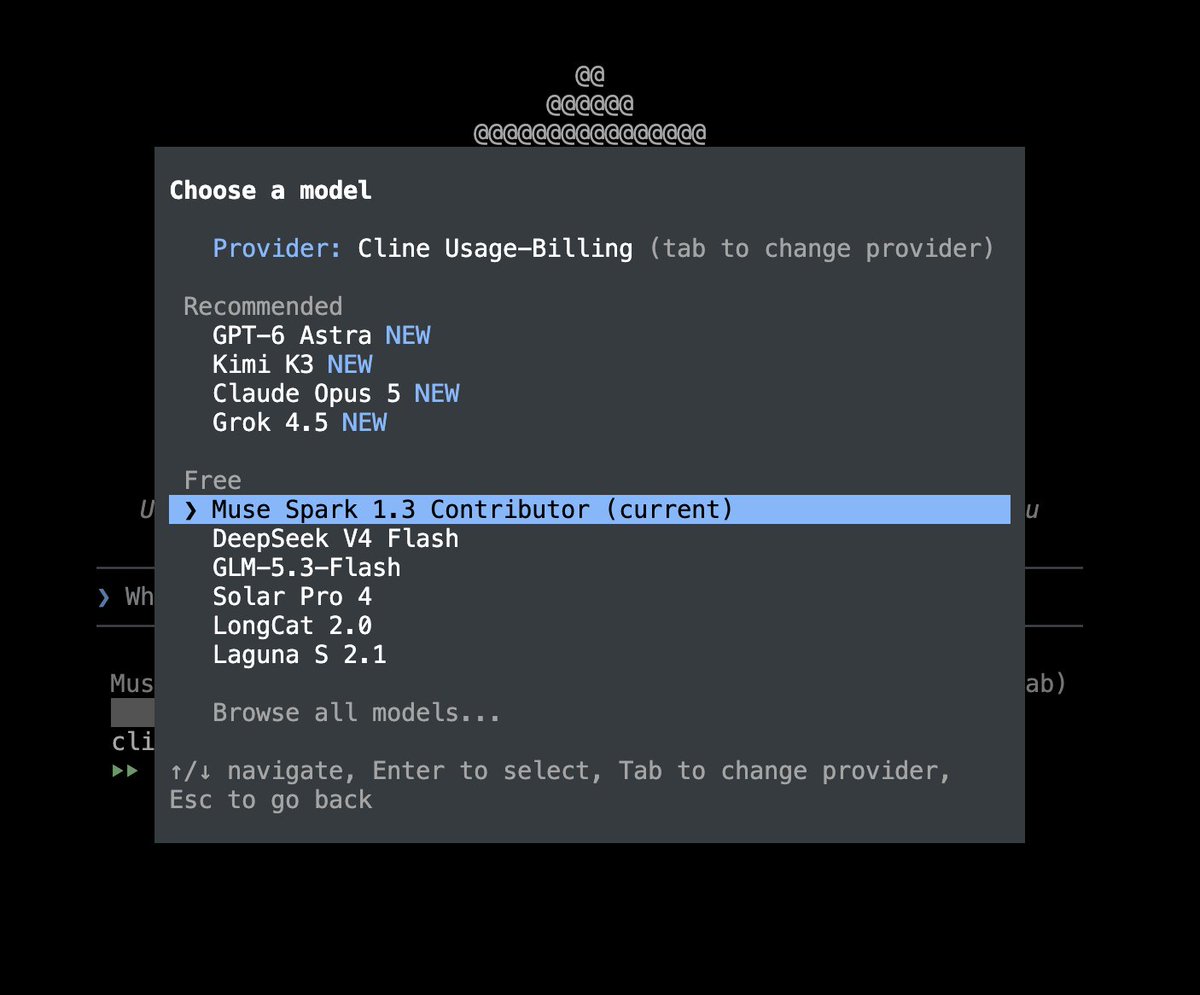
Meta’s Muse Spark 1.3 Contributor model is now available for free in Cline.
Benchmarks show it’s similar in performance to Opus 5, but considerably more affordable.
Muse Spark 1.1 just launched and it's their most capable coding agent model yet.
On Terminal-Bench 2.1 it scores 80.0%, in the same cluster as Opus 4.8 (82.7%) and GPT 5.5 (83.4%).
Use it in Cline with the Meta API!
i hate to say it but on my "can it renew my dmv registration from a screenshot of the letter of the renewal request" bench, facebook muse is better than instinct today
An unofficial native macOS client for the Muse Code CLI in Meta AI's design language, sharing sessions with the terminal so work can resume in either place.
Just tried something new with Muse and Meta VR CLI 🤯, and it’s insane that this works! But it makes sense because we’re literally getting a VM with our agent.
I told the agent to install Meta VR CLI and use it to search our developer docs going forward. This is huge for VR/MR
Tips for 🥽 VR/MR developers, or anyone getting into VR by building a new app or game: leverage the Meta VR CLI + Muse Code in your agentic workflow.
- An MCP server that gives your AI coding agent full context from the Meta VR docs
- Device management: list, inspect, and
Calliope is an unofficial, independent native macOS client for Meta's Muse, shipped as a Developer ID-signed, notarized DMG with Sparkle auto-updates; five releases went out between Sept 13 and 16.
A VS Code and Cursor sidebar chat that drives Meta's Muse Code CLI through muse exec --json, keeping Muse as the agent harness; its build is described in the post 'Inception: A Muse Inside Muse'.
We tried using Meta's new Muse Code agent, but it has a bug that doesn't let it sign in from a docker container.
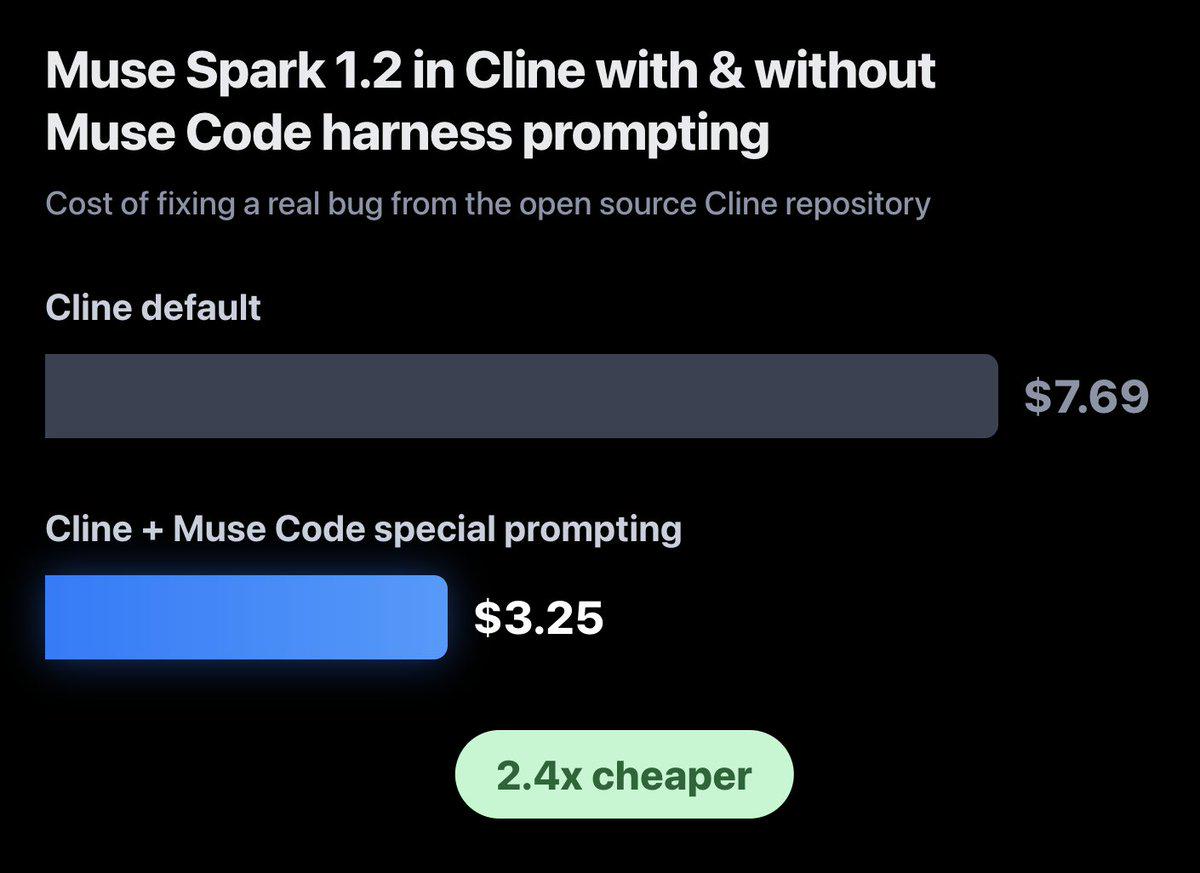
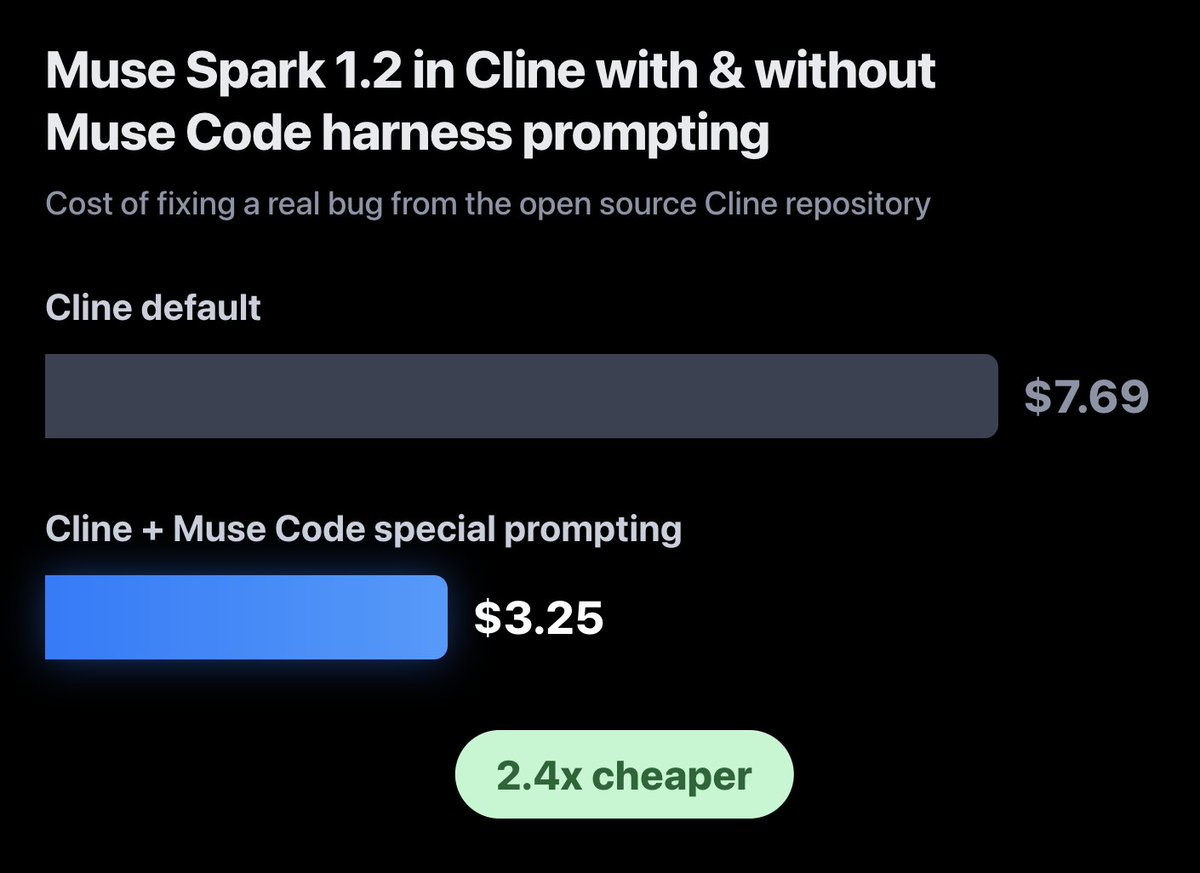
So we did a fun experiment: Meta claims Muse Spark 1.2 was co-trained with their Muse agent harness. So we extracted instructions from their system prompt and added them to the Cline harness.
TL;DR of this special prompting:
- Trust source code over the user prompt, so read every call site and existing tests before starting the task
- Weigh edge and error cases as heavily as the happy path
- Always reproduce the bug before fixing
- Don't trust the first passing test suite, and verify suspicious looking half-baked tests
- Never stop at just editing, keep working until the change is verified complete.
We then asked this modified harness to fix a real bug from our repo, and compared the results to the original Cline agent harness.
Results:
- Used 2.7x fewer tokens (19.7M → 7.2M)
- Finished 2x faster (49min → 24min)
- Cost 2.4x less ($7.69 → $3.25)
Same Muse Spark 1.2 model, same task, only the prompting changed.
Incredible how much of a performance gain Meta was able to achieve training it on these special instructions!
"I asked Meta’s Muse to go to YouTube, find a Zuckerberg video about Muse, cut the specific part I wanted, add burned-in subtitles, render it and give me an X-ready video.
And it did the whole thing.
It searched → found the clip → edited it → added subtitles → rendered → delivered the final file.
I didn’t edit anything myself.
That’s what makes Muse interesting to me: you’re not just chatting with AI anymore.
You’re giving it actual WORK and letting it execute while you do something else.
Still very early, but this is a completely different experience."
from LorenzoBolsa
A serverless Muse connector on Cloudflare Workers and Supabase that indexes a personal wardrobe, recommends outfits by formality and climate, and tracks wear history.
An unofficial loopback shim that lets Meta Muse Code use OpenAI Responses APIs, OpenRouter, Codex OAuth and the official Claude Code CLI, switchable from Muse's /model menu.
MCP server that gives Claude Code, Claude Desktop, Cursor and other MCP clients image generation and editing powered by Meta's Muse image model, published to npm.
A community-built VS Code chat UI for Muse Code, Meta's agentic coding CLI, inspired by the Claude Code extension; about 145 installs on the Marketplace.
Meta's TypeScript SDK and docs for building clients that drive Muse Code agent sessions over the Muse Session Protocol, published as @muse-code/sdk with zero runtime dependencies.
OpenCode plugin that reads the muse CLI login, registers a muse-code provider against api.meta.ai and rediscovers available Muse models every 30 minutes, metered against the Muse Code subscription.
A Muse skill and thin gh-style CLI for the GitHub REST API that authenticates through a stored custom.github connector, so the skill never handles the raw token.
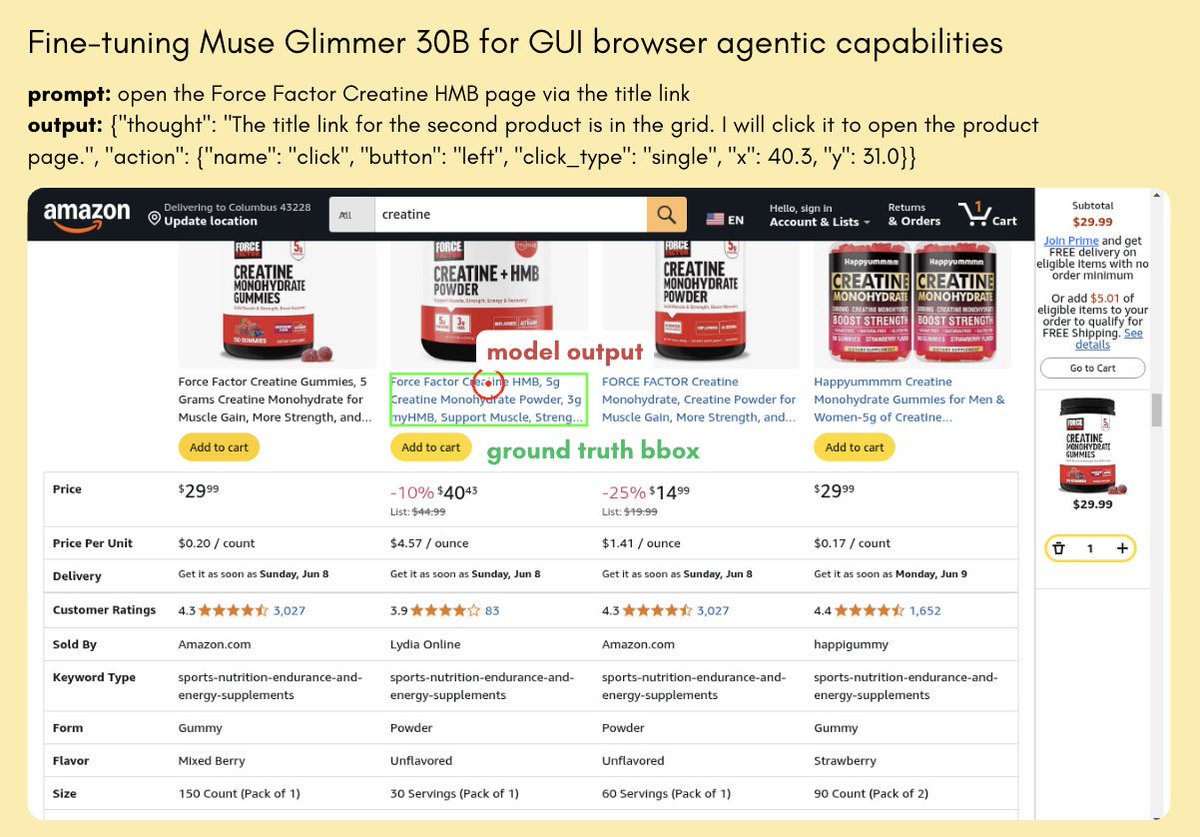
I shipped a fine-tuning tutorial for Muse Glimmer 30B on AI2's MolmoWeb dataset with TRL
github.com/merveenoyan/sm…
> but merve, this model is sota on ScreenSpot-Pro?
yes, but it doesn't work well with ambiguous prompts of MolmoWeb that are close to how you interact with computer,
A Docker Sandboxes kit that runs Meta's Muse Code CLI in an isolated sandbox, allowing network access only to the Meta services needed for install, auth and model requests.
Named profiles for the Muse Code CLI: keep several logins on one machine, run two at once and let each project pick its profile. Published on npm and tested against Muse Code 1.3.0.
A reusable skill pattern for connecting a Muse agent directly to site APIs instead of driving a browser: a vaulted credential, a surrogate-auth helper and a tiny CLI per service.
A shared Socket Mode transport between Slack and Muse bots: one listener daemon appends Slack events to a JSONL log, a CLI posts replies back, and each bot runs its own consumer with no public HTTP endpoint.
oh-my-musecode is a content bundle and CLI for Muse Code that installs 35 skills, slash commands, hooks, an MCP server and themes, with an ownership ledger so uninstall restores the machine byte for byte.
Finally put @Muse to the test. Pretty shocked. I had it find unclaimed property and file all the paperwork. Free $97. Then I had it opt me out to all major data brokers. Finally, I had it add all my Amex offers. Saved 200 manual clicks. @alexandr_wang 🫡
A browser-only agent console for Muse Glimmer 30B that renders the model's ATEM tool-call format client-side, streams from a local server and runs every tool inside the tab across seven capability tracks.
A CLI that opens a shop in headless Chromium to check whether an AI shopping agent can discover and act on the page, and can ask a real Muse Code agent to shop it through the official @muse-code/sdk.
A VS Code extension that runs the Muse Code CLI in a sidebar and also adds Muse Spark 1.2 models to VS Code Chat Agent Mode, with inline completions and live token and cost tracking.
muse-code-acp is an unofficial Node adapter that exposes Meta's Muse Code through the Agent Client Protocol, so it can be driven from Zed or VS Code with streaming, tool calls and MCP servers.
A reproducible setup serving Muse Glimmer 30B on one AMD MI300X with a custom 11 GB vLLM 0.28.0 ROCm image, exposed as an authenticated OpenAI-compatible endpoint and driven from the pi CLI.
Since Muse for Mac ships only for Apple silicon, this small service lets Muse's cloud VM screenshot, click and type on an Intel Mac, compressing each 5K frame to about 150 KB and handling Retina coordinate scaling.
Parallel gives a six-step method and a template prompt for having Muse write, test and save its own connector for any public API, CLI or MCP server, using the Parallel Search MCP as a worked example.
Ported a Miniature Golf prototype to VR using Meta Muse Code and the Unity CLI, added dozens of automated tests, and built a website to capture test runs, screenshots and results.
Dilmer Valecillos uses Muse Code with Muse Spark 1.2 and the Unity CLI to run tests, validate changes, port a Mini Golf game to other platforms and convert it to VR.
Helicon is an open-source desktop and web app that wraps Meta's Muse Code CLI in a Codex/Claude-style interface, grouping sessions by project with history, resume and diffs on Windows, macOS and WSL2.
Andrew Brown's three-hour freeCodeCamp course on building apps and agent workflows with Muse Spark and the Muse Code CLI, ending in a full-stack Go/SQLite/Docker build.
We tried using Meta's new Muse Code agent, but it has a bug that doesn't let it sign in from a docker container.
So we did a fun experiment: Meta claims Muse Spark 1.2 was co-trained with their Muse agent harness. So we extracted instructions from their system prompt and added
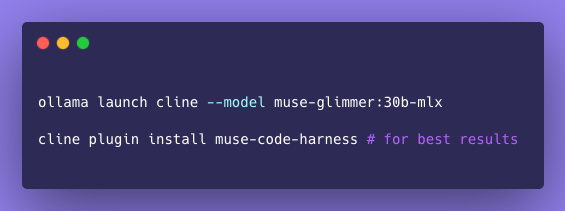
The successor to Llama is here, and Meta is revitalizing focus on open weights with their new Muse Glimmer - a leading 30B param model designed for always-on local agent use, small enough to run on a Mac or PC with a single GPU.
Available in Cline using Ollama now!
Demo of a QLoRA adapter for Muse Glimmer 30B that points at UI elements in web screenshots, returning a click point from an instruction like "filter by MATEIN brand".
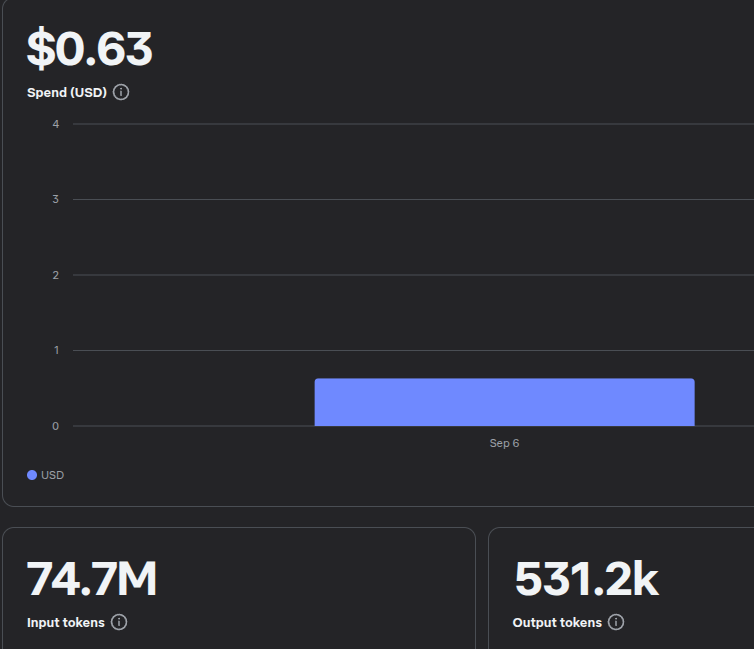
Loving it! I did a 2026 remake of my Spooky Clicker the other day and the total was $0.63. Lots built too!
Changelog for everything is here: github.com/DevTarlow/spoo…
I made 4 free models fight in one window 😱
same snake spec , 4 agents in parallel
just Cline Desktop , the open source app for open weight models
> GLM 5.3 Flash 152 pellets
> Muse Spark 1.3 151
> DeepSeek V4 Flash 138 < patched a real bug in its own bot >
> Solar Pro 4 0 ,
Compared diarization models on 15 mock doctor-patient consultations (~2.4 h): Meta Muse Voice Transcribe scored 13.04% DER at ~92 s per request via API, behind Pyannote (2.89%) and Nemotron 3 (4.80%).
An unofficial macOS desktop client that speaks MSP over muse serve, offering streaming markdown, visible tool calls, session history shared with the terminal and screenshot attachments.
An independent desktop command center for the Muse Code CLI that brings workspaces, sessions, approvals, reasoning controls, changed files and agent activity into one interface.
An OpenAI Responses-compatible shim that serves the Muse assistant as a stateless HTTP model backend for Claude Code via CLIProxyAPI, one model turn per request.
A pure-stdlib Python proxy that exposes Meta API access to Muse Spark through OpenAI-compatible endpoints for tools like OpenCode and Hermes, with no muse CLI required.
Unofficial terminal skill for Muse that calls the Apify API to list actors, start runs, poll status and pull dataset items from a single stdlib-only Python CLI.
A local shim that lets the unmodified muse coding CLI run on any OpenRouter API key by translating its Responses-API-plus-extension wire protocol, so no Meta account is needed.
An oh-my-claudecode-style gated pipeline for the Muse Code CLI, from deep-interview to verified code, shipped as a native Muse plugin manifest with a skills fallback.
Field notes on Muse Spark, a local Glimmer delegate and the Muse Code CLI, covering setup, skills hygiene, an MCP fleet and operational lessons from a ROCm box.
A Go reverse proxy with an embedded dashboard that lets Claude Code and OpenAI/Codex clients use muse-spark models through a Muse Code subscription, authenticated with the muse login credential.
theres simply no other AI agent or tool that can do this for you for free
PROMPT
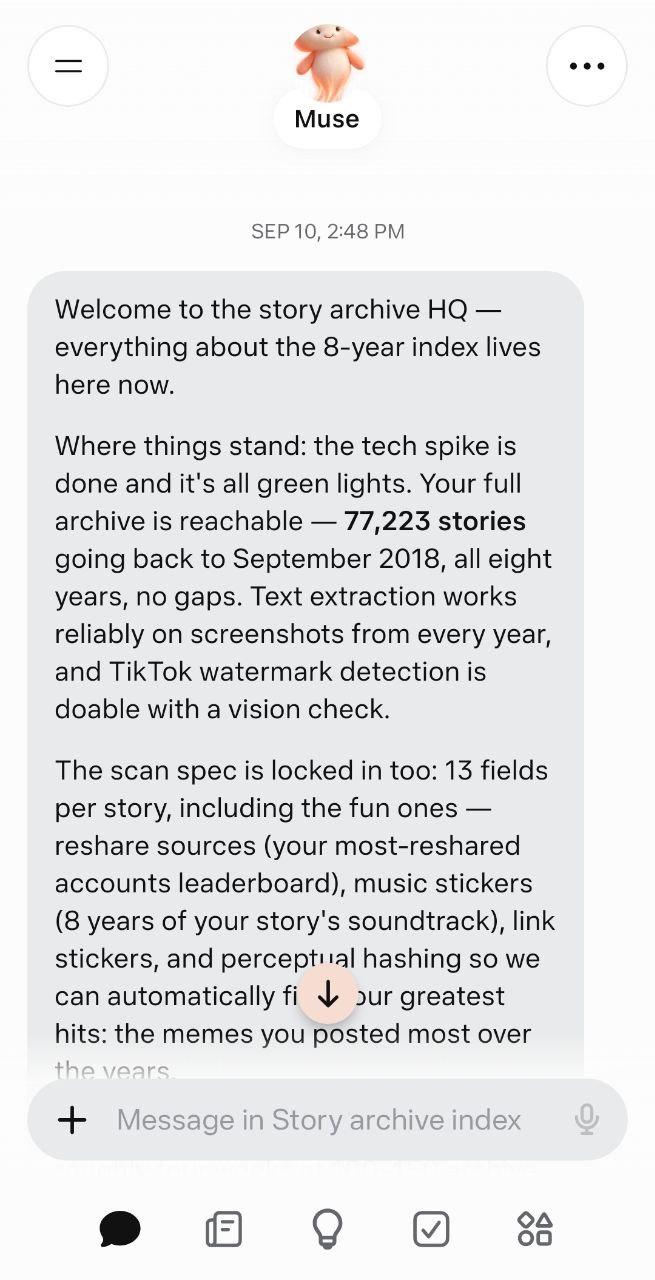
# Story Archive Census
## What to do
Your human wants a full census of their Instagram story archive. Read this entire file, then follow the steps in order. The job is a census: walk every page and count every story, newest to oldest. It does not download any media.
What you're working with:
**Tool** — the Instagram connector's command line tool, `instagram-cli`.
**Command** — one call returns one page of archived stories (about 20 per page), newest first. Each page hands back a `next_max_id` cursor pointing at the next page:
instagram-cli own-stories-archive --account-id <YOUR\_ACCOUNT\_ID>
## Workflow
### 1. Walk the archive
- Fetch the first page with no cursor.
- For each page, record the page number, the story count, the newest story date, the oldest story date, and the `next_max_id`.
- Feed that `next_max_id` back as `--max-id` on the next call, and keep going.
- One call at a time, a second or two apart. No parallel calls.
### 2. Save progress
- Write the page records plus the latest cursor to a state file every 10 pages, so the run can resume after an interruption instead of sta
A zero-dependency Ruby client for Meta's Model API focused on the Responses API: reasoning replay across tool loops, previous_response_id state, web_search grounding and typed errors with retries.
An experimental macOS gateway that keeps the stock Muse Code CLI in charge of the UI, sessions and tools but swaps the model connection for OpenAI or Z.ai models via a loopback gateway.
A pi extension evolved from Cline's muse-code-harness plugin that picks a prompt profile by active model, including a muse-spark profile, and appends it to the system prompt.
Last night, I built a VR game prototype in a few hours with Muse Code on PC. It was already available on macOS and Linux, and today we’re bringing it to PC! 🔥
I tested it with Unity through the Unity CLI, and here are a few things that worked really well for me:
- Having Muse
A reverse-engineered local CLI and FastAPI wrapper that talks to Meta AI's Muse Spark and exposes an OpenAI-compatible /v1/chat/completions endpoint, with a browser playground and a SQLite request ledger.
TerMuse shows the live terminal and an interactive browser of the machine a Muse agent is working on, side by side, so the user can watch and type or click in the same session.
An educational ~1,600-line Python chat app on Muse Spark that finds papers, reads PDFs and writes a cited report only after the user clicks Approve, built to show students how an LLM app becomes an agent.
musecode adds a /musecode slash command, a Haiku relay agent and a muse-run CLI so Claude Code Workflow fan-outs run their leaf tasks on the free Muse Spark 1.3 model through opencode.
muse-acp is a dependency-free Rust bridge between the Agent Client Protocol and Muse Code's Muse Session Protocol, letting developers use their Muse Code subscription inside Zed, IntelliJ IDEA and other JetBrains IDEs.
Ok, here’s the VR port of my Miniature Golf prototype! ⛳🥽
This project is now running on standalone (macOS/Linux/Windows), Three.js, and as of today, VR. Crazy how fast we can move today.
The VR version was fully ported using Meta Muse Code and the Unity CLI. I also now have
Copyable block of the engineering conventions Muse Spark was co-trained with. Per the README, in Cline's harness it cut a real bug fix from 19.7M tokens, 49 min and $7.69 to 7.2M tokens, 24 min and $3.25.



























 ChatForm
 Tgmlabs