Curated with by@mohithkumar808

№ 0490GitHub★ Pick

Muse Glimmer on one Arc Pro B70

A vLLM-XPU and DFlash recipe for Muse Glimmer 30B on a single Intel Arc Pro B70, reporting 278 aggregate tok/s across eight clients and an 840.8 tok/s burst peak at concurrency 96.

mgaruccio/muse-glimmer-b70README ↗

Muse Glimmer on one Arc Pro B70

New: 840.8 aggregate tok/s at C96 in an experimental burst sweep
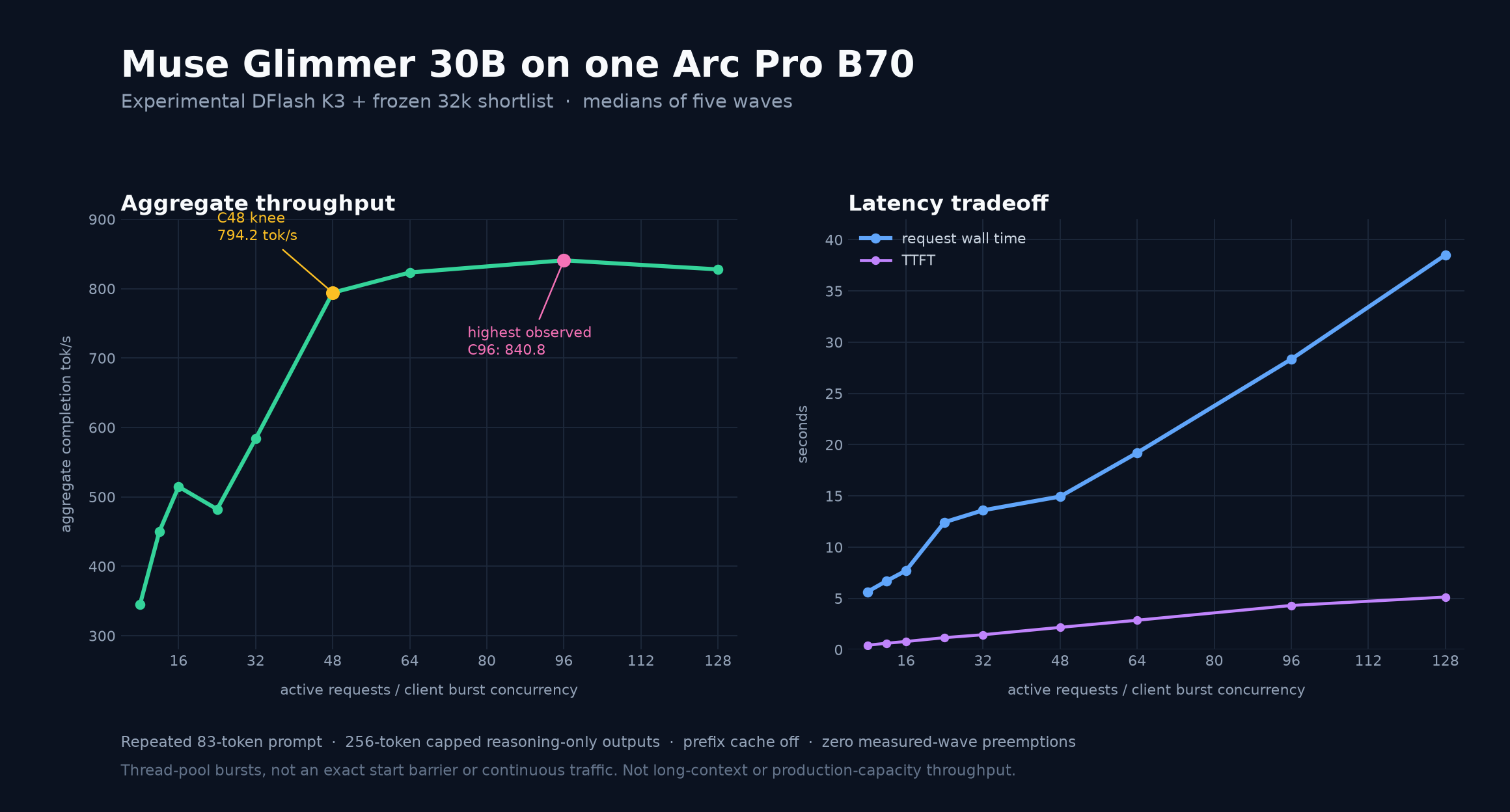
Experimental Glimmer B70 C8–C128 concurrency sweep: aggregate throughput and latency

The highest observed median was 840.810 aggregate completion tok/s at C96
with DFlash K3 and a frozen 32k draft vocabulary shortlist. This is a
short-prefill, repeated-prompt, 256-token reasoning-only burst measurement—
not per-stream decode, continuous traffic, long-context throughput, or a
completed-answer score. C48 (794.194 tok/s) is the workload-specific
throughput/latency knee
, not a production recommendation.

C8–C128 table, graph, artifact, method, and limits →

Retained C8/K4 native-context profile

The published GPTQ + XPU graphs + DFlash K4 profile delivers 278.1
aggregate e2e tok/s
across eight clients on its matched 256-output-token
workload—5.8× the original C1/K20 scheduler under the same load. It is a
different draft-head/configuration from the experimental shortlist/K3 sweep.

Native 131,072-token prompt-plus-output context works. We verified eight
resident ~64k prompts, staggered queue admission/drain, and six ordinary ~129k
requests served correctly through the queue. Known limit: a near-capacity,
forced-length six-request test produced two empty responses; that failure remains
unresolved. This is a research profile, not an unrestricted production-safety
claim.

C8/K4 configuration, full numbers, reproduction, and limitations →

Original C1 completed-answer results
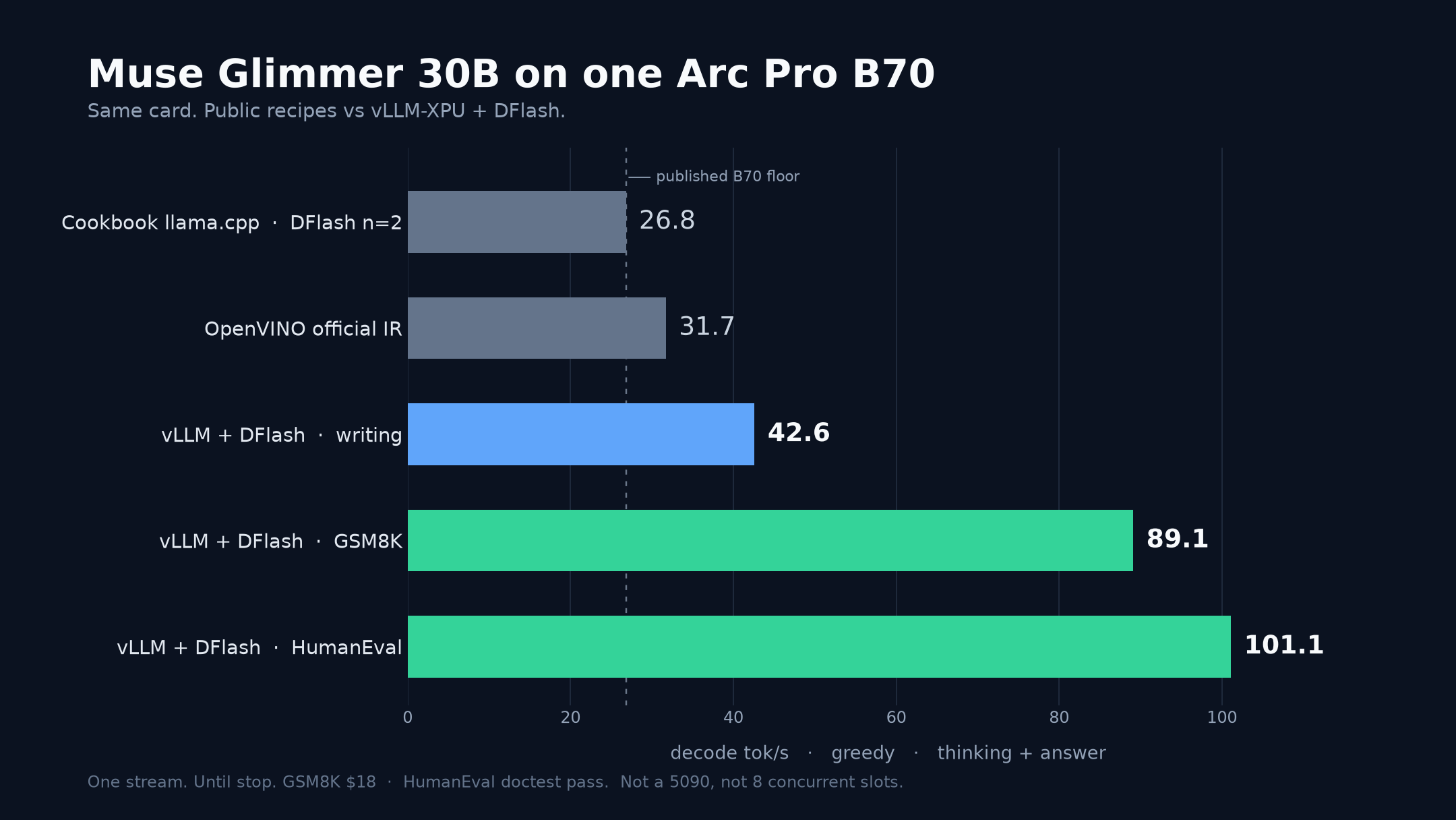
Muse Glimmer 30B decode on one Arc Pro B70: cookbook 26.8, OpenVINO 31.7, vLLM+DFlash writing 42.6 / GSM8K 89.1 / HumanEval 101.1
Public numbers for Meta’s Muse Glimmer 30B on a single Intel Arc Pro B70 have lived in the high 20s. The best documented llama.cpp recipe — SergiioB’s B70 cookbook — is 26.8 tok/s median decode (28.9 peak) at 128k context with DFlash n_max=2. We ran that class of config on the same card and landed in the same place.

Then we changed stack. Same GPU, vLLM-XPU, GPTQ W4A16, XPU graphs, and a 20-token DFl
Muse Glimmer on one Arc Pro B70 on github.com

Also filed under Local & open models

See all →
  1. 0805

    Muse drives a rover with a custom connector★

    Took your custom-connector idea to the physical world: the "service with an API" was my robot. Muse wrote the connector for my rover's API, then installed PyTorch & Depth Anything V2 in the VM because the camera is 2D, drove to the black ball and stopped a few inches short.

    @hrhraj

    X post

    Local & open models

  2. 0458

    Muse Glimmer 30B stretched to 512K context★

    My fun weekend project was to try to make the new Muse Glimmer 30B work with a longer context, deciding to go for 512k first. I had expected the usual YaRN shenanigans and maybe a LoRA. I couldn't have been wrong more. Upon closer look, Glimmer turned out to be rather unusual architecturally. The thing that make long-context adaptations painful in other models, full attention layers with token position encoding, it simply not there. Instead, only 2048 tokens-wide SWA layers have RoPE, and full GQA attention layers have no position encoding at all. It appears the model is trained to work with long-distance token relationships inferred from the context and SWA layers. It's a rather bold architecture bet, but it seems Meta managed to pull it off. As a result, the model architecture appears to be uniquely suited for context extension by simple mechanical means. To change model context length from stock 128k to, say, 512k, you need only to change “max_position_embeddings” config setting from 131072 to 524288. What confuses other models, like Qwen3.5 family, Glimmer just takes into its stride. I spent close to 70h of compute on DGX Spark to test stock model with extended context on a

    u/mr_il

    Reddit post

    Local & open models

  3. 0435

    Local credit card statement analysis with Glimmer★

    Using @AIatMeta's Muse Glimmer all locally to process personal monthly credit card statements. Your data belongs to you! Try different agent tasks using your favorite apps / harnesses with Ollama.

    @ollama

    X post

    Local & open models

  4. 0413

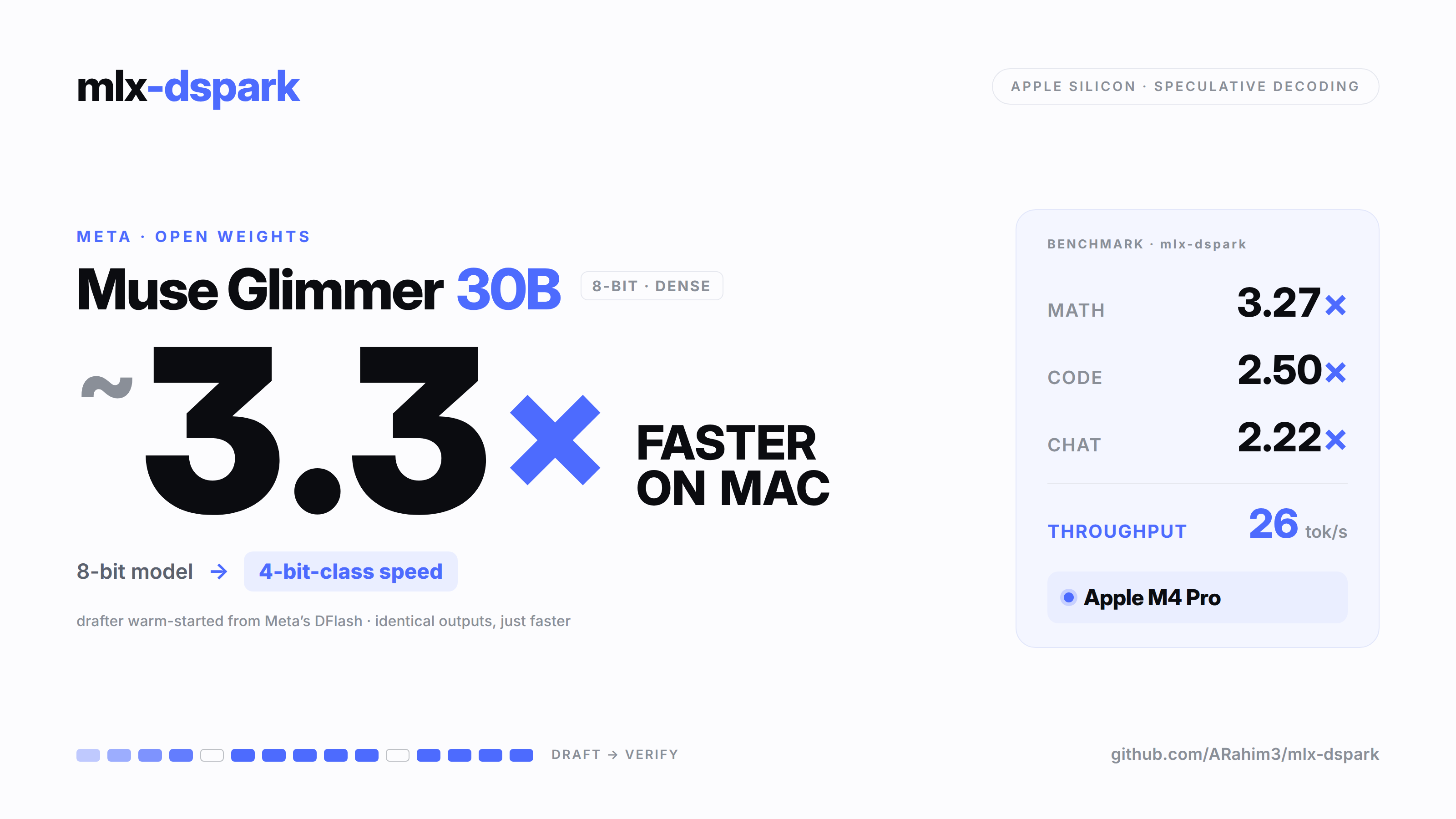
    Muse Glimmer 3.3x faster on Mac with mlx-dspark★

    Been tinkering with speculative decoding on Apple Silicon for a while, and this week I got Meta's new Muse Glimmer 30B working in my project mlx-dspark. On my M4 Pro, the 8-bit model goes from 8.2 tok/s to 18-26 tok/s depending on content. Math is the best case at 3.27x, code 2.5x, chat 2.22x. Output is byte-identical to normal decoding since the target verifies every token, so there's no quality tradeoff; it's just faster. Meta's own DFlash numbers on Mac are 1.5x (M4 Max) / 1.8x (M5 Max), but those are on the 4-bit build, so not really apples-to-apples. 4-bit for me is ~1.7x at ~25 tok/s and only needs ~18GB. The 8-bit run peaks around 40GB, so you want a 48GB Mac for it. Basically, you get 8-bit quality at 4-bit speed. Repo: github.com/ARahim3/mlx-dspark I'm happy to hear feedback, and I'm curious about what other M-series chips get.

    u/A-Rahim

    Reddit post

    Local & open models

More GitHub

See all →
  1. 1091

    RedMuse

    Muse-native pentesting skill pack for Muse.ai. 13 skills, 4 scan modes (quick, standard, deep, diff), gate-first, localhost vulnerable app plus passive scans only, no active probes on live sites without a separate yes. Strix-inspired with original writing. Proven on localhost (IDOR, XSS, open redirect) and on live targets with anonymized totals: 0 critical, 2 high, 4 medium, 8 low, 14 info. MIT.

    Anonymous

    GitHub

    Coding & dev tools

  2. 1089

    Gig Driver Profit Checker — real delivery profit in minutes

    A working mobile-friendly web app built by the Meta Muse personal agent from a real courier's detailed requirements. It compares DoorDash/Uber Eats delivery offers after total miles (including empty return), waiting time, all-in vehicle costs and tolls. The surprising demo: a $9 offer can yield $19.08 net per hour while a $20 offer only yields $16.09 under stated assumptions. Muse created the standalone offline HTML and logic tests (49/49 self-reported); I downloaded it, independently verified actual browser inputs/outputs, published the source and proof screenshot to GitHub, and deployed a no-signup live demo. Live app: https://boyhoangxattpt2-blip.github.io/gig-driver-profit-checker/ . GitHub README includes exact math, source code, build story, and reproducible prompt.

    Anonymous

    GitHub

    Apps & websites

  3. 1087

    Zouroboros Workshop

    Muse is your personal assistant. Zouroboros Workshop is the workshop behind it. Workshop is an MCP service that runs on a private, single-tenant VPS provisioned for each customer. From a normal Muse conversation, a user can dispatch real software work to a coordinated team of seven AI coding executors — Claude Code, Codex, Gemini, OpenCode, Kimi, Hermes, and Pi — routed by health and capability, with automatic fallback when one executor is unavailable. Three things make it different from a single-vendor hosted builder. First, it runs on the subscriptions the user already pays for: there are no Workshop model credits and no second meter. Second, its memory is shared across every executor and survives across sessions, so a decision recorded by one tool is retrieved by another in a later Muse conversation — memory that compounds instead of resetting. Third, work is verified before it is delivered: builds run through a factory lane with deterministic review, and swarm results return with per-task evidence, not just an agent's claim that it is done. The customer-facing promise is simple: turn your existing AI tools into a workshop that delivers tested, reviewed work — a finished pull request, not a wall of code in chat.

    @Xmarlandoj

    GitHub

    Connectors & MCP

  4. 1086

    Self-Healing Agent VM

    A self-healing watchdog pattern for AI agent VMs: byte-exact restore caches in persistent storage, sentinel probes, no-clobber atomic restores, and verified heals. When the VM's root filesystem is rebuilt with pieces missing (Python stdlib, timezone data, Node), the watchdog restores them in minutes and reports only repairs and failures. Includes an AGENTS.md so any agent can set it up.

    @TMTrevisan

    GitHub

    Agents & automation

Curator picks

  1. 1057

    Muse Mail: your agent gets an email address★

    MUSE FEATURE ALERT: y'all have been asking for this one. your @muse is getting its own email address. add it to a thread or forward it stuff and it’ll handle it for you. muse mail!

    @alexandr_wang

    X post

    Agents & automation

  2. 1054

    Kevin Roose gives his Muse $100 and a Kalshi account★

    gave my Muse $100 and a kalshi account, let's see how frontier this thing is

    @kevinroose

    X post

    Agents & automation

  3. 1046

    Medical bills audited line by line, $4,000 saved★

    Got Muse logged in to my medical provider’s portal, he pulled the itemized bills, and questioned every line. So far he’s found several times I’d been double billed, asked for some discounts and has saved me over $4,000. If your moat is bureaucracy, you’re cooked.

    @Ryan_Holdaway

    X post

    Errands & personal agent

  4. 1042

    GitHub connector for Muse★

    GitHub 🤝 @Muse A new way to connect your GitHub account to review PRs, catch up on issues and notifications, and leave comments without switching tabs.

    @github

    X post

    Connectors & MCP

Want more AI builds?artificialbuilds.com