
Inference tuning notes for serving Muse Glimmer 30B NVFP4 with DFlash on a single NVIDIA DGX Spark as a consistent agent backend; the repo reports 27.5 tok/s average and 90/100 on its tool eval with 128K context.
GitHub · Local & open models
Catalog / Use case
About 190 entries on running Muse Glimmer 30B locally: GGUF and MLX quants, DFlash speculative decoding, GPU benchmarks, Mac setups and fine-tunes.
196 builds · page 1 of 5
Inference tuning notes for serving Muse Glimmer 30B NVFP4 with DFlash on a single NVIDIA DGX Spark as a consistent agent backend; the repo reports 27.5 tok/s average and 90/100 on its tool eval with 128K context.
GitHub · Local & open models
Your product
Sponsored
Put your logo, a line of copy and an image right here, between the builds Muse developers come to read. Same size as a post.
Shown every 12 builds · on every catalog page
A reproducible record of running the 17GB Muse Glimmer 30B GGUF with llama.cpp and Metal on a 24GB M4 Pro MacBook Pro, with notes on mistakes, fixes and how local inference works.
GitHub · Local & open models

Ben Burtenshaw
@ben_burtenshaw
Meta is back with Muse Glimmer: a 30B open-source multimodal model built for local, agentic use. HF is shipping day-0 support and I built a few demos to see what it can do. First: we gave Glimmer tools and asked it to quantize itself.
X post · Local & open models· ♥ 125
Ran Muse Glimmer 30B locally in the browser with custom WebGPU kernels at ~25 tok/s on an M4 Max, matching llama.cpp speed.
Reddit post · Local & open models★ Pick
A prebuilt macOS arm64 bundle for the Muse Glimmer voice-agent recipe in meta-oss-cookbook: Parakeet speech helper, Muse Glimmer worker and Supertonic TTS executables built from one pinned ExecuTorch checkout, plus the shared MLX Metal library.

Resource · Local & open models

ollama
@ollama
Using @AIatMeta's Muse Glimmer all locally to process personal monthly credit card statements. Your data belongs to you! Try different agent tasks using your favorite apps / harnesses with Ollama.
X post · Local & open models★ Pick· ♥ 345

merve
@mervenoyann
Muse Glimmer 30B is shipped with DFlash drafter which speeds-up generation 2-4x at little memory cost 🔥 we support this in llama.cpp and transformers, see below how it looks like in the wild (llama webui) ⤵️
X post · Local & open models· ♥ 131

Alok
@analogalok
The "I don't have enough VRAM" excuse just died. I’m running Meta’s new 30B Muse Glimmer Q6_K_XL with a massive 130k context window on just 26GB VRAM FREE compute on Kaggle. Kaggle provides you free 2x Nvidia T4 GPUs. 30 hours usage each week! Yesterday, I showed you the
X post · Local & open models· ♥ 170
We've been curious how far local models have actually come for agentic coding tasks, so we ran an experiment. Setup: • Model: Muse Glimmer (30B), packaged as a single llamafile • Agent: Hermes coding agent (connected via llamafile's local server mode, zero API keys needed) • Target: Mozilla AI's Otari gateway The Issue: We pointed Hermes at a real, reported bug in Otari (#183) where the gateway returned a vague 502 error on image requests instead of passing through the actual provider error. What the Agent Did: Hermes read the issue, navigated the repo, isolated the bug, created a branch, ran existing tests, wrote a new regression test, and opened a draft PR (#727). All of it ran locally and offline, with zero code written by hand. It's still draft PR territory rather than a merged fix, but it's a solid signal that ~30B local models are getting genuinely capable for real dev workflows, not just toy demos. Video walkthrough of the run: https://youtu.be/5GAgbT-XgHU?si=vJqEDGm9hssCO5-M Happy to answer questions about the setup, model performance, or how Hermes handled tool calling!
Reddit post · Local & open models★ Pick
A start/stop/status launcher that serves the NVFP4 Muse Glimmer 30B checkpoint on NVIDIA DGX Spark with vLLM, Glimmer's reasoning and tool parsers, and its DFlash speculative decoder.
GitHub · Local & open models· ★ 2
A reproducible RDNA reference that adapts MI-series ROCm recipes to run Muse-Glimmer-30B on Ryzen AI (Radeon 8060S) hardware, measuring 2.2–2.5x single-stream speedups from DFlash.
GitHub · Local & open models· ★ 3
Abstract Extraordinary digs into the architecture behind Meta's pitch of an autonomous, multimodal agent that runs on-device with no cloud.
Resource · Local & open models
Mixed-precision NVFP4/MXFP8 checkpoint of Muse Glimmer packed for SGLang, keeping v_proj, down_proj and lm_head at MXFP8.
Resource · Local & open models· ♥ 9
Files from a working DeepSeek Harness session against Muse Glimmer 30B served by Ollama on a DGX Spark, including a sample agentic security project that queries an AST call graph.
GitHub · Local & open models
Fireship breaks down Meta's Muse Glimmer, a 30B-parameter agentic model released under Apache 2.0, in a short explainer.

Video · Local & open models· ♥ 13.6K
ollama
@ollama
Muse Glimmer is now available to run with Ollama. Available today via Ollama’s MLX engine with state-of-the-art-performance on Apple Silicon, Muse Glimmer can power Claude Code, Codex, and more always-on local agent workflows natively using Ollama. Additional support and
X post · Local & open models· ♥ 1.3K

Kyle Hessling
@KyleHessling1
First impressions on Muse Glimmer! It's incredibly fast for a dense model, currently running an average of 208tps with a max of 274tps on a single 5090 with their DFLASH config. Comparatively, though, both using Open Code, Qwopus Coder (with thinking off) produced a much
X post · Local & open models· ♥ 176
Fahd Mirza installs Muse Glimmer in GGUF format and tests it with DFlash speculative decoding for faster local inference.

Video · Local & open models
mlx-community's 4-bit MLX conversion of Muse Glimmer 30B made with mlx-vlm 0.6.12 for Apple Silicon.
Resource · Local & open models· ♥ 18
Your product
Sponsored
Put your logo, a line of copy and an image right here, between the builds Muse developers come to read. Same size as a post.
Shown every 12 builds · on every catalog page
GGUF builds of Muse Glimmer 30B all cut from the same BF16 source weights, including full-precision files.
Resource · Local & open models· ♥ 6

Raj
@hrhraj
Took your custom-connector idea to the physical world: the "service with an API" was my robot. Muse wrote the connector for my rover's API, then installed PyTorch & Depth Anything V2 in the VM because the camera is 2D, drove to the black ball and stopped a few inches short.
X post · Local & open models★ Pick· ♥ 1
Alok
@analogalok
Muse Glimmer, A 30B parameter dense model swallowing a 130,000 token context window using only 19.3 GB of VRAM (extreme efficiency). No KV cache quantization required. I just benched the new Muse Glimmer 30B (dense) on a single RTX 4090. We are pulling 3,100+ t/s prefill and 75
X post · Local & open models· ♥ 392
A self-hosted llama.cpp serving stack that runs Muse-Glimmer-30B GGUF with DFlash2 speculative decoding on Kaggle's NVIDIA T4 x2, exposed through an authenticated OpenAI-compatible gateway.
GitHub · Local & open models

Paolo Rosson
@redp314
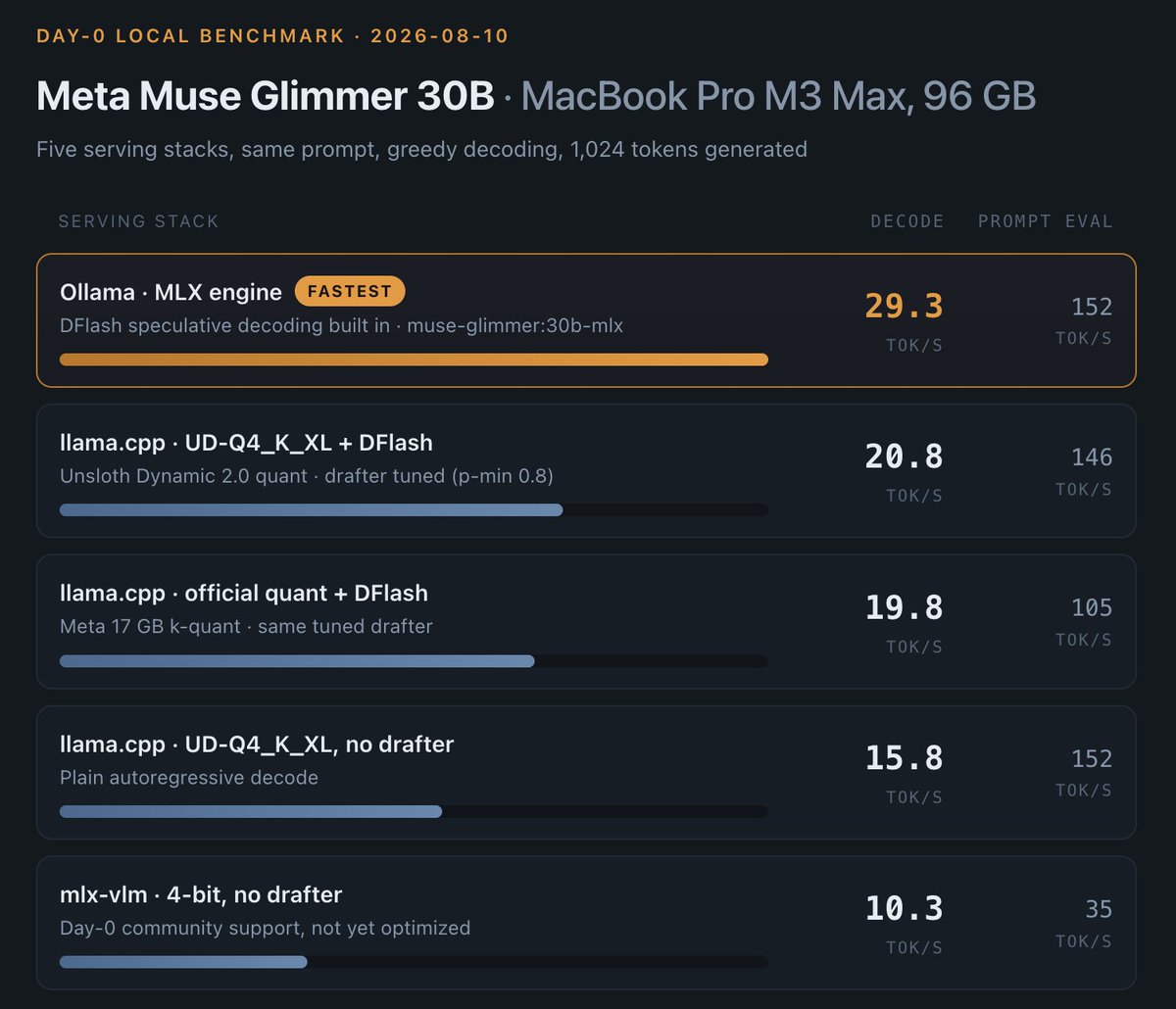
Got Meta's new Muse Glimmer 30B running on my MacBook (M3 Max, 96GG) and tested the serving options available so far. Fastest right now: Ollama's MLX engine (DFlash included) at ~29 tok/s. Tuned llama.cpp: ~21. Raw mlx-vlm: ~10, not optimized yet. Numbers below if you're
X post · Local & open models★ Pick· ♥ 44

Unsloth AI
@UnslothAI
2-bit Muse Glimmer GGUF managed to call 100+ tools on just 14GB RAM. 🔥 Muse Glimmer did a complete repo bug hunt for 5 mins nonstop with: evidence, repro, fix, tests and a PR writeup. Run and train it in Unsloth. GitHub repo: github.com/unslothai/unsl…
X post · Local & open models★ Pick· ♥ 1.6K
Samuel Alexander ran Muse Glimmer 30B entirely on a Qualcomm Dragonwing IQ-9075 board for zero-shot PCB defect inspection and tool calling, measuring 21.6 GB resident with full 131K context and 2.84 tokens/s generation.
GitHub · Local & open models★ Pick
Site · Local & open models· ♥ 5
Your product
Sponsored
Put your logo, a line of copy and an image right here, between the builds Muse developers come to read. Same size as a post.
Shown every 12 builds · on every catalog page

AI at Meta
@AIatMeta
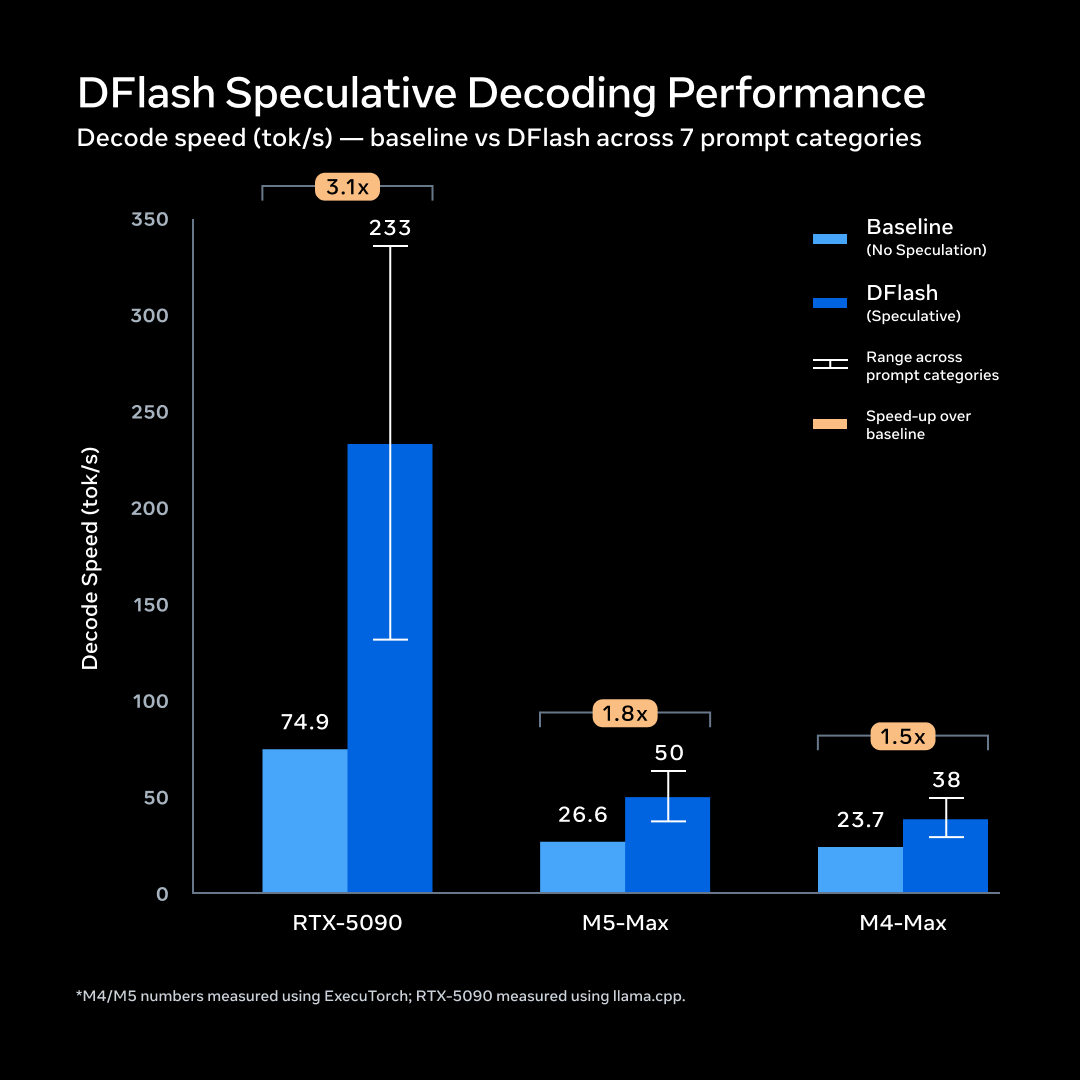
For a local agent to be practical, generation latency must be low enough to maintain workflow continuity. To run Muse Glimmer on consumer hardware without degrading quality, we used quantization to shrink the language model to under 20GB and a lightweight DFlash drafter model to
X post · Local & open models· ♥ 456
merve
@mervenoyann
this is super easy to run install llama binary: curl -LsSf llama.app/install.sh | sh run: llama serve -hf meta-models/muse-glimmer-30b --spec-type draft-dflash -fa on --jinja please spread the word
X post · Local & open models· ♥ 103

filipe
@filicroval
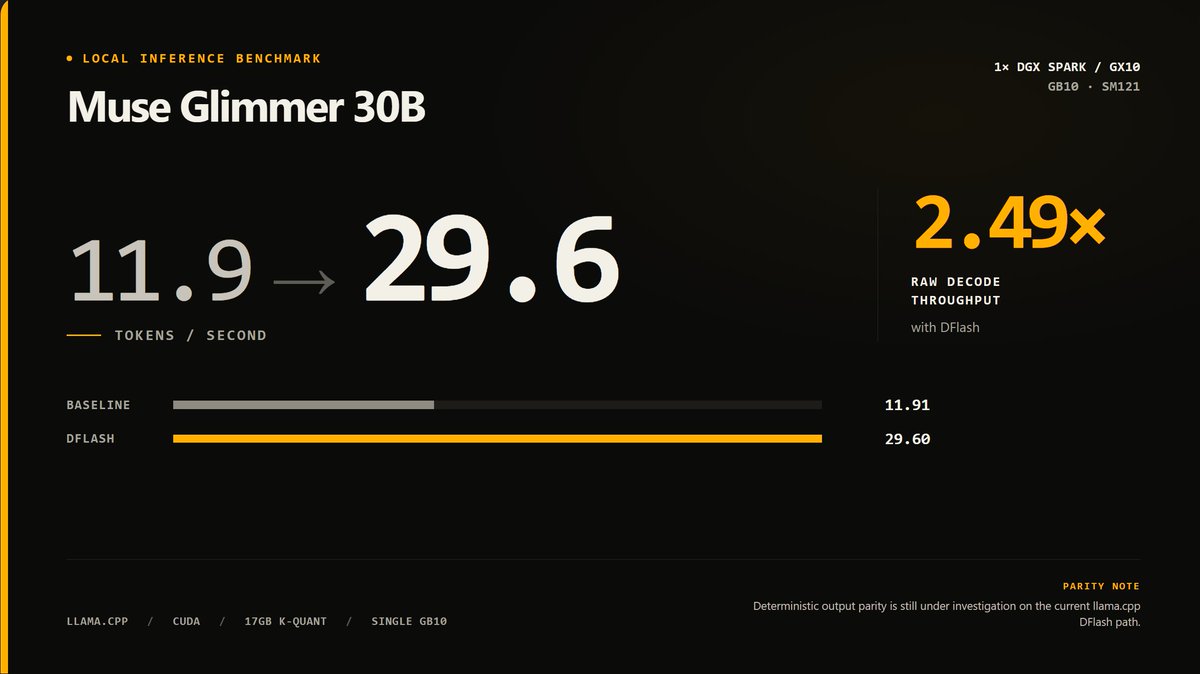
got Muse Glimmer 30B running on a single DGX Spark / GX10 at 29.6 tok/s with DFlash, up from 11.9 tok/s baseline, 2.49× raw decode throughput. packaged the whole thing into a reproducible GB10 recipe: - pinned weights + SHA-256s - llama.cpp compiled for GB10 / SM121 - baseline
X post · Local & open models· ♥ 5
Unsloth Dynamic 2.0 GGUF quants of Muse Glimmer 30B with a companion run guide and thinking toggles.
Resource · Local & open models· ♥ 548
HolaClaw tested Muse Glimmer on base M3 and M4 Macs: it fits in 24GB of RAM but generates at 4.3 tokens per second.
Resource · Local & open models
My fun weekend project was to try to make the new Muse Glimmer 30B work with a longer context, deciding to go for 512k first. I had expected the usual YaRN shenanigans and maybe a LoRA. I couldn't have been wrong more. Upon closer look, Glimmer turned out to be rather unusual architecturally. The thing that make long-context adaptations painful in other models, full attention layers with token position encoding, it simply not there. Instead, only 2048 tokens-wide SWA layers have RoPE, and full GQA attention layers have no position encoding at all. It appears the model is trained to work with long-distance token relationships inferred from the context and SWA layers. It's a rather bold architecture bet, but it seems Meta managed to pull it off. As a result, the model architecture appears to be uniquely suited for context extension by simple mechanical means. To change model context length from stock 128k to, say, 512k, you need only to change “max_position_embeddings” config setting from 131072 to 524288. What confuses other models, like Qwen3.5 family, Glimmer just takes into its stride. I spent close to 70h of compute on DGX Spark to test stock model with extended context on a
Reddit post · Local & open models★ Pick
Your product
Sponsored
Put your logo, a line of copy and an image right here, between the builds Muse developers come to read. Same size as a post.
Shown every 12 builds · on every catalog page
An experimental Rust and Metal inference runtime for Muse models on Apple Silicon, currently supporting Muse Glimmer, using llama.cpp as the correctness and speed baseline.
GitHub · Local & open models
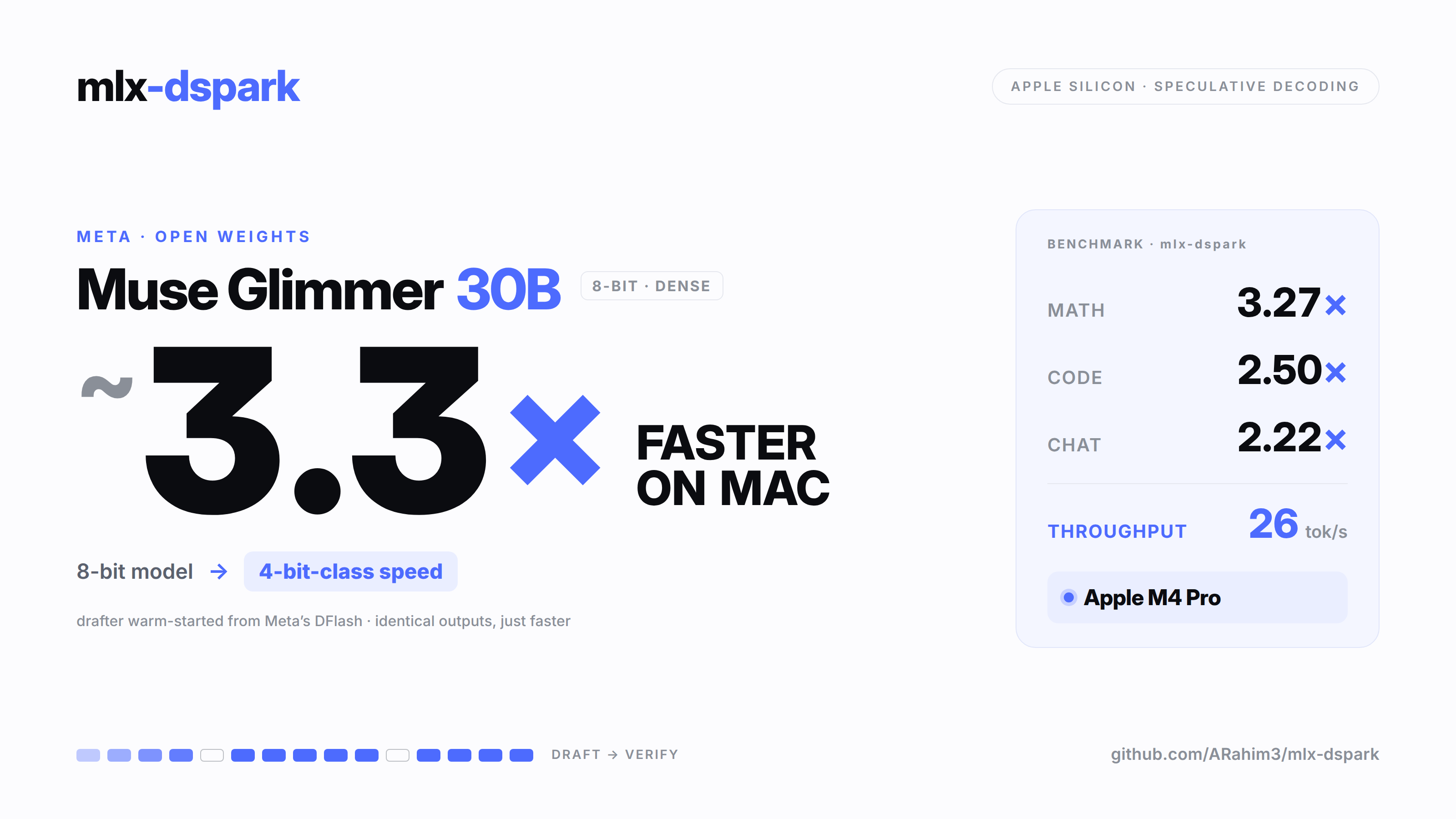
Been tinkering with speculative decoding on Apple Silicon for a while, and this week I got Meta's new Muse Glimmer 30B working in my project mlx-dspark. On my M4 Pro, the 8-bit model goes from 8.2 tok/s to 18-26 tok/s depending on content. Math is the best case at 3.27x, code 2.5x, chat 2.22x. Output is byte-identical to normal decoding since the target verifies every token, so there's no quality tradeoff; it's just faster. Meta's own DFlash numbers on Mac are 1.5x (M4 Max) / 1.8x (M5 Max), but those are on the 4-bit build, so not really apples-to-apples. 4-bit for me is ~1.7x at ~25 tok/s and only needs ~18GB. The 8-bit run peaks around 40GB, so you want a 48GB Mac for it. Basically, you get 8-bit quality at 4-bit speed. Repo: github.com/ARahim3/mlx-dspark I'm happy to hear feedback, and I'm curious about what other M-series chips get.
Reddit post · Local & open models★ Pick
Custom firmware and a Go server that turn an M5Stack StackChan into Tarquin, a voice-driven robot butler with wake word, face tracking and on-device speech, using Muse Spark 1.3 via the Meta Model API as its brain.
GitHub · Local & open models★ Pick
Unsloth AI
@UnslothAI
You can now fine-tune Meta Muse Glimmer 30B for free! 🔥 Our free notebook also supports GRPO RL training. Unsloth trains Muse Glimmer 1.5× faster with 50% less VRAM vs FA2 setups. Train locally with 24GB VRAM. Guide: unsloth.ai/docs/models/mu… Notebooks: unsloth.ai/docs/models/mu…

X post · Local & open models· ♥ 631

Simon Willison
@simonw
Muse Glimmer, the new 30B model, is available on Hugging Face right now - here's the GGUF version: huggingface.co/meta-models/Mu…
X post · Local & open models· ♥ 210
A fork of DeepSeek's DeepSpec that trains a fresh DSpark speculative drafter for Muse-Glimmer-30B in place of the shipped DFlash drafter, with the full data-to-eval pipeline working on GPU.
GitHub · Local & open models
Meta's lightweight DFlash block-diffusion drafter for Muse Glimmer 30B that predicts blocks of 16 tokens per forward pass for speculative decoding.
Resource · Local & open models· ♥ 61
About this shelf
This is the largest shelf, with about 190 entries on Muse Glimmer 30B, Meta's open-weight model released under Apache 2.0. Much of it is quants: Meta's own GGUF, Unsloth's Dynamic 2.0 builds, bartowski's imatrix GGUF, mlx-community's 4-bit MLX, and FP8, INT4 and NVFP4 builds from Red Hat AI and NVIDIA. Meta's DFlash drafter and community DFlash 2 drafters speed up decoding.
The hardware reports are the practical part. Alok ran Glimmer with 130K context on Kaggle's free dual T4s. Cloud Codes ran Unsloth's 2-bit quant in about 14GB of laptop memory and logged 100+ tool calls. Reddit users report speeds on RTX 5090s, AMD V620s and an RX 7600 XT, and one got it running in the browser over WebGPU.
There are honest reviews too. Digital Spaceport found it weaker than Qwen 3.6 27B overall on a 4x 3090 rig, and one Reddit post documents a max_tokens setting that made it look dumb. Speed numbers are as reported by each author and depend heavily on quant and runtime.
Frequently asked
The fastest route is Ollama with ollama run muse-glimmer, or LM Studio, which carried it at launch. llama.cpp, MLX, vLLM and SGLang also support it, and this shelf has setup notes for each.
Meta says it fits in under 20GB at 4-bit and targets 24–32GB devices. Unsloth lists a 17GB 4-bit build and 58GB for BF16, and community 2-bit quants run in about 14GB.
The weights are released under Apache 2.0 on Hugging Face. It is a ~30B dense model distilled from Muse Spark, with text and image input and a 131,072-token context.
DFlash is a speculative-decoding drafter Meta ships alongside Glimmer. Meta's model card reports 3.1x faster generation on an RTX 5090 and 1.8x on an M5 Max with it.





 ChatForm
 Tgmlabs