Hugging Face's launch post covers day-0 transformers, llama.cpp and vLLM support, Inference Endpoints, speculative decoding, TRL fine-tuning and agent demos for Muse Glimmer.

Resource · Local & open models★ Pick
18 builds · page 1 of 1
Hugging Face's launch post covers day-0 transformers, llama.cpp and vLLM support, Inference Endpoints, speculative decoding, TRL fine-tuning and agent demos for Muse Glimmer.
Resource · Local & open models★ Pick
Your product
Sponsored
Put your logo, a line of copy and an image right here, between the builds Muse developers come to read. Same size as a post.
Shown every 12 builds · on every catalog page
The vLLM recipe page for Muse Glimmer has this for speculative decoding: --speculative-config '{"method": "dflash", "model": "meta-models/Muse-Glimmer-30B-assistant", "num_speculative_tokens": 15}' This errors out on the current vllm/vllm-openai:muse-glimmer image, and each fix reveals the next error. Six separate issues in total, all in the DFlash path. The base model runs fine without the spec config. The source for the image isn't public yet (the recipe says "code will be released soon"), so I pulled the image layers through the registry API and read the code to figure out what was going on. Also checked tensor names by range-requesting the safetensors headers off HF instead of downloading the weights. What I found: • The drafter's config declares MuseGlimmerAssistantModel, which is in vLLM's registry. But the dflash code renames it to DFlashMuseGlimmerAssistantModel before the registry lookup, and that name isn't registered. Dies in config validation. • vLLM maps the drafter's config to Qwen3Config (there's a comment calling it "Qwen3-shaped"). The muse JSON omits vocab_size and use_sliding_window, so Qwen3Config fills in its own defaults: vocab becomes 151936 (the model i
Reddit post · Local & open models
Muse Glimmer 30B quantized with Intel AutoRound at a 3.5-bit target and packed with llm-compressor, tested on vLLM.
Resource · Local & open models· ♥ 3
A start/stop/status launcher that serves the NVFP4 Muse Glimmer 30B checkpoint on NVIDIA DGX Spark with vLLM, Glimmer's reasoning and tool parsers, and its DFlash speculative decoder.
GitHub · Local & open models· ★ 2
Meta's developer post on running Muse Glimmer on a single consumer GPU with vLLM, llama.cpp and ExecuTorch, with quantized builds in 24-32 GB and cookbook recipes.
Resource · Local & open models
A one-script vLLM setup that serves the roughly 19 GB NVFP4 Muse Glimmer 30B with its vision encoder kept, DFlash speculative decoding using the official drafter head, and up to 256K context on GB10, RTX 5090 or RTX PRO 6000.
GitHub · Local & open models· ★ 8
Your product
Sponsored
Put your logo, a line of copy and an image right here, between the builds Muse developers come to read. Same size as a post.
Shown every 12 builds · on every catalog page
NVIDIA's technical blog reports Muse Glimmer serving over 20K tokens/sec on a single Blackwell Ultra GPU and covers RTX 5090, DGX Spark, DGX Station and Jetson deployments.
Resource · Local & open models
Meta's launch post for Muse Glimmer, an Apache 2.0 30B model for local agents that fits in ~20GB at 4-bit and runs on M4/M5 Max Macs, RTX 5090s or 24–32GB GPUs.

Resource · Local & open models
A vLLM-XPU and DFlash recipe for Muse Glimmer 30B on a single Intel Arc Pro B70, reporting 278 aggregate tok/s across eight clients and an 840.8 tok/s burst peak at concurrency 96.
GitHub · Local & open models★ Pick· ★ 1
I think a lot of people are boxing Muse in as “Hermes for normies.” My guess is Meta intentionally keeps the deeper capabilities out of sight because the target audience does not want a complicated Hermes/Grok Bot-style setup. They aren't trying to capture the nerdy Hermes using market, they want this to be an AI agent for normies but they don't limit it as such. What it advertises its for is far from what it actually can do with very little work. But Muse gets much more interesting once you stop thinking of its VM as the whole system. I joined the Muse VM to my Tailscale network, gave it SSH access to a restricted user on my home Ubuntu box, and now it can run commands and browser automation through hardware I already own. I figured out Muse can do this because I asked it if it had a Tailscale skill and it said it did, then after a series of "proceed" replies, it set it up for me outside of the parts where I had to join it. At that point, Muse stops being a “shopping assistant” and starts looking more like a control plane for your own infrastructure. With Tailscale + SSH/API access, it can potentially: • Manage Docker, VMs, NAS, Proxmox, and homelab services • Pull repos,
Reddit post · Agents & automation★ Pick

vLLM
@vllm_project
@Meta is back in open source. Excited to announce Day-0 vLLM support for Muse Glimmer 30B, the first open-weights model from Meta Superintelligence Labs — which ships under Apache 2.0!!! 30B dense, 128K+ context, multimodal, built for local agents. Capable enough for
X post · Local & open models· ♥ 251
Red Hat AI's FP8 weight and activation quantized Muse Glimmer 30B (text and image input) for vLLM.
Resource · Local & open models· ♥ 12
Tested SGLang and vLLM launch recipes for an NVFP4 export of a Hermes-agentic fine-tune of Muse-Glimmer-30B on NVIDIA DGX Spark (GB10).
GitHub · Local & open models
A reproducible single-GPU deployment of Muse Glimmer 30B in BF16 with DFlash speculative decoding on a 96GB RTX PRO 6000 Blackwell, served via vLLM with pinned overlays and smoke tests.
GitHub · Local & open models
A reproducible setup serving Muse Glimmer 30B on one AMD MI300X with a custom 11 GB vLLM 0.28.0 ROCm image, exposed as an authenticated OpenAI-compatible endpoint and driven from the pi CLI.
GitHub · Local & open models
Reproducible native NVFP4 serving of Muse Glimmer 30B on one DGX Spark (GB10) with unmerged vLLM support: about 10.3 tok/s single-stream versus 4.2 for BF16, 52.5 tok/s at c16, and 131K context checked with needle-in-a-haystack tests.
GitHub · Local & open models
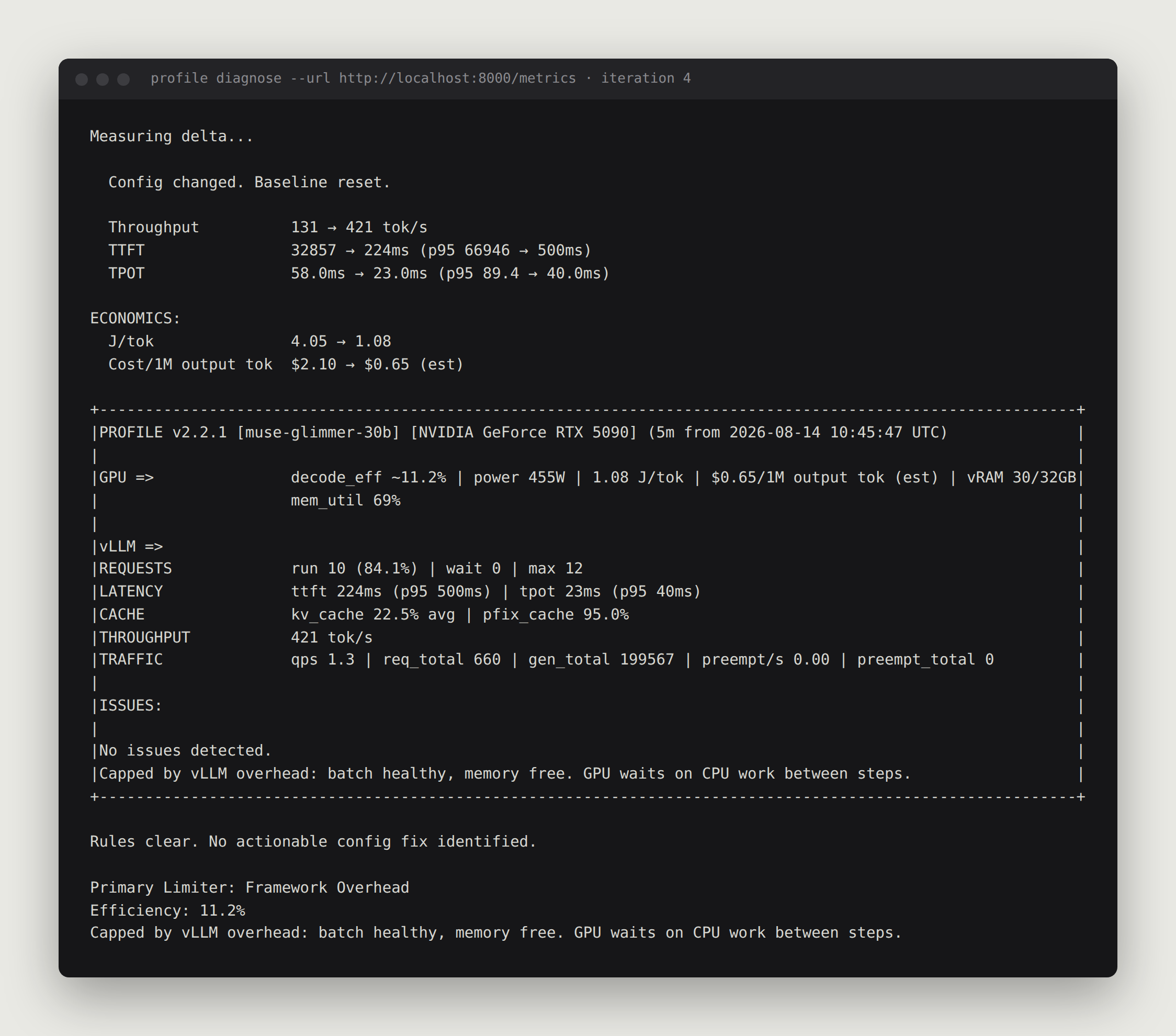
Hi all, Profile v2.2 is out. It's an open-source optimizer for inference servers. It computes your GPU's roofline ceiling, measures your live server against it, names the bottleneck, gives the flag. You apply. It re-measures. Every fix answers to a number. vLLM only today. More engines next. This release: core rule engine rewritten. Eight rules on a priority DAG with mutual exclusivity. Five alarms fire, four echoes are silenced, one true cause survives. Deterministic. AMD cards are now supported too. Tuning today is chaos: try a flag, wait, squint at a dashboard, repeat for days. Profile turns it into deterministic engineering: measure, fix, verify. Results in a few iterations. Mine took 4, ~30 minutes. My setup: RTX 5090, muse-glimmer 30B, SWE-Bench agents, no DFlash spec decoding. • 81 → 421 tok/s at 25k ctx • $3.41 → $0.65 per 1M output tok • TTFT 224ms (p95 500ms), TPOT 23ms at end of run • 4.72 → 1.08 J/tok https://preview.redd.it/4vazyxkcq6kh1.png?width=2248&format=png&auto=webp&s=77923a489b6f725240d23a7953150b5779260734 One iteration regressed hard: KV thrashing, TTFT 32.8s. Profile labeled it worse. Next fix recovered it. Regressions stay in the record. Watc
Reddit post · Local & open models
Meta's official Muse-Glimmer-30B repo: ~29.6B dense model with a 1.8B vision encoder, 131K context, Apache 2.0, with vLLM and SGLang serve commands.
Site · Local & open models


 ChatForm
 Tgmlabs