PyTorch added end-to-end Muse Glimmer support to ExecuTorch; on an M5 Pro, DFlash speculative decoding lifts image+text decode from 21.6 to 33.0 tok/s, and it powers the Pi coding agent locally.
Resource · Local & open models★ Pick
51 builds · page 1 of 1
PyTorch added end-to-end Muse Glimmer support to ExecuTorch; on an M5 Pro, DFlash speculative decoding lifts image+text decode from 21.6 to 33.0 tok/s, and it powers the Pi coding agent locally.
Resource · Local & open models★ Pick
Your product
Sponsored
Put your logo, a line of copy and an image right here, between the builds Muse developers come to read. Same size as a post.
Shown every 12 builds · on every catalog page
DFlash2 drafter for Muse Glimmer 30B fine-tuned on long-horizon, on-policy software-engineering traces to speed up coding workloads.
Resource · Local & open models· ♥ 1
GGUF conversions of Inco AI's DFlash 2 draft model for Muse Glimmer 30B, for speculative decoding in llama.cpp.
Resource · Local & open models· ♥ 16
ROCmFP4 GGUF of Muse Glimmer 30B with DFlash for AMD Strix Halo, requiring a ROCmFPX llama.cpp fork that adds the muse-glimmer architecture.
Resource · Local & open models· ♥ 4
DFlash 2 speculative-decoding draft model for Muse Glimmer 30B from z-lab, run inside a speculative decoding server alongside the target model.
Resource · Local & open models· ♥ 15

merve
@mervenoyann
this is super easy to run install llama binary: curl -LsSf llama.app/install.sh | sh run: llama serve -hf meta-models/muse-glimmer-30b --spec-type draft-dflash -fa on --jinja please spread the word
X post · Local & open models· ♥ 103
Hi all, I'm a newbie and trying to assess the performance of some LLMs I'm running locally via oMLX on my MacBook Pro M5pro CPU 15 cores (5 Super and 10 Performance), GPU 16 cores and 48 GB of LPDDR5 RAM. I asked chatGPT guidance to run some tests and check whether the DFlash-based drafter Muse-Glimmer-30B-Assistant might somewhat speedup the base model Muse-Glimmer-30B-4bit. The results show no or negligible improvement with active DFlash acceleration (speedup between 0.90% and 1.16%). The test was structured with three different prompts fed to both the baseline and the dflash-capable model profiles: Technical prose; Python code; Structured JSON a cap of 2048 tokens, no cache, temperature=0. Each inference was repeated three times. Anyone have similar experience? can we simply dump the Assistant as not useful in this hw/sw configuration?
Reddit post · Local & open models
Your product
Sponsored
Put your logo, a line of copy and an image right here, between the builds Muse developers come to read. Same size as a post.
Shown every 12 builds · on every catalog page
Abliterated Muse Glimmer 30B GGUF quant ladder, updated with a 1.63 GB abliterated DFlash drafter and a 1.40 GB multimodal projector.
Resource · Local & open models· ♥ 49
A local Muse Glimmer 30B vision-and-reasoning chat app for high-memory Apple Silicon Macs, running inference through ExecuTorch, MLX/Metal and DFlash with nothing persisted to disk.
GitHub · Local & open models
The vLLM recipe page for Muse Glimmer has this for speculative decoding: --speculative-config '{"method": "dflash", "model": "meta-models/Muse-Glimmer-30B-assistant", "num_speculative_tokens": 15}' This errors out on the current vllm/vllm-openai:muse-glimmer image, and each fix reveals the next error. Six separate issues in total, all in the DFlash path. The base model runs fine without the spec config. The source for the image isn't public yet (the recipe says "code will be released soon"), so I pulled the image layers through the registry API and read the code to figure out what was going on. Also checked tensor names by range-requesting the safetensors headers off HF instead of downloading the weights. What I found: • The drafter's config declares MuseGlimmerAssistantModel, which is in vLLM's registry. But the dflash code renames it to DFlashMuseGlimmerAssistantModel before the registry lookup, and that name isn't registered. Dies in config validation. • vLLM maps the drafter's config to Qwen3Config (there's a comment calling it "Qwen3-shaped"). The muse JSON omits vocab_size and use_sliding_window, so Qwen3Config fills in its own defaults: vocab becomes 151936 (the model i
Reddit post · Local & open models

Ryan | Intelligence Engineer
@RyanIntEngineer
I just built and validated a complete Muse Glimmer deployment for one DGX Spark. I didn’t make another quant—I integrated the available pieces into a pinned, verified, DFlash-accelerated, tool-capable, reboot-durable stack that actually works in OWUI.
X post · Local & open models· ♥ 4
merve
@mervenoyann
Meta released Muse Glimmer 30B: multimodal model for your Claw/Pi setups 🔥 we tested and fine-tuned the model for you, and shipped day-0 support in transformers and llama.cpp, including DFlash for 2-4x speed-ups 🥵 read our blog huggingface.co/blog/muse-glim…
X post · Local & open models· ♥ 398
Just downloaded the model, UD-Q5_K_XL quant, asked it to generate a long story to test out reasoning and speed with dflash (super fast btw, ~ 90 to 160 tok/s on a 5090 depending on task) and was surprised at the reasoning traces, they are so unlike anything i've seen recently either in gemma 4, qwen 3.5/ 3.6 or laguna, where as these models to like plan stuff out, and have organized thoughts / plans (granted like half the time they just loop and get lost either way) this model's reasoning is like if a gold fish was suddenly granted speech or something, the reasoning is so disorganized, repetitive, using we for some reason? and bringing up policy and safety twice me : write a long story model : write a long story User wants a long story. We can comply. No constraints. Probably provide a long story. Might ask genre? Could just write a long story. Probably provide a story. Maybe ask what kind? The prompt is just write a long story. We can generate a long story. Probably a few paragraphs. Long story could be lengthy. Provide maybe ~1000 words? Could be long. Maybe give a story with decent length. We should not ask clarifying? Could just produce. Probably safe to produce a story.
Reddit post · Benchmarks & research
Your product
Sponsored
Put your logo, a line of copy and an image right here, between the builds Muse developers come to read. Same size as a post.
Shown every 12 builds · on every catalog page
A reproducible single-GPU deployment of Muse Glimmer 30B in BF16 with DFlash speculative decoding on a 96GB RTX PRO 6000 Blackwell, served via vLLM with pinned overlays and smoke tests.
GitHub · Local & open models
Benchmark reports on Muse-Glimmer-30B on NVIDIA DGX Spark covering BF16 to Q4 to DFlash (a 10x speedup) and NVFP4 via SGLang, plus a head-to-head against Qwen3.6-27B.
GitHub · Benchmarks & research
A reproducible RDNA reference that adapts MI-series ROCm recipes to run Muse-Glimmer-30B on Ryzen AI (Radeon 8060S) hardware, measuring 2.2–2.5x single-stream speedups from DFlash.
GitHub · Local & open models· ★ 3

SGLang
@sgl_project
SGLang is honored to provide day-0 support for @AIatMeta's Muse Glimmer. ~230 tok/s on a single RTX 5090 with NVFP4 + DFlash on, and it runs out of the box on @NVIDIAAI RTX PRO 6000, DGX Spark, and Apple Silicon via MLX. Huge thanks to the NVIDIA and Meta teams for the
X post · Local & open models· ♥ 95
Hey. Just tried it on my old ass gpus 😄 Surprisingly Tensor Split is working on 2 gpus almost doubling PP (wonder how it will work with 4 gpus) Q6 — 1 GPU llama-server \ --model <MODEL_DIR>/Muse-Glimmer-30B-GGUF/Muse-Glimmer-30B-UD-Q6_K_XL.gguf \ --mmproj <MODEL_DIR>/Muse-Glimmer-30B-GGUF/mmproj-kquant.gguf \ --spec-draft-model <MODEL_DIR>/Muse-Glimmer-30B-GGUF/dflash-kquant.gguf \ --spec-type draft-dflash \ --spec-draft-ngl 999 \ --spec-draft-n-max 3 \ --spec-draft-type-k f16 \ --spec-draft-type-v f16 \ --ctx-size 65536 \ --override-kv muse-glimmer.context_length=int:65536,dflash.context_length=int:65536 \ --n-gpu-layers 999 \ --device ROCm0 \ --device-draft ROCm0 \ --split-mode layer \ --flash-attn on \ --fit off \ --parallel 1 \ --kv-unified \ --batch-size 2048 \ --ubatch-size 512 \ --threads 32 \ --threads-batch 32 \ --cache-type-k f16 \ --cache-type-v f16 \ --image-min-tokens 1024 \ --image-max-tokens 4096 \ --reasoning-preserve \ --temp 0.7 \ --top-p 0.95 \ --top-k 64 \ --min-p 0.0 \ --jinja Q8 — 2 GPUs with tensor split bash llama-server \ --model <MODEL_DIR>/Muse-Glimmer-30B-GGUF/Muse-Glimmer-30B-UD-Q8_K_XL.gguf \ --mmproj <MODEL_DIR>/Muse-Glimmer-30B-GGUF/mmproj-kquan
Reddit post · Local & open models
Inference tuning notes for serving Muse Glimmer 30B NVFP4 with DFlash on a single NVIDIA DGX Spark as a consistent agent backend; the repo reports 27.5 tok/s average and 90/100 on its tool eval with 128K context.
GitHub · Local & open models
Abid Ali Awan sets up Muse Glimmer 30B on an RTX 5090 with llama.cpp, dynamic quantization and DFlash speculative decoding, serves it locally and wires it into OpenCode to build a medical research web app.
Guide · Local & open models
These numbers were captured during a real feature implementation task in Next.js and Nest.js (adding a theme switching system across components). The structural predictability of UI/state refactoring is likely why DFlash hit such a high draft acceptance rate (~97%). Here is a quick log analysis and performance summary running Muse-Glimmer-30B (UD- Q6_K_XL) paired with DFlash (Speculative Decoding) via llama.cpp (llama-server + single RTX 5090). -ngl 99 -c 200000 --host 0.0.0.0 --port 8080 --timeout 600 --cache-reuse 256 --parallel 1 --flash-attn on --spec-type draft-dflash --spec-draft-n-max 16 --spec-draft-p-min 0.7 --spec-draft-ngl 99 --cache-type-k q8_0 --cache-type-v q8_0 --no-webui --load-mode none --cache-ram 12192 --temperature 0.8 --top-k 30 --top-p 0.95 --min-p 0.05 --repeat-penalty 1.1 --repeat-last-n 64 --reasoning on --chat-template-kwargs {"enable_thinking":true} Compared to Qwen 3.6 27B: No Chinese language-mixing bugs, no overthinking loops, and concise responses. Its lighter memory footprint at Q6 also freed up more VRAM/RAM for a much larger context size. Metric Measured Value Notes Generation Speed (Peak) 100 – 287 tokens/sec Average ~173 t/s across all ta
Reddit post · Local & open models

filipe
@filicroval
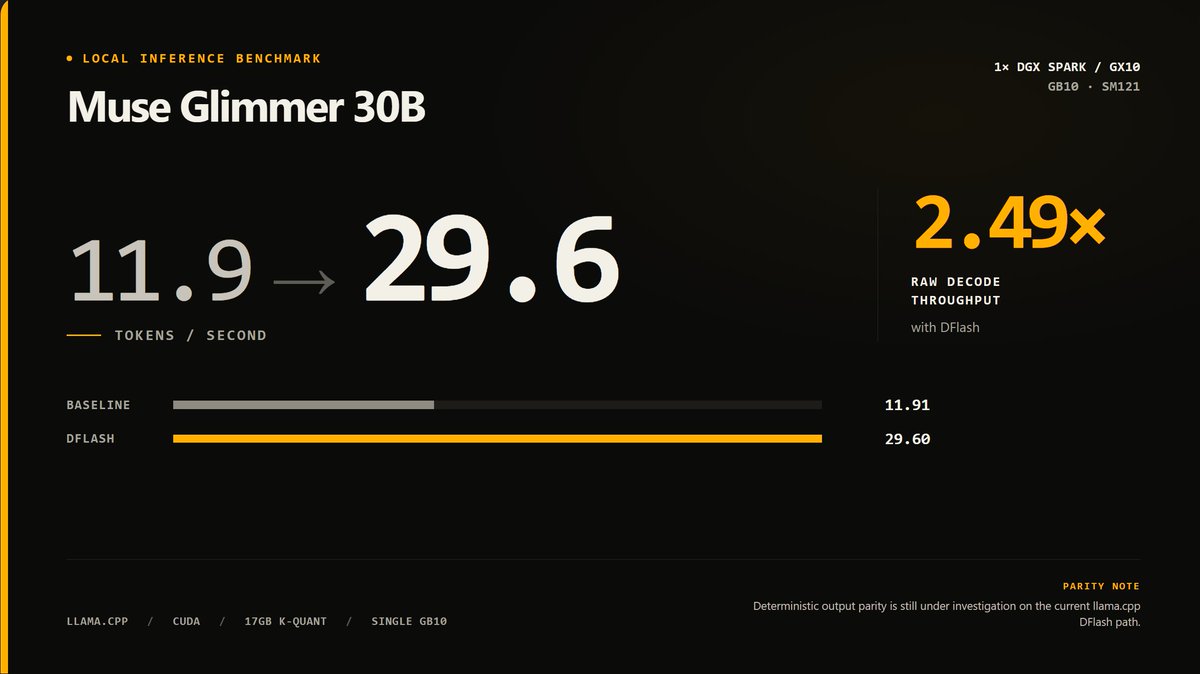
got Muse Glimmer 30B running on a single DGX Spark / GX10 at 29.6 tok/s with DFlash, up from 11.9 tok/s baseline, 2.49× raw decode throughput. packaged the whole thing into a reproducible GB10 recipe: - pinned weights + SHA-256s - llama.cpp compiled for GB10 / SM121 - baseline
X post · Local & open models· ♥ 5
A one-script vLLM setup that serves the roughly 19 GB NVFP4 Muse Glimmer 30B with its vision encoder kept, DFlash speculative decoding using the official drafter head, and up to 256K context on GB10, RTX 5090 or RTX PRO 6000.
GitHub · Local & open models· ★ 8
Quick update on the RTX 5060 Ti local LLM repo. It has changed quite a bit since my previous posts. The project started as a collection of practical notes and benchmark results. That was useful, but as the dataset grew it became harder to answer the question most people actually had: What configuration should I run? I have rebuilt the repo around tested, copyable presets rather than treating every successful benchmark request as a front-page result. What changed? The project now separates three things: • Presets: exact configurations intended for people to copy and run. • Evidence bundles: reviewed proof of context fit, retrieval, sustained generation and performance. • Raw receipts: retries, failed experiments and diagnostic runs that are kept separate as engineering material without automatically becoming recommendations. The website now leads with the published preset catalogue. The larger results explorer is still there for comparisons and historical data, but it is no longer the first thing visitors have to decipher. There are currently seven published presets across the 1× and 2× RTX 5060 Ti lanes: 1× RTX 5060 Ti 16GB • Qwen3.8 27B IQ3_XXS at 64K with q8 K
Reddit post · Local & open models
Ollama shipped Muse Glimmer on day one: `ollama run muse-glimmer`, plus a muse-glimmer:30b-mlx tag for Apple Silicon that Ollama says runs 1.5–1.8x faster with DFlash.

Site · Local & open models
Eleven matched on/off pairs across Gemma 4 and Qwen3.6, holding model, quant, card, corpus and concurrency fixed inside each pair. Speed: 1.65x to 2.54x, every pair. Accuracy: nothing the paired intervals could separate from ordinary run-to-run movement. Muse Glimmer is the one that lost. Meta's matching DFlash drafter made the same 7900 XTX 9% slower, keeping 24.55% of drafted tokens against roughly four in five for the Gemma and Qwen heads. Acceptance fell across the run instead of warming up. Meta's model card reports 3.1x on an RTX 5090, and there are open llama.cpp issues for DFlash on AMD and under Vulkan, so I read it as the backend rather than the model. Acceptance turned out to be a poor predictor of speed. It moved under four points across five models while the multiple nearly doubled. What tracks the multiple is how bandwidth-bound the target is: a heavier quant gains more, and the two mixture-of-experts pairs gained least. Worth knowing before you benchmark anything: -md mtp-head.gguf silently disables speculation. Use -hf REPO:QUANT -hfd REPO, then read speculative from /slots and confirm it is true. Per-pair table, intervals, acceptance counters and the raw predic
Reddit post · Local & open models
Meta's official Muse-Glimmer-30B repo: ~29.6B dense model with a 1.8B vision encoder, 131K context, Apache 2.0, with vLLM and SGLang serve commands.
Site · Local & open models

Paolo Rosson
@redp314
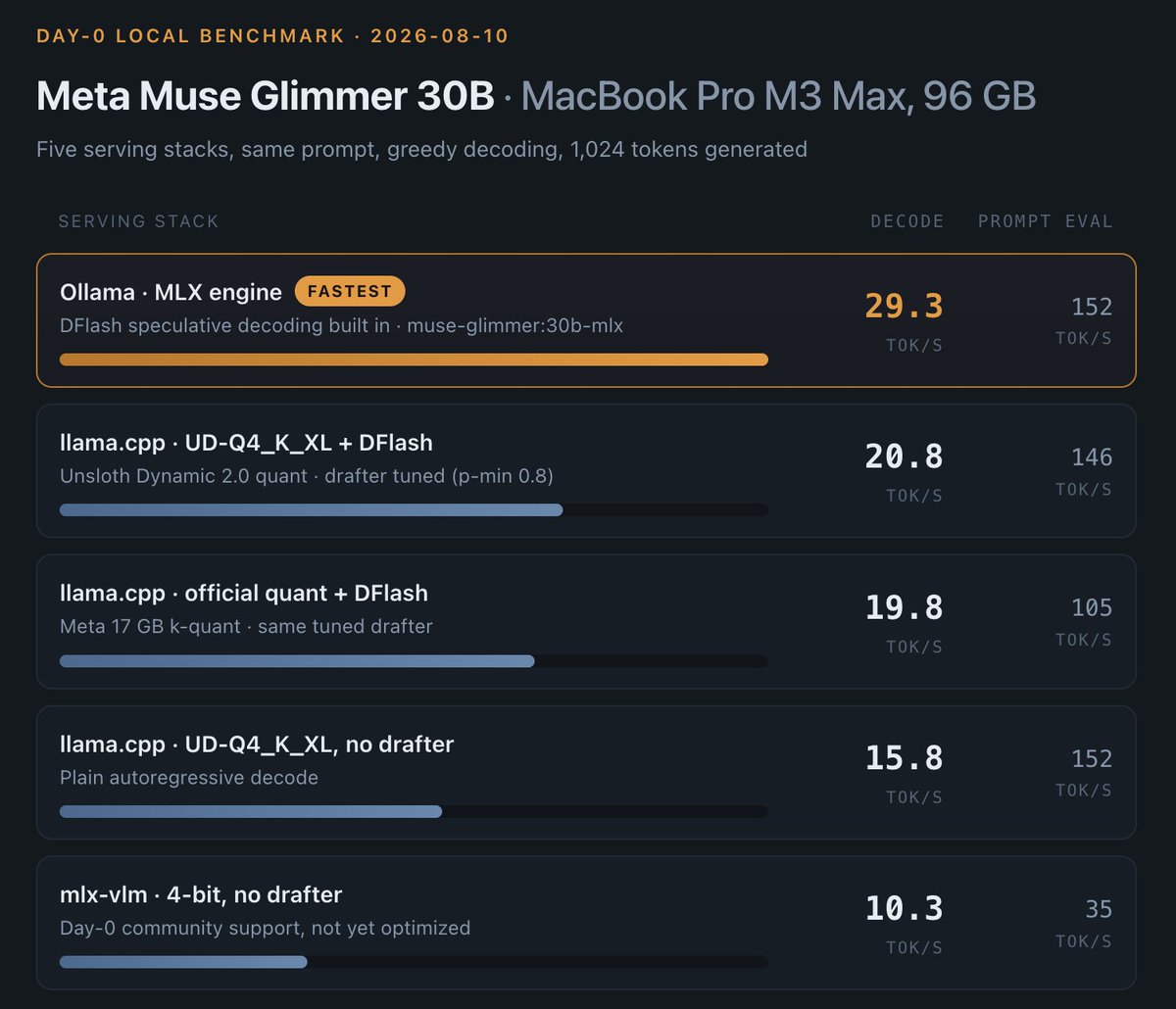
Got Meta's new Muse Glimmer 30B running on my MacBook (M3 Max, 96GG) and tested the serving options available so far. Fastest right now: Ollama's MLX engine (DFlash included) at ~29 tok/s. Tuned llama.cpp: ~21. Raw mlx-vlm: ~10, not optimized yet. Numbers below if you're
X post · Local & open models★ Pick· ♥ 44
A vLLM-XPU and DFlash recipe for Muse Glimmer 30B on a single Intel Arc Pro B70, reporting 278 aggregate tok/s across eight clients and an 840.8 tok/s burst peak at concurrency 96.
GitHub · Local & open models★ Pick· ★ 1
Fahd Mirza installs Muse Glimmer in GGUF format and tests it with DFlash speculative decoding for faster local inference.

Video · Local & open models
GGUF quantizations of the Inco AI DFlash2 drafter for Muse Glimmer 30B, for use with the BeeLlama.cpp llama.cpp fork.
Resource · Local & open models· ♥ 1
Meta's lightweight DFlash block-diffusion drafter for Muse Glimmer 30B that predicts blocks of 16 tokens per forward pass for speculative decoding.
Resource · Local & open models· ♥ 61
merve
@mervenoyann
Muse Glimmer 30B is shipped with DFlash drafter which speeds-up generation 2-4x at little memory cost 🔥 we support this in llama.cpp and transformers, see below how it looks like in the wild (llama webui) ⤵️
X post · Local & open models· ♥ 131
Heeeey all! I just completed some fun tests with Muse Glimmer, I thought I'd let you know. In fact, the summary below was written by Muse itself! I ran a 2× DGX Spark cluster and got Meta's day-old Muse Glimmer 30B running the day after release — then pushed its context from the trained 131K all the way to 1M with YaRN, verifying retrieval at every rung. Sharing config + results since the "131,072+" hint in the model card turned out to be very real. Setup • Hardware: 2× NVIDIA DGX Spark (GB10, 128 GB unified each, ~273 GB/s), ConnectX-7 direct link between them • Engine: llama.cpp master (day-1 muse_glimmer support), built from source with CUDA sm_121 + GGML_RPC • Model: official Muse-Glimmer-30B-GGUF K-Quant-Dynamic (~18.3 GiB) + official mmproj (vision) + official DFlash drafter • Spec decode: --spec-type draft-dflash --spec-draft-n-max 15 (block-diffusion drafter) • Context extension: --rope-scaling yarn --rope-scale <2/4/8> --yarn-orig-ctx 131072 plus --override-kv muse-glimmer.context_length=int:<N> (llama.cpp caps at trained length otherwise) • Yes, we also ran it split across both Sparks with llama.cpp RPC — no reason beyond liking to cluster things for fun. Our daily dri
Reddit post · Local & open models
llama.cpp imatrix quantizations of Muse Glimmer 30B with image support via mmproj and MTP/DFlash notes.
Resource · Local & open models· ♥ 19
DSpark drafter warm-started from Meta's DFlash assistant, adding a rank-256 Markov head and a confidence head (about 103M new parameters).
Resource · Local & open models· ♥ 8

AI at Meta
@AIatMeta
For a local agent to be practical, generation latency must be low enough to maintain workflow continuity. To run Muse Glimmer on consumer hardware without degrading quality, we used quantization to shrink the language model to under 20GB and a lightweight DFlash drafter model to
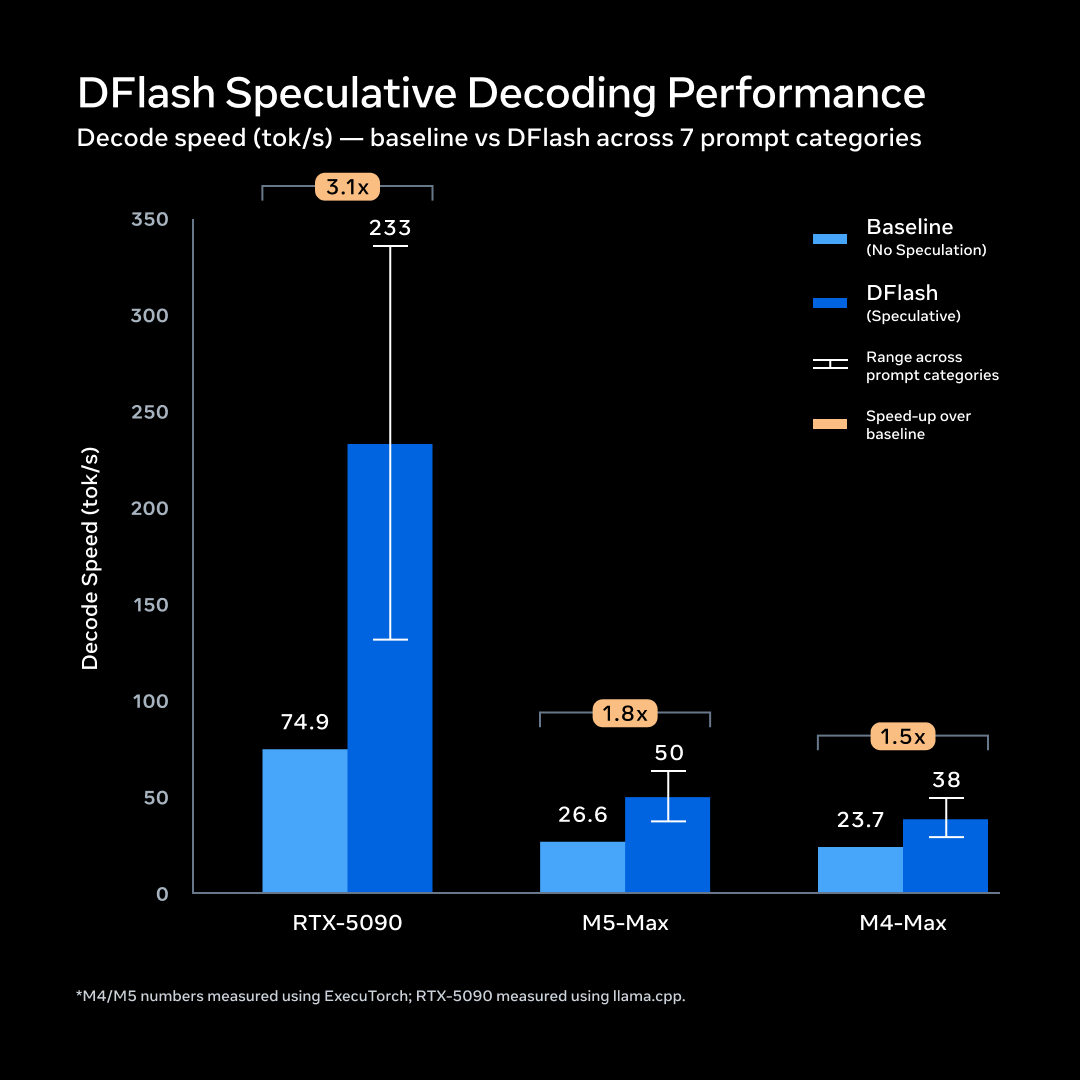
X post · Local & open models· ♥ 456
A correctness-first bring-up of Muse Glimmer 30B on a single Tenstorrent p150 card, with paged KV cache, native DFlash speculative decoding and an OpenAI-compatible server.
GitHub · Local & open models· ★ 4
A start/stop/status launcher that serves the NVFP4 Muse Glimmer 30B checkpoint on NVIDIA DGX Spark with vLLM, Glimmer's reasoning and tool parsers, and its DFlash speculative decoder.
GitHub · Local & open models· ★ 2
I noticed on the same hardware that I can get 24 x 128k contexts with muse glimmer (30b q8_0 + mmproj+dflash) only gets me 3x 256k or 6x 128k with qwen. But a straight forward analysis of the architecture suggests to me that qwen's state per token is somewhat smaller than glimmers. So it seems llama.cpp is particularly memory inefficient for the qwen arch. I presume there is an existing issue for this, but I couldn't find one. What's the deal? The extra concurrency makes a big difference in batched performance.
Reddit post · Local & open models
A self-hosted llama.cpp serving stack that runs Muse-Glimmer-30B GGUF with DFlash2 speculative decoding on Kaggle's NVIDIA T4 x2, exposed through an authenticated OpenAI-compatible gateway.
GitHub · Local & open models

Kyle Hessling
@KyleHessling1
First impressions on Muse Glimmer! It's incredibly fast for a dense model, currently running an average of 208tps with a max of 274tps on a single 5090 with their DFLASH config. Comparatively, though, both using Open Code, Qwopus Coder (with thinking off) produced a much
X post · Local & open models· ♥ 176
A fork of DeepSeek's DeepSpec that trains a fresh DSpark speculative drafter for Muse-Glimmer-30B in place of the shipped DFlash drafter, with the full data-to-eval pipeline working on GPU.
GitHub · Local & open models
A llama.cpp container that serves Muse Glimmer 30B with vision and DFlash on an RTX 5090, reporting 98.8 tok/s single-stream and about 250 tok/s aggregate with 131k context.
GitHub · Local & open models
A measured deployment report of Muse Glimmer 30B NVFP4 with DFlash on a single Dell Pro Max GB10, where it posted top vision and SRE-ops scores but failed five deployment gates against DeepSeek V4 Flash.
GitHub · Local & open models

LMSYS Org
@lmsysorg
@AIatMeta's Muse Glimmer (30B dense, open-weights) launches with SGLang day-0 support. We got ~230 tok/s on a single RTX 5090, with NVFP4 + DFlash on. It also works out of the box on @NVIDIAAIDev RTX Pro 6000, DGX Spark, and MLX for Mac. Speed and reliability have always been
X post · Local & open models· ♥ 129
Your product
Sponsored
Put your logo, a line of copy and an image right here, between the builds Muse developers come to read. Same size as a post.
Shown every 12 builds · on every catalog page
Got Muse Glimmer 30B running locally using the UD-Q2-K-XL quant paired with DFlash speculative decoding, and the results on modest hardware are pretty impressive. Hardware Setup Host: Ryzen 5 4600G with 96GB DDR4 RAM running headless Debian Trixie. Guest VM: QEMU/KVM assigned 4 cores and 32GB RAM, running Debian Sid with ROCm 7.2. GPU: AMD Radeon RX 7600 XT 16GB passed through to the VM, built llama.cpp fresh from master targeting gfx1102 and gfx1201 via HIP. Context Size: Set to 62144 tokens. Processed 14685 total tokens at roughly 308 tokens per second prompt evaluation and 20 tokens per second generation speed. Speculative Decoding: Using the dflash-kquant draft model with spec-draft-n-max set to 2. Fed it a clean context slate consisting of eight JavaScript files and one HTML file alongside the problem description. On the first turn, it identified and output the necessary diff snippets. A quick follow-up prompt telling it to stop being lazy and output the complete updated files yielded functional code that dropped straight in and worked on the first try.
Reddit post · Local & open models

atomic.chat
@atomic_chat_hq
Run Meta's new Muse Glimmer 30B♾locally with 16GB VRAM! We ship our own GGUF quants. AD-IQ3_XXS does 62 tokens/s on a single RTX 4080 with vision and DFlash, and picks the same next token as the BF16 original 90% of the time! Run the model via Atomic Chat
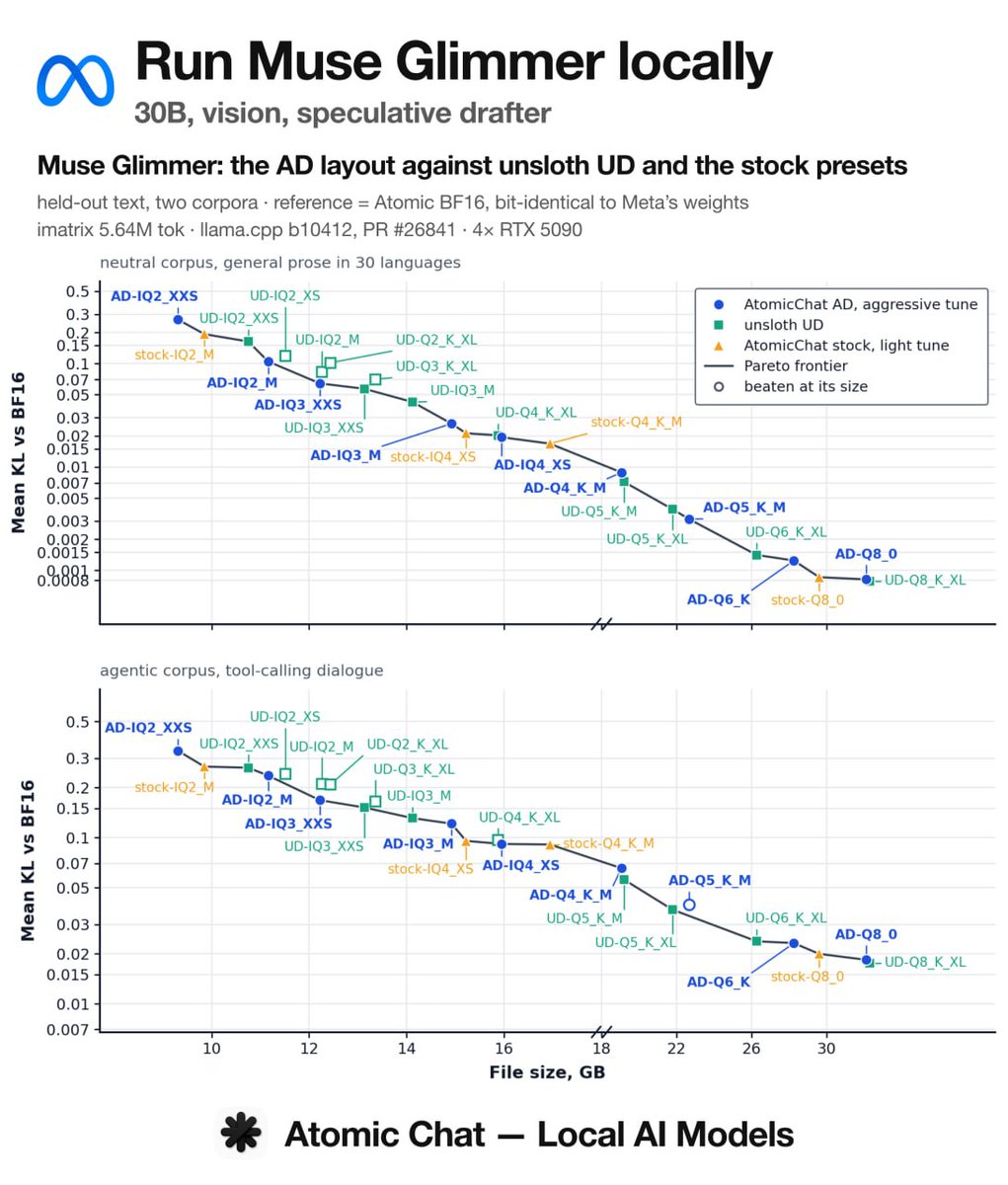
X post · Local & open models· ♥ 59
Agent Workflow Lab runs the Q8 GGUF of Muse Glimmer 30B through llama.cpp on an RTX 4090 plus 3x RTX 3090, measures DFlash speedups and a 120K-token retrieval probe, then has it build a Three.js browser FPS with no human edits.
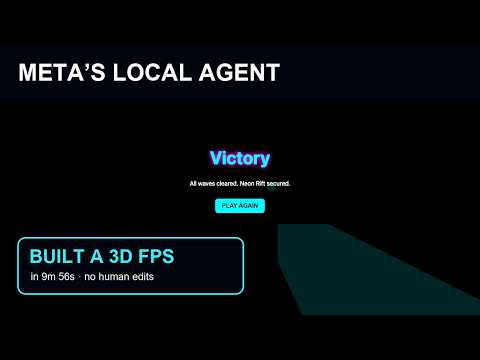
Video · Games & 3D
A 40-chapter book on Muser, an engine that runs Muse Glimmer on Apple Silicon Metal. It covers kquant and DFlash speculative lanes, exact KV-cache replay with kvpack, and GB10 NVFP4 prefill handed off to a Mac, with every number tied to an evidence receipt.
GitHub · Local & open models· ★ 3
Benchmarked Muse Glimmer 30B on my RTX 5090 (32GB), 262k context, UD-Q5_K_M + dflash-kquant + mmproj. Workload Stock master + DFlash ngram-simple PR #26842 + DFlash Code patch 78 t/s 57 t/s 220-253 t/s Mixed agent turn 77 t/s 68 t/s 188-213 t/s Tool-call JSON 71 t/s 75 t/s 155-181 t/s Heavy reasoning 52 t/s 58 t/s 120-130 t/s PR #26842 moves the DFlash draft argmax from CPU to GPU, which was the bottleneck. I cherry-picked it onto master (it branched before the Muse merge, one conflict to resolve manually) and it builds clean. Code generation now matches Meta's published 233 t/s, which I could not reproduce on stock master. Notes: • ngram-simple loses to DFlash on every coding workload. • Server caps context at the model's metadata context_length, use --override-kv for 262k. • The reasoning budget flags do not work with this template. This is verified: with the budget set to 64, the model still burned 2000+ chars thinking and the budget message never appeared. Leave max_tokens headroom for the reasoning block. Flags: llama-server ^ --model Muse-Glimmer-30B-UD-Q5_K_M.gguf ^ --mmproj mmproj-kquant.gguf ^ -c 262144 --parallel 1 ^ --override-kv "muse-glimmer.context_le
Reddit post · Local & open models
Your product
Sponsored
Put your logo, a line of copy and an image right here, between the builds Muse developers come to read. Same size as a post.
Shown every 12 builds · on every catalog page


 ChatForm
 Tgmlabs