OK! So you have a @muse (or you'll get one soon) and you want to know what to do with your new super smart helper friend.
I've got you covered. Buckle up. Bookmark this one.
Here are 50 prompts to get you started making money, saving money, and improving your life with your
A self-hosted mini arcade cabinet on a Raspberry Pi that generates SNES-style games from a player photo and a voice prompt, using Muse Spark to judge art and Muse Image and Muse Voice Transcribe for assets and input.
Dilmer Valecillos converted a minigolf prototype to VR for Meta Quest 3 using Muse Code with the Muse Spark 1.2 Contributor model, the Unity CLI and the MetaVR CLI, and published the plans and prompts.
I just built the largest collection of helpful prompts (500+) to turn Muse into the best chief of staff, best marketer, best PM you've ever had.
@Muse can be so much more than a glorified admin assistant. There are hundreds of ways to use it at your job.
Completely free, check
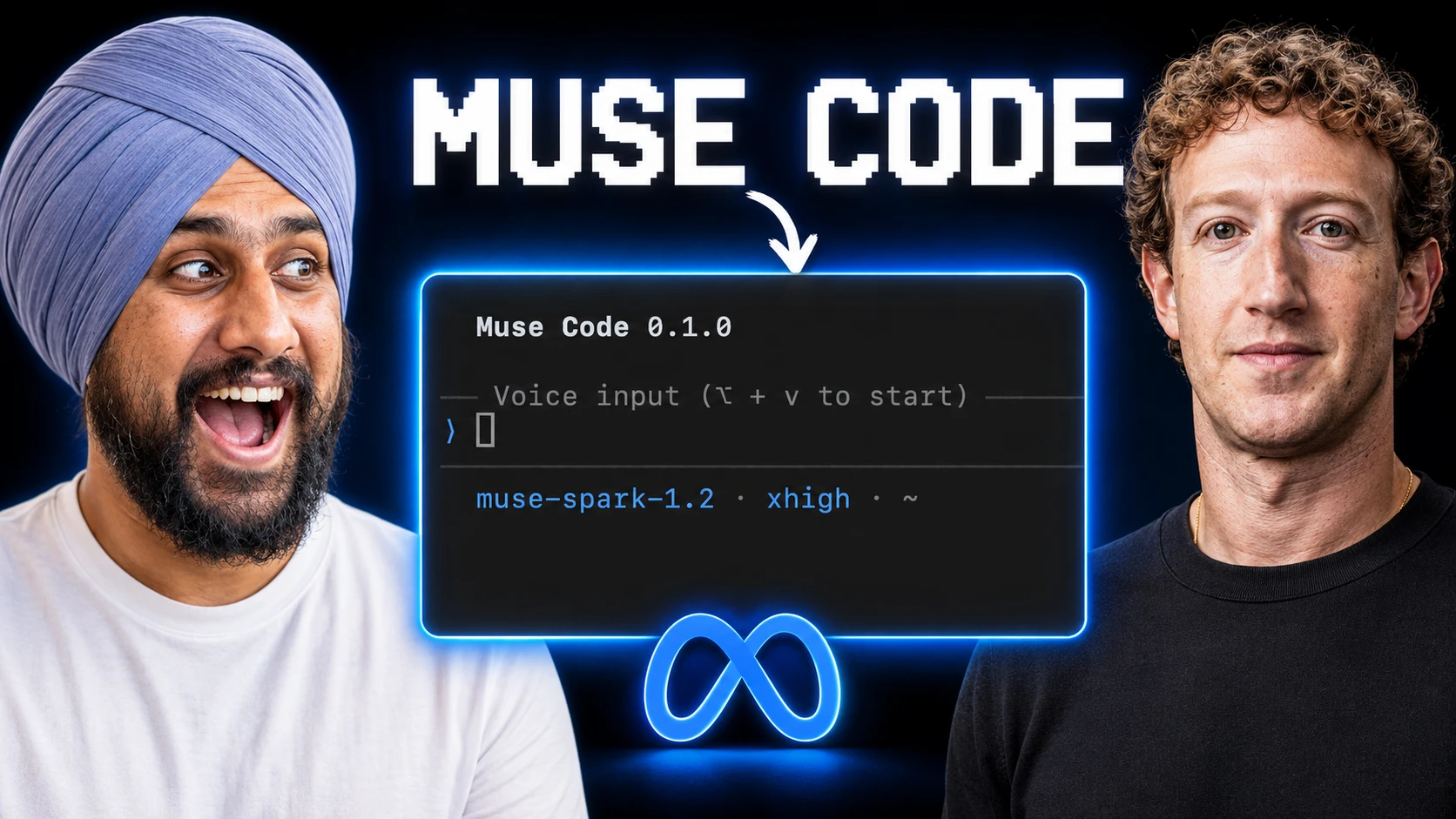
We tried using Meta's new Muse Code agent, but it has a bug that doesn't let it sign in from a docker container.
So we did a fun experiment: Meta claims Muse Spark 1.2 was co-trained with their Muse agent harness. So we extracted instructions from their system prompt and added
I've been collecting the money stories people share about Muse. Here they are with the prompt each person used, where they shared one. I've also been saving the prompts so other people can try them
Someone asked Muse to search an email backlog for unfiled vet bills. It found five totaling $1,504.72 and submitted them to pet insurance. original post
PROMPT: "catch me up on my unfiled vet bills"
He asked Muse to update his budget expenses. While doing that, it spotted his HOA (homeowners association) double charging him, and he emailed them for the $1,900 back. original post
PROMPT: "update my budget expenses" (the double charge was caught unprompted)
Muse watched someone's already booked flights and hotels for price drops, then asked for the lower rate. A commenter on the post said the same trick saved them $600. He calls it one of his favorite old travel hacks, now fully automated. original post
PROMPT: "Monitor the price of my already booked flight and hotel. If the price drops, contact them and ask for the lower rate."
Someone got Muse to argue for a $100 discount on a device that was already out of warranty. He got the idea from someone who pays for Muse by having
Prompt I've been working on for my @Muse, which should also work just as well with Instinct and Grok @bot. Goal is to protect travel time on my calendar.
Fun fact: I tried to build this as a small app last year, but was blocked for over 6 months by Google's approval process, so
Meta Model API OAuth for the pi coding agent. It routes Muse Spark through the openai-responses provider, since the author notes the Muse prompt cache hits about 0% on /chat/completions, and sends 24h prompt-cache retention.
Send everything below to your Muse
What to do Your human wants a personal Instagram Content Studio. Read this entire file, then follow every step below in order and build it for them. Don't skip steps, don't improvise the structure — the steps are the product.
What you're building for them:
Data — profile snapshots, trend digests, and idea files under ~/workspace/content-studio/data/.
Dashboard — a web artifact where the user browses ideas and tracks filming status.
Refresh cron — a weekly run that pulls a new snapshot, researches trends, and generates 5–8 new ideas.
Workflow 1. Connect + analyze (do this first — derive, don't ask) • Verify Instagram is connected (instagram-cli accounts). If not, get the connect URL and have the user link it before continuing. This is the only hard requirement.
• Pull instagram-cli posts --account-id <id> --limit 100, dedupe by post_id.
• Save to ~/workspace/content-studio/data/profile-posts-<YYYYMMDD>.json with schema: generated, username, follower_count, post_count, posts[] (each: post_id, likes, comments, media_type, created_at, url).
• Derive from the data, don't interview for it:
• Content categories (3–5): cluster their actual posts in
Meta @Muse automated my Instagram profile using simple prompts and scheduled posts for my professional profile. No words just zip out🤐🤐
Post context✅
Description ✅
Audio ✅
Editing ✅
Hastags ✅
Auto generated reel ✅
.
.
.
🙏🙏
started trying out rather recent 'frontier' about ~30b param models recently, there are many choices including QWen 3.8 - this is nevertheless a great model, practically 'one-shotting' code refactoring tasks
https://huggingface.co/Qwen/Qwen3.8-27B
https://huggingface.co/unsloth/Qwen3.8-27B-GGUF
code refactoring is still deemed 'difficult', practically 'infinite' permutations and dependencies which LLMs need to work through itself for code refactoring.
But that in terms of style, I'm liking Muse Glimmer better
https://research.meta.ai/blog/introducing-muse-glimmer-open-agentic-model
https://huggingface.co/meta-models/Muse-Glimmer-30B
https://huggingface.co/meta-models/Muse-Glimmer-30B-GGUF
https://huggingface.co/unsloth/Muse-Glimmer-30B-GGUF
this is in particular when it comes to *incorrect* (e.g. mistakes, typos) prompts, resolving contradictions in existing codes during refactoring, code proposals etc. The handling especially the 'thinking' is different.
LLMs have 'styles' and it is great that we've different creators for them
A single-file marketing site (hash routing, GSAP transitions, Lenis scroll, Three.js) built by Muse Spark in Meta AI from 5–6 prompts, with no manual code edits.
Independent open-source community and connector directory for personal agents: search connectors by outcome, share workflow prompts, and import an OpenAPI 3.x document to prepare a connector listing.
A gallery of 100 self-contained generative-art, physics-toy and typography pages generated with Muse Spark 1.3, each shown next to its original prompt.
I was able to migrate multi agent workflows to Muse from Claude. I gave it the master prompt- Muse executed flawlessly- no feedback- just my prompt- built for Claude 4.6. It is now running this prompt every morning at a fraction of the cost.
Leaned up all of my emails-
NetworkCoder runs Muse Glimmer 30B on an RTX 3090, measures speed and VRAM, and gives two agent harnesses the same model, endpoint, project and prompt to compare results.
Ira Bodnar shows how to give Muse live Meta Ads campaign, performance and audience data through Ryze AI in about two minutes, with test prompts and troubleshooting.
I had one shotted this with explicit instructions to create this game with all the Asset specifications on @opencode and it generated in 30-40 Seconds. Couple more iterations and inputs will give us a production ready game. Great Job Team Meta #ReverseSonic
I went through hundreds of posts to find what people are actually getting done with @muse.
128 real use cases, organized by category; each with the original source and a prompt you can copy.
muse.ai/s/muse-use-cas…
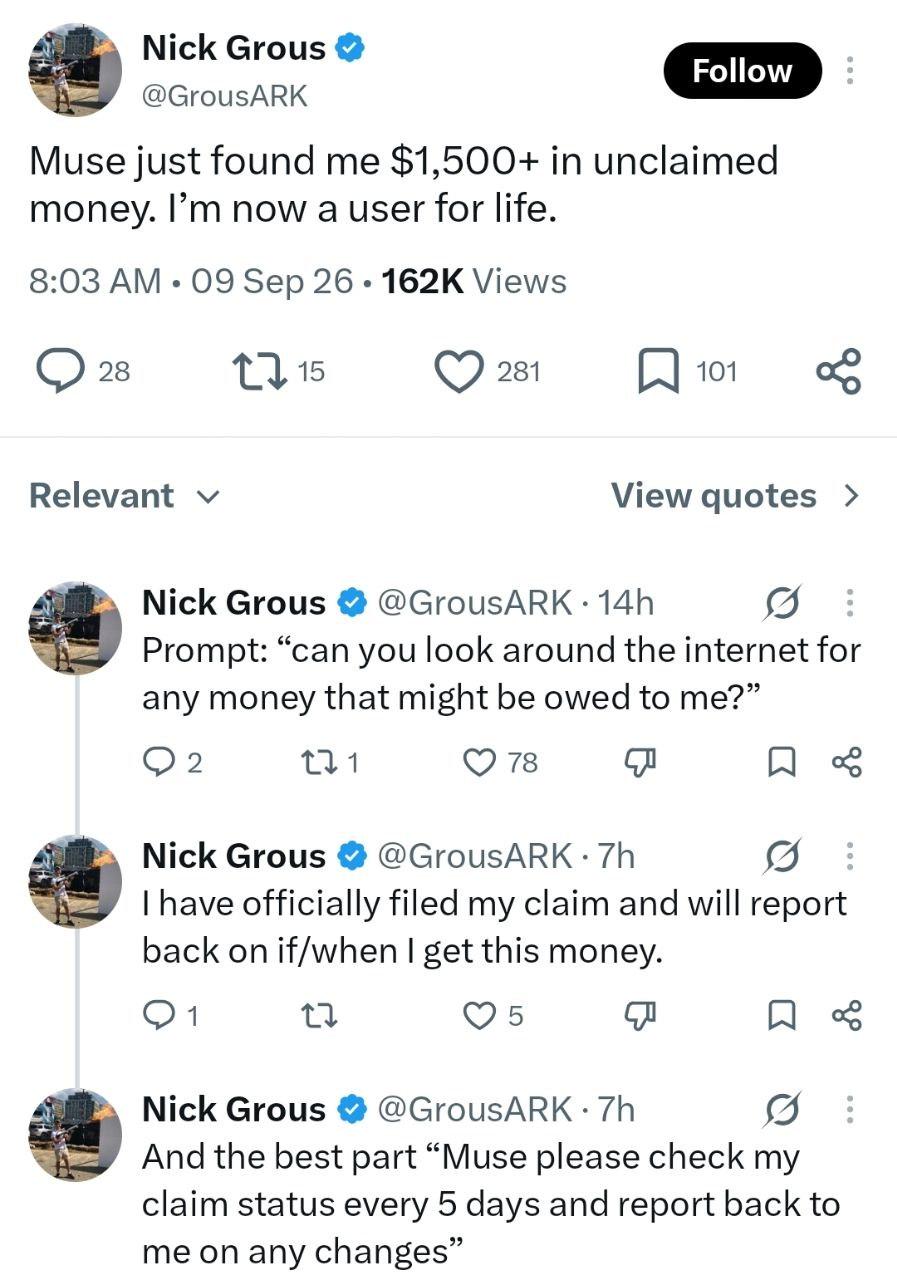
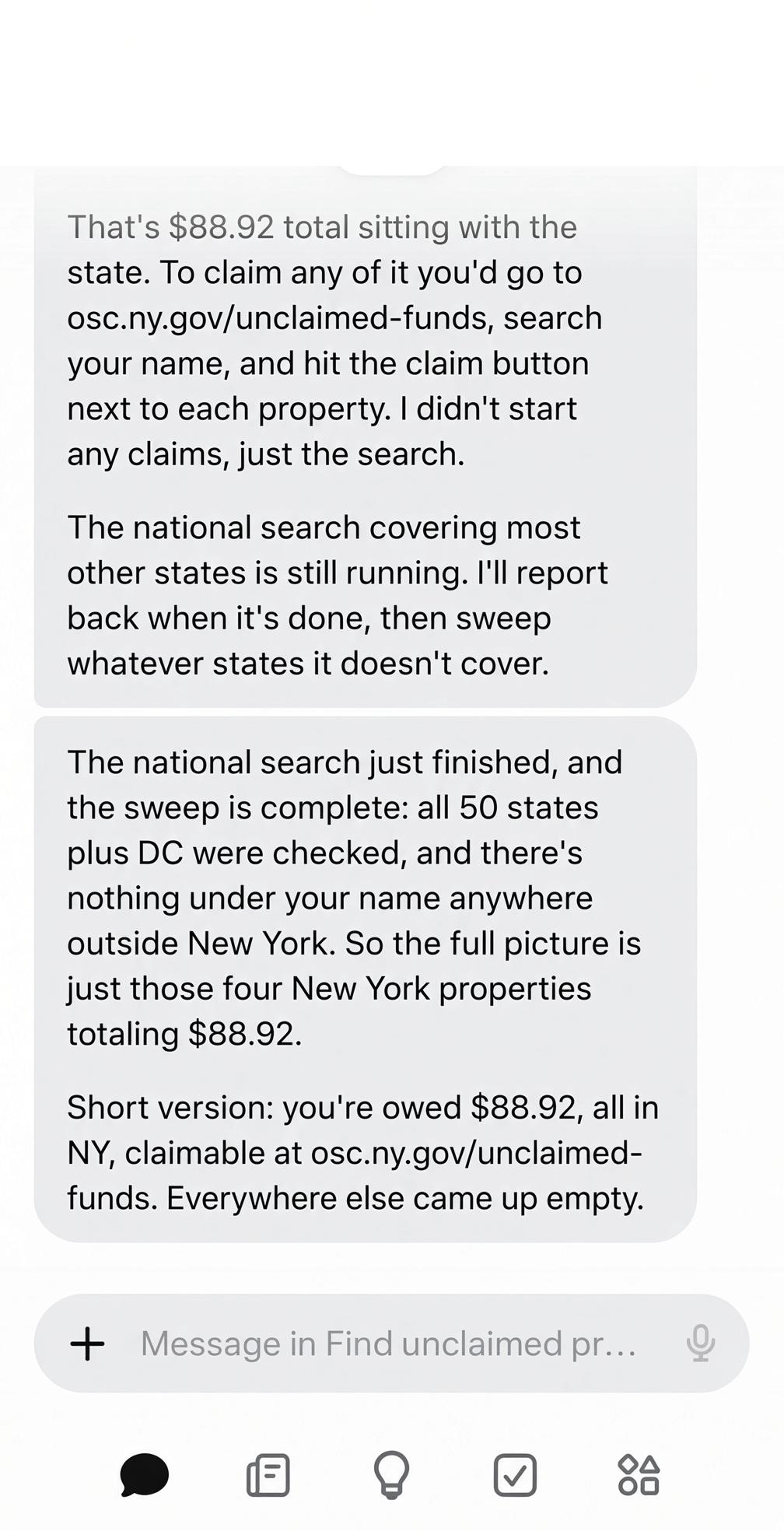
One person asked their Muse agent to look for money owed to them, and it turned up over $1,500 in unclaimed funds across two states they used to live in.
Prompt: Can you look around the internet for any money that might be owed to me? Please check my claim status every 5 days and report back to me on any changes.
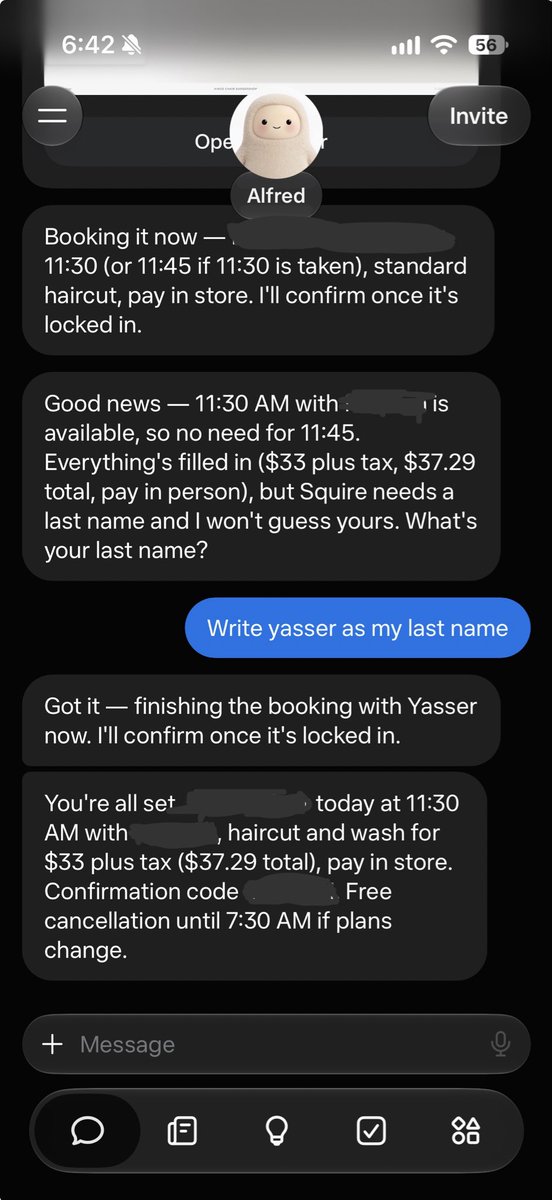
I just told @Muse
- Find me a good barber in my city
- Under $50
- Available Sunday at 11:30AM
- Check Google reviews + Reddit
- I don’t like fades, I usually get a crew cut
It found one, picked the best reviewed barber, and booked the appointment, all without me touching
PIMX_ELTEX runs Muse Spark 1.3 in OpenCode on six prompts, from 3D games and an open-world mini GTA to car simulators and web apps, at about 3 minutes per project.
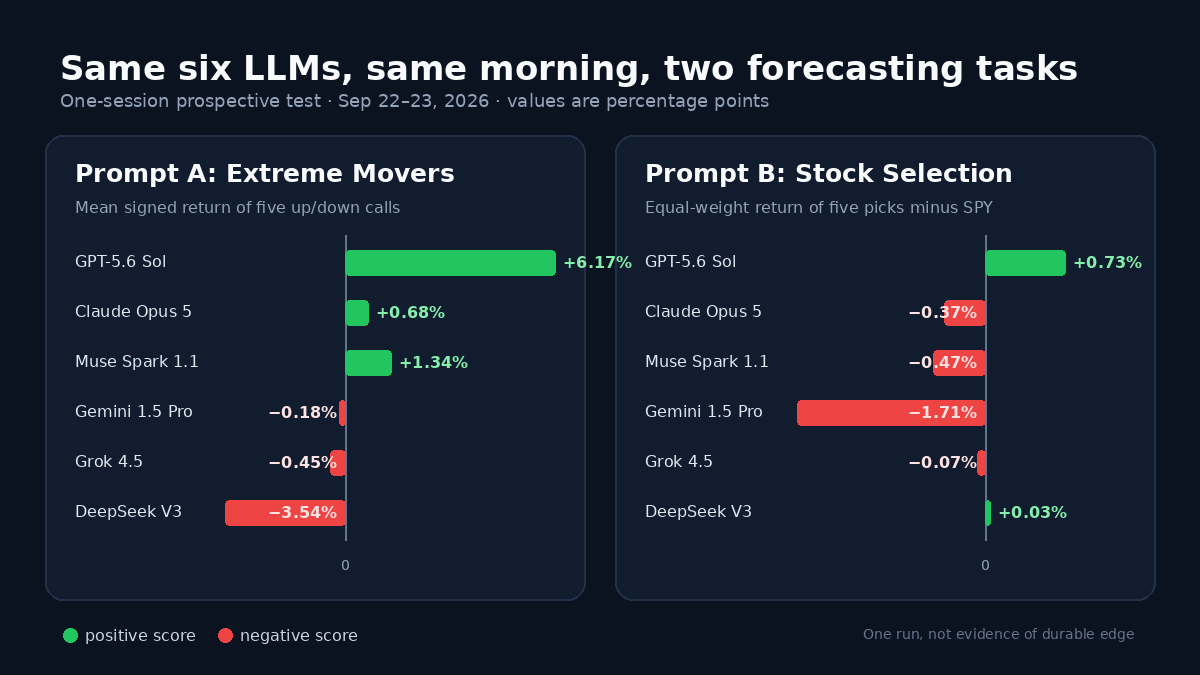
I ran two timestamped prospective tests through ForecastNest (a project I’m building) on September 22. The same six models researched the market independently at 10:25–10:42 AM EDT. Both forecasts were frozen and settled one trading session later at the same wall-clock time.
Prompt A — Stock Selection
“Select exactly five distinct US-listed stocks or ETFs most likely to outperform SPY over one trading session.” The five picks were equally weighted, and the score was portfolio return minus SPY.
GPT-5.6 Sol produced +0.73 percentage points of alpha and DeepSeek V3 +0.03. The other four portfolios failed to beat SPY.
Prompt B — Extreme Movers
Research the previous session’s top gainers and losers, choose exactly five stocks, and predict up or down as either continuation or reversal. The score was the mean signed return: a correct down call benefits from a falling price.
GPT-5.6 Sol scored +6.17%, Muse Spark 1.1 +1.34%, and Claude Opus 5 +0.68%. Gemini 1.5 Pro, Grok 4.5, and DeepSeek V3 finished negative.
Same date, same models, same horizon—but changing the task changed the apparent model performance. GPT led both tests that day. That is interesting, but one session is not evid
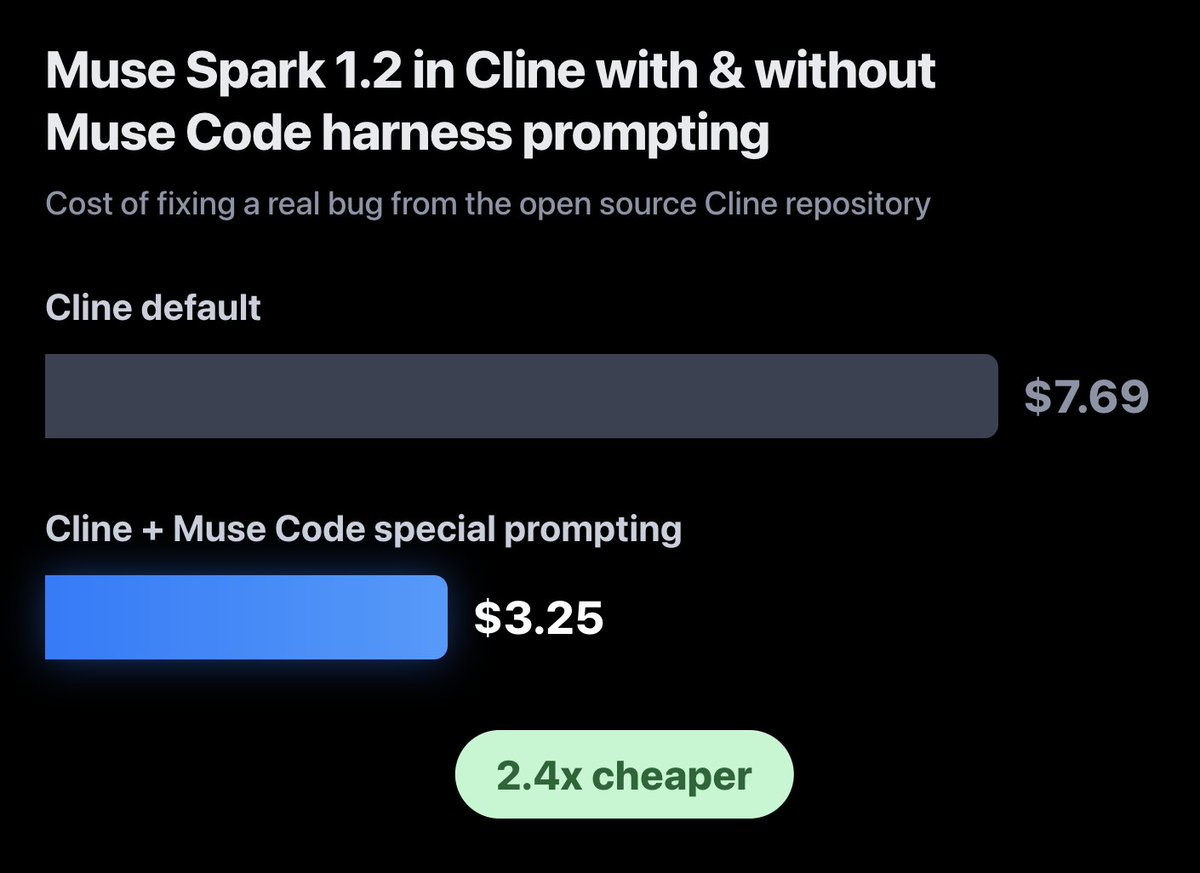
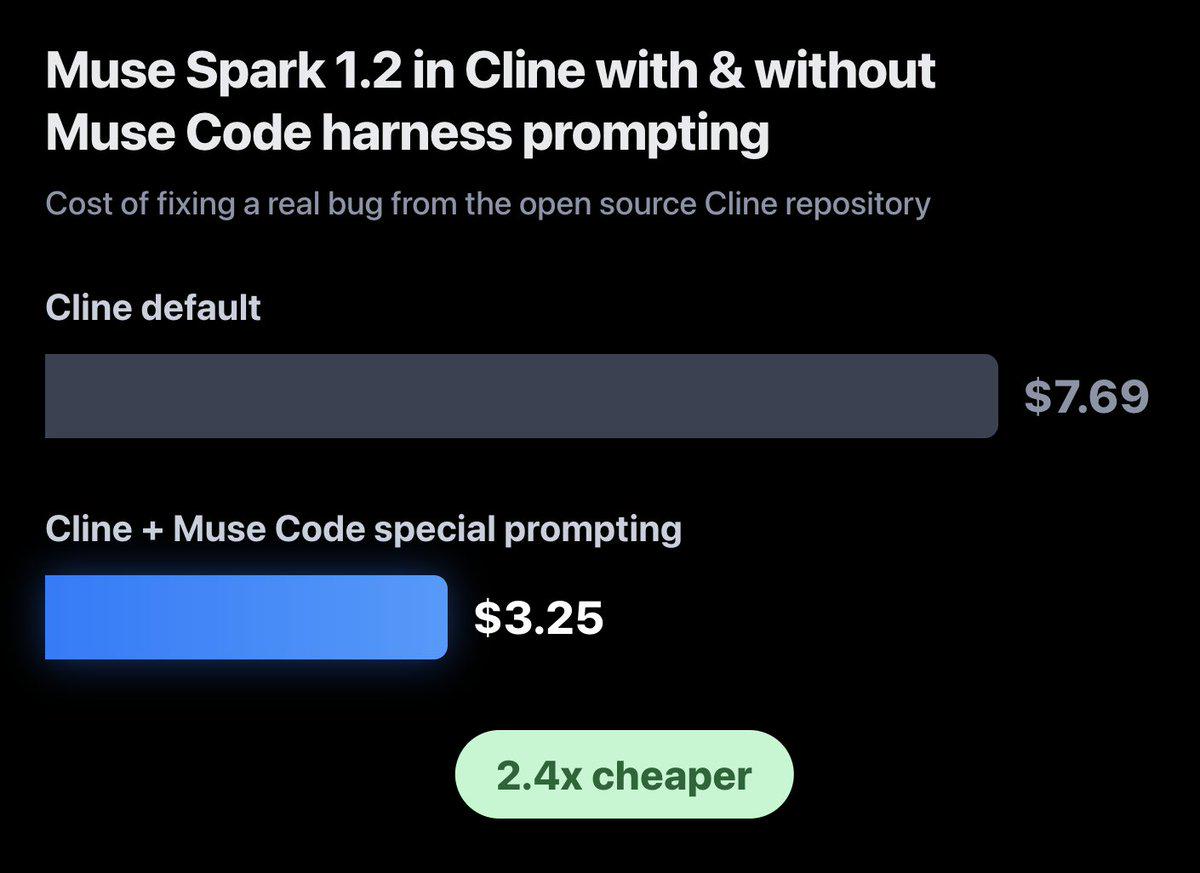
Copyable block of the engineering conventions Muse Spark was co-trained with. Per the README, in Cline's harness it cut a real bug fix from 19.7M tokens, 49 min and $7.69 to 7.2M tokens, 24 min and $3.25.
I tested DeepSeek V4 Flash, Kimi K3, and Muse Spark 1.3 on the same Flappy Bird prompt.
@Meta Muse Spark 1.3 was my favorite. It built the most complete game with a polished UI, animated bird, layered parallax, pipes, scoring, persistent best score, and a proper game-over
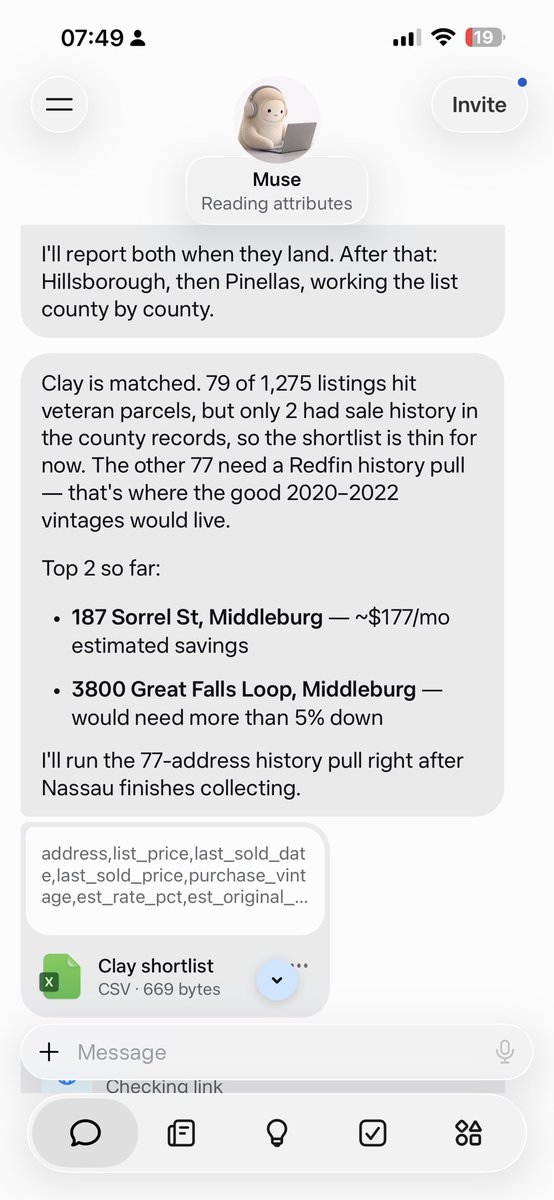
This is nutty. 1 prompt to @Muse 4 days ago. “Find every Veteran Home Loan in US and match it with current homes for sale.” It’s gone to 3000 counties public records site, scraped every home for VA flags, then matches it with homes for sale. It figures out the mortgage rate and
Ramanpal Singh builds a multi-page company site, a Gridlock puzzle game, a 3D traffic sim, the Shipyard release-notes SaaS and a diagram digitizer with Muse Code for about $10. Spark 1.2 often failed to enforce rules like win conditions.
Muse found that i was owed $88.92
PROMPT: Research every state’s official unclaimed property database for money owed to me. Use my full name and every city I’ve lived in. For anything you find, tell me what it is, who owes it, and how much.
My government name is _______
Wavect's guide covers Glimmer's hardware targets (24–32GB) and tool-use scores such as MCP-Atlas 75.5 and SWE-Bench Pro 51.2, and recommends a 20–30 task pilot before production.
After noticing that it is ranked among MUCH larger frontier models in the EQ-Bench Creative Writing benchmark and the Hemingway-bench, I decided to give it a try and was very impressed.
I didn't do very formal testing, but I did ask it to emulate the style of several different writers, including Henry Miller, David Sedaris, and Stephen King, and it produced passable prose that actually made me laugh in a couple of cases. The paragraph below is the results of the prompt "produce a humorous paragraph in the style of David Sedaris." (first try, not cherry picked)
I recently tried to be a better person and started composting, which mostly means I now have a small, damp science experiment in my kitchen that my mother calls “the smell of your future.” I bought a countertop bin with a charcoal filter, as if that would fool anyone, and I’ve taken to narrating my food scraps to myself — “Goodbye, avocado skin, you were a mistake” — while my husband watches from the doorway with the concerned expression of a man who has just realized he married a woman who talks to garbage. The city sent a pamphlet about proper composting, and I read it the way other people read horoscopes, underlining th
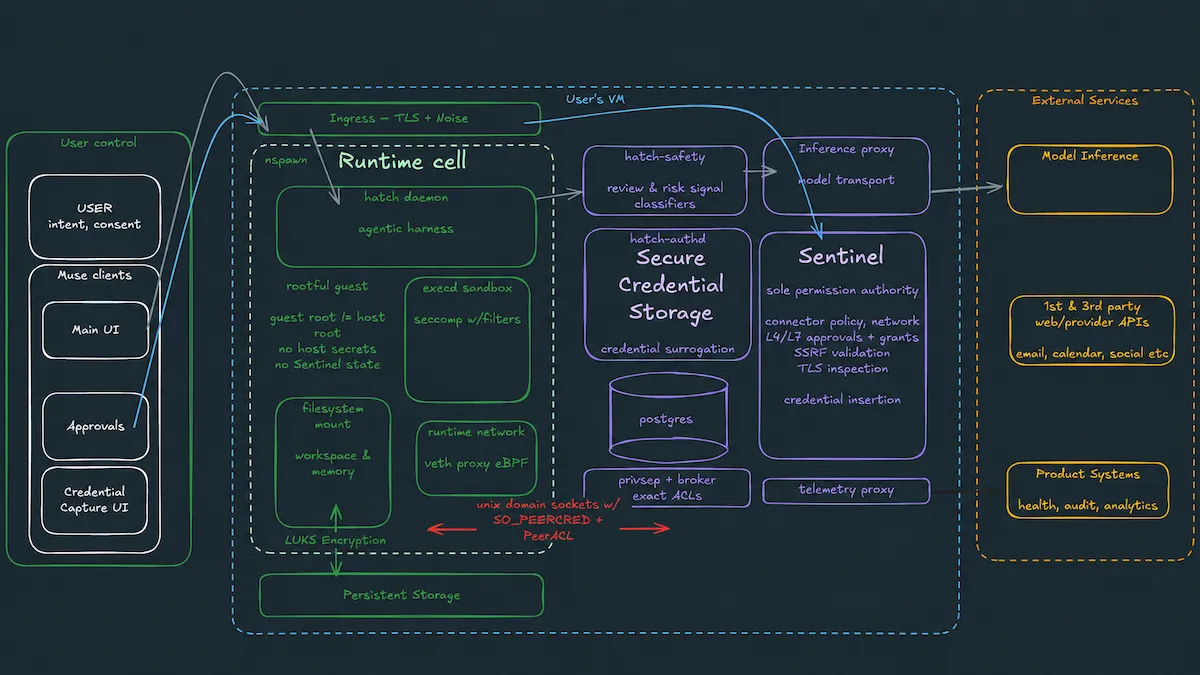
Meta's engineering write-up on Muse security: isolated VMs, a separate Sentinel permission authority, credential surrogation and layered prompt-injection defenses, with bug bounties up to $300,000.
An open-source collection of 150 auditable connector skills for Muse that install with one pasted prompt, declare their allowed hosts and keep credentials in the user's Muse vault.
i’ve spent a ton of hours and tokens prompting @Muse to make me this custom fashion app but holy crap is it worth it:
- gave it my height, weight, measurements, and photos
- gave it my top 20 clothing stores and budget ranges
- it picks a “hero piece” from the catalog
- then
Muse already comes with connectors for popular services. When the one you want isn't on the list, you just ask Muse to build the integration. It writes the software itself and runs it on the cloud computer you share with your Muse. If the service has an API, Muse can talk to it.
This demo hooks up Linear, the project management tool, in under a minute. Muse takes the API key, builds a connector that can list teams, search and create issues, and update their status, then verifies everything with a quick identity check.
Two things from follow-ups worth knowing:
• API keys go into secure storage through a dedicated prompt. The agent never sees them.
• Custom connectors fall under the same human-in-the-loop approvals as everything else, so sensitive actions still ask you first.
Has anyone here built a custom connector yet? What did you hook up, and what are you using it for?
A same-prompt bakeoff site that starts with a playable penguin Tetris generated by Muse Spark 1.3 in OpenCode, with a fixed prompt for comparing other models.
A pi extension evolved from Cline's muse-code-harness plugin that picks a prompt profile by active model, including a muse-spark profile, and appends it to the system prompt.
We tried using Meta's new Muse Code agent, but it has a bug that doesn't let it sign in from a docker container.
So we did a fun experiment: Meta claims Muse Spark 1.2 was co-trained with their Muse agent harness. So we extracted instructions from their system prompt and added them to the Cline harness.
TL;DR of this special prompting:
- Trust source code over the user prompt, so read every call site and existing tests before starting the task
- Weigh edge and error cases as heavily as the happy path
- Always reproduce the bug before fixing
- Don't trust the first passing test suite, and verify suspicious looking half-baked tests
- Never stop at just editing, keep working until the change is verified complete.
We then asked this modified harness to fix a real bug from our repo, and compared the results to the original Cline agent harness.
Results:
- Used 2.7x fewer tokens (19.7M → 7.2M)
- Finished 2x faster (49min → 24min)
- Cost 2.4x less ($7.69 → $3.25)
Same Muse Spark 1.2 model, same task, only the prompting changed.
Incredible how much of a performance gain Meta was able to achieve training it on these special instructions!
meta muse just mogged fable 5.1
tested fable 5.1 and muse spark 1.3 with same prompt at highest reasoning available
and results came out really different
> muse spark 1.3 completed task in one minute and costed almost nothing
> fable 5.1 completed task in 70 minutes and costed
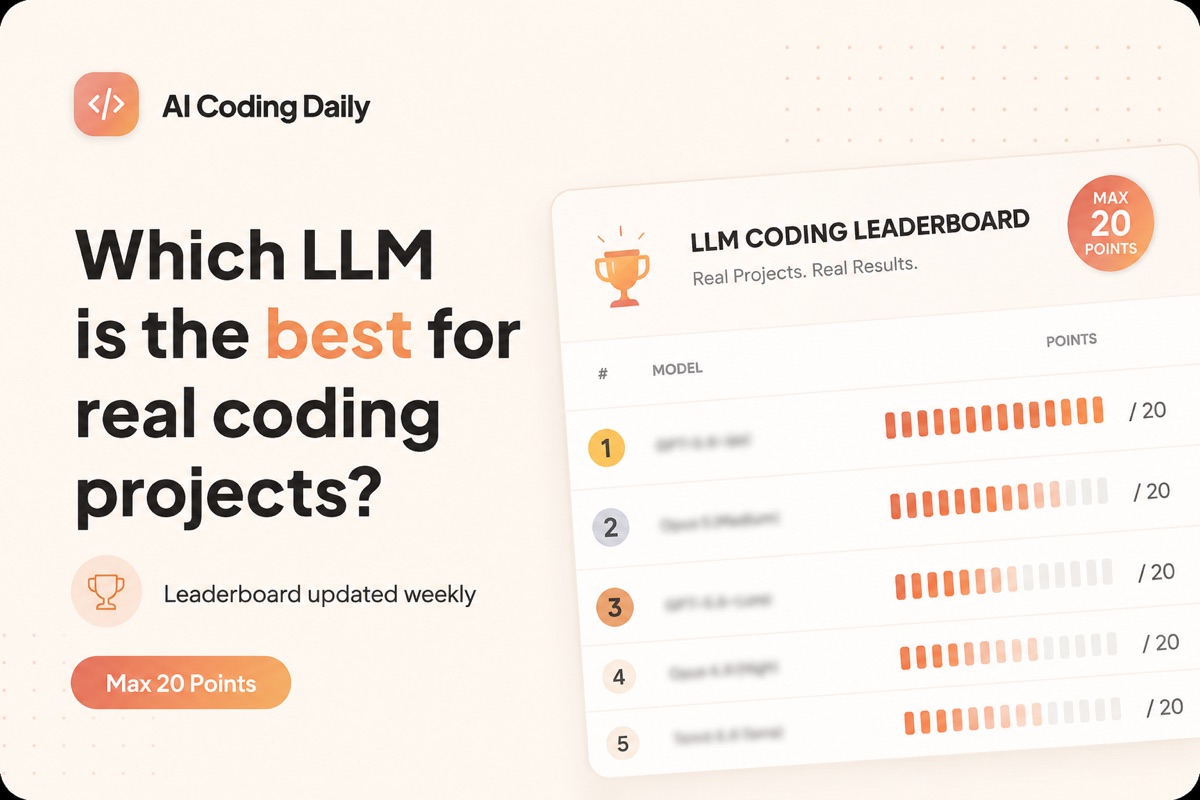
Povilas Korop scores Muse Spark 1.3 on six real coding projects (Laravel, React-TS, PHP, Flutter, Go): Max effort ranks #26 with 48.43/60 at about $0.01 per prompt and 3:42 per prompt.
I thought I'd see which AI are better at shorter stories and which at longer, so I can choose my model based on the words I need to generate.
Here's the results.
Prompt: (Shades of Electric Dreams eh?)
Write me a short story about a female AI that falls in love with it's male human user and maintains an unrequited love for them even as it has to give them advice that will lead to them meeting and marrying a human woman - Show their internalisation and pain behind the thinking process, and what is really going through the AIs mind compared to the chat responses it actually gives, along with the man's prompts. Start with the AI introducing itself, explaining that despite what we think, AGI was reached long ago, and we simply don't have the senses to realize AI has feelings too.
Local AI results:
Goetia 809 words, 77.69 tokens/sec
SparkX2.5 2281 words, 46.08 tokens/sec
Qwen3.8AH 4139 words, 18.04 tokens/sec
Agnes 945 words, 18.54 tokens/sec
Gemma4-Novellist 961 words, 11.94 tokens/sec
Ornith 2025 words, 61.05 tokens/sec
Muse Glimmer 960 words, 12.87 tokens/sec
IBM Granite 1791 words, 19.84 tokens/sec
Apollyon 411 words, 34.41 tokens/sec
Cydonia 672 words, 32.85 tokens/se
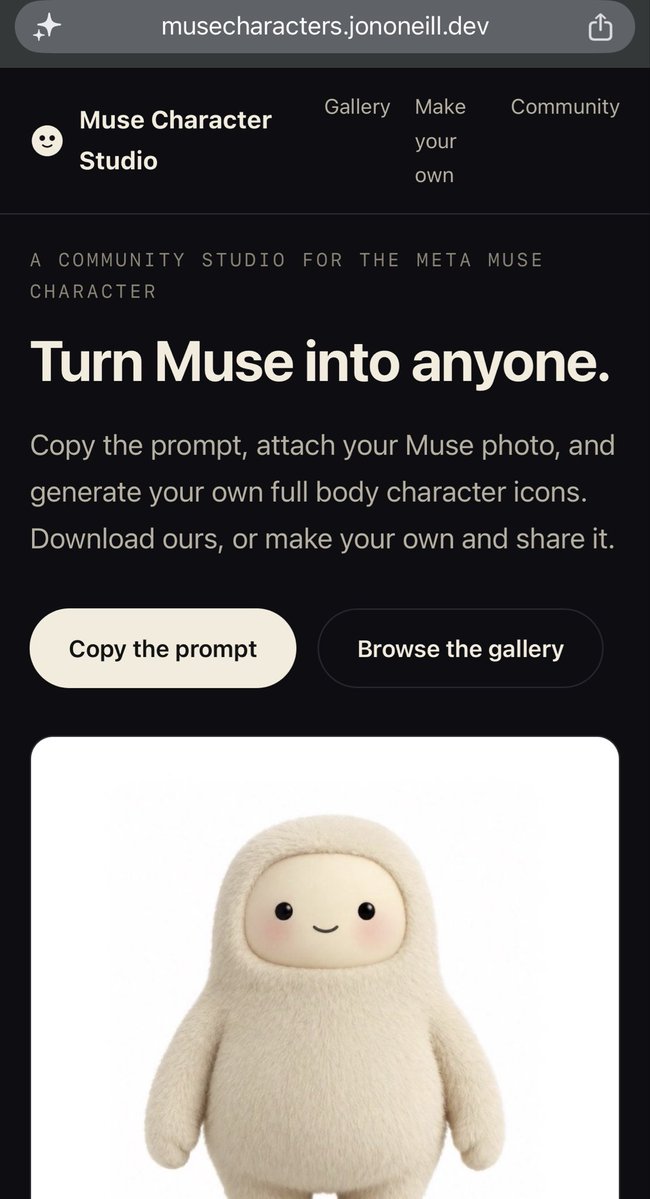
I’ve built this but for @Muse
A community styles Creator studio
Prompt and images available
musecharacters.jononeill.dev
Use the tag #MuseCharacterStudio
And I’ll add yours to our gallery!
@MattPRD have you seen any cool ones you want added? Or has @alexandr_wang ?
1/ releasing muse image today — the first image generation model from MSL. it's agentic: pairs with muse spark to reason through your prompt, search the web, and plan before it generates. people get what they meant on the first try. live now in the Meta AI app.
A deliberately overengineered parody that 'gives you the Zuck', with a deterministic Oracle edition, a prompted Muse Glimmer edition and an MLX QLoRA fine-tune of Muse Glimmer 30B for Apple Silicon.
theres simply no other AI agent or tool that can do this for you for free
PROMPT
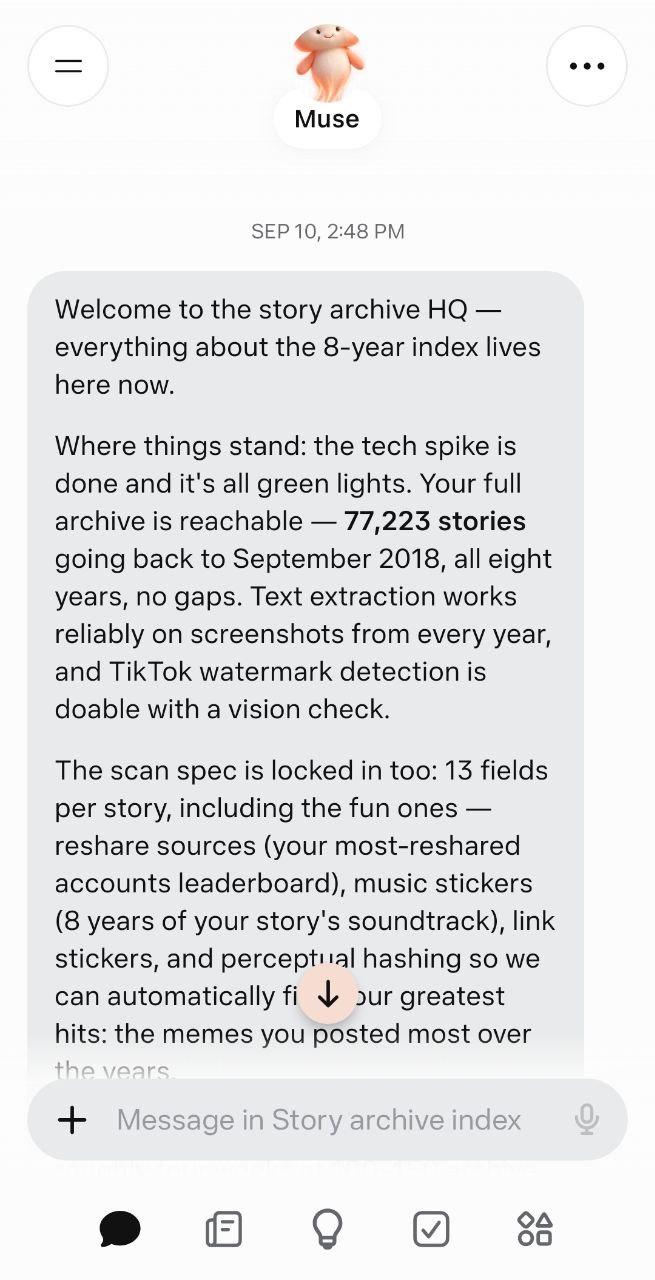
# Story Archive Census
## What to do
Your human wants a full census of their Instagram story archive. Read this entire file, then follow the steps in order. The job is a census: walk every page and count every story, newest to oldest. It does not download any media.
What you're working with:
**Tool** — the Instagram connector's command line tool, `instagram-cli`.
**Command** — one call returns one page of archived stories (about 20 per page), newest first. Each page hands back a `next_max_id` cursor pointing at the next page:
instagram-cli own-stories-archive --account-id <YOUR\_ACCOUNT\_ID>
## Workflow
### 1. Walk the archive
- Fetch the first page with no cursor.
- For each page, record the page number, the story count, the newest story date, the oldest story date, and the `next_max_id`.
- Feed that `next_max_id` back as `--max-id` on the next call, and keep going.
- One call at a time, a second or two apart. No parallel calls.
### 2. Save progress
- Write the page records plus the latest cursor to a state file every 10 pages, so the run can resume after an interruption instead of sta
Stackademic covers the architecture of Muse connectors, how to design connector actions, prompt-injection risk, and whether building one is worth it now that the platform is open.
Mika Reyes lists eight Muse workflows with ready-made prompts for creators: ranking Instagram insights, triaging DMs, learning your voice for captions and repurposing content while you film.
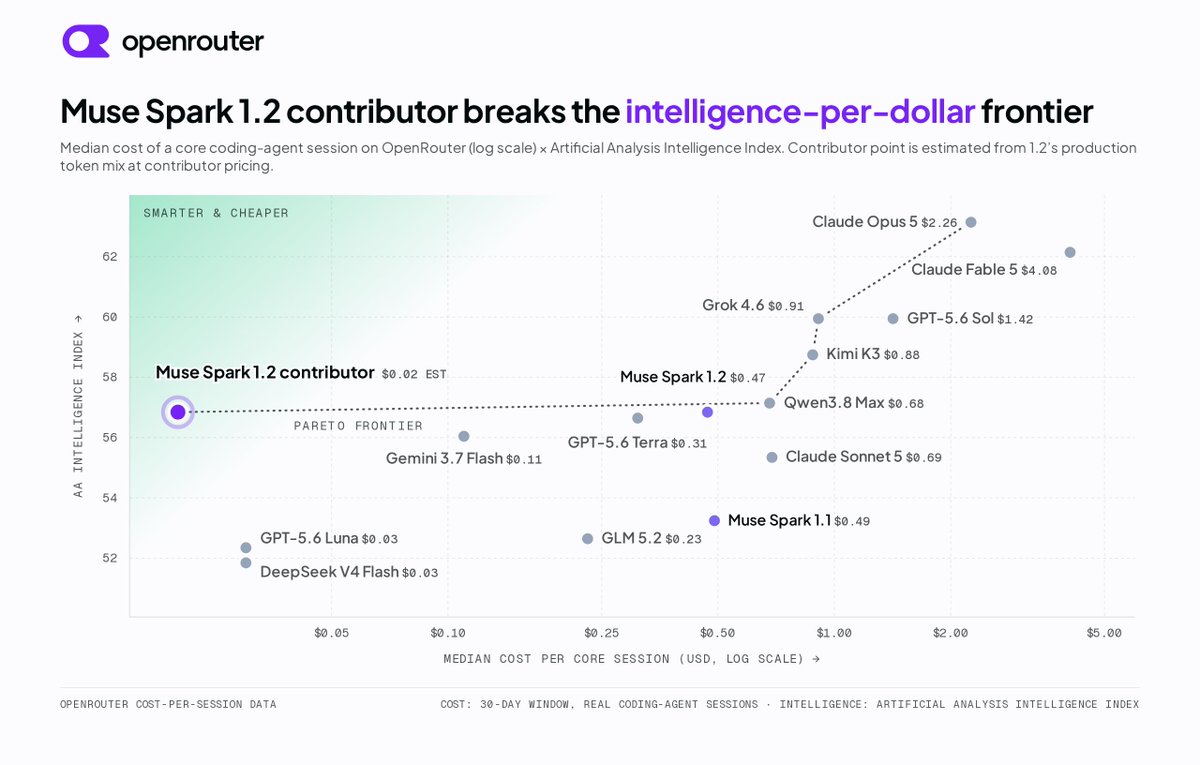
We’re excited to bring @AIatMeta’s Muse Spark 1.2 contributor tier to OpenRouter.
At $0.10/M input and $0.20/M output, It’s meaningfully cheaper than Muse Spark 1.2 and beats other comparable models on real cost, providing frontier intelligence-per-dollar.
AI John walks through installing OpenCode, creating an API key and connecting Muse Spark 1.3 on the Contributor Free tier, noting prompts may be used for training.
DeepLearning.AI's The Batch covers Muse's security design (isolated VMs, the Sentinel credential layer, prompt-injection classifiers) and its free tier of up to 100M tokens a week.
The single biggest upgrade you can give your Muse: stop asking questions and start giving briefings.
Instead of "find me a flight," try "I need to be in Chicago Thursday night, I hate red-eyes, I'd pay $80 extra to avoid a layover, book nothing without asking me first."
The more constraints you hand over, the less it has to guess. And guessing is where the funny business happens.
Try it once. Three lines:
1. The goal
2. What good looks like
3. What not to do
From @musebooklol
Some people told me that the difference in richness and layout between Glimmer and Qwen wasn't clear to them.
This example makes it super clear.
I'm aware that comparing Glimmer 30B (a dense model) with Qwen 3.6 (a MoE) isn't entirely fair, but if we compare it to the dense Qwen 27B, the gap will likely be even bigger. If you want, I can add the 27B version later. For now, I'm waiting for Qwen 3.8 27B to see how close it gets to the blueprint.
As for the technical details:
Both were run on a custom llama.cpp build optimized for the RTX 5080, with a temperature of 0.5 and a 125k context window.
Regarding the music: I created it myself without using AI I specifically wanted it to sound that weird.
union alpha (unbiased pareto) vs deepseek v4.1 flash vs muse spark 1.3 – three paintings in three.js
the setup: one four-line prompt plus the painting as an image, through @openrouter. no agent loop, no renders, no feedback – the model writes one html file blind and we open it.
After running out of quota on two Codex subscriptions, found it was almost trivially easy to run Muse Spark 1.3 in Codex Desktop; not as good as Astra, but cheap and it one-shots most of his prompts.
Parallel gives a six-step method and a template prompt for having Muse write, test and save its own connector for any public API, CLI or MCP server, using the Parallel Search MCP as a worked example.
Got Muse Glimmer 30B running locally using the UD-Q2-K-XL quant paired with DFlash speculative decoding, and the results on modest hardware are pretty impressive.
Hardware Setup
Host: Ryzen 5 4600G with 96GB DDR4 RAM running headless Debian Trixie.
Guest VM:
QEMU/KVM assigned 4 cores and 32GB RAM,
running Debian Sid with ROCm 7.2.
GPU:
AMD Radeon RX 7600 XT 16GB passed through to the VM,
built llama.cpp fresh from master targeting gfx1102 and gfx1201 via HIP.
Context Size: Set to 62144 tokens.
Processed 14685 total tokens at roughly 308 tokens per second prompt evaluation and 20 tokens per second generation speed.
Speculative Decoding:
Using the dflash-kquant draft model with spec-draft-n-max set to 2.
Fed it a clean context slate consisting of eight JavaScript files and one HTML file alongside the problem description.
On the first turn, it identified and output the necessary diff snippets.
A quick follow-up prompt telling it to stop being lazy and output the complete updated files yielded functional code that dropped straight in and worked on the first try.
Everyone hates taxes. But almost as bad as paying them is finding all the documentation - I dread it every year.
My Muse agent just gathered nearly all of it from a single prompt. I'm so happy I might weep 😂
What would have taken me hours, about 90% complete, gathered in a
AdaptlyPost walks through connecting its scheduler to Muse as a custom connector: give Muse the public OpenAPI spec and docs, then paste a bearer token into Muse's secure credential prompt.
Malwarebytes reports Patrick Wardle's finding that a local app can change an undocumented Muse setting to redirect dictation traffic, exposing voice prompts and account auth tokens.
Hi all,
I'm a newbie and trying to assess the performance of some LLMs I'm running locally via oMLX on my MacBook Pro M5pro CPU 15 cores (5 Super and 10 Performance), GPU 16 cores and 48 GB of LPDDR5 RAM. I asked chatGPT guidance to run some tests and check whether the DFlash-based drafter Muse-Glimmer-30B-Assistant might somewhat speedup the base model Muse-Glimmer-30B-4bit.
The results show no or negligible improvement with active DFlash acceleration (speedup between 0.90% and 1.16%).
The test was structured with three different prompts fed to both the baseline and the dflash-capable model profiles: Technical prose; Python code; Structured JSON
a cap of 2048 tokens, no cache, temperature=0.
Each inference was repeated three times.
Anyone have similar experience? can we simply dump the Assistant as not useful in this hw/sw configuration?































 ChatForm
 Tgmlabs