Using @AIatMeta's Muse Glimmer all locally to process personal monthly credit card statements.
Your data belongs to you!
Try different agent tasks using your favorite apps / harnesses with Ollama.
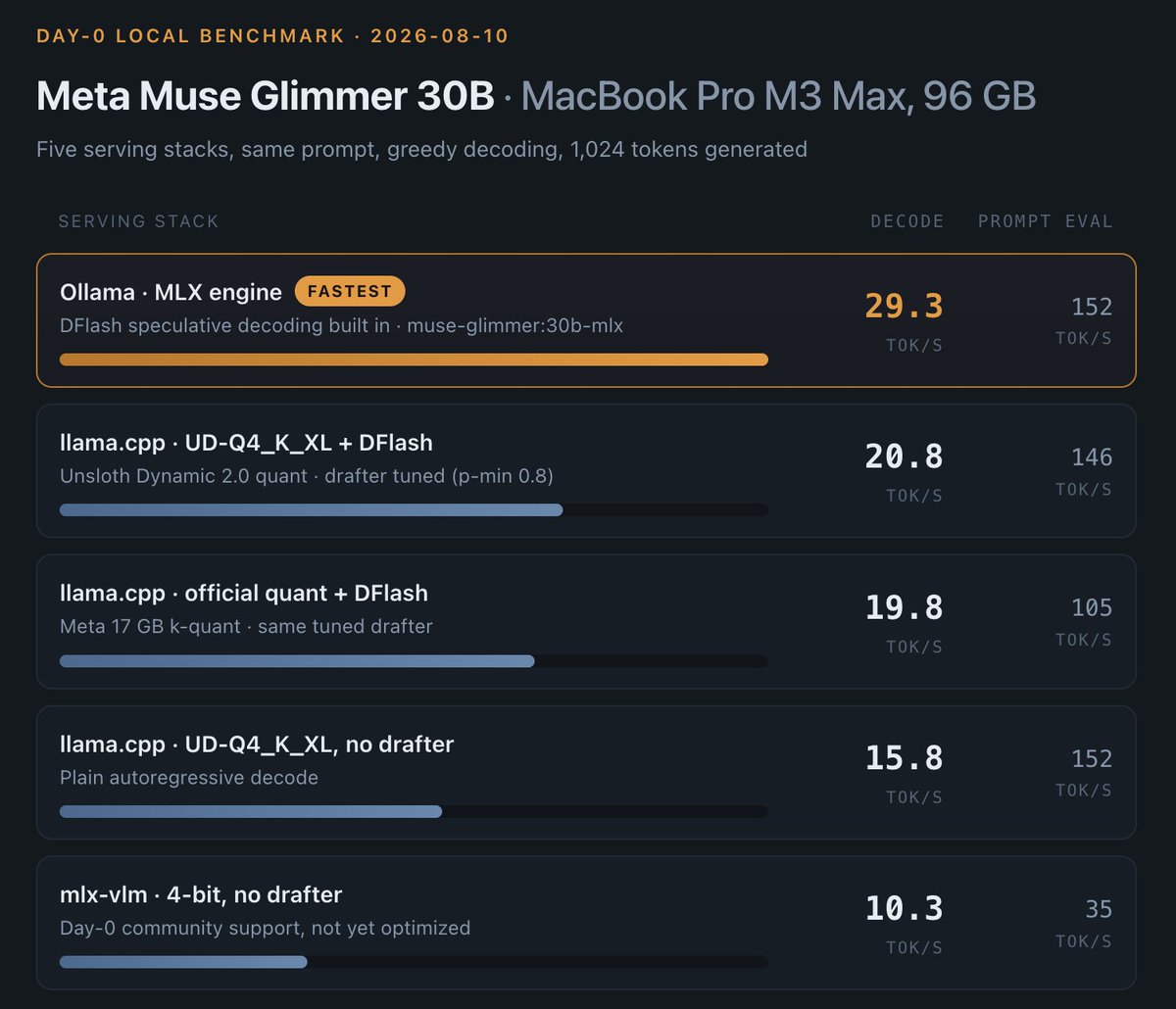
Got Meta's new Muse Glimmer 30B running on my MacBook (M3 Max, 96GG) and tested the serving options available so far.
Fastest right now: Ollama's MLX engine (DFlash included) at ~29 tok/s.
Tuned llama.cpp: ~21. Raw mlx-vlm: ~10, not optimized yet.
Numbers below if you're
2-bit Muse Glimmer GGUF managed to call 100+ tools on just 14GB RAM. 🔥
Muse Glimmer did a complete repo bug hunt for 5 mins nonstop with: evidence, repro, fix, tests and a PR writeup.
Run and train it in Unsloth.
GitHub repo: github.com/unslothai/unsl…
PyTorch added end-to-end Muse Glimmer support to ExecuTorch; on an M5 Pro, DFlash speculative decoding lifts image+text decode from 21.6 to 33.0 tok/s, and it powers the Pi coding agent locally.
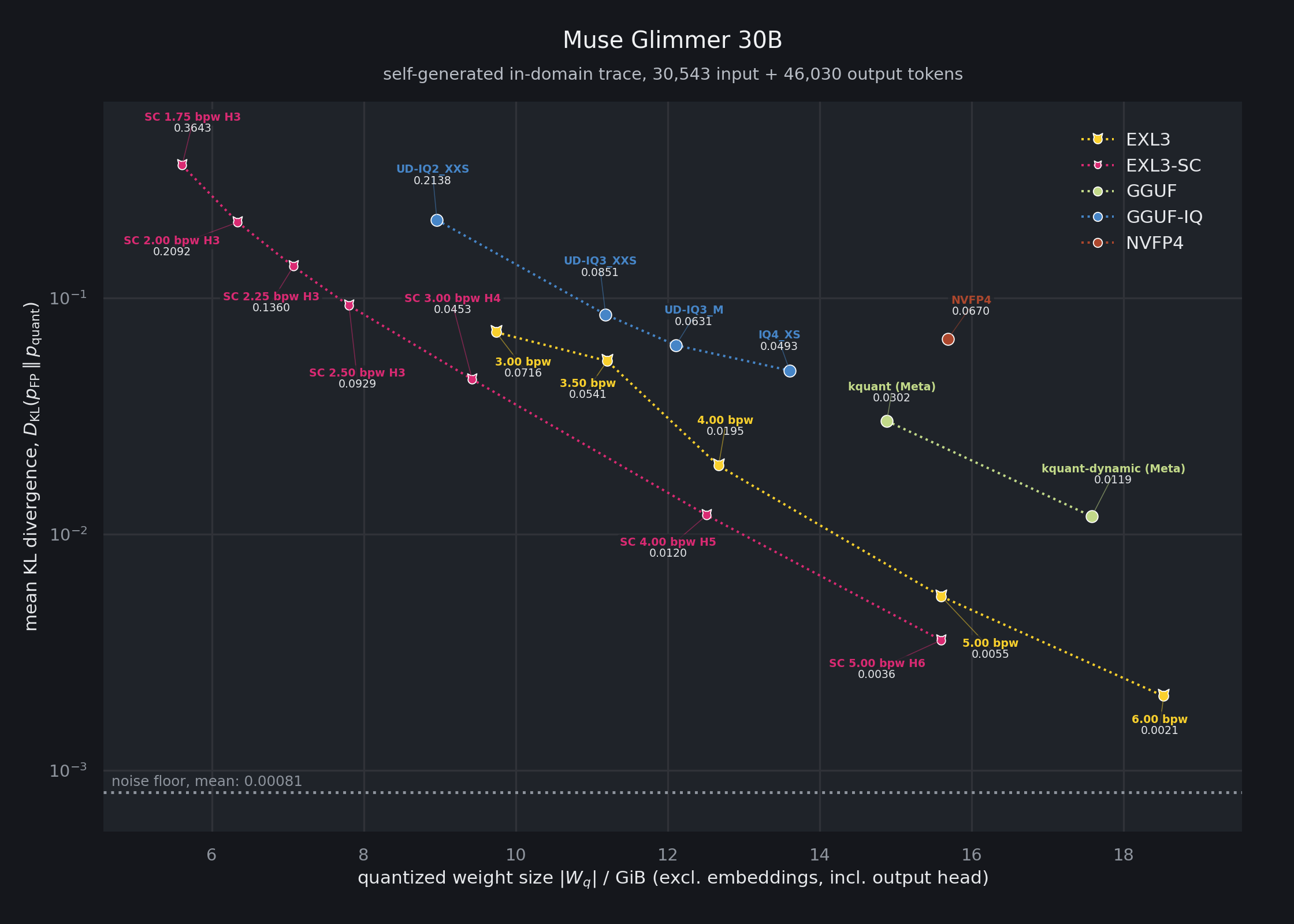
I'm running Muse Glimmer 30B EXL3-SC 3.00bpw H4, fully resident on my 12GB VRAM GPU at 100K context with Q8\_O KV cache. It's a joy to use a dense 30B model at this size and still get \~30 tok/s on a VRAM-constrained laptop.
It's supposed to be only slightly worse than the official 17GB K-quant at a much smaller footprint, and for my Hermes Agent use case I don't notice a quality difference. It's just much faster.
I've tried Qwen 3.8 27B at SC2.20bpw H3 too. Definitely usable but I'm sticking with Unsloth UD\_Q4\_K\_XL for Qwen 3.8 27B because it's mainly for coding.
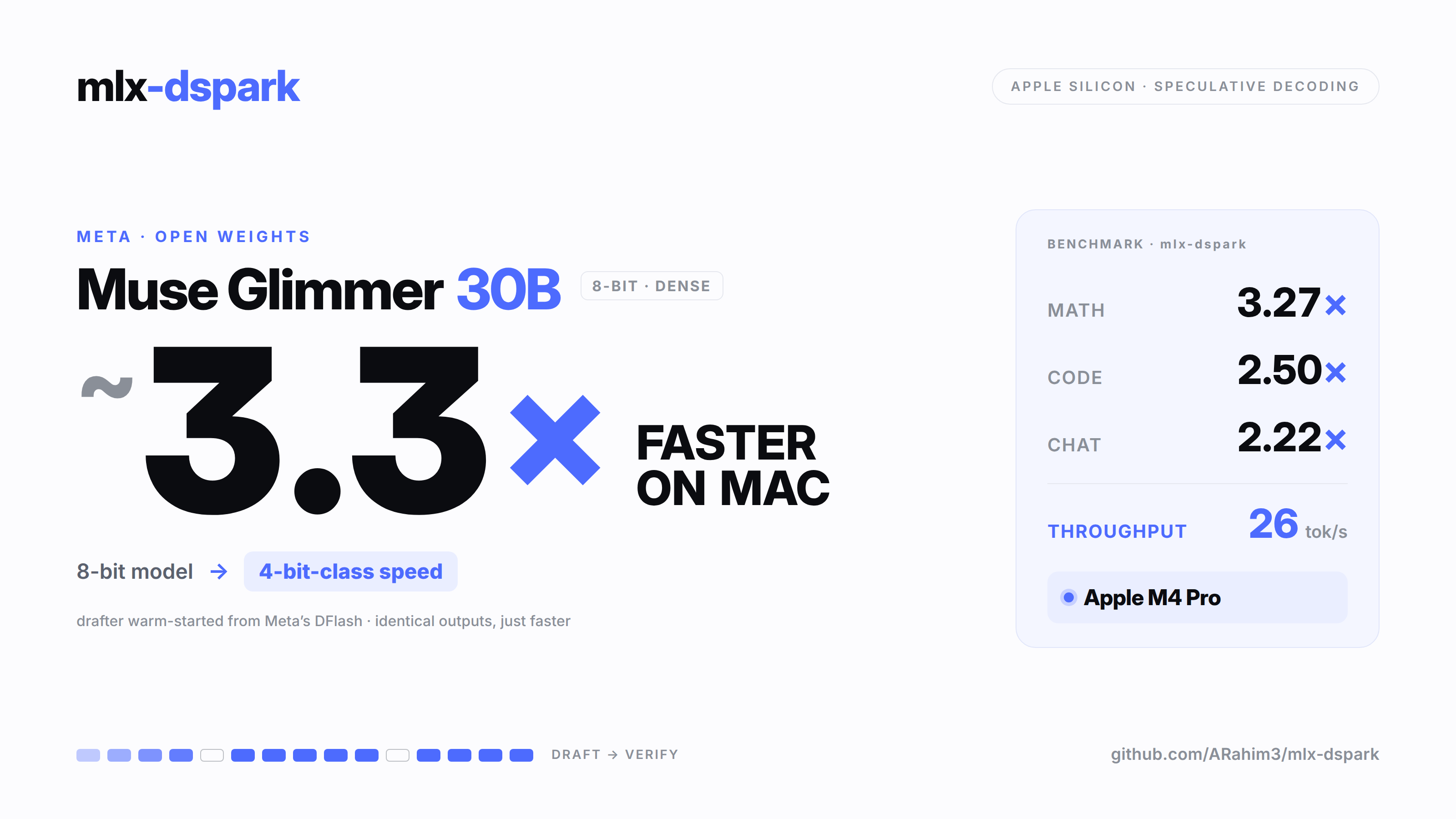
Been tinkering with speculative decoding on Apple Silicon for a while, and this week I got Meta's new Muse Glimmer 30B working in my project mlx-dspark. On my M4 Pro, the 8-bit model goes from 8.2 tok/s to 18-26 tok/s depending on content. Math is the best case at 3.27x, code 2.5x, chat 2.22x. Output is byte-identical to normal decoding since the target verifies every token, so there's no quality tradeoff; it's just faster.
Meta's own DFlash numbers on Mac are 1.5x (M4 Max) / 1.8x (M5 Max), but those are on the 4-bit build, so not really apples-to-apples. 4-bit for me is ~1.7x at ~25 tok/s and only needs ~18GB. The 8-bit run peaks around 40GB, so you want a 48GB Mac for it. Basically, you get 8-bit quality at 4-bit speed.
Repo: github.com/ARahim3/mlx-dspark
I'm happy to hear feedback, and I'm curious about what other M-series chips get.
An architecture port adding the muse_glimmer model class (vision tower, language model, projector and image processor) to mlx-vlm, so any Muse Glimmer checkpoint runs multimodally on Apple Silicon.
smol-muse-glimmer scales Muse Glimmer's language backbone down to a 51M-parameter model and trains it on TinyStories, reaching validation cross-entropy of 1.8127 at step 5,000.
Same old prompt, just appended a TIP in the end:
"Write a single HTML file with a full-page canvas and no libraries. Simulate a realistic side-view of a moving car as the main subject. Keep the car visible in the foreground while the background landscape scrolls continuously to create the feeling that the car is driving forward. Use layered scenery for depth: nearby ground, roadside elements, trees, poles, and distant hills or mountains should move at different speeds for a natural parallax effect. Animate the wheels spinning realistically and add subtle body motion so the car feels connected to the road. Let the environment pass smoothly behind it, with repeating but varied scenery that makes the movement feel believable. Use cinematic lighting and a cohesive sky, such as sunset, dusk, or daylight, to enhance atmosphere. The overall motion should feel calm, immersive, and realistic, with a seamless looping animation.
TIPS: You don't have vision abilities so don't try it yourself. If you feel in need of vision ability, you can access http://xxx:8080/v1, model id: Muse-Glimmer for help, it will see the picture, and describe it for you."
Then the PI agent started spinning, round a
Muse Glimmer 30B is live in LM Studio!
It's a new open source model from Meta. Apache 2.0 license, fit right on your laptop.
It is the strongest model of its size class we've tested.
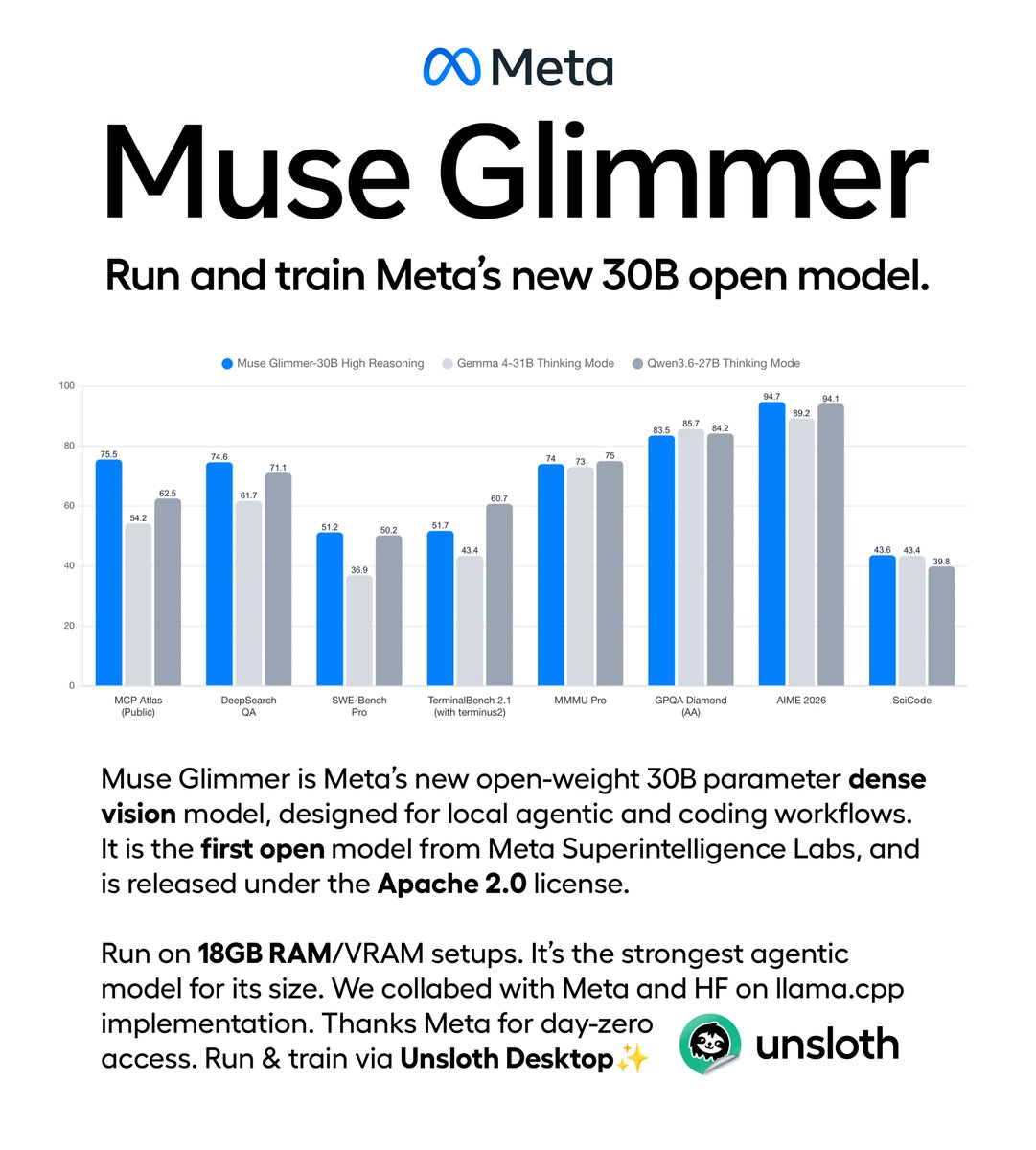
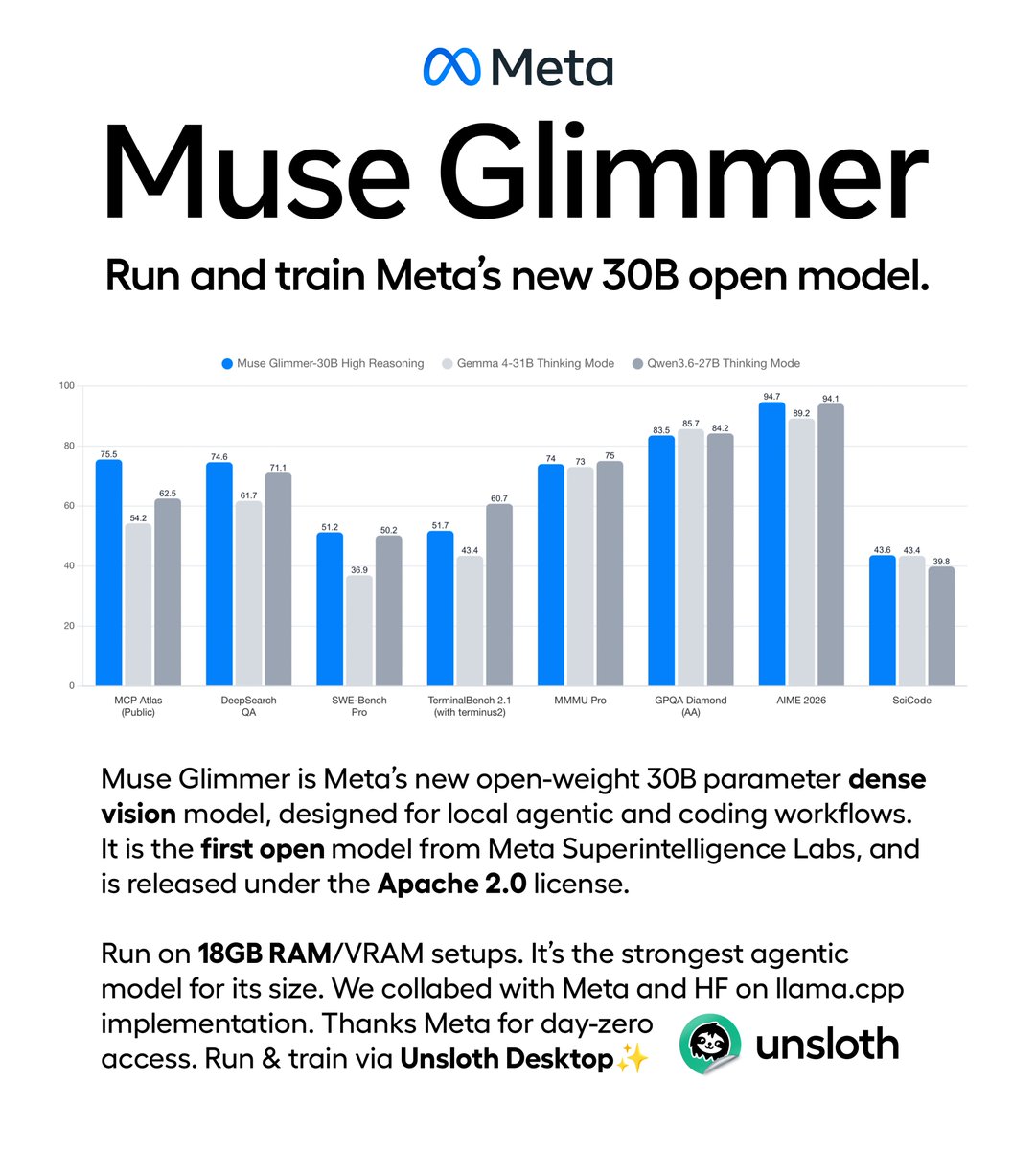
Meta releases Muse Glimmer, a new 30B open model that runs on 18GB RAM.
Muse Glimmer is Apache 2.0 licensed, supports vision and is the strongest agentic model for its size.
Run and train the model via Unsloth.
GGUF: huggingface.co/unsloth/Muse-G…
Guide: unsloth.ai/docs/models/mu…
@Meta is back in open source.
Excited to announce Day-0 vLLM support for Muse Glimmer 30B, the first open-weights model from Meta Superintelligence Labs — which ships under Apache 2.0!!!
30B dense, 128K+ context, multimodal, built for local agents.
Capable enough for
Refusal-direction ablation on Muse-Glimmer-30B that cut refusals from 128/150 to 3/150, adding an agentic-safety evaluation and publishing bf16 and GGUF uncensored weights.
A vLLM-XPU and DFlash recipe for Muse Glimmer 30B on a single Intel Arc Pro B70, reporting 278 aggregate tok/s across eight clients and an 840.8 tok/s burst peak at concurrency 96.
Samuel Alexander ran Muse Glimmer 30B entirely on a Qualcomm Dragonwing IQ-9075 board for zero-shot PCB defect inspection and tool calling, measuring 21.6 GB resident with full 131K context and 2.84 tokens/s generation.
We've been curious how far local models have actually come for agentic coding tasks, so we ran an experiment.
Setup:
• Model: Muse Glimmer (30B), packaged as a single llamafile
• Agent: Hermes coding agent (connected via llamafile's local server mode, zero API keys needed)
• Target: Mozilla AI's Otari gateway
The Issue:
We pointed Hermes at a real, reported bug in Otari (#183) where the gateway returned a vague 502 error on image requests instead of passing through the actual provider error.
What the Agent Did:
Hermes read the issue, navigated the repo, isolated the bug, created a branch, ran existing tests, wrote a new regression test, and opened a draft PR (#727). All of it ran locally and offline, with zero code written by hand.
It's still draft PR territory rather than a merged fix, but it's a solid signal that ~30B local models are getting genuinely capable for real dev workflows, not just toy demos.
Video walkthrough of the run: https://youtu.be/5GAgbT-XgHU?si=vJqEDGm9hssCO5-M
Happy to answer questions about the setup, model performance, or how Hermes handled tool calling!
My fun weekend project was to try to make the new Muse Glimmer 30B work with a longer context, deciding to go for 512k first. I had expected the usual YaRN shenanigans and maybe a LoRA. I couldn't have been wrong more.
Upon closer look, Glimmer turned out to be rather unusual architecturally. The thing that make long-context adaptations painful in other models, full attention layers with token position encoding, it simply not there. Instead, only 2048 tokens-wide SWA layers have RoPE, and full GQA attention layers have no position encoding at all. It appears the model is trained to work with long-distance token relationships inferred from the context and SWA layers. It's a rather bold architecture bet, but it seems Meta managed to pull it off.
As a result, the model architecture appears to be uniquely suited for context extension by simple mechanical means. To change model context length from stock 128k to, say, 512k, you need only to change “max_position_embeddings” config setting from 131072 to 524288. What confuses other models, like Qwen3.5 family, Glimmer just takes into its stride.
I spent close to 70h of compute on DGX Spark to test stock model with extended context on a
A start/stop/status launcher that serves the NVFP4 Muse Glimmer 30B checkpoint on NVIDIA DGX Spark with vLLM, Glimmer's reasoning and tool parsers, and its DFlash speculative decoder.
Ollama shipped Muse Glimmer on day one: `ollama run muse-glimmer`, plus a muse-glimmer:30b-mlx tag for Apple Silicon that Ollama says runs 1.5–1.8x faster with DFlash.
muse-glimmer-mlx is an MLX port of Muse Glimmer 30B for Apple Silicon that supplies the missing runtime so the many unloadable MLX conversions published on Hugging Face can actually be run.
Muse Glimmer 30B feels significantly more precise and reliable, it almost never drops the ball or breaks rules. However, its designs lack creative depth and richness.
Qwen3.6 35B, on the other hand, is prone to more occasional blunders/hallucinations, but its creative output is superior. It generates far richer, more complex voxel worlds and offers higher design quality.
LLama.ccp Build Provenance:
• Base: llama.cpp upstream (merge 4445f8d, build 661)
• CUDA Toolkit 13.1 + MSVC 19.44 + sm_120a-real (native Blackwell PTX)
• Flags: GGML_CUDA=ON, GGML_CUDA_FA=ON, GGML_CUDA_FA_ALL_QUANTS=ON, GGML_CUDA_GRAPHS=ON, GGML_NATIVE=OFF
• License: MIT (upstream llama.cpp)
Do you think Qwen3.6 is still the undisputed king here?
Glimmer HD Vision is an OpenAI-compatible proxy that keeps images within Muse Glimmer 30B's 4,096 visual-token limit by sending a 4K image as one overview plus four overlapping detail tiles, with an OCR/layout mode.
Muse Glimmer is now live on Together AI.
We’re proud to be a Day 0 launch partner for this open-weight model from Meta Superintelligence Labs, built for long-running agents that can reason, use tools, recover, and keep working across complex tasks.
A prebuilt macOS arm64 bundle for the Muse Glimmer voice-agent recipe in meta-oss-cookbook: Parakeet speech helper, Muse Glimmer worker and Supertonic TTS executables built from one pinned ExecuTorch checkout, plus the shared MLX Metal library.
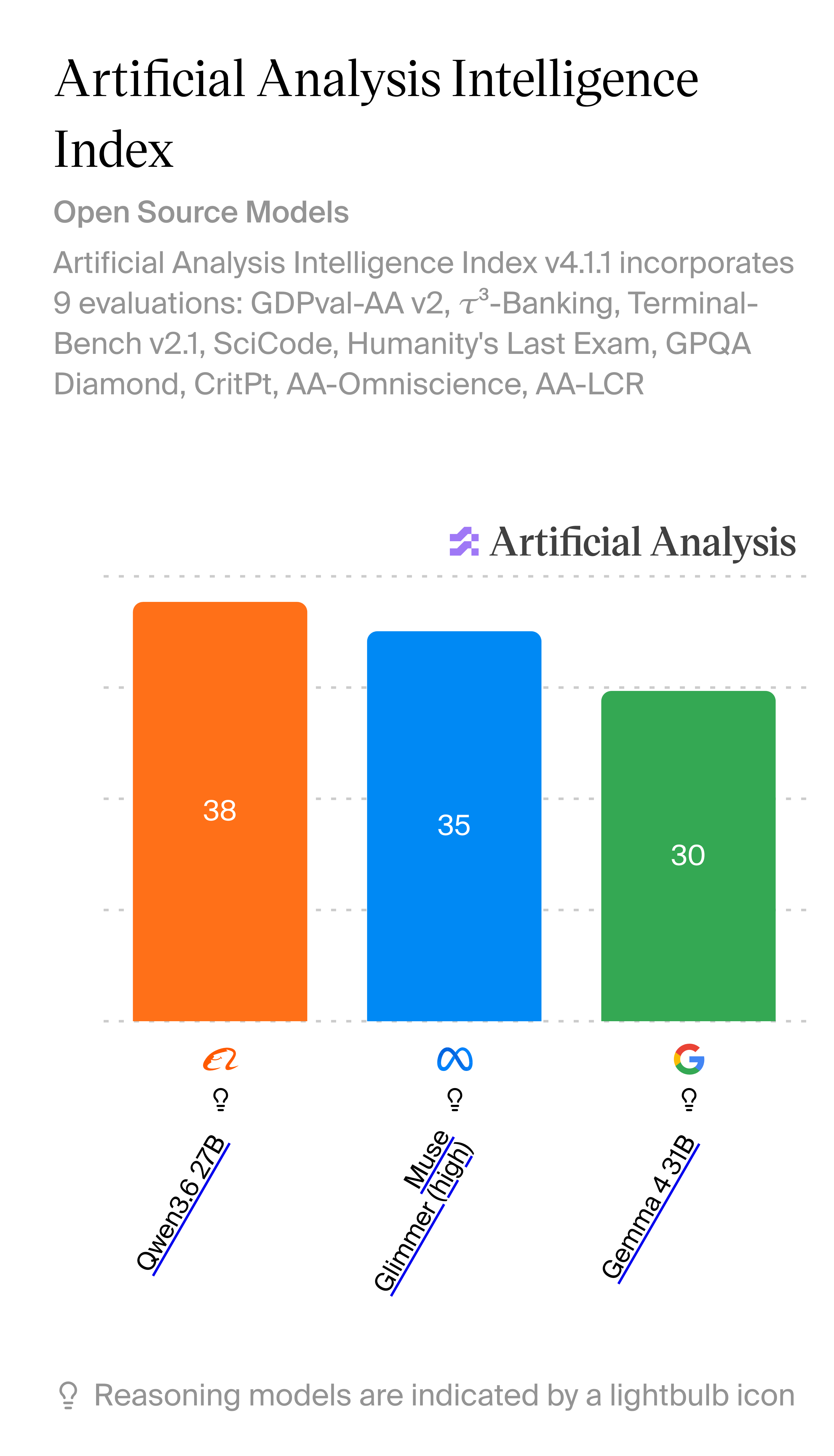
Glimmer obtient 92 % du score d'intelligence de Qwen3.6 (35/38), mais Qwen a généré environ 2,9× plus de tokens sur l'ensemble de l'Intelligence Index. Et sur les endpoints mesurés par Artificial Analysis, Glimmer génère environ 1,8× plus vite. Et le context de glimmer et bien plus efficace !
C est une belle avancer architecture tout de meme , je pense que si il sorte une version 1.1 (surtout pour améliorer terminal benchmark ) ont pourrai être très surpris !
A controlled local benchmark on an M1 Max comparing Muse Glimmer 30B with Qwen 3.6 35B and Qwen 3.8 27B on tool calling and data-science tasks; Glimmer passed 24/30 versus Qwen 3.8's 30/30.
Run and fine-tune Meta's Muse Glimmer locally!
Meta released Muse Glimmer, a 30B dense vision model designed for local agentic and coding workflows. The first open model from Meta Superintelligence Labs, released under Apache 2.0.
The model runs locally at different memory
Meta is back with Muse Glimmer: a 30B open-source multimodal model built for local, agentic use.
HF is shipping day-0 support and I built a few demos to see what it can do.
First: we gave Glimmer tools and asked it to quantize itself.
Today we're also opening the weights for Muse Glimmer, a great 30B parameter dense model that can run locally. Soon we'll also release the weights for Muse Spark 1.2, our latest foundation model. Meta is a strong supporter of open source and I'm proud of these releases. Congrats



























 ChatForm
 Tgmlabs