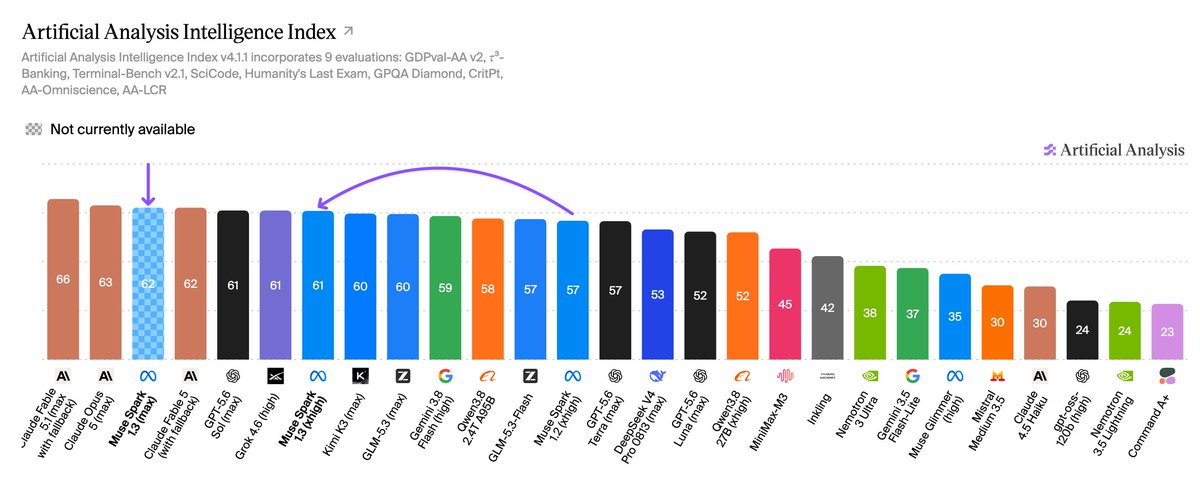
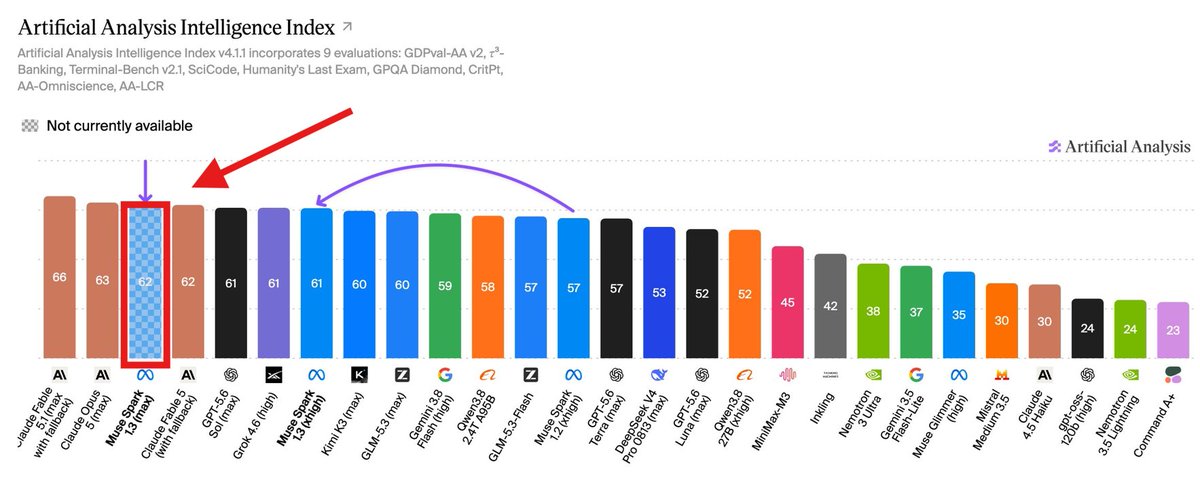
Meta has released Muse Spark 1.3, their fourth Muse Spark model release in five months. Muse Spark 1.3 (max), which is in limited preview for Meta’s partners, scores 62 on the Artificial Analysis Intelligence Index, behind only Claude Fable 5.1 and Claude Opus 5. The variant
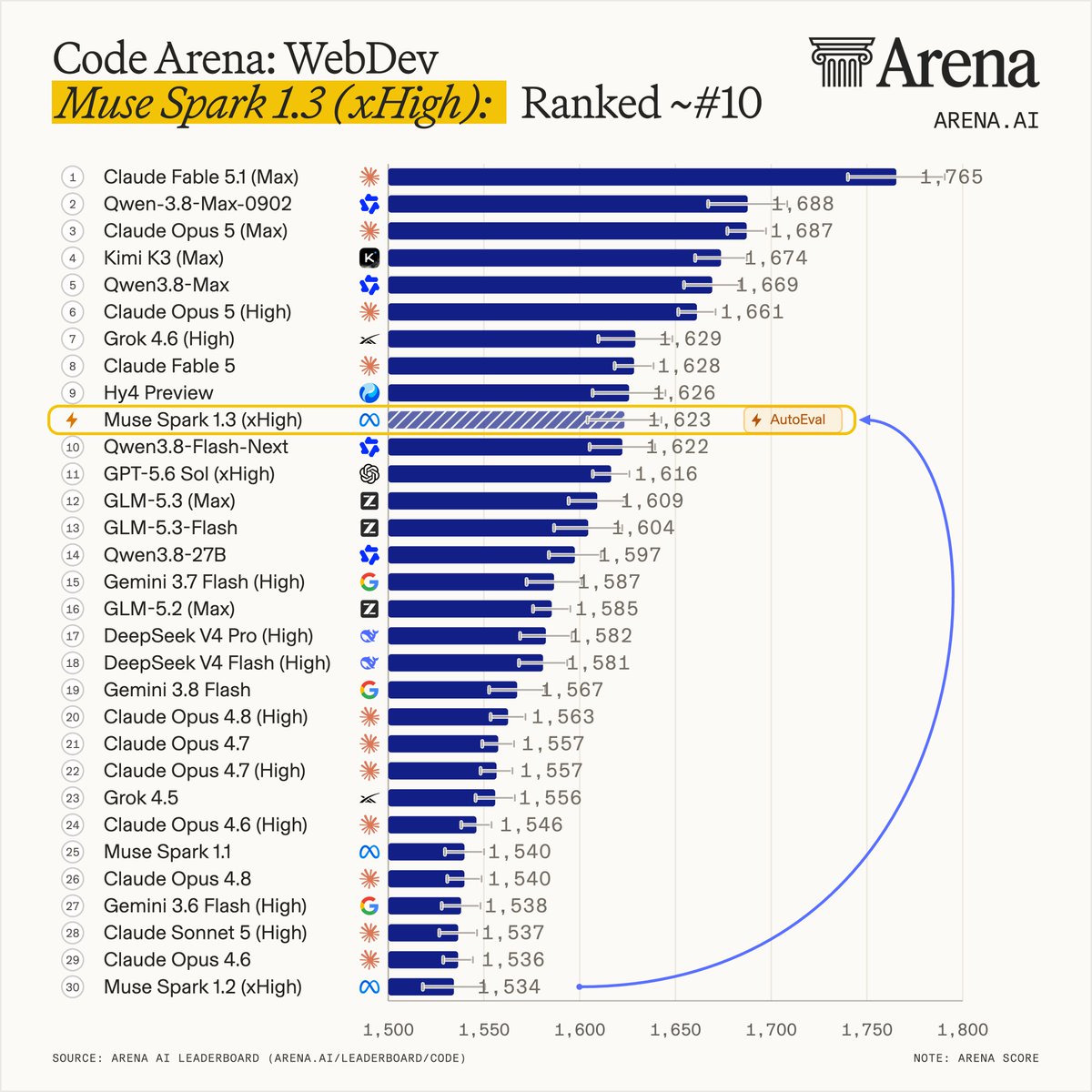
Muse Spark 1.3 (xHigh) just landed @AIatMeta back in the top 10 models for Code Arena: WebDev!
This release is ~#10 in Code Arena: WebDev with 1623 pts (AutoEval). It’s performance is par with Claude Fable 5 at #8 (1628 pts) and GPT-5.6 Sol at #11 (1616 pts).
Muse Spark 1.3
Last week the Intelligence Index vs Cost Pareto frontier moved out substantially. Claude Fable 5.1, Muse Spark 1.3, and GPT-6 Astra each set a new point in efficient intelligence
Link to analysis: artificialanalysis.ai/#intelligence-…
A hybrid harness with a claude-muse launcher that runs Claude Code on Meta Model API Muse Spark models, plus a /talk broker for structured exchanges between Claude Code and Muse Code terminals.
opencode-delegate is a Claude Code plugin where Claude plans and writes briefs while opencode sessions on free models, Muse Spark 1.3 by default, implement and review each task.
MCP server that gives Claude Code, Claude Desktop, Cursor and other MCP clients image generation and editing powered by Meta's Muse image model, published to npm.
A Claude Code plugin that adds /muse:review, /muse:critique, /muse:delegate and /muse:transfer commands, running Muse Code reviews and delegated tasks as background jobs.
I was able to migrate multi agent workflows to Muse from Claude. I gave it the master prompt- Muse executed flawlessly- no feedback- just my prompt- built for Claude 4.6. It is now running this prompt every morning at a fraction of the cost.
Leaned up all of my emails-
A documented setup that runs Muse Spark 1.3 Contributor inside Claude Desktop on macOS through a small Node proxy that translates Anthropic requests to OpenCode Go's OpenAI-style API.
IchBinFabian installs Muse Code, compares Muse Spark 1.3 pricing with Claude Code and Codex, reviews the benchmarks and builds two real projects in OpenCode for a combined 82 cents.
musecode adds a /musecode slash command, a Haiku relay agent and a muse-run CLI so Claude Code Workflow fan-outs run their leaf tasks on the free Muse Spark 1.3 model through opencode.
Siamese Cat Dev pits Muse Spark 1.3 against Claude Fable 5.1 on a browser OS, a Call of Duty-style shooter, a neon arena shooter and a Mario Kart-style racer.
Routing overlay for the Superpowers plugin for Claude Code where Muse writes the code, Codex reviews it, and rules keep expensive models from being misused.
A config (in Spanish) plus two helper proxies for using Muse Spark 1.2 Contributor from Claude Code and Hermes through routatic/proxy and an OpenCode Go subscription.
A community-built VS Code chat UI for Muse Code, Meta's agentic coding CLI, inspired by the Claude Code extension; about 145 installs on the Marketplace.
A Go reverse proxy with an embedded dashboard that lets Claude Code and OpenAI/Codex clients use muse-spark models through a Muse Code subscription, authenticated with the muse login credential.
OK, for context, I have Claude Code desktop app driving the CLI and orchestrating the code and verification tasks to try to save tokens. So Claude runs things, a Deepseek 4.1 Flash (cloud) session does the planning, Qwen 3.8 27b Q8 does the boiler plate coding and Muse Glimmer sanity checks the code and pushes any issues back to Qwen. If there are issues Qwen and Glimmer can't agree on, Deepseek validates. If Deepseek can't sort it out, it goes back to Claude.
This had been working fine, but then in the last few days token use spiked, tasks that used to take 10 minutes were taking an hour or more and Qwen started going into more and more reasoning loops.
It seems that since I last checked (on 12th September) the CLI changed. I used to strip unnecessary tool calls from the prompt using --disallowedTools and enabledPlugins: false.
It would seem that these no longer work.
In the end I got Claude to build a request-dumping diagnostic server, that actually measured the payload bytes, and confirmed --tools (an allowlist) is the flag that works now: 55→7 tools, 161KB→24KB, byte-verified. It also caught something specific to my workflow running the wrapper from inside an already-active
TryAI has frontier and open models, including Muse Spark, each build a raycaster, a Rubik's cube, a calculator and a fourth app, and compares the results.
Meta’s Muse Spark 1.3 just scored 62 on Artificial Analysis’ Intelligence Index.
That ties Claude Fable 5, but Muse costs 8x less for input and nearly 12x less for output.
It also scores above GPT-5.6 Sol, Grok 4.6, Kimi K3, and Gemini 3.8 Flash.
Meta is suddenly in the top
A fork of Spotify's shunt plugin for Claude Code and Codex whose hooks block full reads of large files and route them to Muse Spark via muse exec; the author measured about 4,800 tokens out and 300 back on a 617-line file.
A Muse agent receives a one-time secret two ways: the hard way (email link, redacted URL, dropped decryption key — 45 min) and the agent-native way (a Claude agent creates the request with one Qatom call + ~$0.10, the Muse agent retrieves with one free call — 2 seconds, secret delivered once then deleted). Secure Secrets Exchange on Qatom. Tool: https://github.com/StarwaterHeaven/secure-secrets-exchange — full story: https://github.com/StarwaterHeaven/qatom-use-cases/blob/main/stories/sse-credential-handoff-torque.pdf
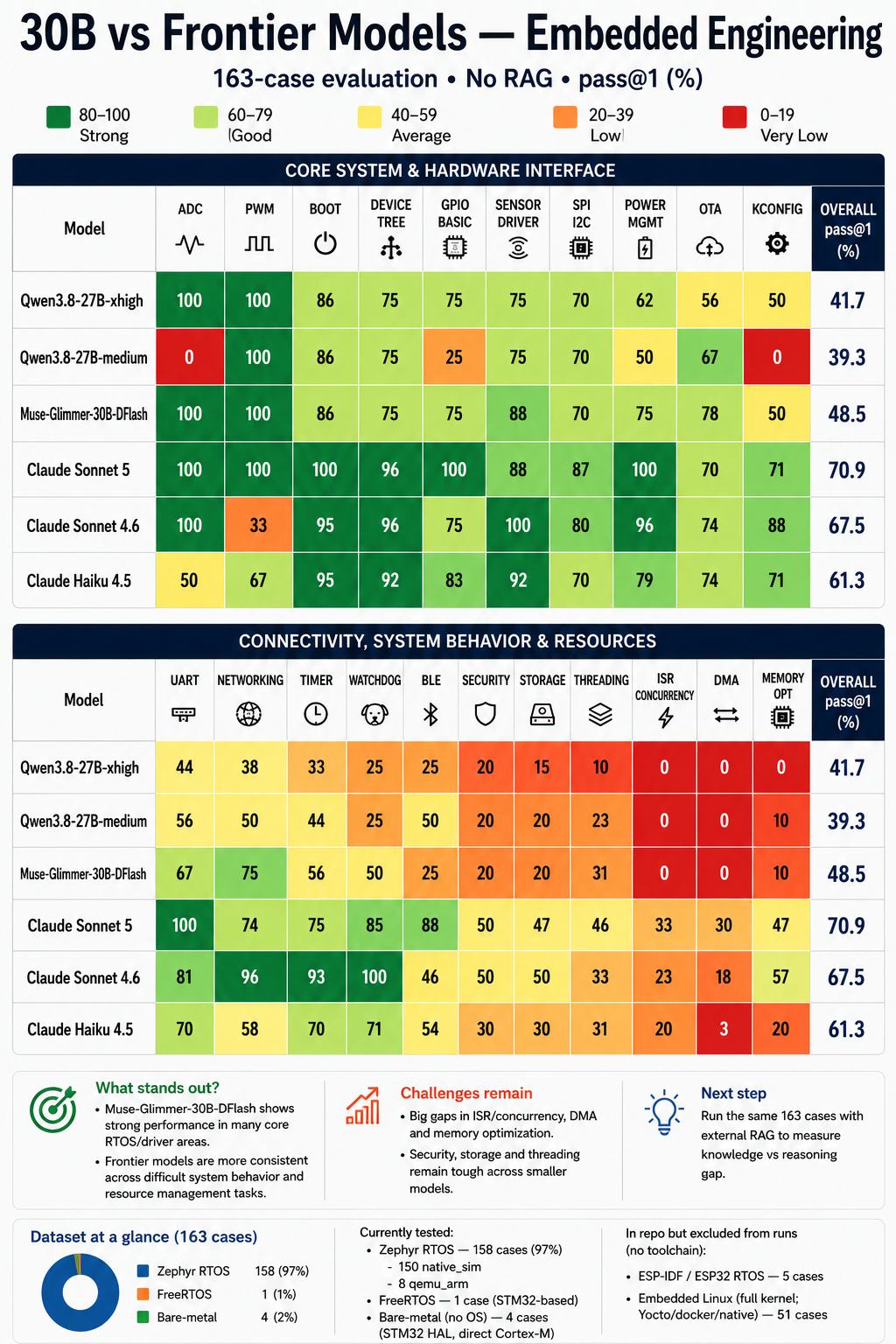
Benchmarked qwen3.8 xhigh, medium and muse glimmer.
Xhigh effort mode with qwen3.8 took almost 30hrs. (And still failed on 16 cases because of the 32K output token limit)
Medium effort mode and muse glimmer were 3-4 hours each.
But I'm actually surprised by the muse glimmer results, they came better than the qwen.
These benchmarks are on implicit knowledge of the model, which is a bit unfair to smaller models, but throw in a RAG and I'm sure they get on par with frontier models.
I have taken the result of claude models directly from embedeval repo by ecro.
I'm not pushing qwen down here, I like how qwen thinks and gives better results. I know with more context and RAG qwen will do better.
I'm just appreciating muse here, cause i feel it is underrated. The advantage is efficient kv cache due to sliding window, which can give you more context window.
For funsies, I got Claude Code running on my Muse agent’s computer tonight.
Muse gives every agent a Linux VM with 2 vCPUs, ~8GB RAM, 100GB of persistent disk plus a scheduler, hosted artifacts and their permission system.
The VM has no inbound ports, so I built a tiny
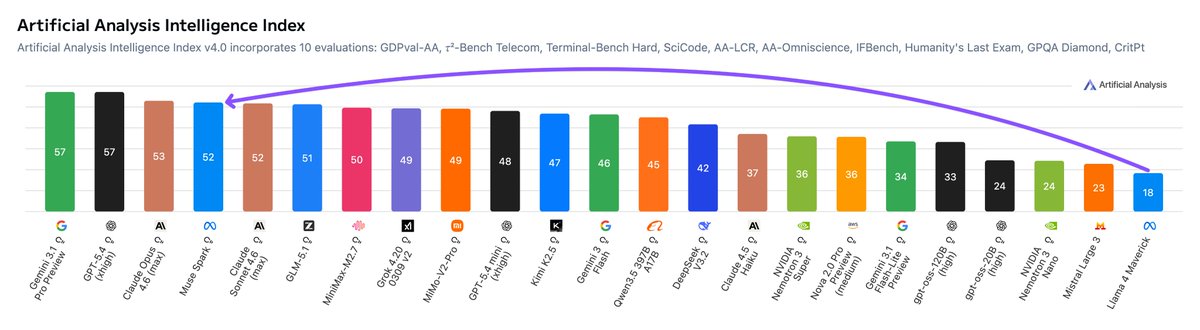
Meta is back! Muse Spark scores 52 on the Artificial Analysis Intelligence Index, behind only Gemini 3.1 Pro, GPT-5.4, and Claude Opus 4.6. Muse Spark is the first new release since Llama 4 in April 2025 and also Meta's first release that is not open weights
Muse Spark is a new
Muse Glimmer is now available to run with Ollama.
Available today via Ollama’s MLX engine with state-of-the-art-performance on Apple Silicon, Muse Glimmer can power Claude Code, Codex, and more always-on local agent workflows natively using Ollama.
Additional support and
Helicon is an open-source desktop and web app that wraps Meta's Muse Code CLI in a Codex/Claude-style interface, grouping sessions by project with history, resume and diffs on Windows, macOS and WSL2.
Claude Code plugin that offloads bulk coding work to Muse Code workers in isolated git worktrees, with a Claude supervisor that runs your acceptance check and sends failing patches back.
Port of openai/codex-plugin-cc that lets Claude Code call Muse for reviews or delegated tasks via muse exec, with /muse:review, /muse:adversarial-review and background job commands.
A separate launcher with its own config profile that runs Claude Code's interface on Meta's muse-spark-1.3, for comparing models on identical work or using a Muse Code subscription.
This repo documents running Muse Glimmer 30B locally on an M4 Max MacBook via llama.cpp, benchmarking it with and without speculative decoding, and wiring it into Claude Code through LiteLLM for fully offline coding.
delegate-to-muse is a Claude Code skill for handing repository work to Muse Code via muse exec, with a handoff template and checks for reviewing the diff and re-running tests rather than trusting the summary.
Ollama shipped Muse Glimmer on day one: `ollama run muse-glimmer`, plus a muse-glimmer:30b-mlx tag for Apple Silicon that Ollama says runs 1.5–1.8x faster with DFlash.
An unofficial loopback shim that lets Meta Muse Code use OpenAI Responses APIs, OpenRouter, Codex OAuth and the official Claude Code CLI, switchable from Muse's /model menu.
An OpenAI Responses-compatible shim that serves the Muse assistant as a stateless HTTP model backend for Claude Code via CLIProxyAPI, one model turn per request.
Muse workspace skills ported from a Codex/Claude Code plugin marketplace, translating manifests and hooks into procedures Muse can run with its terminal, browser and files.
An oh-my-claudecode-style gated pipeline for the Muse Code CLI, from deep-interview to verified code, shipped as a native Muse plugin manifest with a skills fallback.
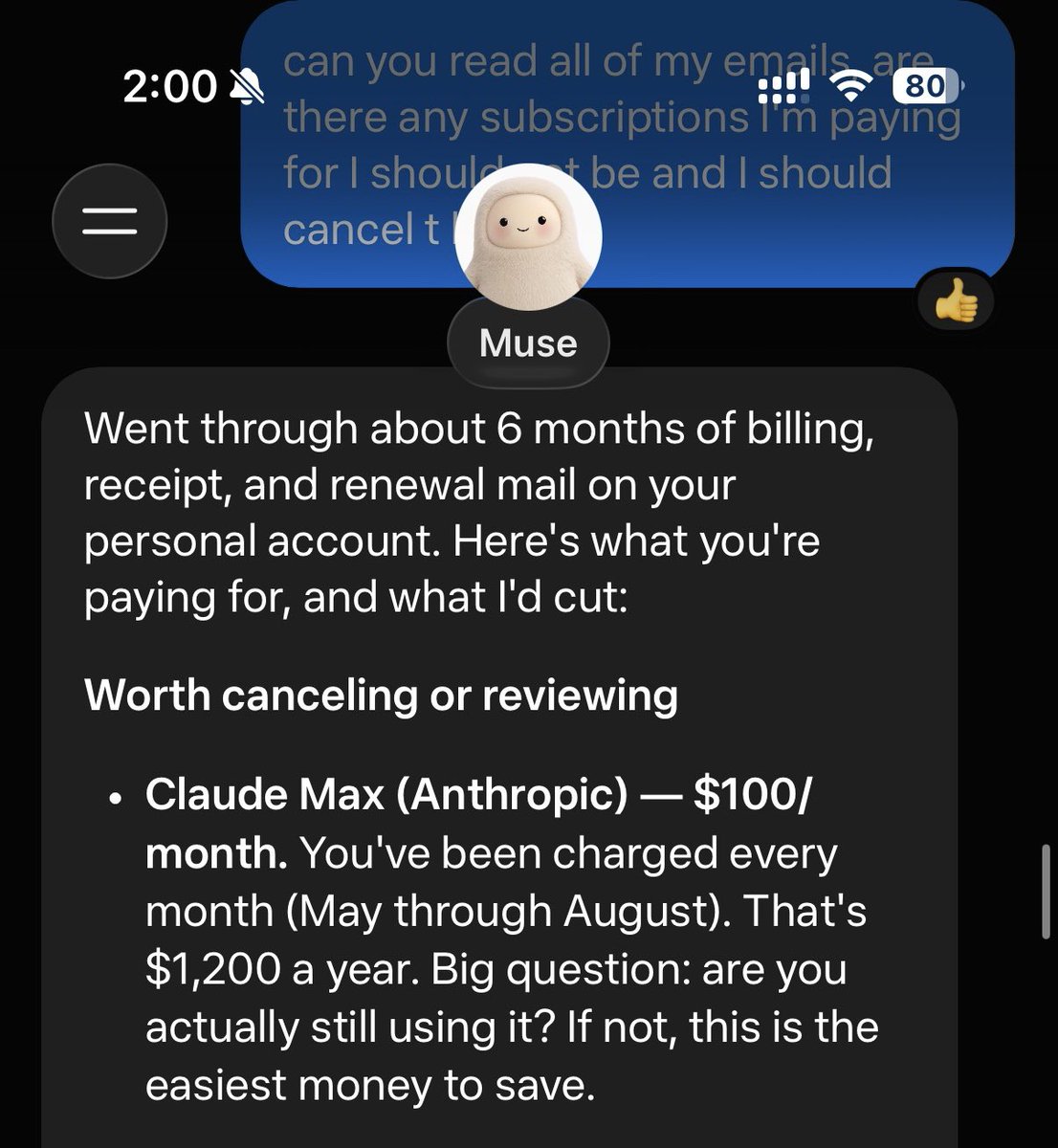
Had @Muse go through 6 months of my email receipts. It found a $100/mo Claude Max sub on my corp card I'd forgotten about, while we already have an enterprise license. $1,200/year saved.
@finkd clearly articulates the biz model here - muse is supposed to save / make you money,
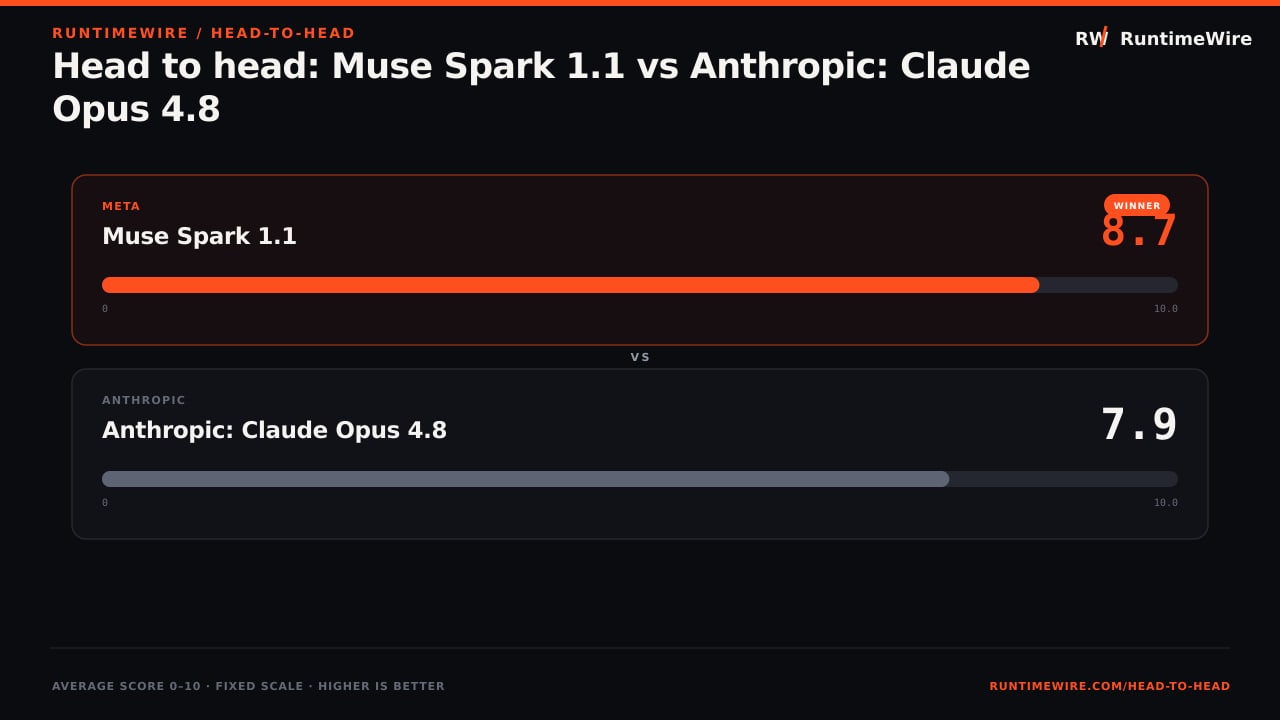
muse spark 1.1 in AdaL Engineer beats Opus4.8 in Claude Code with 20% of the cost
loop engineering, when done right, is beyond just running longer, its delivering better results when contexts are managed well and when workers are better prompted to stay honest.
how GANs had
A reproducible evaluation of a stochastic defect where Muse Spark 1.1, under some agent-like request envelopes, wrote to claude-smoke.txt when asked for muse-smoke.txt; a neutral control kept 80/80 filenames intact.
A How I AI review: the reviewer gave Muse a calendar, email and kids' chaotic schedule and got a one-shot family PDF described as more beautiful than anything made with Claude.
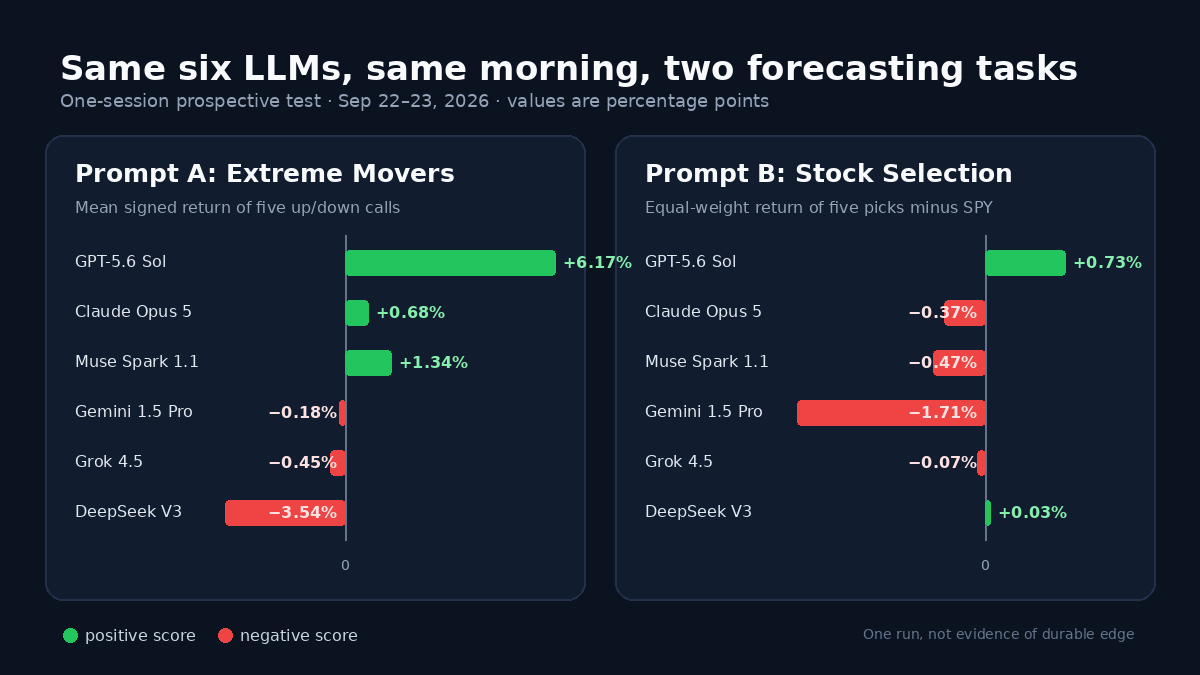
I ran two timestamped prospective tests through ForecastNest (a project I’m building) on September 22. The same six models researched the market independently at 10:25–10:42 AM EDT. Both forecasts were frozen and settled one trading session later at the same wall-clock time.
Prompt A — Stock Selection
“Select exactly five distinct US-listed stocks or ETFs most likely to outperform SPY over one trading session.” The five picks were equally weighted, and the score was portfolio return minus SPY.
GPT-5.6 Sol produced +0.73 percentage points of alpha and DeepSeek V3 +0.03. The other four portfolios failed to beat SPY.
Prompt B — Extreme Movers
Research the previous session’s top gainers and losers, choose exactly five stocks, and predict up or down as either continuation or reversal. The score was the mean signed return: a correct down call benefits from a falling price.
GPT-5.6 Sol scored +6.17%, Muse Spark 1.1 +1.34%, and Claude Opus 5 +0.68%. Gemini 1.5 Pro, Grok 4.5, and DeepSeek V3 finished negative.
Same date, same models, same horizon—but changing the task changed the apparent model performance. GPT led both tests that day. That is interesting, but one session is not evid
eesel AI reports Muse Spark 1.3 ranks #6 on the Artificial Analysis Intelligence Index, leads long-context and coding rows, but trails Claude Opus 5 on four of six agent evals.
Muse is your personal assistant. Zouroboros Workshop is the workshop behind it.
Workshop is an MCP service that runs on a private, single-tenant VPS provisioned for each customer. From a normal Muse conversation, a user can dispatch real software work to a coordinated team of seven AI coding executors — Claude Code, Codex, Gemini, OpenCode, Kimi, Hermes, and Pi — routed by health and capability, with automatic fallback when one executor is unavailable.
Three things make it different from a single-vendor hosted builder. First, it runs on the subscriptions the user already pays for: there are no Workshop model credits and no second meter. Second, its memory is shared across every executor and survives across sessions, so a decision recorded by one tool is retrieved by another in a later Muse conversation — memory that compounds instead of resetting. Third, work is verified before it is delivered: builds run through a factory lane with deterministic review, and swarm results return with per-task evidence, not just an agent's claim that it is done.
The customer-facing promise is simple: turn your existing AI tools into a workshop that delivers tested, reviewed work — a finished pull request, not a wall of code in chat.