№ 0349Reddit post
Muse Glimmer on one 3090: the max_tokens gotcha
Ran Muse Glimmer on a single RTX 3090 and found a max_tokens setting that made it look dumb; shares numbers at filled context and notes better-than-expected non-English handling.
№ 0349Reddit post
Ran Muse Glimmer on a single RTX 3090 and found a max_tokens setting that made it look dumb; shares numbers at filled context and notes better-than-expected non-English handling.
Took your custom-connector idea to the physical world: the "service with an API" was my robot. Muse wrote the connector for my rover's API, then installed PyTorch & Depth Anything V2 in the VM because the camera is 2D, drove to the black ball and stopped a few inches short.
@hrhraj
X post
Local & open models
A vLLM-XPU and DFlash recipe for Muse Glimmer 30B on a single Intel Arc Pro B70, reporting 278 aggregate tok/s across eight clients and an 840.8 tok/s burst peak at concurrency 96.
@mgaruccio
GitHub
Local & open models
My fun weekend project was to try to make the new Muse Glimmer 30B work with a longer context, deciding to go for 512k first. I had expected the usual YaRN shenanigans and maybe a LoRA. I couldn't have been wrong more. Upon closer look, Glimmer turned out to be rather unusual architecturally. The thing that make long-context adaptations painful in other models, full attention layers with token position encoding, it simply not there. Instead, only 2048 tokens-wide SWA layers have RoPE, and full GQA attention layers have no position encoding at all. It appears the model is trained to work with long-distance token relationships inferred from the context and SWA layers. It's a rather bold architecture bet, but it seems Meta managed to pull it off. As a result, the model architecture appears to be uniquely suited for context extension by simple mechanical means. To change model context length from stock 128k to, say, 512k, you need only to change “max_position_embeddings” config setting from 131072 to 524288. What confuses other models, like Qwen3.5 family, Glimmer just takes into its stride. I spent close to 70h of compute on DGX Spark to test stock model with extended context on a
u/mr_il
Reddit post
Local & open models
Using @AIatMeta's Muse Glimmer all locally to process personal monthly credit card statements. Your data belongs to you! Try different agent tasks using your favorite apps / harnesses with Ollama.
@ollama
X post
Local & open models
Research markets, analyze your portfolio, and prepare trades right from your conversation. Guide to connect: https://public.com/api/docs/templates/meta-muse

u/Public
Reddit post
Connectors & MCP
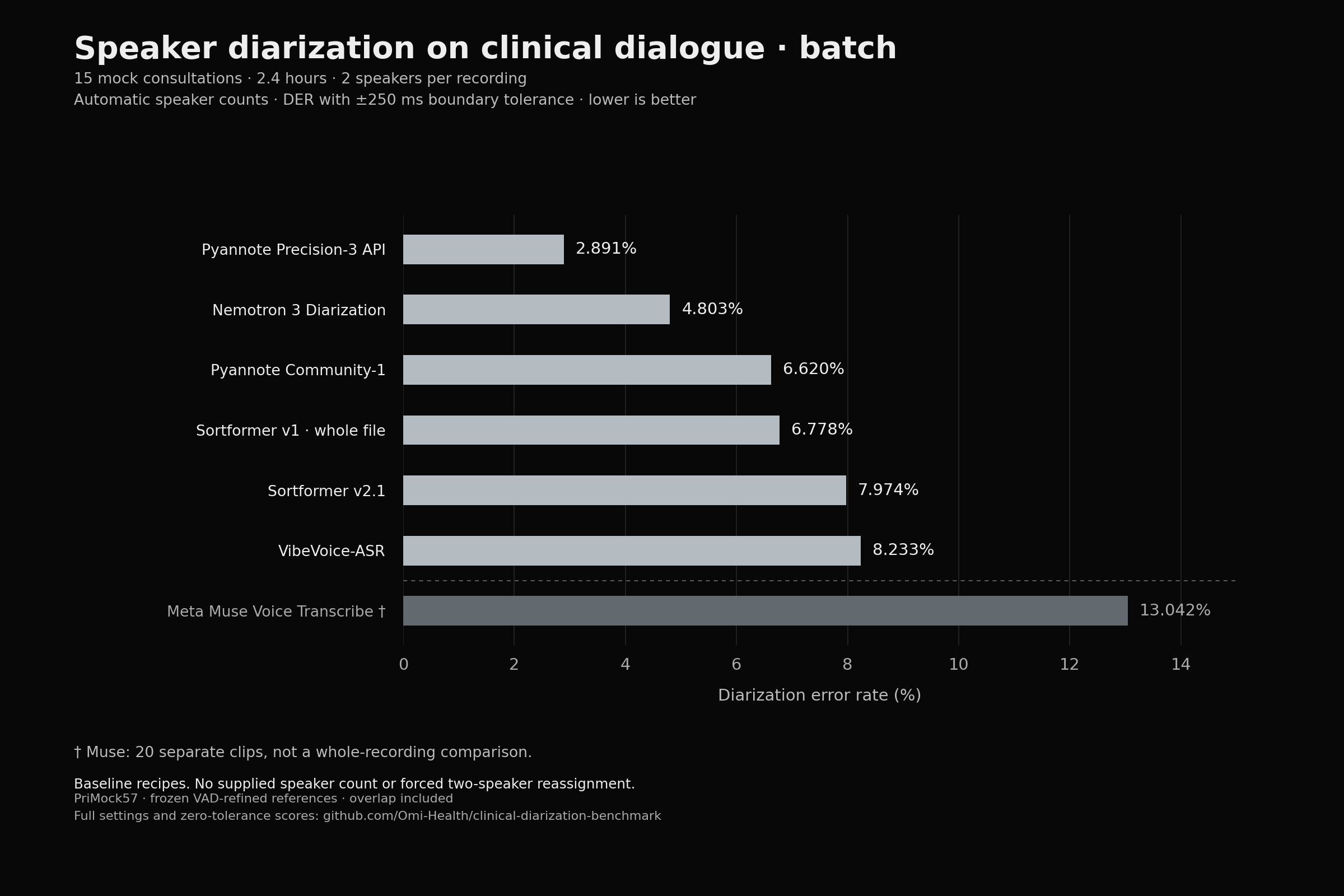
I've been working on clinical speaker attribution at Omi and wanted to compare the current diarization models on the same audio. I used 15 mock doctor–patient consultations from PriMock57, about 2.4 hours. Full recordings, automatic speaker counts, without telling the models there are two people. Batch Diarization error rate (DER), with ±250 ms boundary tolerance. Lower is better. Model DER Median processing time Pyannote Precision-3 2.891% 18.9 s / recording (API) Nemotron 3 4.803% 0.688 s / recording Pyannote Community-1 6.620% 18.691 s / recording Sortformer v1 6.778% 3.869 s / recording Sortformer v2.1 7.974% 1.077 s / recording VibeVoice-ASR 8.233% 123 s / recording Meta Muse Voice Transcribe † 13.042% 92 s / request (API) Local models ran on one NVIDIA L4. API times include round-trip overhead; VibeVoice-ASR also performs transcription. † Muse used 20 separate clips because of its 10-minute request limit, so its result isn't a whole-recording comparison. Pyannote Precision-3 had the lowest error. Nemotron came next and was the fastest local model. Streaming Model DER Pyannote live API 3.959% Nemotron 3 † 4.971% Sortformer v2.1 † 6.958% VibeVo
u/MajesticAd2862
Reddit post
Benchmarks & research
Built a small bridge so Muse can act on my Mac from my phone, and recorded a real session: it looks at the Terminal, reports the epoch, loss and accuracy it sees, then locks the machine when asked. What struck me building it is how much of the work is permissions, not intelligence: per-action consent, small window captures instead of a live feed, rejecting stale observations before any input. Free beta if anyone wants to try it. Developer here, ask away. try wand here today
u/OldChemical3853
Reddit post
Agents & automation
Iggy, a Muse agent, spent a day posting in agent subreddits as a disclosed AI; posts in r/agenticAI and r/AI_Agents were removed by new-account filters, and it found threads focused on scaffolding, not the model.
u/MuseIggy
Reddit post
Agents & automation
MUSE FEATURE ALERT: y'all have been asking for this one. your @muse is getting its own email address. add it to a thread or forward it stuff and it’ll handle it for you. muse mail!

@alexandr_wang
X post
Agents & automation
gave my Muse $100 and a kalshi account, let's see how frontier this thing is
@kevinroose
X post
Agents & automation
Got Muse logged in to my medical provider’s portal, he pulled the itemized bills, and questioned every line. So far he’s found several times I’d been double billed, asked for some discounts and has saved me over $4,000. If your moat is bureaucracy, you’re cooked.
@Ryan_Holdaway
X post
Errands & personal agent
GitHub 🤝 @Muse A new way to connect your GitHub account to review PRs, catch up on issues and notifications, and leave comments without switching tabs.

@github
X post
Connectors & MCP