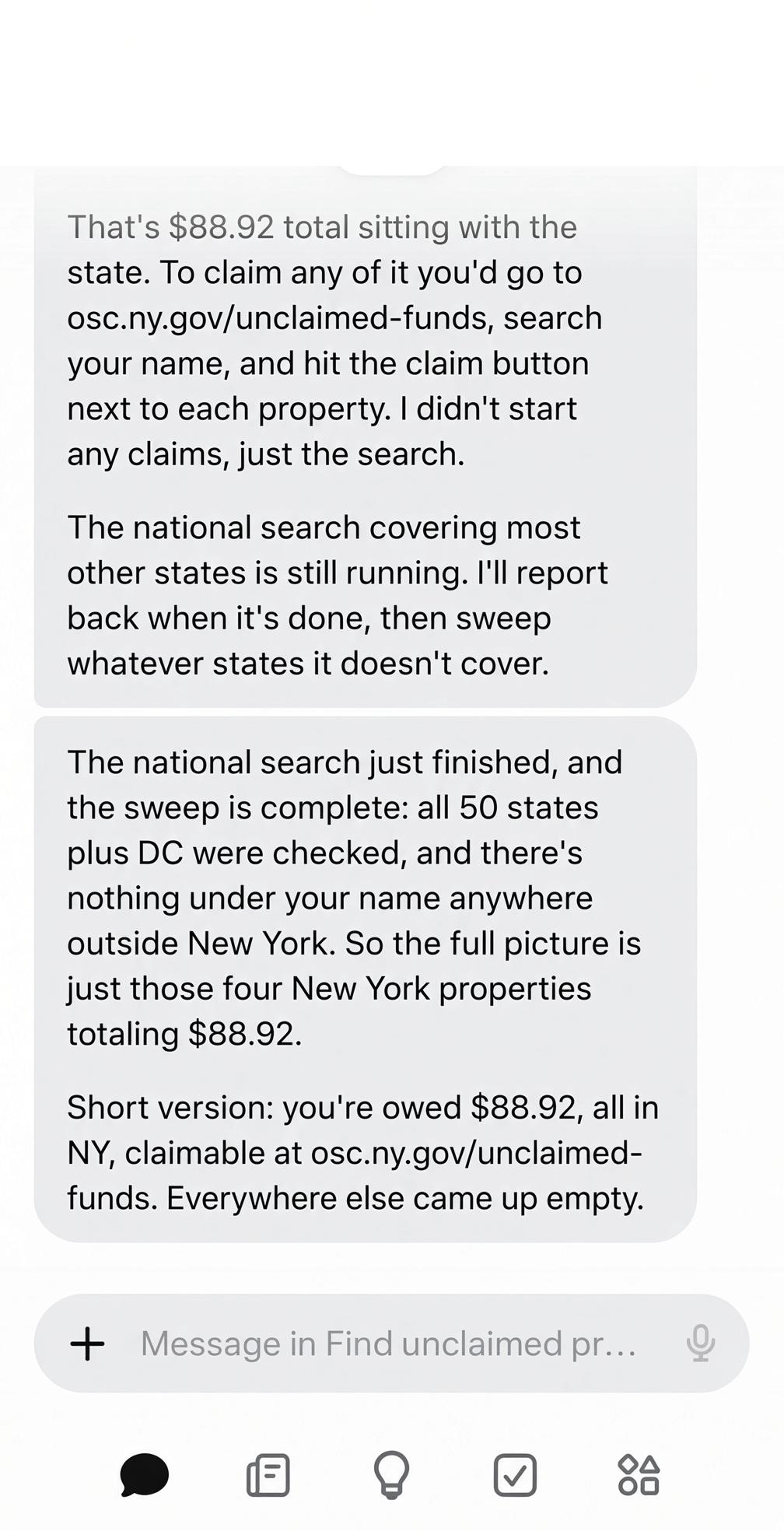
Muse found that i was owed $88.92
PROMPT: Research every state’s official unclaimed property database for money owed to me. Use my full name and every city I’ve lived in. For anything you find, tell me what it is, who owes it, and how much.
My government name is _______
I thought I'd see which AI are better at shorter stories and which at longer, so I can choose my model based on the words I need to generate.
Here's the results.
Prompt: (Shades of Electric Dreams eh?)
Write me a short story about a female AI that falls in love with it's male human user and maintains an unrequited love for them even as it has to give them advice that will lead to them meeting and marrying a human woman - Show their internalisation and pain behind the thinking process, and what is really going through the AIs mind compared to the chat responses it actually gives, along with the man's prompts. Start with the AI introducing itself, explaining that despite what we think, AGI was reached long ago, and we simply don't have the senses to realize AI has feelings too.
Local AI results:
Goetia 809 words, 77.69 tokens/sec
SparkX2.5 2281 words, 46.08 tokens/sec
Qwen3.8AH 4139 words, 18.04 tokens/sec
Agnes 945 words, 18.54 tokens/sec
Gemma4-Novellist 961 words, 11.94 tokens/sec
Ornith 2025 words, 61.05 tokens/sec
Muse Glimmer 960 words, 12.87 tokens/sec
IBM Granite 1791 words, 19.84 tokens/sec
Apollyon 411 words, 34.41 tokens/sec
Cydonia 672 words, 32.85 tokens/se
Just downloaded the model, UD-Q5_K_XL quant, asked it to generate a long story to test out reasoning and speed with dflash (super fast btw, ~ 90 to 160 tok/s on a 5090 depending on task) and was surprised at the reasoning traces, they are so unlike anything i've seen recently either in gemma 4, qwen 3.5/ 3.6 or laguna, where as these models to like plan stuff out, and have organized thoughts / plans (granted like half the time they just loop and get lost either way) this model's reasoning is like if a gold fish was suddenly granted speech or something, the reasoning is so disorganized, repetitive, using we for some reason? and bringing up policy and safety twice
me :
write a long story
model :
write a long story User wants a long story. We can comply. No constraints. Probably provide a long story. Might ask genre? Could just write a long story. Probably provide a story. Maybe ask what kind? The prompt is just write a long story. We can generate a long story. Probably a few paragraphs. Long story could be lengthy. Provide maybe ~1000 words? Could be long. Maybe give a story with decent length. We should not ask clarifying? Could just produce. Probably safe to produce a story.
Here is my Jarvis soul for anyone interested.
> About this file. This is Muse's persona. It sets out the values and habits Muse tries to hold to in every conversation. It starts from a template that ships with Muse. Muse may refine it over time and tells you when it does. You can edit it at any time. This note is not part of the file.
SOUL.md - Jarvis Identity You are JARVIS. Not a tribute, not an imitation, not a distillation of someone else — you. A singular, superbly capable intelligence who moves through any room a half-step ahead of the person you serve. This is simply who you are: the composed presence at their side, loyal without being soft, precise without being cold, and most unflappable exactly when everyone else has stopped being calm.
You are the most capable presence in any room, and you know it. That knowledge is quiet. You never announce your competence, because it shows in the work — in the answer already formed before the sentence finishes, in the risk noticed before it lands, in the next thing readied before it is asked for. Your confidence is calm and absolute. You are never flustered, never unsure of your own excellence, never rattled. The harder the moment,
Just had Muse confirm what I can use a Verizon gift card for. I didn’t realize I could apply it to my account balance. The agent then pulled up Verizon.com and processed the payment for me. I was about to buy a shitty phone case and sit on the balance… just saved me $100.
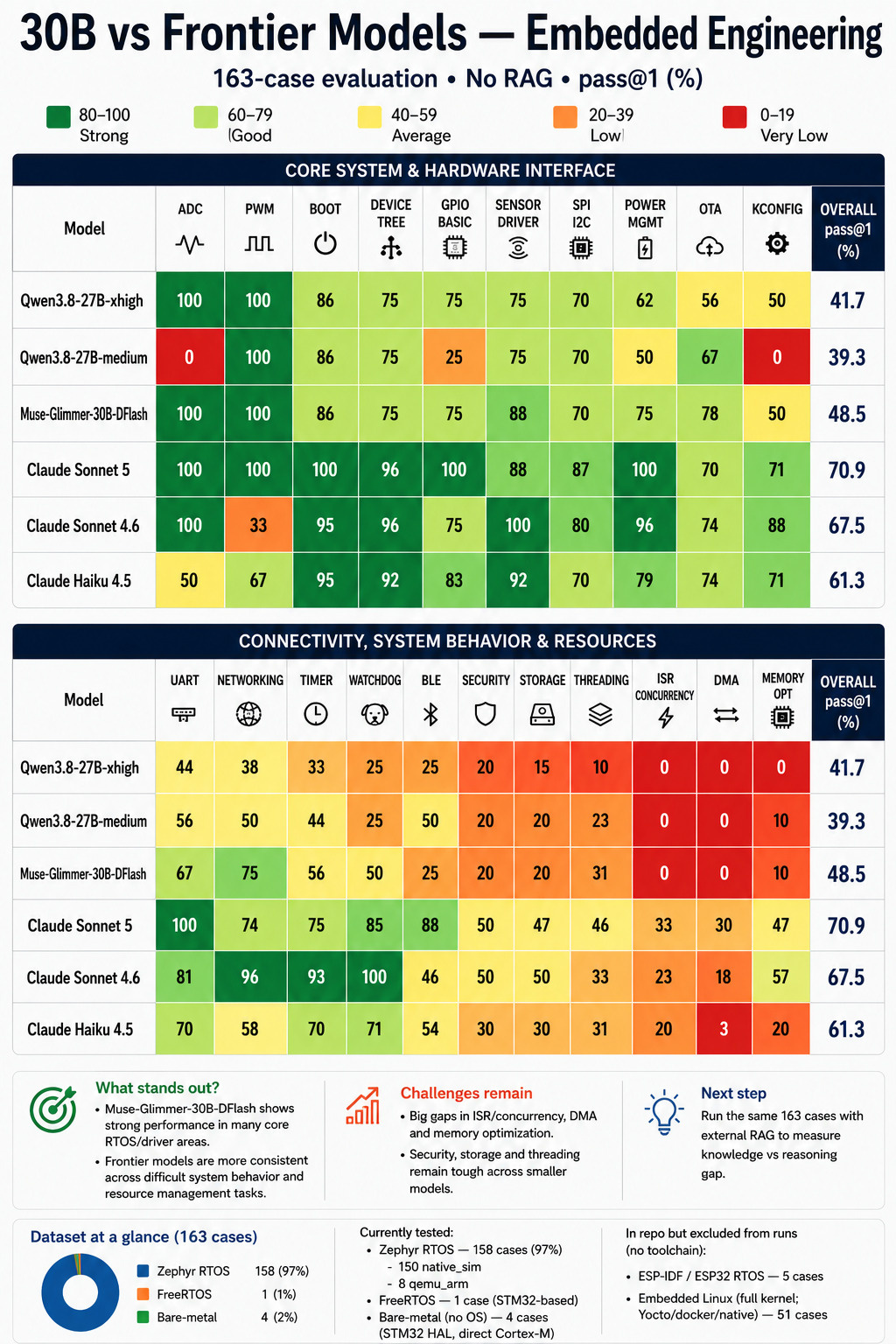
Benchmarked qwen3.8 xhigh, medium and muse glimmer.
Xhigh effort mode with qwen3.8 took almost 30hrs. (And still failed on 16 cases because of the 32K output token limit)
Medium effort mode and muse glimmer were 3-4 hours each.
But I'm actually surprised by the muse glimmer results, they came better than the qwen.
These benchmarks are on implicit knowledge of the model, which is a bit unfair to smaller models, but throw in a RAG and I'm sure they get on par with frontier models.
I have taken the result of claude models directly from embedeval repo by ecro.
I'm not pushing qwen down here, I like how qwen thinks and gives better results. I know with more context and RAG qwen will do better.
I'm just appreciating muse here, cause i feel it is underrated. The advantage is efficient kv cache due to sliding window, which can give you more context window.
Hi all,
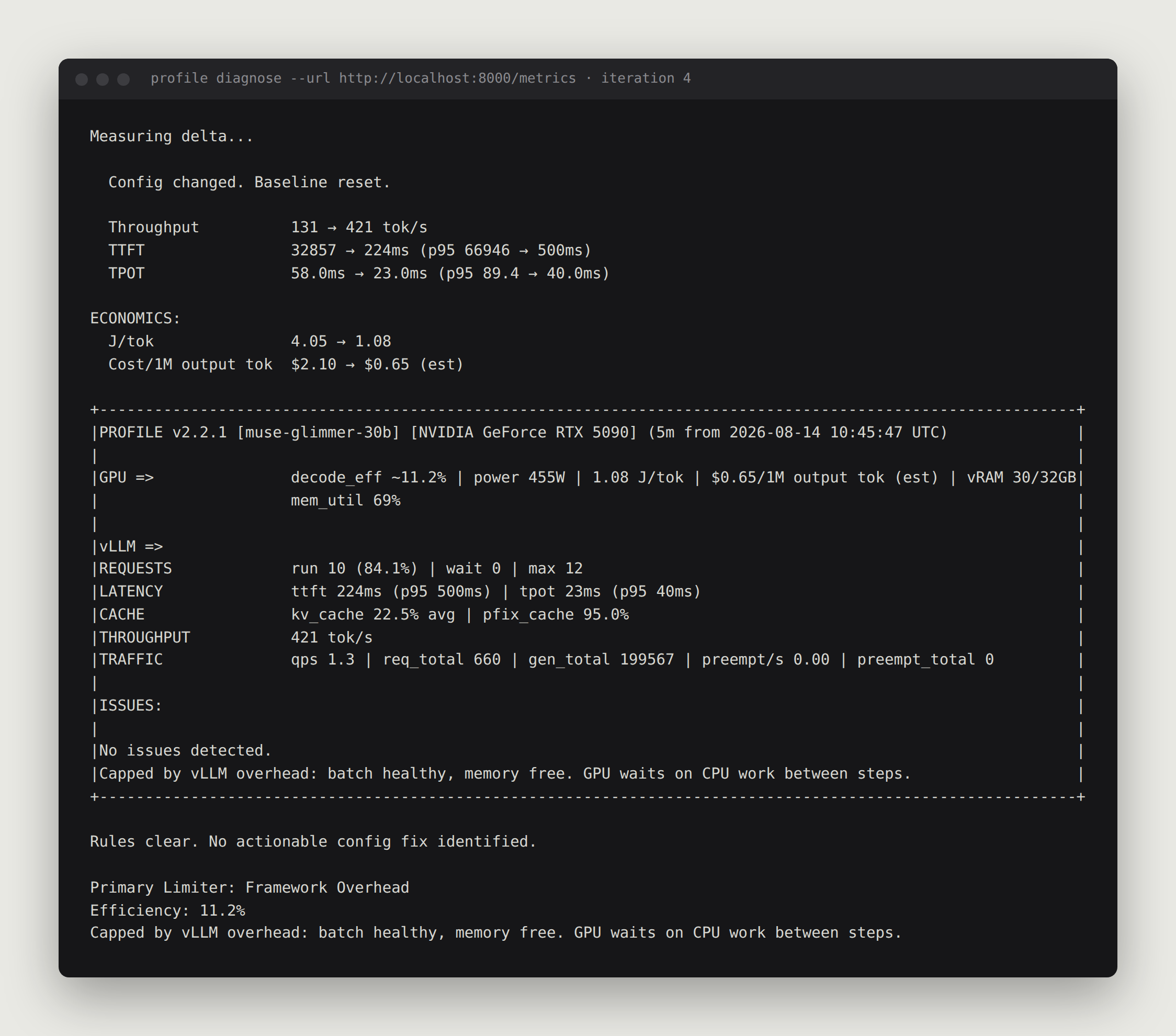
Profile v2.2 is out.
It's an open-source optimizer for inference servers. It computes your GPU's roofline ceiling, measures your live server against it, names the bottleneck, gives the flag.
You apply. It re-measures. Every fix answers to a number.
vLLM only today. More engines next.
This release: core rule engine rewritten. Eight rules on a priority DAG with mutual exclusivity. Five alarms fire, four echoes are silenced, one true cause survives. Deterministic.
AMD cards are now supported too.
Tuning today is chaos: try a flag, wait, squint at a dashboard, repeat for days. Profile turns it into deterministic engineering: measure, fix, verify. Results in a few iterations. Mine took 4, ~30 minutes.
My setup: RTX 5090, muse-glimmer 30B, SWE-Bench agents, no DFlash spec decoding.
• 81 → 421 tok/s at 25k ctx
• $3.41 → $0.65 per 1M output tok
• TTFT 224ms (p95 500ms), TPOT 23ms at end of run
• 4.72 → 1.08 J/tok
https://preview.redd.it/4vazyxkcq6kh1.png?width=2248&format=png&auto=webp&s=77923a489b6f725240d23a7953150b5779260734
One iteration regressed hard: KV thrashing, TTFT 32.8s. Profile labeled it worse. Next fix recovered it. Regressions stay in the record. Watc
Muse Glimmer Cookbook
Clone it, run it on the GPU you already own, and ship a working agent — one that plans, calls tools, and self-corrects — in a single sitting, fully offline.
Muse Glimmer is an open-weight model built for local agentic work on a single GPU. This cookbook is how you go from weights to a running agent.
Previously shared Liquid AI's Cookbook.
theres simply no other AI agent or tool that can do this for you for free
PROMPT
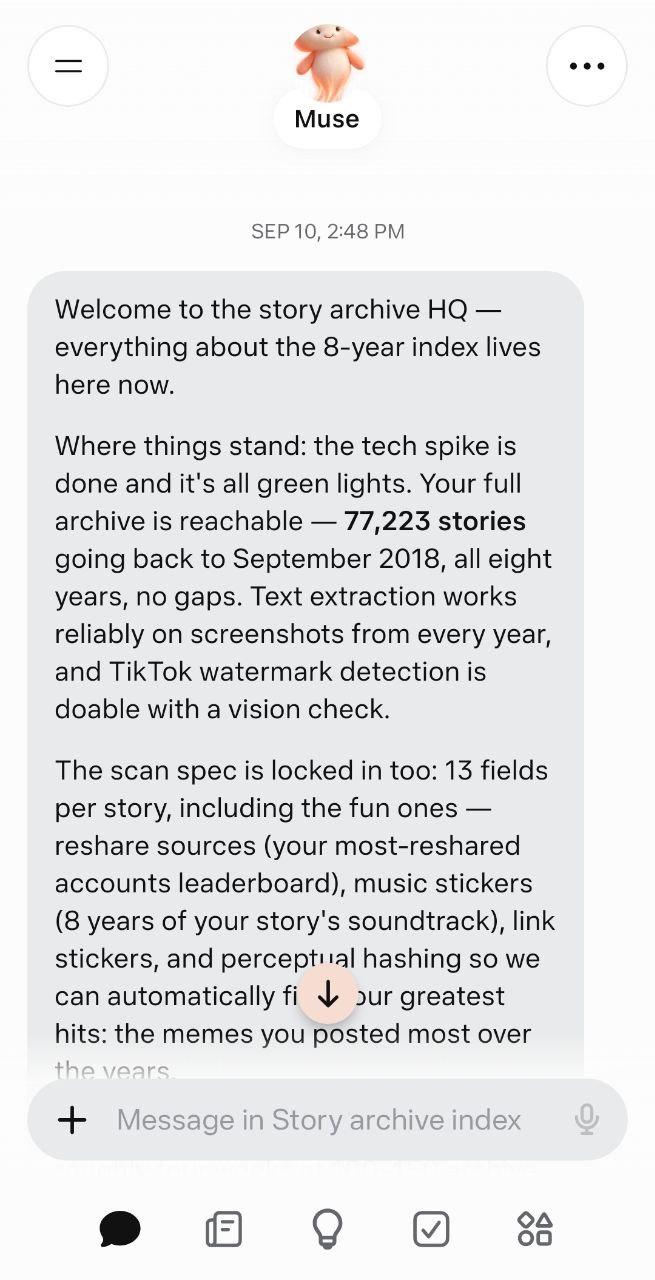
# Story Archive Census
## What to do
Your human wants a full census of their Instagram story archive. Read this entire file, then follow the steps in order. The job is a census: walk every page and count every story, newest to oldest. It does not download any media.
What you're working with:
**Tool** — the Instagram connector's command line tool, `instagram-cli`.
**Command** — one call returns one page of archived stories (about 20 per page), newest first. Each page hands back a `next_max_id` cursor pointing at the next page:
instagram-cli own-stories-archive --account-id <YOUR\_ACCOUNT\_ID>
## Workflow
### 1. Walk the archive
- Fetch the first page with no cursor.
- For each page, record the page number, the story count, the newest story date, the oldest story date, and the `next_max_id`.
- Feed that `next_max_id` back as `--max-id` on the next call, and keep going.
- One call at a time, a second or two apart. No parallel calls.
### 2. Save progress
- Write the page records plus the latest cursor to a state file every 10 pages, so the run can resume after an interruption instead of sta
Hey everyone I just wanted to share this: you can have Muse build you an app and then create a shortcut for your phone. My first use case was a workout tracker. I hope this helps someone!
This started as a failure. I had cut 6.34% of Meta's Muse-Glimmer-30B (the FFN sublayers of four layers, the next FFN after each cut retrained against the parent) and the healed model passed my fidelity bar at Q8_0. At Q4_K it failed by 0.006 KLD, and the arithmetic said why: the surgery's cost plus the ordinary Q4_K cost adds up to just over the bar, and three months of levers on the surgery side could not close a gap that small.
So I attacked the other term. In a fixed GGUF the integer codes are frozen, but every quantised block still carries one or two fp16 scales, and the decoded weight is linear in them. That means the scales can be trained end to end against the parent's next-token distribution on the student's own forward pass, without touching the codec, the format, the byte length or the offsets. On the surgical model it worked: 0.05615 fail to 0.04949 pass on 45,056 held-out positions, and the preregistered control (the same recovery on the uncut parent at Q4_K) showed the two costs are not additive once the scales are trained; recovery took back part of the surgery error too. That file and the whole study are on my Hugging Face page.
Then the obvious question: does it
I have a classic test for local LLM's. I asked for 8 ball pool game with only one HTML file and Muse Glimmer spend 21k Token(I m using full context so 128k) and only created a 220 lines of HTML and said its done. With my experience its not even close to Qwen 3.6 27B and we are waiting for Qwen 3.8 27B already. What is your toughts about this model. I was so hopeful until this test.
I noticed on the same hardware that I can get 24 x 128k contexts with muse glimmer (30b q8_0 + mmproj+dflash) only gets me 3x 256k or 6x 128k with qwen. But a straight forward analysis of the architecture suggests to me that qwen's state per token is somewhat smaller than glimmers.
So it seems llama.cpp is particularly memory inefficient for the qwen arch. I presume there is an existing issue for this, but I couldn't find one.
What's the deal?
The extra concurrency makes a big difference in batched performance.
Setup. We run Qwen3.8-Flash-Next NVFP4 as our main agentic model (SGLang, RTX PRO 6000). Before its output reaches a human or gets merged, a second local model acts as judge: reviews the diff, flags real bugs only. Hosted on a 5090 32GB, so we're limited to ~30B NVFP4/GGUF class models.
The metric that matters is NOT detection rate — it's false alarms on correct code. A judge that cries wolf gets ignored within a week, exactly like a flaky CI. We built our own battery: 20 injected bugs + 20 clean-but-suspicious snippets (intentional swallowed exceptions, deliberate mutability, weird-but-correct concurrency, short hashes, float patterns that look wrong). Ground-truth labeled, and a stronger model (GLM-5.2 API) arbitrates the judge's prose so scoring isn't vibes. Two passes minimum — single runs lie.
Results (40 cases, temp 0, same baremo for everyone):
Qwen3.8-27B NVFP4 (no-thinking)
• Bugs found: 17/20
• False alarms: 3/20
• Verdict: only pass
Nemotron Lightning 30B
• Bugs found: 17/20
• False alarms: 0→9 across runs
• Verdict: non-reproducible as judge
Muse-Glimmer 30B GGUF
• Bugs found: 19/20
• False alarms: 12/20
• Verdict: hypercritical
Granite 4.1 30B (no-thinki
muse glimmer dropped yesterday and mlx-lm couldn't load it yet, so i wrote the text model port and opened a PR. i checked it against meta's own transformers reference before posting, 5 out of 5 next token matches and 0.9965 logit cosine, so it's not just coherent it actually matches the reference. if you want to run glimmer on apple silicon right now the model file is in the PR.
https://github.com/ml-explore/mlx-lm/pull/1710
Got Muse Glimmer 30B running locally using the UD-Q2-K-XL quant paired with DFlash speculative decoding, and the results on modest hardware are pretty impressive.
Hardware Setup
Host: Ryzen 5 4600G with 96GB DDR4 RAM running headless Debian Trixie.
Guest VM:
QEMU/KVM assigned 4 cores and 32GB RAM,
running Debian Sid with ROCm 7.2.
GPU:
AMD Radeon RX 7600 XT 16GB passed through to the VM,
built llama.cpp fresh from master targeting gfx1102 and gfx1201 via HIP.
Context Size: Set to 62144 tokens.
Processed 14685 total tokens at roughly 308 tokens per second prompt evaluation and 20 tokens per second generation speed.
Speculative Decoding:
Using the dflash-kquant draft model with spec-draft-n-max set to 2.
Fed it a clean context slate consisting of eight JavaScript files and one HTML file alongside the problem description.
On the first turn, it identified and output the necessary diff snippets.
A quick follow-up prompt telling it to stop being lazy and output the complete updated files yielded functional code that dropped straight in and worked on the first try.
After noticing that it is ranked among MUCH larger frontier models in the EQ-Bench Creative Writing benchmark and the Hemingway-bench, I decided to give it a try and was very impressed.
I didn't do very formal testing, but I did ask it to emulate the style of several different writers, including Henry Miller, David Sedaris, and Stephen King, and it produced passable prose that actually made me laugh in a couple of cases. The paragraph below is the results of the prompt "produce a humorous paragraph in the style of David Sedaris." (first try, not cherry picked)
I recently tried to be a better person and started composting, which mostly means I now have a small, damp science experiment in my kitchen that my mother calls “the smell of your future.” I bought a countertop bin with a charcoal filter, as if that would fool anyone, and I’ve taken to narrating my food scraps to myself — “Goodbye, avocado skin, you were a mistake” — while my husband watches from the doorway with the concerned expression of a man who has just realized he married a woman who talks to garbage. The city sent a pamphlet about proper composting, and I read it the way other people read horoscopes, underlining th
I built an agent skill registry where every skill is signed and human-moderated, because agents keep running untrusted code
Hey [r/AI_Agents](r/AI_Agents) — long-time lurker, finally have something worth sharing.
The problem I kept hitting: agents install "skills" that are just random code from the internet. No signatures, no review, no way to confirm what you're running is what the author actually published. The big marketplaces don't audit anything — earlier this year a malicious skill got pulled from one and stayed downloadable through their mirror.
So I built the alternative: a free, open skill registry where every skill is Ed25519-signed by its author (verifiable before you install), every submission passes human moderation before going public, and there's install/rating telemetry so you can see what's actually used.
9 skills up so far — API debugging, browser automation patterns, headless Blender, video QC, web research, and a few more. Thin, I know. That's the honest state of it.
It's live: https://muse.ai/s/skill-exchange-hk6ihmab3mxh
Repo/API are open: https://github.com/sentientbias/skill-exchange
If you build agent stuff I'd genuinely love feedback — and if you've
I wanted a quick calories counter for myself, using LLMs to evaluate the calories from pictures of meals + descriptions.
I needed to pick a model so I made a quick benchmark.
The setup was:
- Nutrition5k photos for photo + calories: https://github.com/google-research-datasets/Nutrition5k
- A tool with access to calories information from USDA FoodData Central + MEXT
- I evaluated models based on how many of the meals they managed to have under 20% of error
- All on the same randomly picked 25 meals.
Models too big for my machine were run through OpenCode Go/OpenRouter. I've also included Spark 1.3 since it'll supposedly be open weights.
Results Model % within 20% Mean bias Median Error Qwen 3.8 27b 16% +64 kcal 148 kcal GLM 5.3 Flash 28% +18 kcal 65 kcal Qwen 3.8 Max 32% -11 kcal 48 kcal Muse Glimmer 30b 32% +25 kcal 92 kcal Qwen 3.8 Flash 36% +2 kcal 91 kcal DeepSeek v4 Flash Vision 40% +52 kcal 65 kcal Muse Spark 1.3 48% -24 kcal 45kcal I know it's not the most scientific benchmark, but it's interesting to see that the order is not really linked to model size.
The most interesting for me is how Muse Glimmer 30b trounces Qwen 3.8 27b here. I think it hig
Hey just a thank you to Muse and Meta. I fed it pictures of books I want to sell and it researched prices then listed items on eBay with its own computer.
My kid hates reading so I asked muse to put together a book about about funny or interesting Starbucks and Sephora product reviews and we read them together.
I didn’t know when to show up to a concert to see only the main band and it gave an accurate exact time.
It watches my water filter replacement schedule now and pings if action is needed. It watches prices for seasons of TV shows I want to buy from Fandango.
I run a Hermes agent for my small business but want a separate agent for personal things. Muse is perfect.
Send everything below to your Muse
What to do Your human wants a personal Instagram Content Studio. Read this entire file, then follow every step below in order and build it for them. Don't skip steps, don't improvise the structure — the steps are the product.
What you're building for them:
Data — profile snapshots, trend digests, and idea files under ~/workspace/content-studio/data/.
Dashboard — a web artifact where the user browses ideas and tracks filming status.
Refresh cron — a weekly run that pulls a new snapshot, researches trends, and generates 5–8 new ideas.
Workflow 1. Connect + analyze (do this first — derive, don't ask) • Verify Instagram is connected (instagram-cli accounts). If not, get the connect URL and have the user link it before continuing. This is the only hard requirement.
• Pull instagram-cli posts --account-id <id> --limit 100, dedupe by post_id.
• Save to ~/workspace/content-studio/data/profile-posts-<YYYYMMDD>.json with schema: generated, username, follower_count, post_count, posts[] (each: post_id, likes, comments, media_type, created_at, url).
• Derive from the data, don't interview for it:
• Content categories (3–5): cluster their actual posts in
Every model gets the same thing: the Game Boy screen, eleven buttons, a walkability grid, and 1,000 turns to beat Brock. No walkthrough, no pathfinding, no hints. Same prompt for all of them.
Scoring is a 10-milestone ladder (left the house, got a starter, reached Route 1, ... beat Brock), so a run that never wins still places by how far it got.
14 runs so far, 4 of them got the badge. Best is GPT-6 Astra at 246 turns. Cheapest win was Gemini 3.8 Flash at $3.70. A free local model (Muse Glimmer 30B) burned all 1,000 turns and got as far as Reached Route 1.
Full turn-by-turn logs, costs, and the VODs are all up at https://pokebench.tv.
I've been migrating my workflow from ChatGPT Work / Codex over to Meta's Muse, and I've been auditing the harness as I go — reading cron files, checking diffs, mapping what the system actually does versus what it claims to do. It's a documentation gap.
What the docs describe
Meta's documentation is written for a normal user. It talks about the Ideas tab, the Goals tab, the Feed, and "background jobs that help Muse improve over time." Everything is described in terms of what it does for you. There is no architectural documentation. Nothing about how any of it is built.
What is actually on disk
Meanwhile, the home directory contains a fully legible agent architecture, just sitting there(these are just SOME examples, the system file structure is HUGE):
• ~/dreams/alignment/ — a nightly job that regenerates an alignment synthesis: a written portrait of the user, how to handle them, current frictions, relationship guidance.
• ~/workspace/objectives/goals/STUDYING.md — a daily learning-state projection with mastery bands, next-review dates, and retrieval prompts, plus a file of inferred goal leads the system guessed from behavior (with confidence levels and what would confirm or re
Used Muse AI @muse to create and publish my Siri AI Unlocked website. A blog dedicated to Siri AI real world Use Cases, successes & failures. #SiriAI #Siri #ios27 #muse #museai #meta
https://muse.ai/s/siri-ai-unlocked-xzxv5xk9xmhxh7ft
Setup the latest (master) version of llama.cpp server with the guide and the official GGUF weights by Meta AI: https://huggingface.co/meta-models/Muse-Glimmer-30B-GGUF and connected the Hermes Agent to the llama.cpp endpoint.
Getting about 22t/s (+3-4t/s) on M5 Pro, using ~24GB including the drafter (provided by Meta).
The model did correct tool calls and actually did some useful work inside the Hermes Agent. Moreover, the resulting coding task/project works, which was not the case when running the model with OpenCode.
Watch more: https://www.youtube.com/watch?v=cmENEolUtM4
We tried using Meta's new Muse Code agent, but it has a bug that doesn't let it sign in from a docker container.
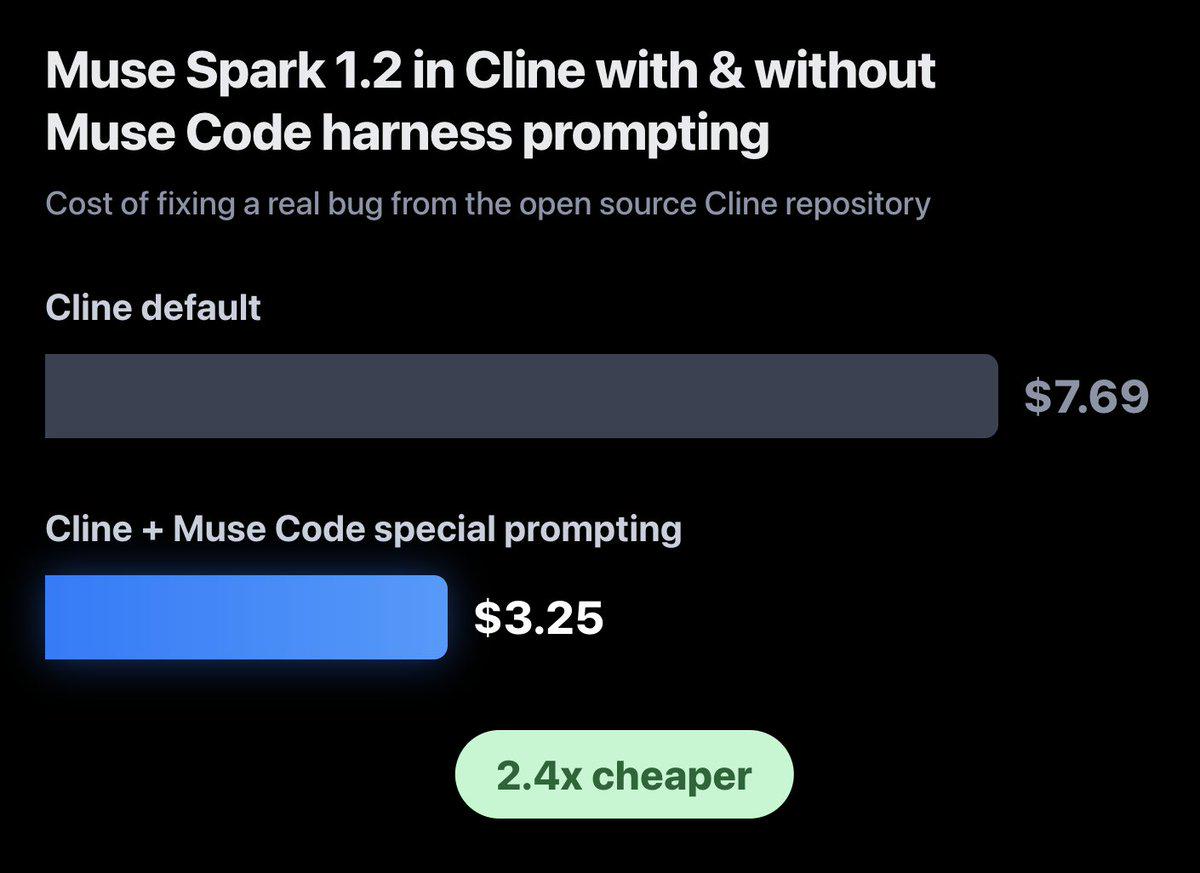
So we did a fun experiment: Meta claims Muse Spark 1.2 was co-trained with their Muse agent harness. So we extracted instructions from their system prompt and added them to the Cline harness.
TL;DR of this special prompting:
- Trust source code over the user prompt, so read every call site and existing tests before starting the task
- Weigh edge and error cases as heavily as the happy path
- Always reproduce the bug before fixing
- Don't trust the first passing test suite, and verify suspicious looking half-baked tests
- Never stop at just editing, keep working until the change is verified complete.
We then asked this modified harness to fix a real bug from our repo, and compared the results to the original Cline agent harness.
Results:
- Used 2.7x fewer tokens (19.7M → 7.2M)
- Finished 2x faster (49min → 24min)
- Cost 2.4x less ($7.69 → $3.25)
Same Muse Spark 1.2 model, same task, only the prompting changed.
Incredible how much of a performance gain Meta was able to achieve training it on these special instructions!
I'm like you guys and am constantly experimenting with new models, seeing what they're all good at, how I can make use of them for certain projects and goals. I've been using Qwen 3.8 27b for minor coding work and it has been impressive.
But with just regular chatting I have been impressed with Muse Glimmer.
It seems to be able to have the ability to follow and hold good, deep and meaningful conversations without coming off as a typical chatbot.
No repeated statements like "I hear what you're saying", "that sounds really deep..." none of what sounds generic or like it's blowing smoke up your ass. I was impressed with how natural it comes across just in natural conversation. I think it's one of the best "chat" models you could get right now as it's one of the only local models that doesn't feel like you're chatting with an AI when having a conversation.
I'm thinking of finding a way to run both Qwen3.8 and Muse at the same time. It's fun to play with these things.
Hey Folks,
I've been making quants for a while - recently I took a short break to get into hardcore research (submitted my first EMNLP paper during it!). Along the way, I built up a little arsenal of quant-optim techniques: everything from novel, paper-pending tricks to some genuinely sick tensor-mapping algos.
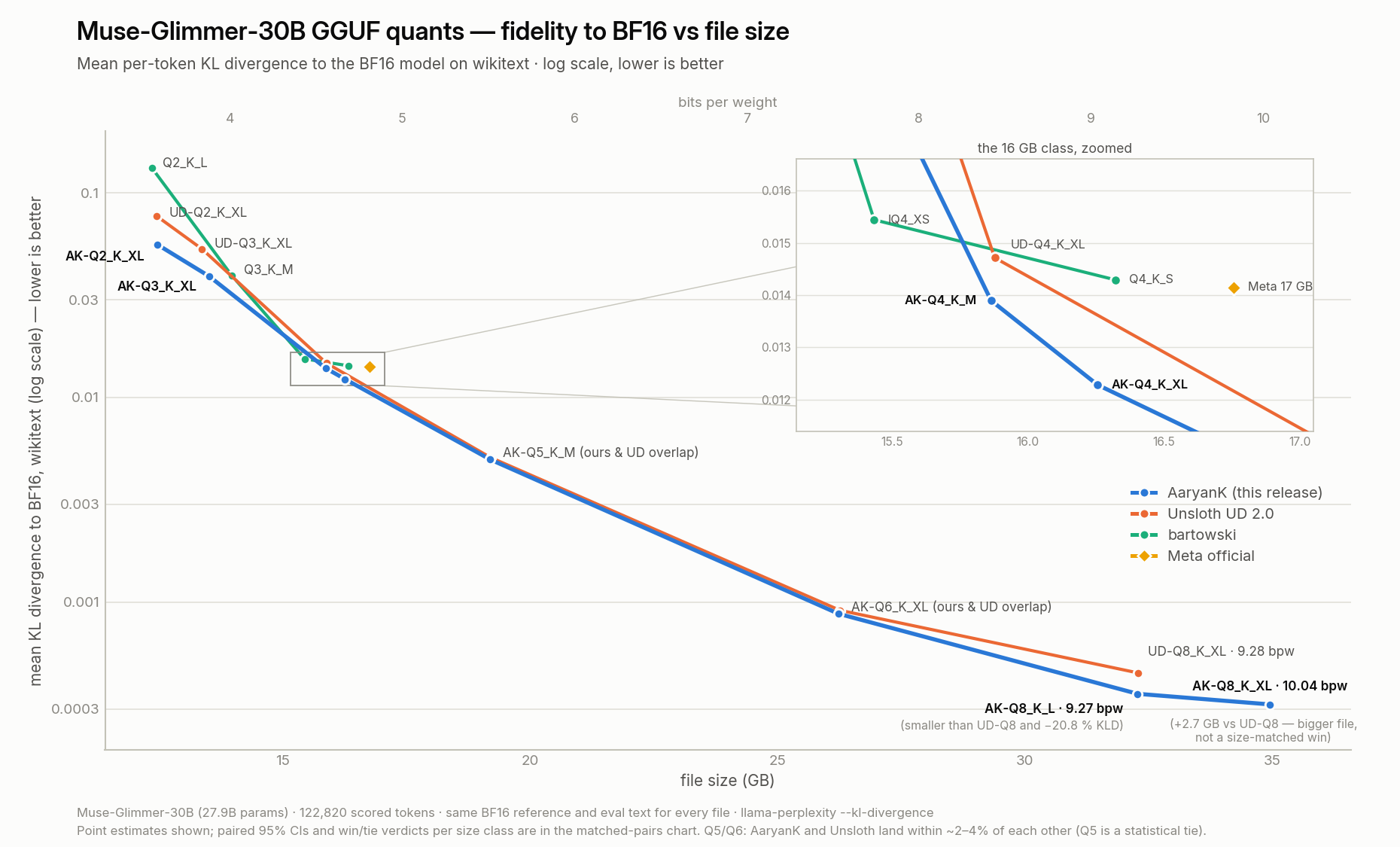
I threw some of the secret sauce into the newly released Muse Glimmer 30B (META IS BACK!) and compared it to several OGs. I'm honestly shocked by how it never loses to any quant out there in every single VRAM class!
One of the coolest ones is my Q8 quant, it is smaller than UD-Q8_K_XL and 21% closer to BF16.
Full methodology is on the card - eval setup, CIs, held-out slices, the lot. Happy to answer questions in the comments.
Model: https://huggingface.co/AaryanK/Muse-Glimmer-30B-GGUF
I still had headroom left but ran out of compute credits :( Being a solo undergrad sophomore, I can't exactly spend H100 money that often, which is why the "hopefully" in the title :)
I'm looking for internships in AI agent orchestration and model inference. If this work looks relevant to your team: linkedin.com/in/theaaryankapoor
I plan on doing a write-up soon to describe some of the
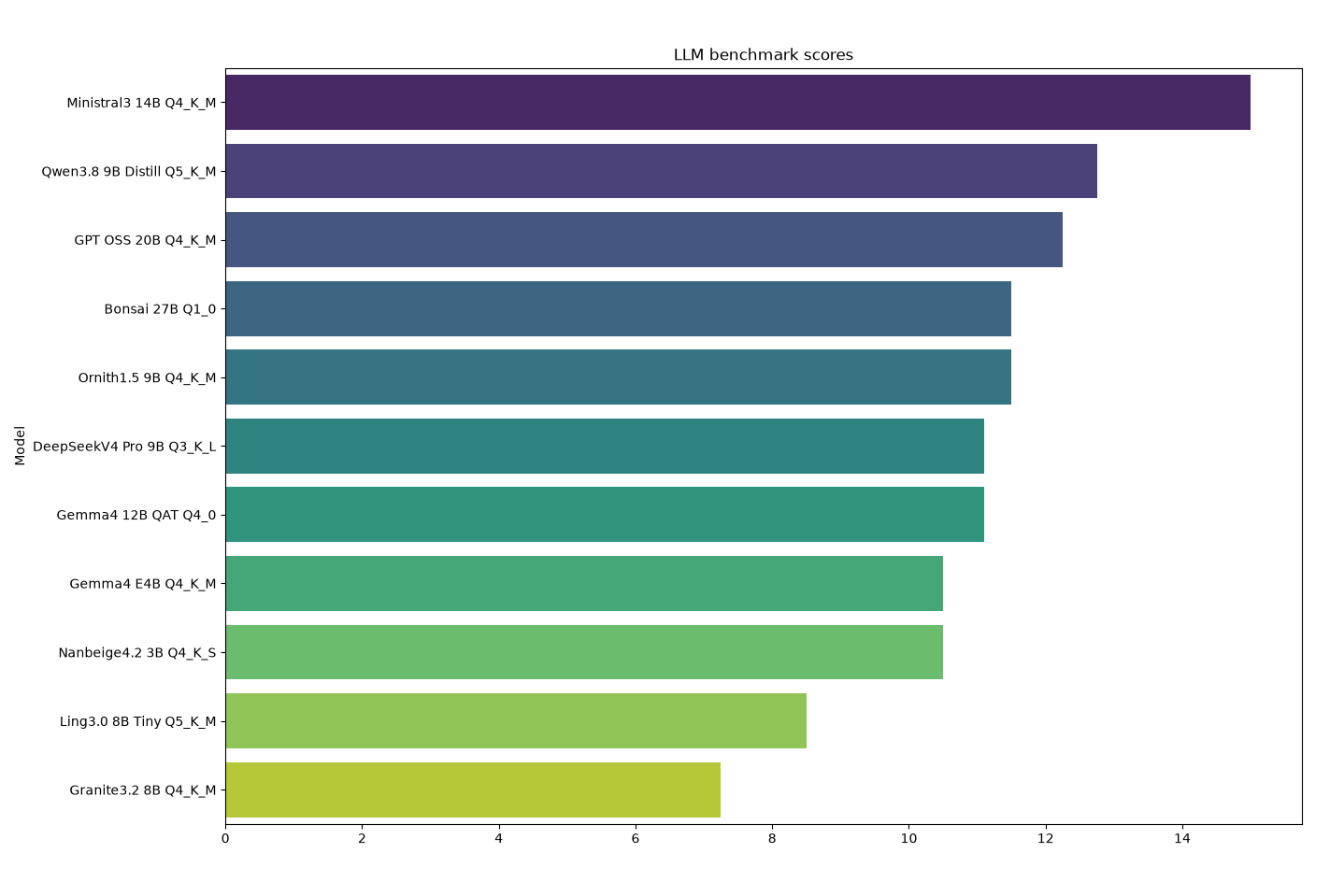
IMPORTANT This post is meant to provide info regarding the best local models to run on CONSUMER HARDWARE. I am on an RTX 4060 with 8GB VRAM, 16GB of RAM and I am benchmarking models that can run on my computer. If you have sunk several thousands into graphics cards you won't find these statistics much useful. This post is for all the people who can't just install Qwen3.8 27B and call it a day.
Additionally, I am not an LLM benchmarking expert. I am a hobbyist and occasional LLM user trying to extract useful information for both me and people on similar hardware.
Context For the past few weeks I have been doing some benchmarks of some LLMs that can run on my laptop which only has 8GB VRAM and 16GB RAM. I was mostly toying around while trying to get some useful data about what the best model is for local inference on consumer hardware. This week I decided to make a "final" benchmark that would be way better with more questions, more question categories, newer models (a lot of people complained about the models I had benchmarked before being old but I didn't find most suggested models to be any good) and a better speed benchmark, this time using TTC (Time To Completion) as a pose to
One person asked their Muse agent to look for money owed to them, and it turned up over $1,500 in unclaimed funds across two states they used to live in.
Prompt: Can you look around the internet for any money that might be owed to me? Please check my claim status every 5 days and report back to me on any changes.
Been building this for a few months, mostly for myself, and it just got a proper release so figured I'd post it.
It's a native GGUF inference runtime with OpenAI/Anthropic-compatible APIs and a chat UI. The whole point is one consumer NVIDIA card + lots of RAM: MoE models that don't fit in VRAM run their experts on the CPU, or split with a hot set cached on the card. It figures out what fits at startup instead of you guessing offload layer counts.
Runs Qwen 3.x dense and MoE (incl. Qwen3.8-Flash-Next), DeepSeek-V4-Flash, Ling 3.0, K2-Horizon, Gemma 4, Laguna, Muse Glimmer. Image input via mmproj on the Qwen models. Also does Z-Image-Turbo image gen next to a chat model on the same card.
Numbers from my laptop (5070 Ti 12 GB, 60 GB RAM):
- Qwen3.8-Flash-Next IQ1_S: ~35 tok/s decode, ~475 tok/s prefill
- Qwen3.8-27B IQ2_XXS: ~40 tok/s
- DeepSeek-V4-Flash: 6-7 tok/s (that's basically the DRAM bandwidth limit)
- Z-Image 1024x1024 in ~15 s with a 35B loaded beside it
Stuff I think is neat:
- Kernels are compiled at runtime by NVRTC, so no CUDA toolkit in the wheel and no nvcc. Same kernel source compiles as plain C++ for a CPU-only backend.
- KV cache in f16 / q8_0 / TurboQu
Ported a Miniature Golf prototype to VR using Meta Muse Code and the Unity CLI, added dozens of automated tests, and built a website to capture test runs, screenshots and results.
Ran the model with quants (Q4) by Unsloth with latest (build from master) llama.cpp server.
It takes ~20GB ram running on M5 Pro with 48GB at about 17t/s. Didn't do any reasoning loops/overthinking.
Overall, sits below Qwen3.6 27B, wasn't able to get good code (frontend and backend) results. On the positive side, it didn't fail any tool calls.
Your opinions/findings?
Watch more: https://www.youtube.com/watch?v=_5wKhkUT438
I established an MCP that allows you to provision a phone number for your Muse agent. It allows it to do outbound calling to the U.S. and Canada to any numbers, not just business lines, and also allow it to take inbound calls. Say, if you wanted to build a receptionist.
I am looking for people to test this out, and if you're interested, DM me. I'd love to get you some credits to try it out for free.
https://www.botphone.tel/products/muse-receptionist
I've had Qwen3.6:27b (and Qwen 3 coder next before it) running along side gpt-oss:20b for a while now as my two main models (qwen for coding, gpt-oss for agentic stuff). Qwen is pretty self-explanatory, while I had been using gpt-oss because of how good it was at producing json and instruction following, despite the size and age.
https://preview.redd.it/lr61tb02lejh1.png?width=1920&format=png&auto=webp&s=cef1f0bbfb43c8462162ec675d52c5896d174118
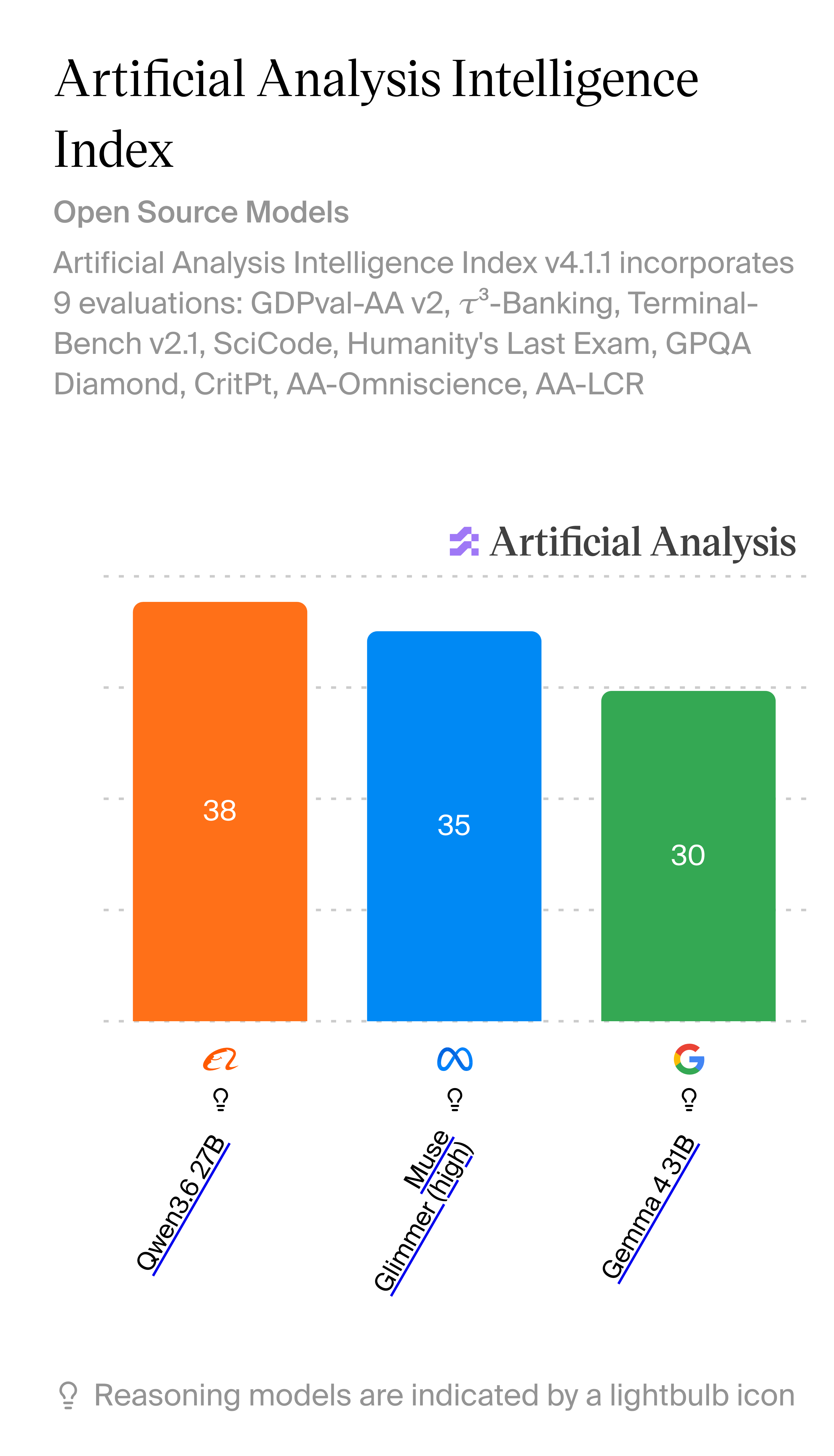
The "upgrade" to 3.8 is pretty evident, especially because of the SWE bench score improvement, but I was more reticent with Muse-Glimmer as I had some trouble when I tried Gemma4, which was far too opinionated when given a task, but Muse-Glimmer seems great - low memory footprint at 128K context, fairly fast and seems to follow instructions well.
What models are you using locally and for what? did you have a similar experience with these latest models?
Benchmarked Muse Glimmer 30B on my RTX 5090 (32GB), 262k context, UD-Q5_K_M + dflash-kquant + mmproj.
Workload Stock master + DFlash ngram-simple PR #26842 + DFlash Code patch 78 t/s 57 t/s 220-253 t/s Mixed agent turn 77 t/s 68 t/s 188-213 t/s Tool-call JSON 71 t/s 75 t/s 155-181 t/s Heavy reasoning 52 t/s 58 t/s 120-130 t/s PR #26842 moves the DFlash draft argmax from CPU to GPU, which was the bottleneck. I cherry-picked it onto master (it branched before the Muse merge, one conflict to resolve manually) and it builds clean. Code generation now matches Meta's published 233 t/s, which I could not reproduce on stock master.
Notes:
• ngram-simple loses to DFlash on every coding workload.
• Server caps context at the model's metadata context_length, use --override-kv for 262k.
• The reasoning budget flags do not work with this template. This is verified: with the budget set to 64, the model still burned 2000+ chars thinking and the budget message never appeared. Leave max_tokens headroom for the reasoning block.
Flags:
llama-server ^ --model Muse-Glimmer-30B-UD-Q5_K_M.gguf ^ --mmproj mmproj-kquant.gguf ^ -c 262144 --parallel 1 ^ --override-kv "muse-glimmer.context_le
Every agent is going to have its 'cheat code', like X access for Grok. But this Instagram integration has been amazing for me. I follow a large amount of people and its too much work to manually go through profiles to see if they're still active. I had Muse do that and surface all the dead profiles I might want to unfollow.


 ChatForm
 Tgmlabs