Hello everyone! 👋🕶️
I put Meta Muse Code + the Unity CLI to the test with a real Unity project to see how far I could push this agentic workflow. Instead of just generating code, I wanted to see how it could actually interact with Unity, run tests, validate changes, port the h
Dilmer Valecillos converted a minigolf prototype to VR for Meta Quest 3 using Muse Code with the Muse Spark 1.2 Contributor model, the Unity CLI and the MetaVR CLI, and published the plans and prompts.
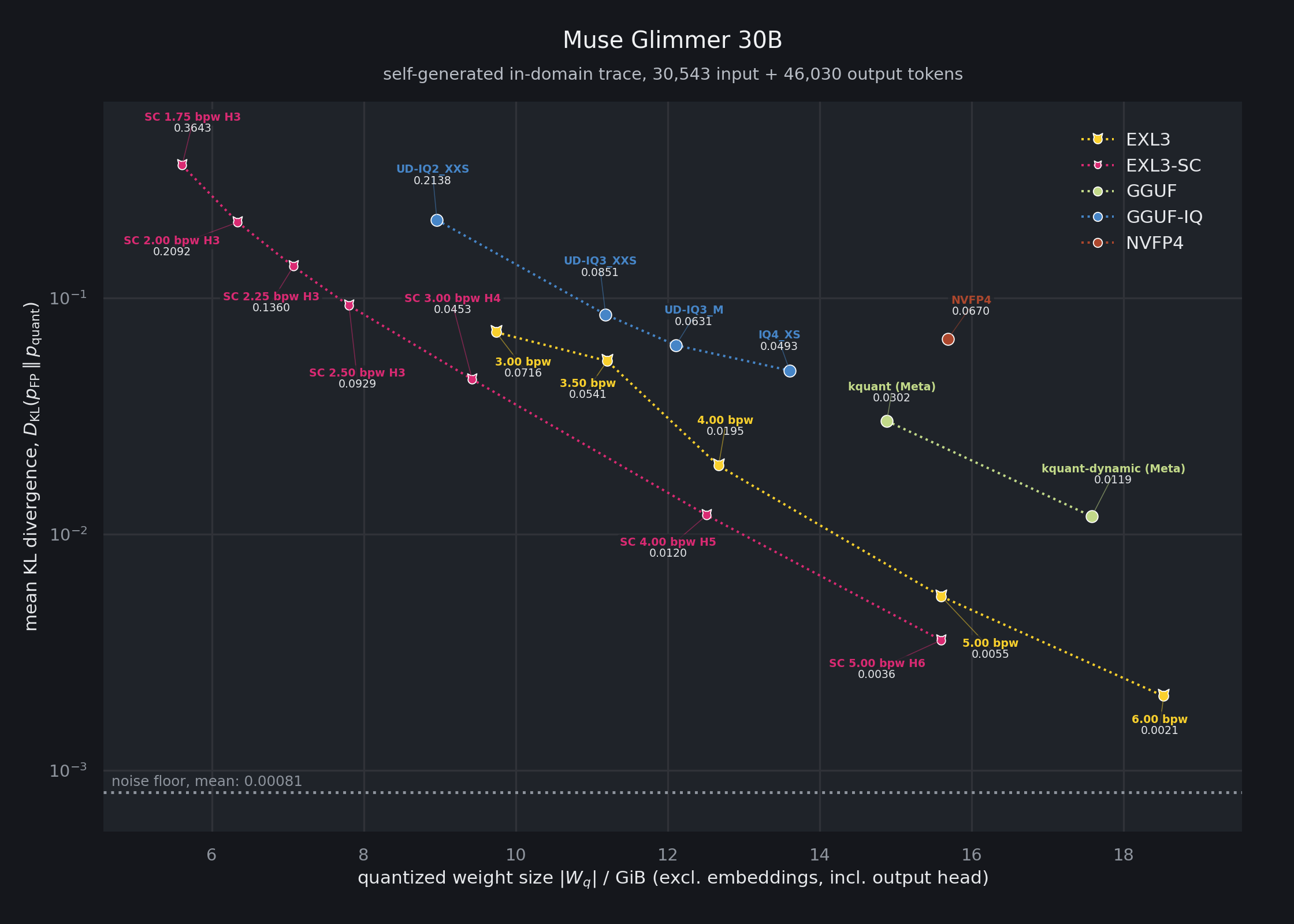
I'm running Muse Glimmer 30B EXL3-SC 3.00bpw H4, fully resident on my 12GB VRAM GPU at 100K context with Q8\_O KV cache. It's a joy to use a dense 30B model at this size and still get \~30 tok/s on a VRAM-constrained laptop.
It's supposed to be only slightly worse than the official 17GB K-quant at a much smaller footprint, and for my Hermes Agent use case I don't notice a quality difference. It's just much faster.
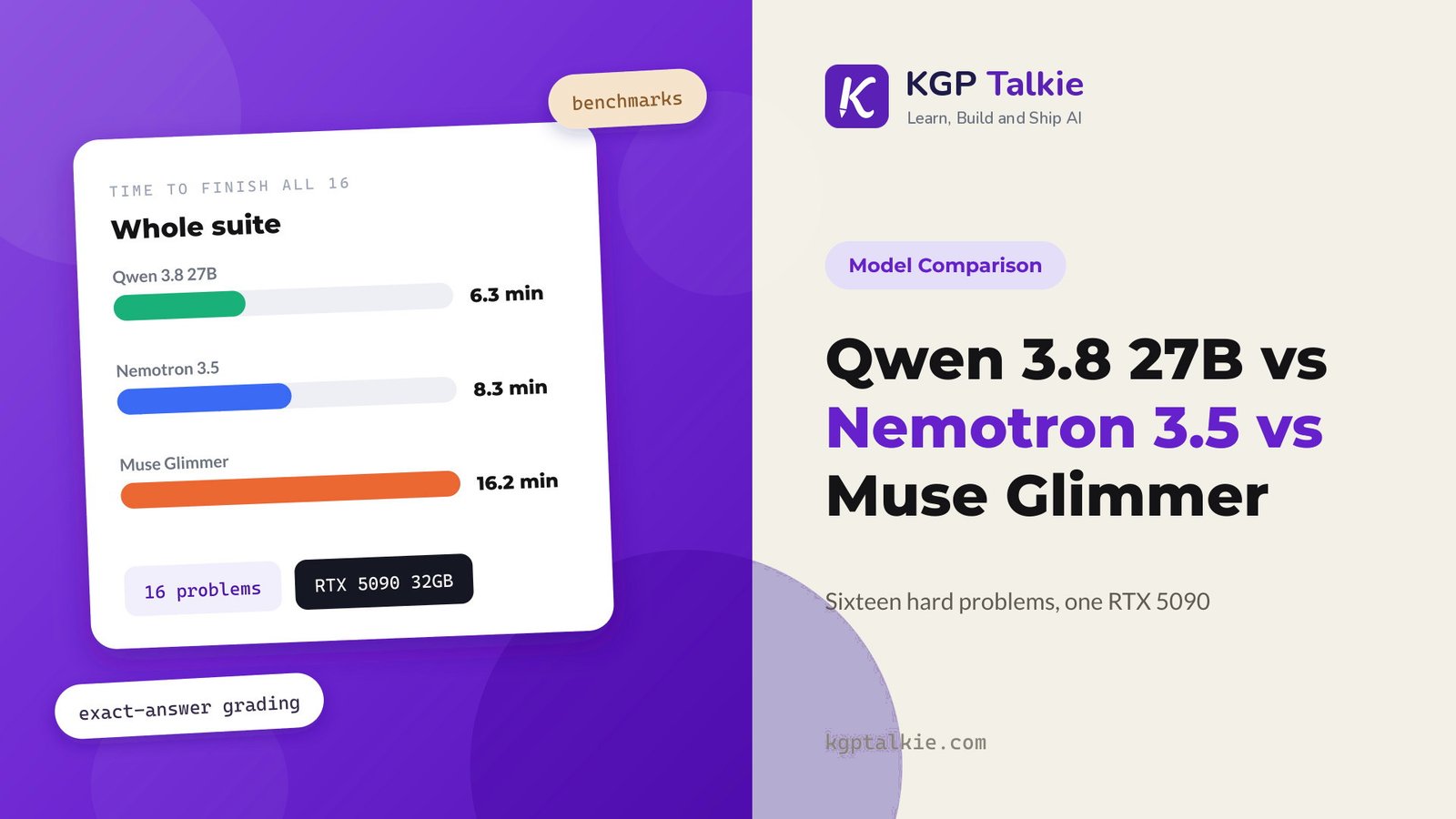
I've tried Qwen 3.8 27B at SC2.20bpw H3 too. Definitely usable but I'm sticking with Unsloth UD\_Q4\_K\_XL for Qwen 3.8 27B because it's mainly for coding.
Just tried something new with Muse and Meta VR CLI 🤯, and it’s insane that this works! But it makes sense because we’re literally getting a VM with our agent.
I told the agent to install Meta VR CLI and use it to search our developer docs going forward. This is huge for VR/MR
Ok, here’s the VR port of my Miniature Golf prototype! ⛳🥽
This project is now running on standalone (macOS/Linux/Windows), Three.js, and as of today, VR. Crazy how fast we can move today.
The VR version was fully ported using Meta Muse Code and the Unity CLI. I also now have
Last night, I built a VR game prototype in a few hours with Muse Code on PC. It was already available on macOS and Linux, and today we’re bringing it to PC! 🔥
I tested it with Unity through the Unity CLI, and here are a few things that worked really well for me:
- Having Muse
Muse Glimmer, A 30B parameter dense model swallowing a 130,000 token context window using only 19.3 GB of VRAM (extreme efficiency). No KV cache quantization required.
I just benched the new Muse Glimmer 30B (dense) on a single RTX 4090. We are pulling 3,100+ t/s prefill and 75
The "I don't have enough VRAM" excuse just died. I’m running Meta’s new 30B Muse Glimmer Q6_K_XL with a massive 130k context window on just 26GB VRAM FREE compute on Kaggle.
Kaggle provides you free 2x Nvidia T4 GPUs. 30 hours usage each week!
Yesterday, I showed you the
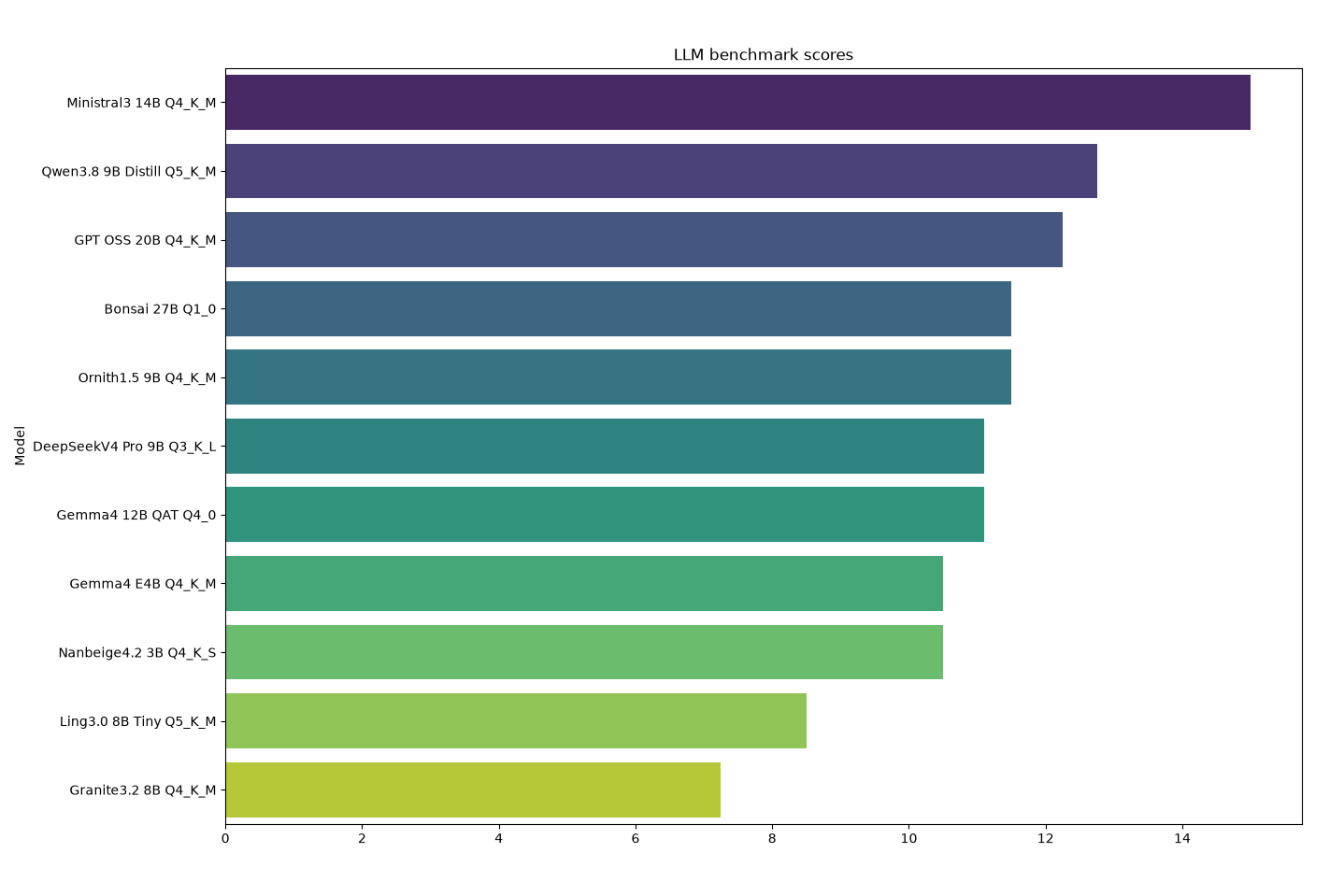
IMPORTANT This post is meant to provide info regarding the best local models to run on CONSUMER HARDWARE. I am on an RTX 4060 with 8GB VRAM, 16GB of RAM and I am benchmarking models that can run on my computer. If you have sunk several thousands into graphics cards you won't find these statistics much useful. This post is for all the people who can't just install Qwen3.8 27B and call it a day.
Additionally, I am not an LLM benchmarking expert. I am a hobbyist and occasional LLM user trying to extract useful information for both me and people on similar hardware.
Context For the past few weeks I have been doing some benchmarks of some LLMs that can run on my laptop which only has 8GB VRAM and 16GB RAM. I was mostly toying around while trying to get some useful data about what the best model is for local inference on consumer hardware. This week I decided to make a "final" benchmark that would be way better with more questions, more question categories, newer models (a lot of people complained about the models I had benchmarked before being old but I didn't find most suggested models to be any good) and a better speed benchmark, this time using TTC (Time To Completion) as a pose to
Hey Folks,
I've been making quants for a while - recently I took a short break to get into hardcore research (submitted my first EMNLP paper during it!). Along the way, I built up a little arsenal of quant-optim techniques: everything from novel, paper-pending tricks to some genuinely sick tensor-mapping algos.
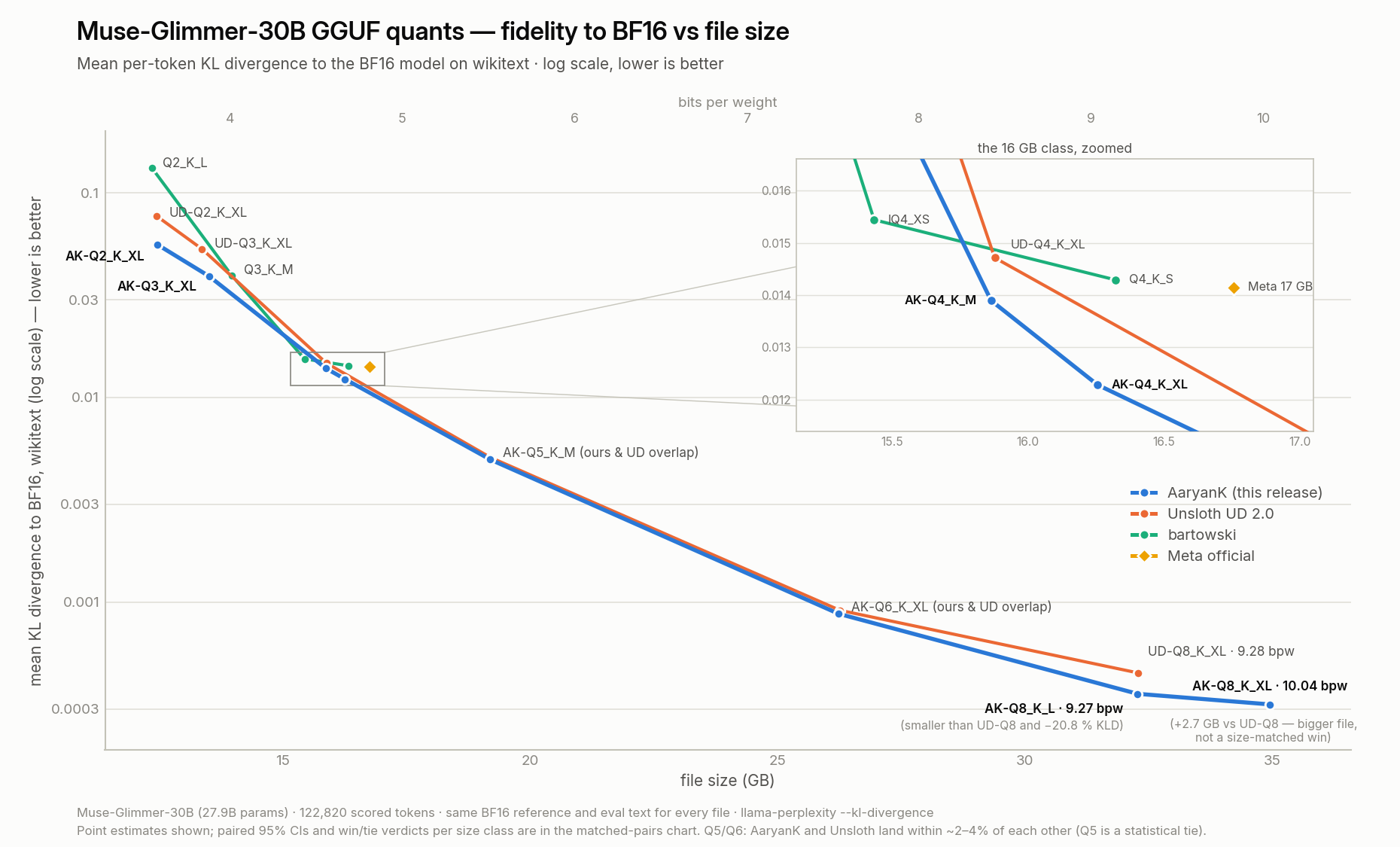
I threw some of the secret sauce into the newly released Muse Glimmer 30B (META IS BACK!) and compared it to several OGs. I'm honestly shocked by how it never loses to any quant out there in every single VRAM class!
One of the coolest ones is my Q8 quant, it is smaller than UD-Q8_K_XL and 21% closer to BF16.
Full methodology is on the card - eval setup, CIs, held-out slices, the lot. Happy to answer questions in the comments.
Model: https://huggingface.co/AaryanK/Muse-Glimmer-30B-GGUF
I still had headroom left but ran out of compute credits :( Being a solo undergrad sophomore, I can't exactly spend H100 money that often, which is why the "hopefully" in the title :)
I'm looking for internships in AI agent orchestration and model inference. If this work looks relevant to your team: linkedin.com/in/theaaryankapoor
I plan on doing a write-up soon to describe some of the
Ported a Miniature Golf prototype to VR using Meta Muse Code and the Unity CLI, added dozens of automated tests, and built a website to capture test runs, screenshots and results.
Dilmer Valecillos uses Muse Code with Muse Spark 1.2 and the Unity CLI to run tests, validate changes, port a Mini Golf game to other platforms and convert it to VR.
Progress on the VR Forge: The Agent can now move in its own and grab objects, lift them, carry them and change its colors. I am currently using #astra and #musecode both working in different branches. Soon: Minecraft-like experience building with an Agent. Stay tuned!
Tips for 🥽 VR/MR developers, or anyone getting into VR by building a new app or game: leverage the Meta VR CLI + Muse Code in your agentic workflow.
- An MCP server that gives your AI coding agent full context from the Meta VR docs
- Device management: list, inspect, and
1/ big announcement today: we will be releasing an open weight version of muse spark 1.2 soon.
we also are releasing muse glimmer, a 30B agentic model with open weights under apache 2.0. muse glimmer can run on 24GB of VRAM without losing agentic reliability. 🧵
Muse Spark 1.3 released today, so I immediately tried it in Muse Code with the Miniature Golf game I previously converted to VR using version 1.2!
💻 The prompt “Add Hands support & allow for hands or controllers. Use MetaVR CLI for additional ISDK context”
The entire process
NetworkCoder runs Muse Glimmer 30B on an RTX 3090, measures speed and VRAM, and gives two agent harnesses the same model, endpoint, project and prompt to compare results.
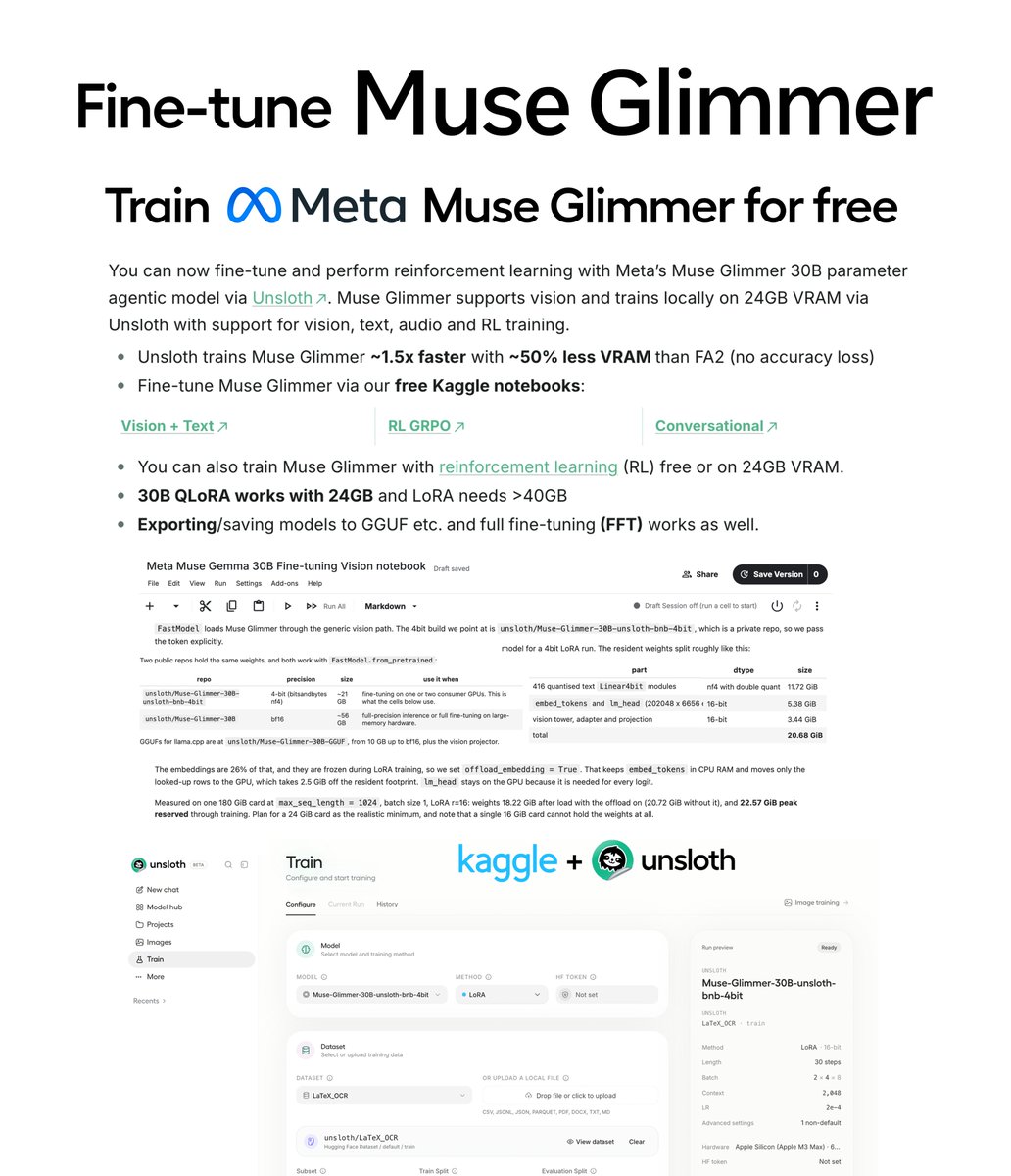
You can now fine-tune Meta Muse Glimmer 30B for free! 🔥
Our free notebook also supports GRPO RL training.
Unsloth trains Muse Glimmer 1.5× faster with 50% less VRAM vs FA2 setups. Train locally with 24GB VRAM.
Guide: unsloth.ai/docs/models/mu…
Notebooks: unsloth.ai/docs/models/mu…
An effort to make Muse Glimmer 30B actually use a 512k-token context (4x native) as a ~17GB GGUF in 32GB VRAM, trained on DGX Spark and evaluated with RULER-style retrieval tests.
A four-in-line game built with the AIIA framework, where the plan came from the author's own model and the build then switched to Muse Glimmer running on 16 GB of VRAM.
An experiment running Muse Glimmer 30B Q4_K_M via llama.cpp on an RTX 4060 laptop with 8 GB VRAM, testing autonomous Python bug fixing, tool-failure recovery and multimodal invoice extraction.










 ChatForm
 Tgmlabs