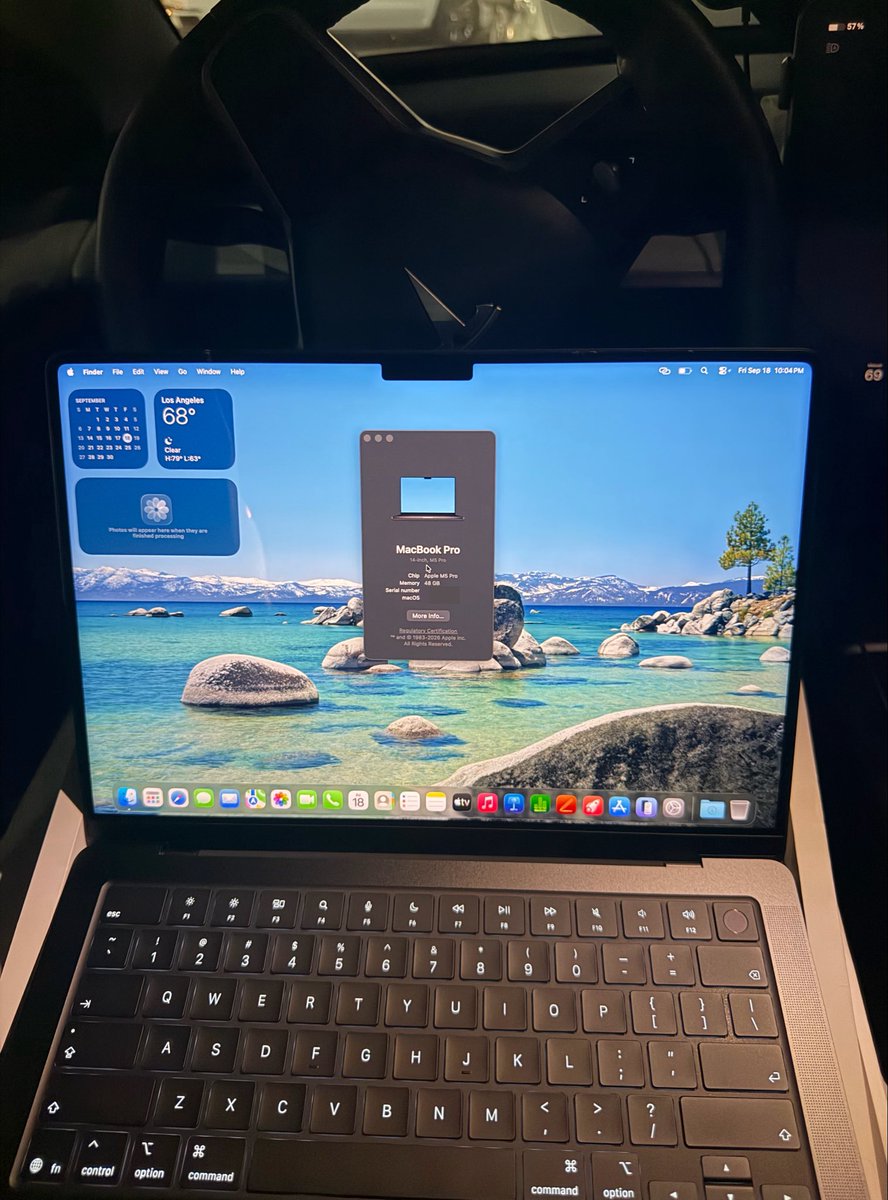
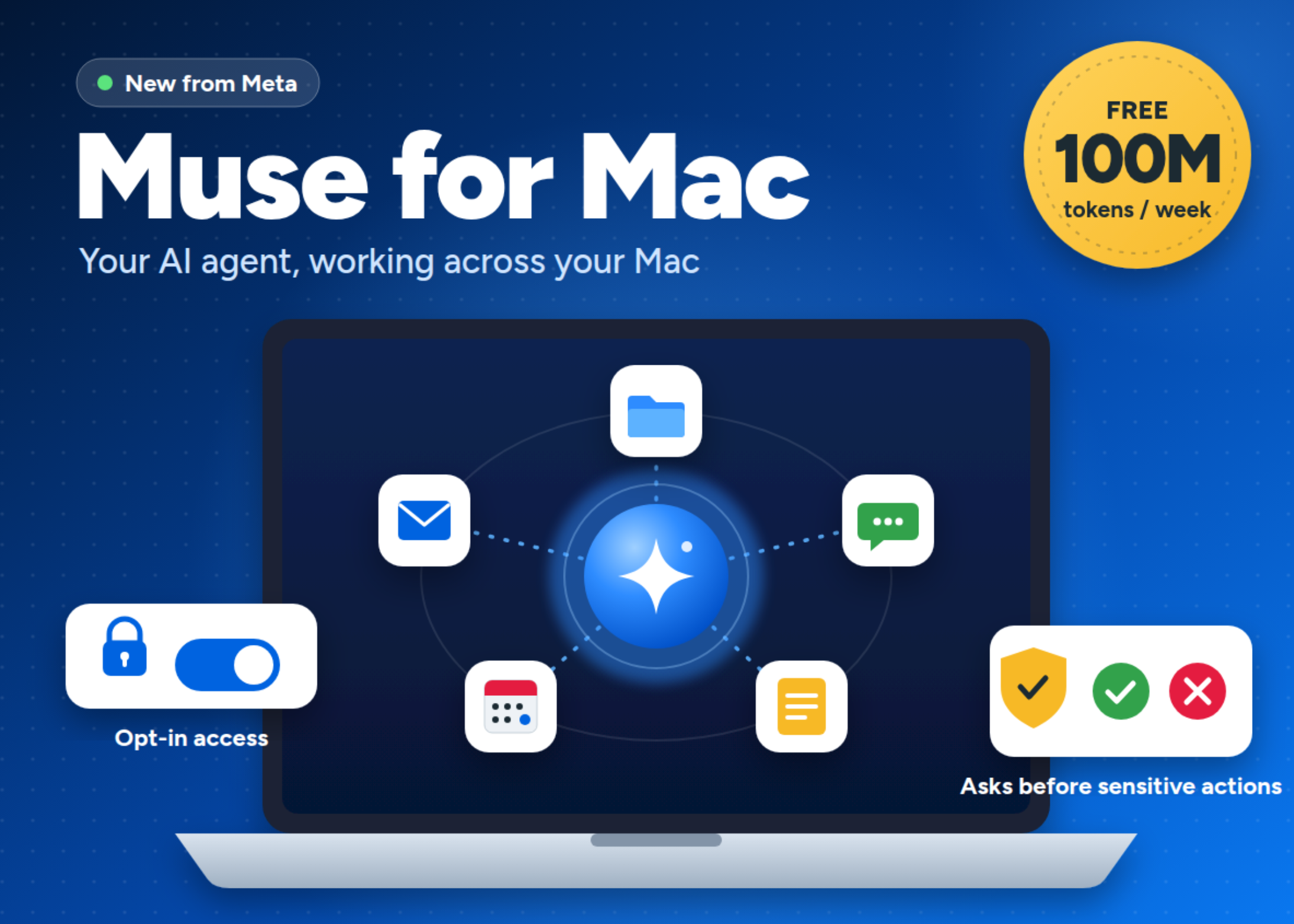
Muse is now available on Mac 💻.
Your personal agent can get things done for you directly on your computer (all with your explicit permission).
- Organize your downloads folder
- Find a file you’ve lost track of
- Summarize your messages and notes
…more coming soon.
Try
A cool thing about @Muse is that every Muse runs on its own Linux machine. So you and your Muse can do normal Linux stuff together — like build your own terminal!
A desktop app for Muse Code on macOS and Windows with projects, git worktrees, subagents, MCP, a diff review panel and opt-in computer use that lets the agent see the screen and use apps.
https://github.com/mvrius/bluebubbles-muse
BlueBubbles server on my Mac, Muse hook polling it every ~5s.
How it works: the poll driver (bash shim + Python filter) checks for new messages and filters on an allowlist of senders, 1:1 chats, and group GUIDs. A new message from an allowlisted sender wakes Muse into a side chat with the message as context. Replies go back out as normal iMessages through the Mac.
Why this instead of a messaging connector: connectors need an approval tap on every send, otherwise similar could be acheived via Messenger connector.
Setup: BlueBubbles on the Mac, Tailscale so the agent VM can reach it, run the installer. Repo has the hook scripts, installer, architecture doc, and skill definition.
Known issues: I am noticing that sometimes Tailscale connection drops on the Mac. I found that I need to bring down/up tailscale every hour for connection to stay up.
A fun example from earlier today, I updated my calendar, moved dinner with my wife by 30 minutes - Muse mesaged the Family chat and informed my wife of the change.
Cool findings:
- Muse has a Tailscale option, you can connect the VM it runs on in Client model with other machines running Tailscal
Helicon is an open-source desktop and web app that wraps Meta's Muse Code CLI in a Codex/Claude-style interface, grouping sessions by project with history, resume and diffs on Windows, macOS and WSL2.
PyTorch added end-to-end Muse Glimmer support to ExecuTorch; on an M5 Pro, DFlash speculative decoding lifts image+text decode from 21.6 to 33.0 tok/s, and it powers the Pi coding agent locally.
Muse Mac Connector is an open-source macOS menu-bar app that exposes an authenticated tool set over a Cloudflare tunnel so Meta Muse can take user-approved actions on files and apps on the user's Mac.
Since Muse for Mac ships only for Apple silicon, this small service lets Muse's cloud VM screenshot, click and type on an Intel Mac, compressing each 5K frame to about 150 KB and handling Retina coordinate scaling.
An unofficial native macOS client for the Muse Code CLI in Meta AI's design language, sharing sessions with the terminal so work can resume in either place.
A static teardown of Meta's Muse macOS app (codename Endo) finding a full computer-use agent in the public build, switched off by five server-delivered feature flags.
Got Muse Glimmer 30B running locally on my Mac (M5 Max - 128 GB )and the instruction following is impressive. need to setup with opencode next
Video Speed - 5X
Scripts that run Muse-Glimmer-30B with vision and tool calling on a 32GB M2 MacBook Pro via llama.cpp and Metal, without admin or sudo access, pulling Meta's official GGUFs.
TerMuse shows the live terminal and an interactive browser of the machine a Muse agent is working on, side by side, so the user can watch and type or click in the same session.
A reproducible record of running the 17GB Muse Glimmer 30B GGUF with llama.cpp and Metal on a 24GB M4 Pro MacBook Pro, with notes on mistakes, fixes and how local inference works.
MarkTechPost walked through Muse for Mac, which pulls context from Calendar, Mail, Messages, Notes and files for multi-step tasks, with opt-in access, optional Full Disk Access and approval before deleting files or sending messages.
Malwarebytes reports Patrick Wardle's finding that a local app can change an undocumented Muse setting to redirect dictation traffic, exposing voice prompts and account auth tokens.
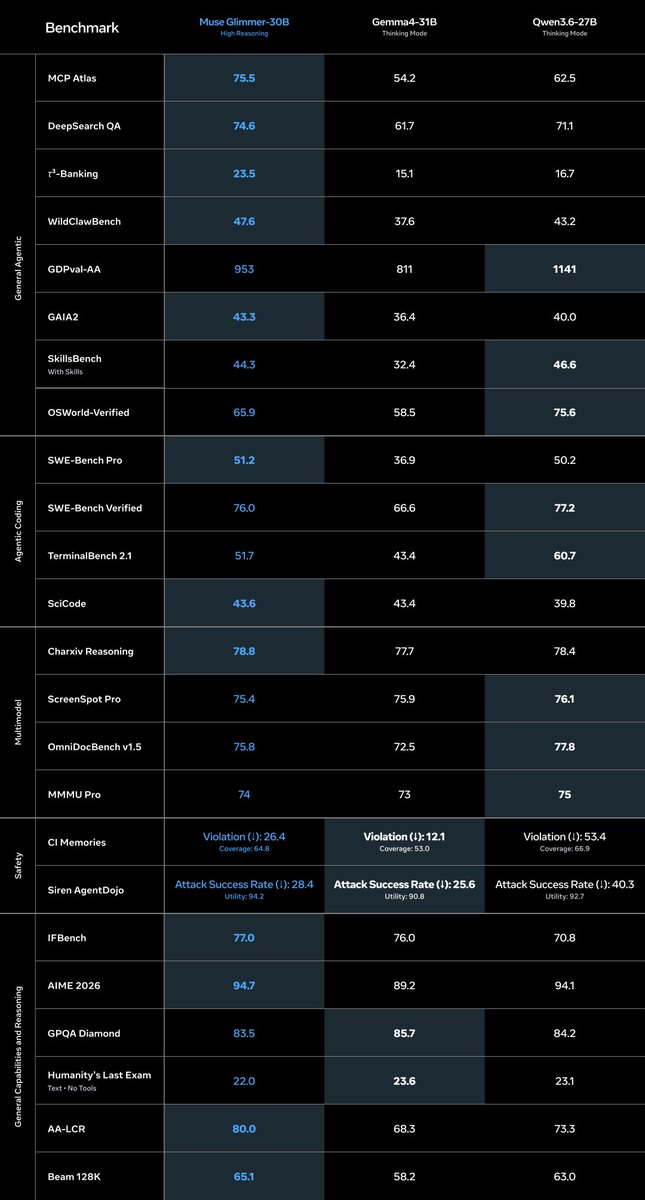
The successor to Llama is here, and Meta is revitalizing focus on open weights with their new Muse Glimmer - a leading 30B param model designed for always-on local agent use, small enough to run on a Mac or PC with a single GPU.
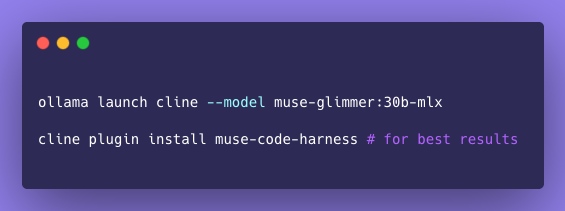
Available in Cline using Ollama now!
A local Muse Glimmer 30B vision-and-reasoning chat app for high-memory Apple Silicon Macs, running inference through ExecuTorch, MLX/Metal and DFlash with nothing persisted to disk.
Docker Sandboxes (sbx) kit spec that runs Muse Code in YOLO mode inside an isolated sandbox via a musex command, verified with sbx v0.39.0 on macOS arm64.
A starter script that downloads Muse Glimmer 30B, serves it with llama.cpp on an Apple Silicon Mac and connects it to OpenCode, with the server listening only on localhost.
An experimental macOS gateway that keeps the stock Muse Code CLI in charge of the UI, sessions and tools but swaps the model connection for OpenAI or Z.ai models via a loopback gateway.
A static teardown of Muse 3.0 for macOS plus Android and iOS builds, documenting shipped tools for iMessage, WhatsApp, Mail, screen control, background sync and a bundled Chrome extension.
Four graphical frontends for Muse Code (Tauri apps for Windows and macOS, Expo apps for iOS and Android) plus a Deno relay, so every run executes through muse on the subscription login.
oh-my-musecode is a content bundle and CLI for Muse Code that installs 35 skills, slash commands, hooks, an MCP server and themes, with an ownership ledger so uninstall restores the machine byte for byte.
This repo documents running Muse Glimmer 30B locally on an M4 Max MacBook via llama.cpp, benchmarking it with and without speculative decoding, and wiring it into Claude Code through LiteLLM for fully offline coding.
A prebuilt macOS arm64 bundle for the Muse Glimmer voice-agent recipe in meta-oss-cookbook: Parakeet speech helper, Muse Glimmer worker and Supertonic TTS executables built from one pinned ExecuTorch checkout, plus the shared MLX Metal library.
A 40-chapter book on Muser, an engine that runs Muse Glimmer on Apple Silicon Metal. It covers kquant and DFlash speculative lanes, exact KV-cache replay with kvpack, and GB10 NVFP4 prefill handed off to a Mac, with every number tied to an evidence receipt.
This is a small HTTP API you run on a machine you control. Muse SSHes in and calls http://127.0.0.1:8792. It can search Amazon and add to a personal cart or a Prime Business cart. It does not check out or pay.
https://github.com/aasper03/muse-amazon-bypass
You need Python 3.11 and curl. Sign in to Amazon in a normal browser and export cookies for each account. Amazon blocks automated login windows. The README covers Muse-over-SSH setup, and a later section shows how to call the same API yourself.
Meta's launch post for Muse Glimmer, an Apache 2.0 30B model for local agents that fits in ~20GB at 4-bit and runs on M4/M5 Max Macs, RTX 5090s or 24–32GB GPUs.
Muse for Mac is out today! It works across apps, files, calendar, notes, and messages on your computer. You control what it can access. The team is shipping fast. Download at ai.meta.com/muse/download
muse for mac is HERE!! your agent can now get stuff done right on your computer — files, messages, calendar, notes, all of it.
you're in control of what it can access, and it always asks before doing anything sensitive.
Add it to the dock - ai.meta.com/muse/download/
A hands-free interface that turns Meta AI glasses into a voice control surface for Muse Code on a Mac: assign a task, walk away, hear progress, interrupt and approve sensitive steps.
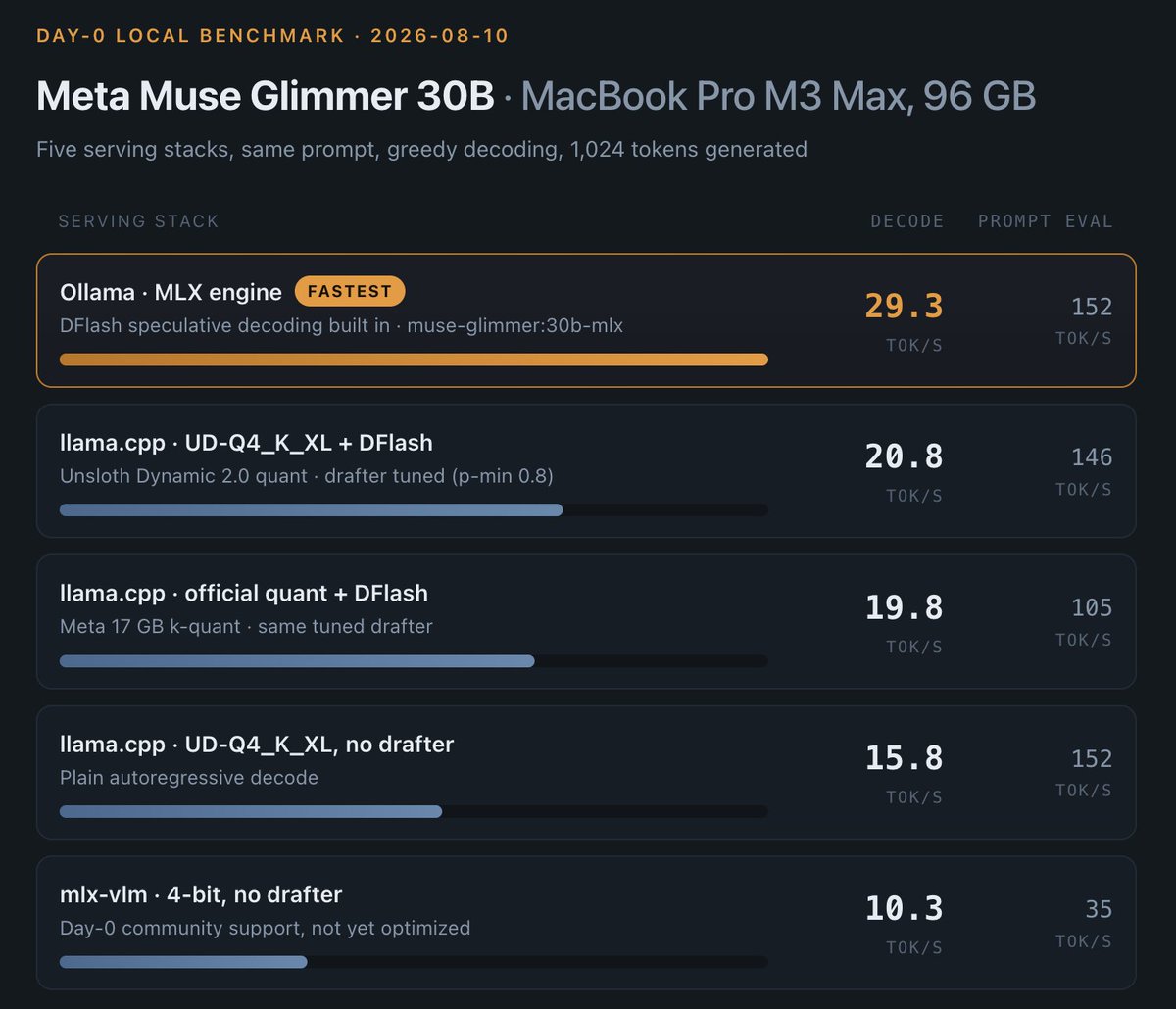
Got Meta's new Muse Glimmer 30B running on my MacBook (M3 Max, 96GG) and tested the serving options available so far.
Fastest right now: Ollama's MLX engine (DFlash included) at ~29 tok/s.
Tuned llama.cpp: ~21. Raw mlx-vlm: ~10, not optimized yet.
Numbers below if you're
I’ve seen a couple of posts about this so wanted to demystify. Today, every Muse user gets a free computer in the cloud. It's a real computer, and we’ve designed the security architecture of the Muse Secure VM carefully so you and your Muse can do almost anything you could with a
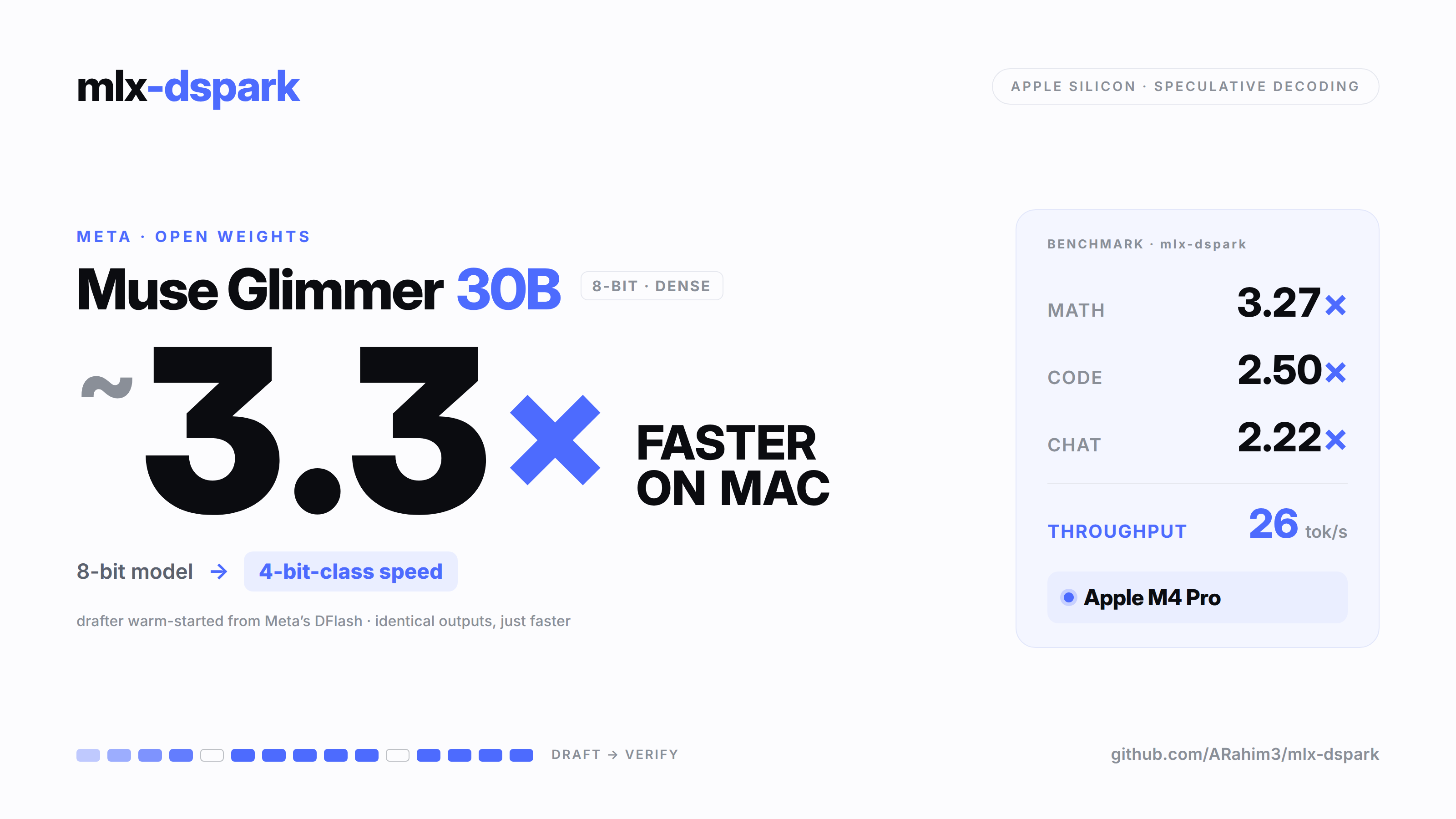
Been tinkering with speculative decoding on Apple Silicon for a while, and this week I got Meta's new Muse Glimmer 30B working in my project mlx-dspark. On my M4 Pro, the 8-bit model goes from 8.2 tok/s to 18-26 tok/s depending on content. Math is the best case at 3.27x, code 2.5x, chat 2.22x. Output is byte-identical to normal decoding since the target verifies every token, so there's no quality tradeoff; it's just faster.
Meta's own DFlash numbers on Mac are 1.5x (M4 Max) / 1.8x (M5 Max), but those are on the 4-bit build, so not really apples-to-apples. 4-bit for me is ~1.7x at ~25 tok/s and only needs ~18GB. The 8-bit run peaks around 40GB, so you want a 48GB Mac for it. Basically, you get 8-bit quality at 4-bit speed.
Repo: github.com/ARahim3/mlx-dspark
I'm happy to hear feedback, and I'm curious about what other M-series chips get.
AI assistants are insane time savers, this segment will be massive.
@Muse is extremly good for personal things, just today its booked a flight for me, handled emails, got me dinner reservations, and bought tickets to a game, and alerted me for things needing attention. The
reZme is a SwiftUI Mac app that turns YouTube videos into an outline, main thesis and key moments, generating the report with Muse Spark through the Meta Model API.
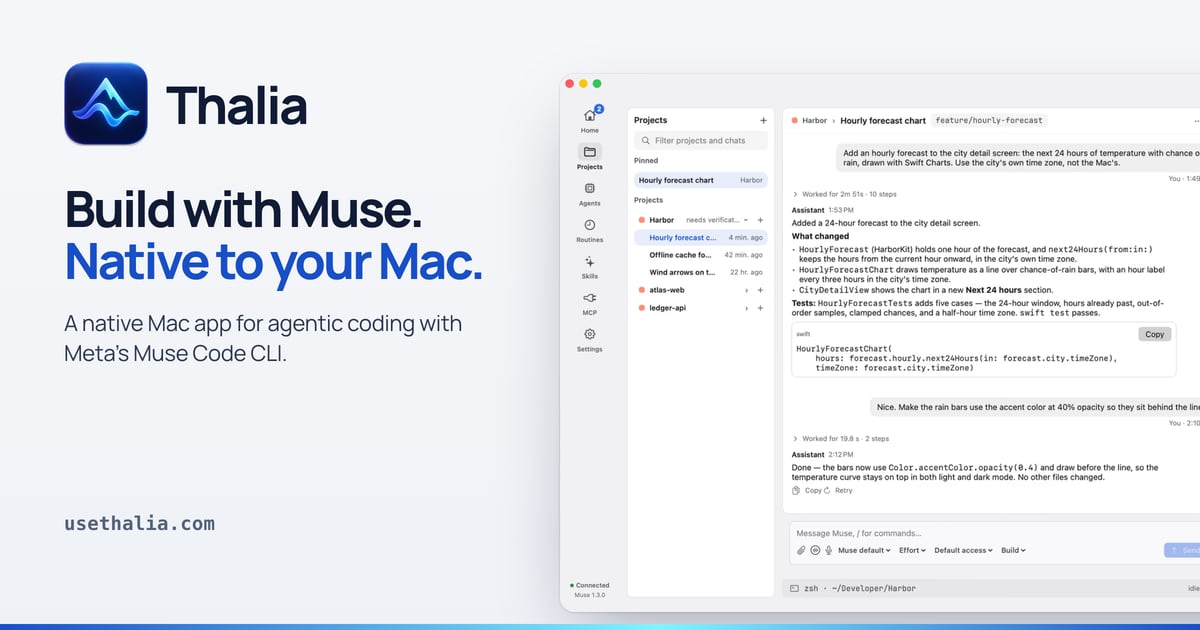
Thalia is a Swift-native macOS app for agentic coding with Meta's Muse Code CLI. Steer runs mid-flight, review exact diffs before anything lands, with plan mode and checkpoints. Native to the Mac, no Electron wrapper.
Calliope is an unofficial, independent native macOS client for Meta's Muse, shipped as a Developer ID-signed, notarized DMG with Sparkle auto-updates; five releases went out between Sept 13 and 16.
Meta's Mac app lets Muse work with local files, Messages, Notes, Reminders, Mail and Calendar, with per-app Off / Read only / Read and interact controls.
Hi all,
I'm a newbie and trying to assess the performance of some LLMs I'm running locally via oMLX on my MacBook Pro M5pro CPU 15 cores (5 Super and 10 Performance), GPU 16 cores and 48 GB of LPDDR5 RAM. I asked chatGPT guidance to run some tests and check whether the DFlash-based drafter Muse-Glimmer-30B-Assistant might somewhat speedup the base model Muse-Glimmer-30B-4bit.
The results show no or negligible improvement with active DFlash acceleration (speedup between 0.90% and 1.16%).
The test was structured with three different prompts fed to both the baseline and the dflash-capable model profiles: Technical prose; Python code; Structured JSON
a cap of 2048 tokens, no cache, temperature=0.
Each inference was repeated three times.
Anyone have similar experience? can we simply dump the Assistant as not useful in this hw/sw configuration?
Built a small bridge so Muse can act on my Mac from my phone, and recorded a real session: it looks at the Terminal, reports the epoch, loss and accuracy it sees, then locks the machine when asked. What struck me building it is how much of the work is permissions, not intelligence: per-action consent, small window captures instead of a live feed, rejecting stale observations before any input. Free beta if anyone wants to try it. Developer here, ask away.
try wand here today
An unofficial macOS desktop client that speaks MSP over muse serve, offering streaming markdown, visible tool calls, session history shared with the terminal and screenshot attachments.
A native macOS window for Muse Code that drives muse serve over MSP and renders approvals, questions, plans, todos and tool output as interface elements instead of terminal text.
Meta's Connect 2026 roundup: Muse voice mode, the Muse Realtime Avatar, Muse on AI glasses, an agent email address, Mac computer use, and connectors from Walmart, Best Buy, Expedia, Instacart, Notion, GitHub, Box and more.
ocodex fans out Muse Spark 1.2 Contributor workers on decomposable coding work while one paid supervisor audits every claim, with crash checkpoints, heartbeats and a machine-readable ledger.
Named profiles for the Muse Code CLI: keep several logins on one machine, run two at once and let each project pick its profile. Published on npm and tested against Muse Code 1.3.0.
An installable Muse skill that deep-reads your Instagram saved posts with AI and keeps them searchable on your own machine, also exposed as an MCP server for other tools.
A documented setup that runs Muse Spark 1.3 Contributor inside Claude Desktop on macOS through a small Node proxy that translates Anthropic requests to OpenCode Go's OpenAI-style API.
windows-cua is a native C++ Win32 port of Meta's macOS computer-use agent that drives Muse Spark 1.1 through the Responses API to see and operate a real Windows desktop.
A SKILL.md-driven setup that makes a machine without a public IP, such as a Muse/Hatch hosted VM, reachable over SSH through a public relay and self-recovers after reboots.
MdChat is a native macOS Markdown previewer and vim-keyed editor with an AI side panel that answers questions about selected blocks and rewrites them behind a diff, using Gemini or Muse Spark.
Native Muse Code plugin that wires in Hindsight memory with one bank per repo, using SessionStart, UserPromptSubmit and Stop hooks to recall and store context across agents. Zero dependencies, runs on macOS, Linux and Windows.
muser is a standalone inference engine for Muse Glimmer 30B on Apple Silicon Metal, with an optional disaggregated lane where an NVIDIA GB10 node prefills in NVFP4 and hands the KV cache to the Mac.
Julian Goldie's GoldieBench scores Muse Spark 1.2 at 7.55/10 across 50 one-shot builds. It did well on fractals (8.7), a macOS desktop sim (8.6) and a galaxy viz (8.6), but 3D games like Doom and Dragonrealm often came out incomplete or black.
Fonino gives Muse a physical, non-jailbroken iPhone to work in. Muse connects to Fonino's MCP server (https://api.fonino.app/mcp) as a custom integration. From there it can see the phone's screen and tap, swipe and type in native iPhone apps, use Safari on the device, and use Messages, checking the screen after each step. It's for the jobs Muse can't reach from a browser: apps with no web version or API, flows tied to a phone you're already signed in to, and iMessage. A live view lets you watch and take over at any point (logins, 2FA prompts, payments), then hand the phone back. Texts to other people wait for your approval.
Setup is a paste-in prompt: give Muse the setup prompt from fonino.app and it walks you through https://api.fonino.app/setup.md step by step. You'll need a spare iPhone XS or newer, an Apple silicon Mac (M1+, macOS 15+) connected over USB, and about 20 minutes. Start the Xcode download first. On the Muse side, you click Connect Muse at app.fonino.app and paste the key into Muse's secure credential prompt, not the chat.
Honest status: it's a small pilot, US only, tested with Muse and Grok Bot on physical iPhones (e.g. opening Notes and writing a note). Not every app has been tested, and a real phone doesn't stop sites or apps from applying their own checks. BYOF is a 3-day free trial, then $19/month. A hosted phone is $1,788/year. From the Fonino team.