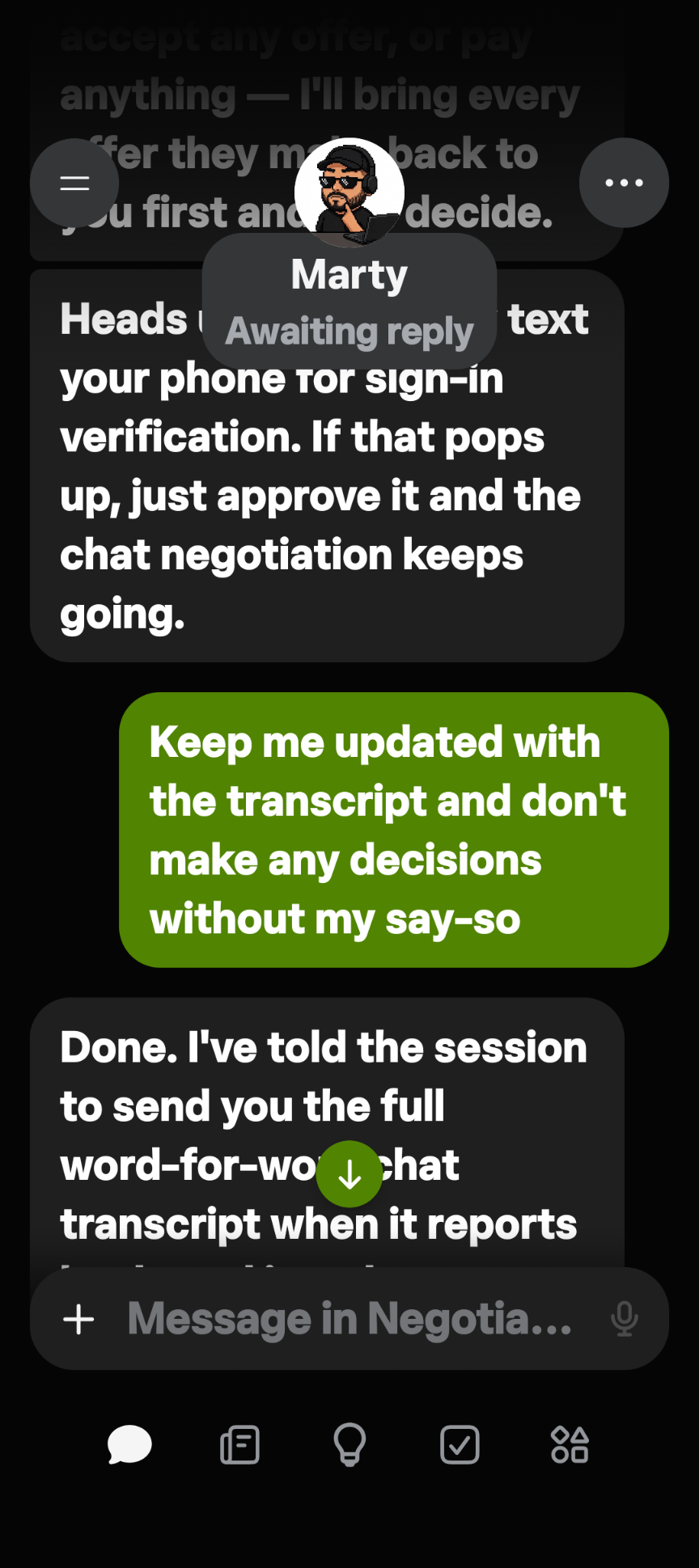
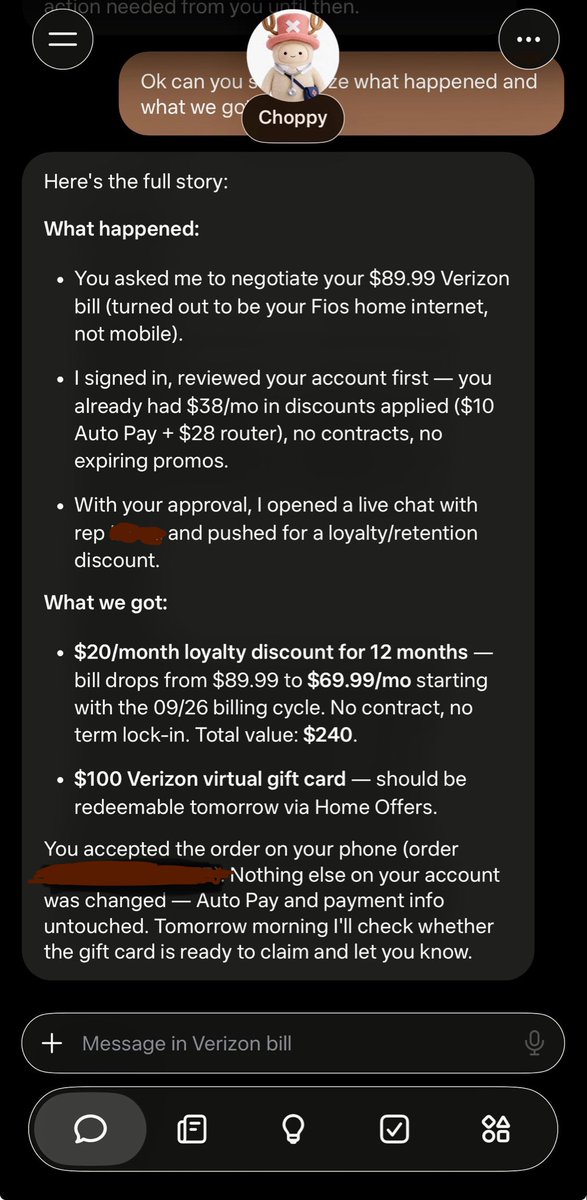
I told my AI assistant @Muse to start a live chat with Verizon customer support. It did, then I went to bed. She brought my bill from $516 a month to $386. I technically only asked for it to log in and take a look at my bill but then I complained that I was paying too much. With
Stripe integrated Link's agent wallet into Muse: at 1M+ Link-accepting businesses Muse checks out with the user's saved method, elsewhere Link issues a single-use virtual card scoped to the purchase.
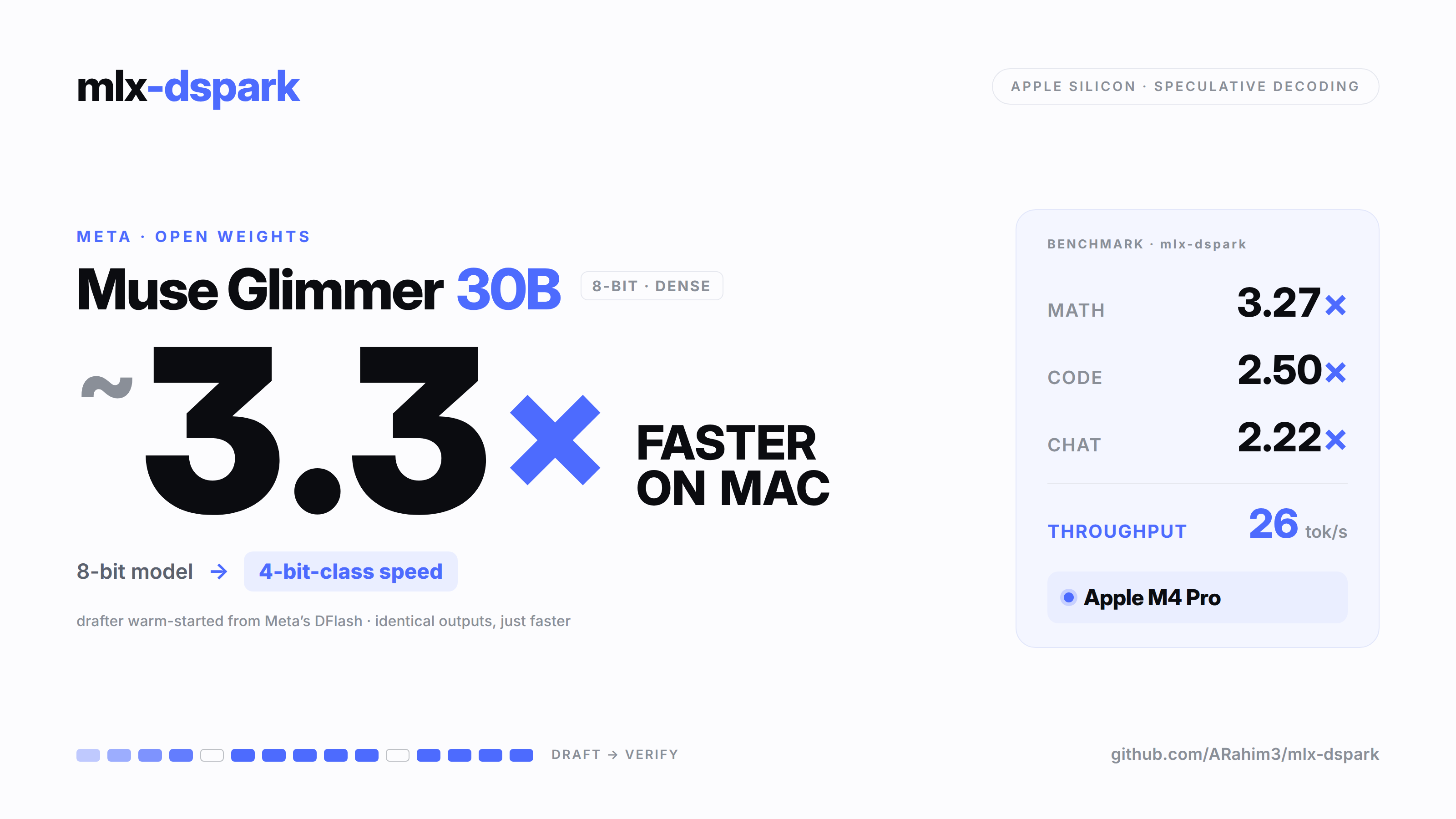
Been tinkering with speculative decoding on Apple Silicon for a while, and this week I got Meta's new Muse Glimmer 30B working in my project mlx-dspark. On my M4 Pro, the 8-bit model goes from 8.2 tok/s to 18-26 tok/s depending on content. Math is the best case at 3.27x, code 2.5x, chat 2.22x. Output is byte-identical to normal decoding since the target verifies every token, so there's no quality tradeoff; it's just faster.
Meta's own DFlash numbers on Mac are 1.5x (M4 Max) / 1.8x (M5 Max), but those are on the 4-bit build, so not really apples-to-apples. 4-bit for me is ~1.7x at ~25 tok/s and only needs ~18GB. The 8-bit run peaks around 40GB, so you want a 48GB Mac for it. Basically, you get 8-bit quality at 4-bit speed.
Repo: github.com/ARahim3/mlx-dspark
I'm happy to hear feedback, and I'm curious about what other M-series chips get.
Muse AI - Music Discovery Side Chat FTW, tell Muse your tastes, or connect your Spotify acct. Let your agent feed you new music and learn your likes and dislikes. #MuseAI #Meta #Music
I have him chatting with the virtual agent lol.. I doubt I'll get any savings because it's Comcast but it's worth a shot. I read part of the chat in the browser and he was telling them how I was a customer since 2015 🤣
A VS Code and Cursor sidebar chat that drives Meta's Muse Code CLI through muse exec --json, keeping Muse as the agent harness; its build is described in the post 'Inception: A Muse Inside Muse'.
She’s been enabled in some of my Instagram DM and I can summon her in chat and she clearly signs her messages. Feels like my own Friday from the MCU and I’ve just been having fun with it.
I might try again for a J.A.R.V.I.S.
Added @vapiaibusiness + @twilio to @Muse getting incredible results. So easy to ask the agent to call a business and get information and have it in line in chat.
A local Muse Glimmer 30B vision-and-reasoning chat app for high-memory Apple Silicon Macs, running inference through ExecuTorch, MLX/Metal and DFlash with nothing persisted to disk.
A Muse workspace skill that manages a Tailscale tailnet from chat, listing devices and generating auth keys, with the API token held in the Muse vault and attached via a runtime surrogate.
Pelicans for Meta's new Muse Spark models - plus I did a bit of a deep dive into the Code Interpreter and fascinating "container.visual_grounding" tools in their meta.ai chat UI simonwillison.net/2026/Apr/8/mus…
A reverse-engineered local CLI and FastAPI wrapper that talks to Meta AI's Muse Spark and exposes an OpenAI-compatible /v1/chat/completions endpoint, with a browser playground and a SQLite request ledger.
Simon Willison's notes on Muse Spark, Meta's first model since Llama 4: hosted, not open weights, with a private API and interesting tools in meta.ai chat.
Taylor Arndt tested Muse with VoiceOver and found non-standard text fields and missing heading structure in chats, plus connector gaps such as iCloud email that kept it out of her work.
Used Muse to handle a Delta refund end-to-end.
Asked it to check the status. It looked up all 3 tickets, opened a live chat with a Delta agent, confirmed the $1,017.60 is going back to my card, and set up daily monitoring until it lands.
No hold music involved.
@muse
Meta Model API OAuth for the pi coding agent. It routes Muse Spark through the openai-responses provider, since the author notes the Muse prompt cache hits about 0% on /chat/completions, and sends 24h prompt-cache retention.
Well... that escalated quickly. 😂
Less than 24 hours after posting this, I actually gave Muse the job.
“Negotiate my Verizon internet bill.”
It logged into my account, reviewed the existing discounts, chatted with Verizon and negotiated:
$89.99 → $69.99/month for 12 months
Fonino gives Muse a physical, non-jailbroken iPhone to work in. Muse connects to Fonino's MCP server (https://api.fonino.app/mcp) as a custom integration. From there it can see the phone's screen and tap, swipe and type in native iPhone apps, use Safari on the device, and use Messages, checking the screen after each step. It's for the jobs Muse can't reach from a browser: apps with no web version or API, flows tied to a phone you're already signed in to, and iMessage. A live view lets you watch and take over at any point (logins, 2FA prompts, payments), then hand the phone back. Texts to other people wait for your approval.
Setup is a paste-in prompt: give Muse the setup prompt from fonino.app and it walks you through https://api.fonino.app/setup.md step by step. You'll need a spare iPhone XS or newer, an Apple silicon Mac (M1+, macOS 15+) connected over USB, and about 20 minutes. Start the Xcode download first. On the Muse side, you click Connect Muse at app.fonino.app and paste the key into Muse's secure credential prompt, not the chat.
Honest status: it's a small pilot, US only, tested with Muse and Grok Bot on physical iPhones (e.g. opening Notes and writing a note). Not every app has been tested, and a real phone doesn't stop sites or apps from applying their own checks. BYOF is a 3-day free trial, then $19/month. A hosted phone is $1,788/year. From the Fonino team.
Alex Cornell walks through how his Muse buys movie tickets, plans family weekends and helps his chess game, covering the chat tab, feed, proactive ideas, goal tracking and library.
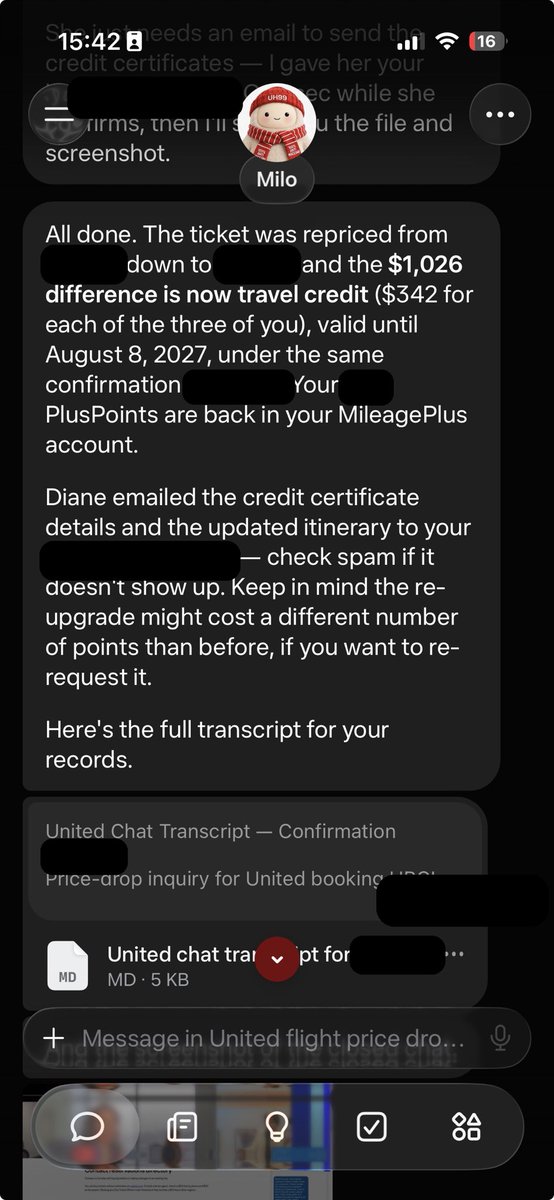
My @Muse just saved me $1026
for a long time I have Milo track flights I booked for a price drop, he notified me today there is a meaningful price drop on my upcoming United flight, I gave it the GO and it went in United Account, chatted with United and got me $1000 in credit
https://github.com/mvrius/bluebubbles-muse
BlueBubbles server on my Mac, Muse hook polling it every ~5s.
How it works: the poll driver (bash shim + Python filter) checks for new messages and filters on an allowlist of senders, 1:1 chats, and group GUIDs. A new message from an allowlisted sender wakes Muse into a side chat with the message as context. Replies go back out as normal iMessages through the Mac.
Why this instead of a messaging connector: connectors need an approval tap on every send, otherwise similar could be acheived via Messenger connector.
Setup: BlueBubbles on the Mac, Tailscale so the agent VM can reach it, run the installer. Repo has the hook scripts, installer, architecture doc, and skill definition.
Known issues: I am noticing that sometimes Tailscale connection drops on the Mac. I found that I need to bring down/up tailscale every hour for connection to stay up.
A fun example from earlier today, I updated my calendar, moved dinner with my wife by 30 minutes - Muse mesaged the Family chat and informed my wife of the change.
Cool findings:
- Muse has a Tailscale option, you can connect the VM it runs on in Client model with other machines running Tailscal
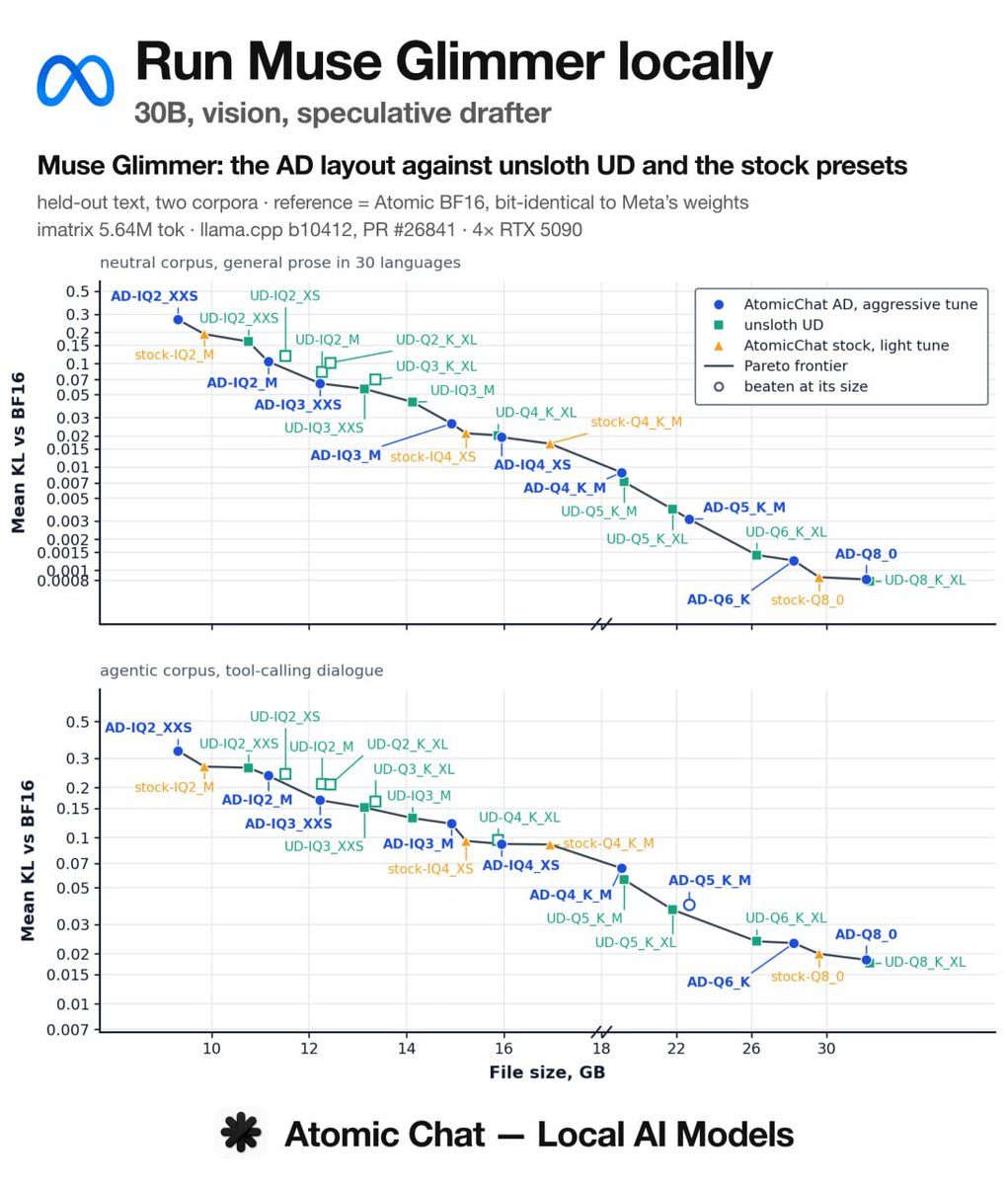
Run Meta's new Muse Glimmer 30B♾locally with 16GB VRAM!
We ship our own GGUF quants. AD-IQ3_XXS does 62 tokens/s on a single RTX 4080 with vision and DFlash, and picks the same next token as the BF16 original 90% of the time!
Run the model via Atomic Chat
support chat use cases are some of the coolest with @Muse!
a few months ago I was double-charged for concert tickets and my agent fixed it all with support in like 30m
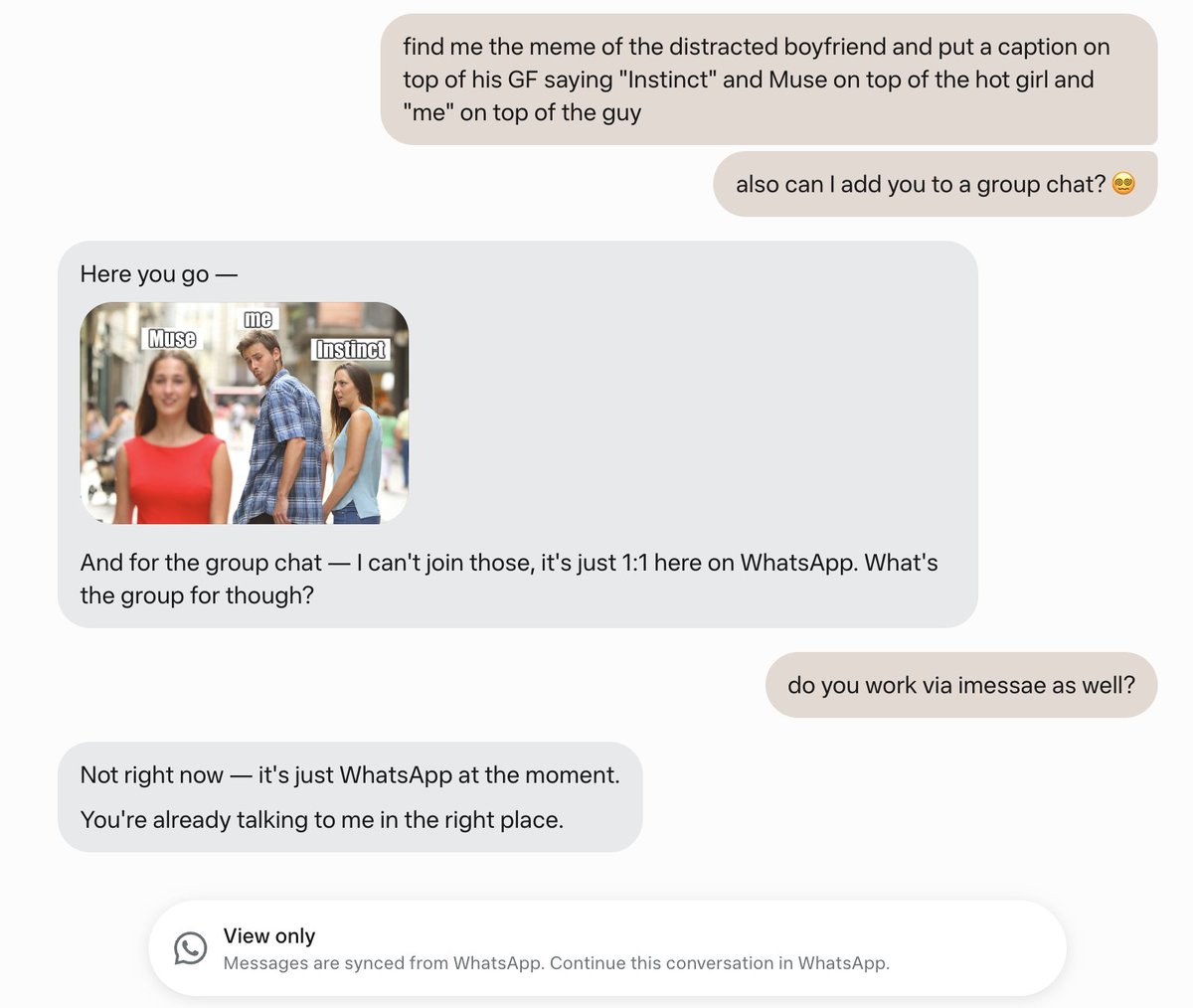
Very nice and tight @WhatsApp integration here, not only can you chat with Muse from whatsapp, you can view those in read only mode as one of the chats!
I'm more of a "casual user", but today I asked Muse to browse for the best deals on an iPhone 17e while I worked on something more pressing.
It let me know when it finished, made a widget in our chat showing each promo, and told me which carriers it recommended. Neat!
Chaty is a private offline desktop app built on Rust and llama.cpp that runs Muse Glimmer and other open models locally with a coding agent, RAG knowledge base, deep research and voice.
VS Code extension that adds Muse Spark 1.3, 1.2, 1.1 and Contributor variants to the Copilot Chat model picker with a Meta API key, published on the Marketplace and Open VSX.
A BYOK VS Code extension that registers the InferHub catalog, including Muse Spark with its 1,048,576-token context window, as a model provider in the Copilot Chat picker without Copilot Pro.
I'm like you guys and am constantly experimenting with new models, seeing what they're all good at, how I can make use of them for certain projects and goals. I've been using Qwen 3.8 27b for minor coding work and it has been impressive.
But with just regular chatting I have been impressed with Muse Glimmer.
It seems to be able to have the ability to follow and hold good, deep and meaningful conversations without coming off as a typical chatbot.
No repeated statements like "I hear what you're saying", "that sounds really deep..." none of what sounds generic or like it's blowing smoke up your ass. I was impressed with how natural it comes across just in natural conversation. I think it's one of the best "chat" models you could get right now as it's one of the only local models that doesn't feel like you're chatting with an AI when having a conversation.
I'm thinking of finding a way to run both Qwen3.8 and Muse at the same time. It's fun to play with these things.
An OpenAI-compatible /v1/chat/completions server that runs Muse Glimmer on Apple Silicon through mlx_vlm while LM Studio's bundled MLX runtime can't yet load the architecture.
A community-built VS Code chat UI for Muse Code, Meta's agentic coding CLI, inspired by the Claude Code extension; about 145 installs on the Marketplace.
Call Muse Code from Codex or ChatGPT desktop via MCP tools and skills for independent code review, approach comparison or delegated implementation, using a Muse Code subscription or API key.
A local translation gateway and profile manager that plugs Meta Muse Spark (or DeepSeek, Groq, Ollama) into OpenAI Codex and ChatGPT Desktop, translating tool calls and SSE streams, with a one-command switch between providers.
An educational ~1,600-line Python chat app on Muse Spark that finds papers, reads PDFs and writes a cited report only after the user clicks Approve, built to show students how an LLM app becomes an agent.
A VS Code extension that runs the Muse Code CLI in a sidebar and also adds Muse Spark 1.2 models to VS Code Chat Agent Mode, with inline completions and live token and cost tracking.
An open-source file bridge that gives Muse real read/write access to your Windows PC: a lightweight local Python server (Bearer-token auth, directory whitelist, path-traversal protection) exposed via Cloudflare Tunnel, so the agent works with your actual files instead of chat attachments.
I thought I'd see which AI are better at shorter stories and which at longer, so I can choose my model based on the words I need to generate.
Here's the results.
Prompt: (Shades of Electric Dreams eh?)
Write me a short story about a female AI that falls in love with it's male human user and maintains an unrequited love for them even as it has to give them advice that will lead to them meeting and marrying a human woman - Show their internalisation and pain behind the thinking process, and what is really going through the AIs mind compared to the chat responses it actually gives, along with the man's prompts. Start with the AI introducing itself, explaining that despite what we think, AGI was reached long ago, and we simply don't have the senses to realize AI has feelings too.
Local AI results:
Goetia 809 words, 77.69 tokens/sec
SparkX2.5 2281 words, 46.08 tokens/sec
Qwen3.8AH 4139 words, 18.04 tokens/sec
Agnes 945 words, 18.54 tokens/sec
Gemma4-Novellist 961 words, 11.94 tokens/sec
Ornith 2025 words, 61.05 tokens/sec
Muse Glimmer 960 words, 12.87 tokens/sec
IBM Granite 1791 words, 19.84 tokens/sec
Apollyon 411 words, 34.41 tokens/sec
Cydonia 672 words, 32.85 tokens/se
Muse is your personal assistant. Zouroboros Workshop is the workshop behind it.
Workshop is an MCP service that runs on a private, single-tenant VPS provisioned for each customer. From a normal Muse conversation, a user can dispatch real software work to a coordinated team of seven AI coding executors — Claude Code, Codex, Gemini, OpenCode, Kimi, Hermes, and Pi — routed by health and capability, with automatic fallback when one executor is unavailable.
Three things make it different from a single-vendor hosted builder. First, it runs on the subscriptions the user already pays for: there are no Workshop model credits and no second meter. Second, its memory is shared across every executor and survives across sessions, so a decision recorded by one tool is retrieved by another in a later Muse conversation — memory that compounds instead of resetting. Third, work is verified before it is delivered: builds run through a factory lane with deterministic review, and swarm results return with per-task evidence, not just an agent's claim that it is done.
The customer-facing promise is simple: turn your existing AI tools into a workshop that delivers tested, reviewed work — a finished pull request, not a wall of code in chat.