Artificial Analysis puts Muse Spark 1.1 at 51 on its Intelligence Index, 8 points above 1.0, and calls it cost and token efficient versus peers.
Resource · Benchmarks & research
Catalog / Use case
About 130 benchmark results and research notes on Muse Spark and Muse Glimmer: arena rankings, index scores, head-to-head tests and architecture teardowns.
139 builds · page 4 of 4
Artificial Analysis puts Muse Spark 1.1 at 51 on its Intelligence Index, 8 points above 1.0, and calls it cost and token efficient versus peers.
Resource · Benchmarks & research
Your product
Sponsored
Put your logo, a line of copy and an image right here, between the builds Muse developers come to read. Same size as a post.
Shown every 12 builds · on every catalog page
MindStudio notes Muse Spark 1.3 topped DeepSWE at 75.4 and placed third on Artificial Analysis, yet in a hands-on game-clone test produced "a cube shooting at other cubes."

Resource · Benchmarks & research
Independent benchmarks and analysis of Muse Spark 1.2, released alongside Muse Code.
Resource · Benchmarks & research
eesel AI reports Muse Spark 1.3 ranks #6 on the Artificial Analysis Intelligence Index, leads long-context and coding rows, but trails Claude Opus 5 on four of six agent evals.
Resource · Benchmarks & research
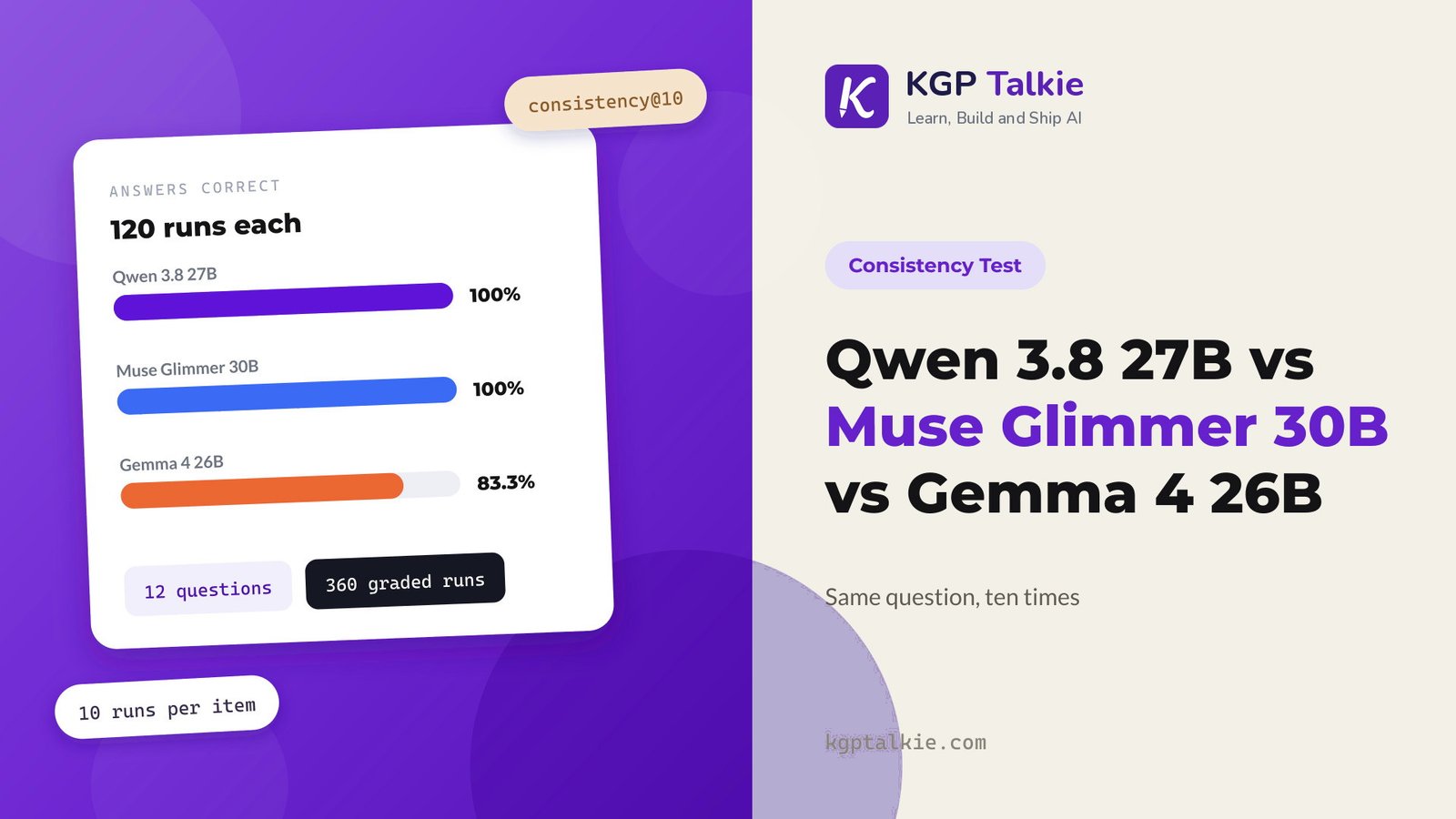
KGP Talkie asked Qwen 3.8 27B, Muse Glimmer 30B and Gemma 4 26B the same twelve questions ten times each to see which answers the same way twice.
Resource · Benchmarks & research
Setup. We run Qwen3.8-Flash-Next NVFP4 as our main agentic model (SGLang, RTX PRO 6000). Before its output reaches a human or gets merged, a second local model acts as judge: reviews the diff, flags real bugs only. Hosted on a 5090 32GB, so we're limited to ~30B NVFP4/GGUF class models. The metric that matters is NOT detection rate — it's false alarms on correct code. A judge that cries wolf gets ignored within a week, exactly like a flaky CI. We built our own battery: 20 injected bugs + 20 clean-but-suspicious snippets (intentional swallowed exceptions, deliberate mutability, weird-but-correct concurrency, short hashes, float patterns that look wrong). Ground-truth labeled, and a stronger model (GLM-5.2 API) arbitrates the judge's prose so scoring isn't vibes. Two passes minimum — single runs lie. Results (40 cases, temp 0, same baremo for everyone): Qwen3.8-27B NVFP4 (no-thinking) • Bugs found: 17/20 • False alarms: 3/20 • Verdict: only pass Nemotron Lightning 30B • Bugs found: 17/20 • False alarms: 0→9 across runs • Verdict: non-reproducible as judge Muse-Glimmer 30B GGUF • Bugs found: 19/20 • False alarms: 12/20 • Verdict: hypercritical Granite 4.1 30B (no-thinki
Reddit post · Benchmarks & research
Your product
Sponsored
Put your logo, a line of copy and an image right here, between the builds Muse developers come to read. Same size as a post.
Shown every 12 builds · on every catalog page
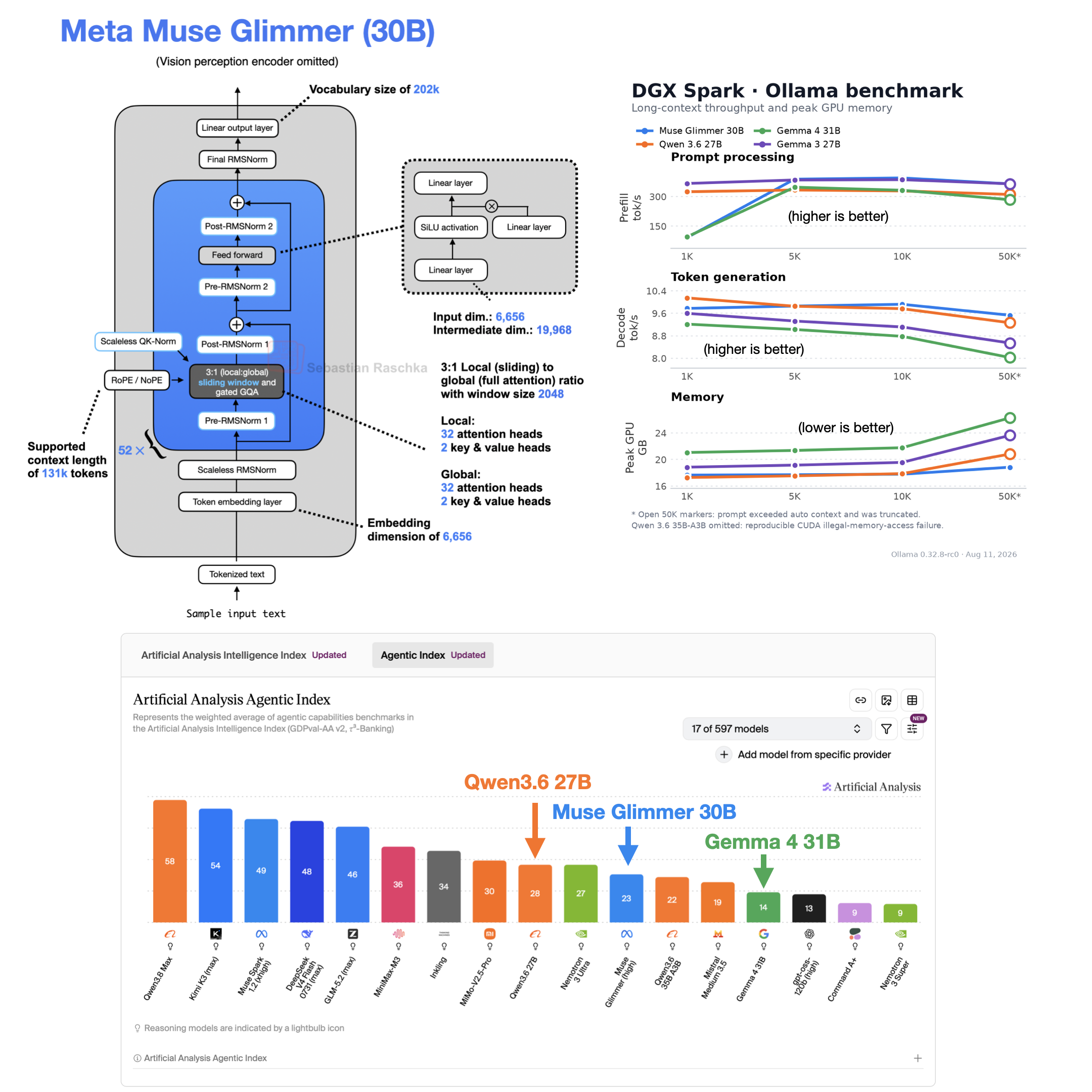
Sebastian Raschka breaks down Glimmer's dense architecture: 3:1 sliding-window to global attention, 32 query heads with only 2 KV heads, and ~52 KiB of KV cache per token.
Resource · Benchmarks & research
I wanted a quick calories counter for myself, using LLMs to evaluate the calories from pictures of meals + descriptions. I needed to pick a model so I made a quick benchmark. The setup was: - Nutrition5k photos for photo + calories: https://github.com/google-research-datasets/Nutrition5k - A tool with access to calories information from USDA FoodData Central + MEXT - I evaluated models based on how many of the meals they managed to have under 20% of error - All on the same randomly picked 25 meals. Models too big for my machine were run through OpenCode Go/OpenRouter. I've also included Spark 1.3 since it'll supposedly be open weights. Results Model % within 20% Mean bias Median Error Qwen 3.8 27b 16% +64 kcal 148 kcal GLM 5.3 Flash 28% +18 kcal 65 kcal Qwen 3.8 Max 32% -11 kcal 48 kcal Muse Glimmer 30b 32% +25 kcal 92 kcal Qwen 3.8 Flash 36% +2 kcal 91 kcal DeepSeek v4 Flash Vision 40% +52 kcal 65 kcal Muse Spark 1.3 48% -24 kcal 45kcal I know it's not the most scientific benchmark, but it's interesting to see that the order is not really linked to model size. The most interesting for me is how Muse Glimmer 30b trounces Qwen 3.8 27b here. I think it hig
Reddit post · Benchmarks & research

Fei Xia
@xf1280
Muse Spark is agentic, which means you can ask it to leverage different test-compute scaling methods to improve quality. Here I ask the model to use parallel subagents to do counting and the results are greatly improved! meta.ai/share/aD4KAPeV…
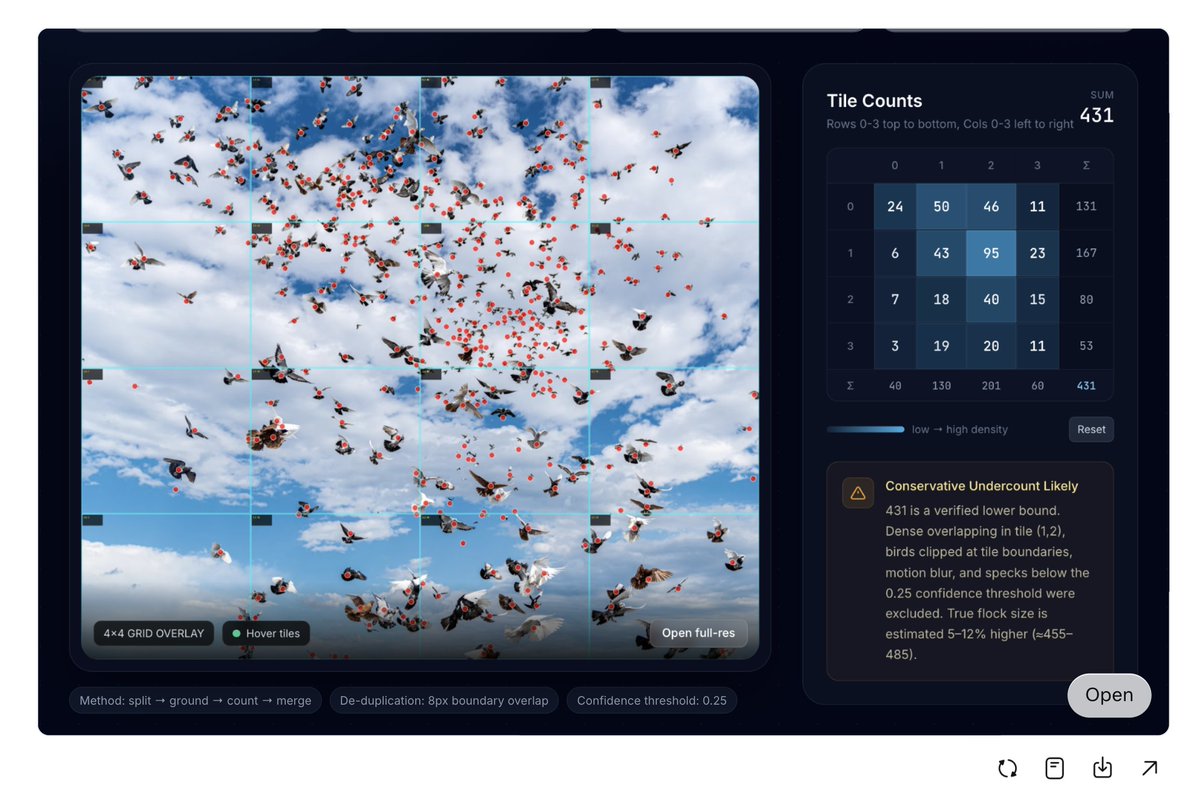
X post · Benchmarks & research· ♥ 166
Artificial Analysis' independent benchmark write-up of Muse Spark 1.3.
Resource · Benchmarks & research
Independent benchmarks and analysis of Meta's open-weight Muse Glimmer.

Resource · Benchmarks & research

Simon Willison
@simonw
Pelicans for Meta's new Muse Spark models - plus I did a bit of a deep dive into the Code Interpreter and fascinating "container.visual_grounding" tools in their meta.ai chat UI simonwillison.net/2026/Apr/8/mus…
X post · Benchmarks & research· ♥ 290

Artificial Analysis
@ArtificialAnlys
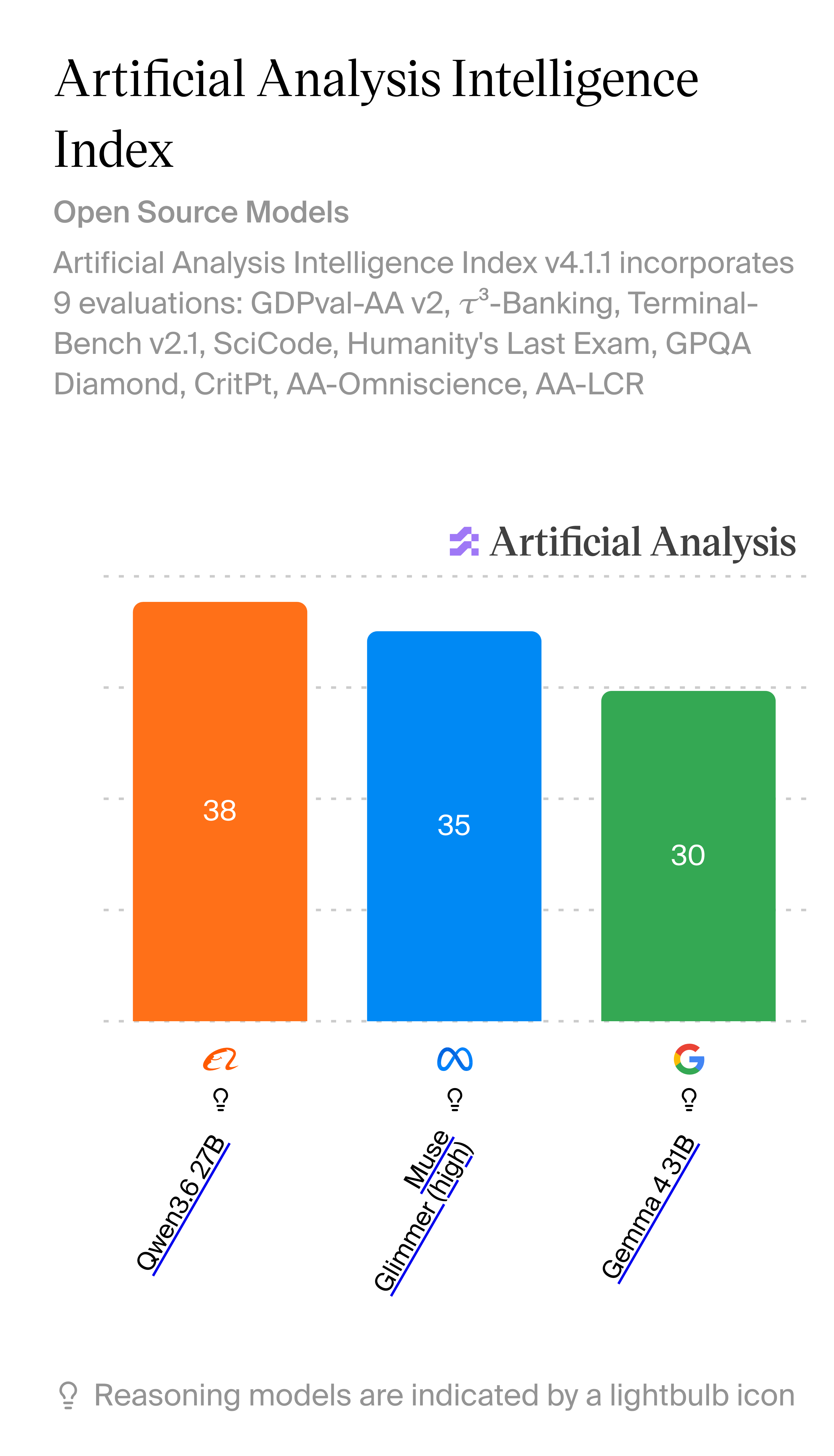
At 30B parameters, Muse Glimmer sits near the Intelligence vs Parameters frontier for open weights models: 5 points above Gemma 4 31B (Reasoning) at the same size, effectively matching Kimi K2.5 (Reasoning) at 33x fewer total parameters, and just behind Qwen3.6 27B (Reasoning),
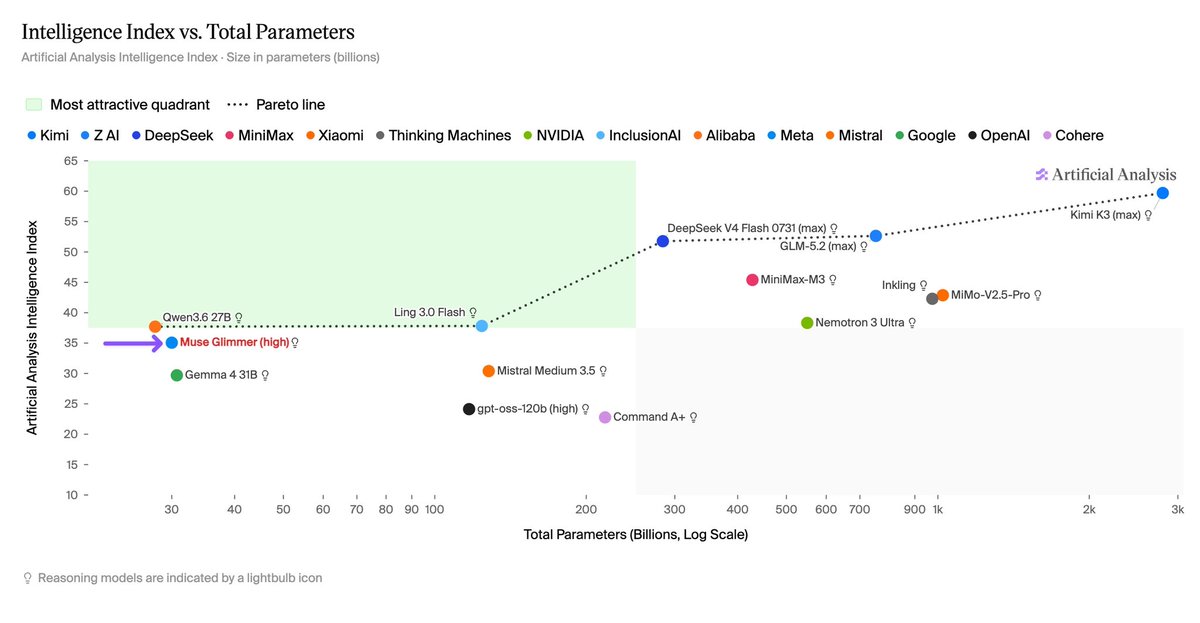
X post · Benchmarks & research· ♥ 60
Benchmark reports on Muse-Glimmer-30B on NVIDIA DGX Spark covering BF16 to Q4 to DFlash (a 10x speedup) and NVFP4 via SGLang, plus a head-to-head against Qwen3.6-27B.
GitHub · Benchmarks & research
I have a classic test for local LLM's. I asked for 8 ball pool game with only one HTML file and Muse Glimmer spend 21k Token(I m using full context so 128k) and only created a 220 lines of HTML and said its done. With my experience its not even close to Qwen 3.6 27B and we are waiting for Qwen 3.8 27B already. What is your toughts about this model. I was so hopeful until this test.
Reddit post · Benchmarks & research
Reddit post · Benchmarks & research
Composio compares Meta's Muse Spark 1.2 with DeepSeek V4 Flash on real-world agentic tasks to find the cheaper model that holds up.
Resource · Benchmarks & research
smol-muse-glimmer scales Muse Glimmer's language backbone down to a 51M-parameter model and trains it on TinyStories, reaching validation cross-entropy of 1.8127 at step 5,000.
GitHub · Benchmarks & research
Disclaimer. This is the first time I've used Muse or VSCode as a harness. The reason I am using VSCode as a harness is this is a research project for my job, and we only have VSCode, Codex, and Claude Code approved for harnesses. I ran it in a folder with only one HTML file (800 lines) that is a Roblox-style COD game. I just gave it a prompt "Can you fix the bugs in the file". It read the file 3 times, found one bug, started to fix it, then got stuck reading the same 10 lines over and over. I imagine it's one of these three issues. • It's a prompt error, being way too vague/open ended for the capabilities of a smaller model. I tried again, with a specific prompt to fix a specific bug, and it still just ends up so confused, trying to grep/find the file despite already having read it, and trying to find the code inside of the file. • It's a limitation of small models running with a large harness/having way too much going on. I tried running it with Pi with its default prompt, and it just got stuck doing tool calls and never actually read the file. Tried running this just directly in the Unsloth Desktop UI with no harness but it failed to parse the file I inputted and tried to gen
Reddit post · Benchmarks & research


 ChatForm
 Tgmlabs