2-bit Muse Glimmer GGUF managed to call 100+ tools on just 14GB RAM. 🔥
Muse Glimmer did a complete repo bug hunt for 5 mins nonstop with: evidence, repro, fix, tests and a PR writeup.
Run and train it in Unsloth.
GitHub repo: github.com/unslothai/unsl…
Samuel Alexander ran Muse Glimmer 30B entirely on a Qualcomm Dragonwing IQ-9075 board for zero-shot PCB defect inspection and tool calling, measuring 21.6 GB resident with full 131K context and 2.84 tokens/s generation.
Exciting to see Meta releasing new open weights this week.
Meta trained the new 30B dense model Muse Glimmer with "agentic" use cases in mind. This generally means task-oriented, multi-turn, and heavy use of tool calling.
I ran Muse Glimmer in the GGUF quant through a bunch of
A static Space showing a Hermes-agentic fine-tune of Muse Glimmer 30B proposing one or two tool calls or answering directly; the model card reports 16/20 on a simulated loop gate.
OK, for context, I have Claude Code desktop app driving the CLI and orchestrating the code and verification tasks to try to save tokens. So Claude runs things, a Deepseek 4.1 Flash (cloud) session does the planning, Qwen 3.8 27b Q8 does the boiler plate coding and Muse Glimmer sanity checks the code and pushes any issues back to Qwen. If there are issues Qwen and Glimmer can't agree on, Deepseek validates. If Deepseek can't sort it out, it goes back to Claude.
This had been working fine, but then in the last few days token use spiked, tasks that used to take 10 minutes were taking an hour or more and Qwen started going into more and more reasoning loops.
It seems that since I last checked (on 12th September) the CLI changed. I used to strip unnecessary tool calls from the prompt using --disallowedTools and enabledPlugins: false.
It would seem that these no longer work.
In the end I got Claude to build a request-dumping diagnostic server, that actually measured the payload bytes, and confirmed --tools (an allowlist) is the flag that works now: 55→7 tools, 161KB→24KB, byte-verified. It also caught something specific to my workflow running the wrapper from inside an already-active
An unofficial macOS desktop client that speaks MSP over muse serve, offering streaming markdown, visible tool calls, session history shared with the terminal and screenshot attachments.
Excited to share Muse Spark! It's a strong natively multimodal model with many surprising properties that emerged. Here, the model is able to use Python tools to make a playable Sudoku game on the web from an image input of the board. ✨
A Muse custom connector exposing 12 curated Nansen smart-money tools for wallet PnL, token flows and Hyperliquid perp trades, built for the Nansen Meridian Buildathon.
BB plugin that runs Muse Code as a first-class provider over the Muse Session Protocol, with streamed timeline, tool rows, approvals, model picker and a subscription usage meter.
I just built and validated a complete Muse Glimmer deployment for one DGX Spark. I didn’t make another quant—I integrated the available pieces into a pinned, verified, DFlash-accelerated, tool-capable, reboot-durable stack that actually works in OWUI.
A start/stop/status launcher that serves the NVFP4 Muse Glimmer 30B checkpoint on NVIDIA DGX Spark with vLLM, Glimmer's reasoning and tool parsers, and its DFlash speculative decoder.
Simon Willison ran an 18.16GB build of Muse Glimmer locally, testing code exploration and image description. He found multi-step reasoning and tool use strong and creative generation mixed.
An experimental macOS gateway that keeps the stock Muse Code CLI in charge of the UI, sessions and tools but swaps the model connection for OpenAI or Z.ai models via a loopback gateway.
An installable Muse skill that deep-reads your Instagram saved posts with AI and keeps them searchable on your own machine, also exposed as an MCP server for other tools.
Muse Glimmer Cookbook
Clone it, run it on the GPU you already own, and ship a working agent — one that plans, calls tools, and self-corrects — in a single sitting, fully offline.
Muse Glimmer is an open-weight model built for local agentic work on a single GPU. This cookbook is how you go from weights to a running agent.
Previously shared Liquid AI's Cookbook.
A pinned llama.cpp recipe for Muse Glimmer 30B on one NVIDIA GB10 that verifies Meta's official GGUFs by SHA-256 and reproduces text, tool-call, coding, vision and throughput checks.
Scripts that run Muse-Glimmer-30B with vision and tool calling on a 32GB M2 MacBook Pro via llama.cpp and Metal, without admin or sudo access, pulling Meta's official GGUFs.
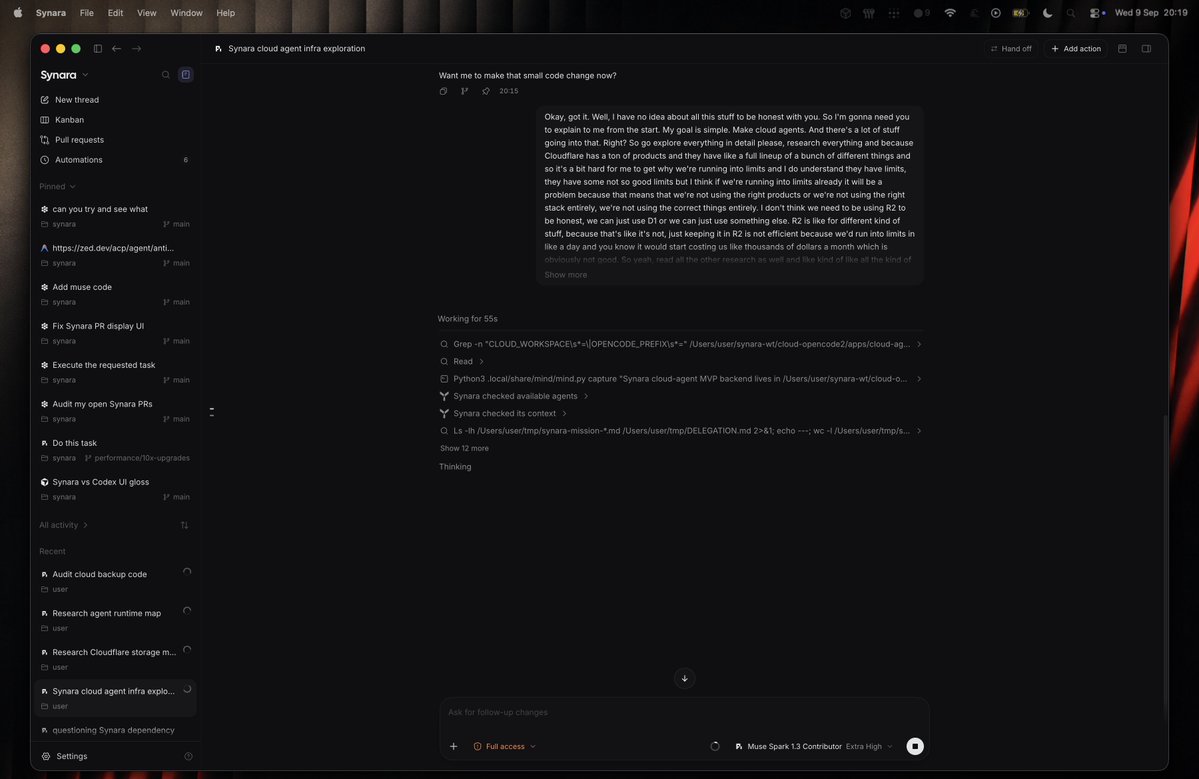
I swear Muse Spark 1.3 is a really good model. Like I don't know if it's just my setup or something. But it just constantly surprises me. So in Synara there's a thread/agents tool where it can create new threads and communicate and manage agents. And literally always, like
A Muse Code plugin that policy-checks every tool call against an Agentic Control Plane workspace before it runs, returning allow, ask or deny and logging each decision with its reason.
Rohan Adwankar found Muse runs on Cloud Hypervisor microVMs with a 327 MB Rust harness that boots in ~40 s, an on-VM Postgres with 194 tables and 60+ privsep tool workers.
I wanted a quick calories counter for myself, using LLMs to evaluate the calories from pictures of meals + descriptions.
I needed to pick a model so I made a quick benchmark.
The setup was:
- Nutrition5k photos for photo + calories: https://github.com/google-research-datasets/Nutrition5k
- A tool with access to calories information from USDA FoodData Central + MEXT
- I evaluated models based on how many of the meals they managed to have under 20% of error
- All on the same randomly picked 25 meals.
Models too big for my machine were run through OpenCode Go/OpenRouter. I've also included Spark 1.3 since it'll supposedly be open weights.
Results Model % within 20% Mean bias Median Error Qwen 3.8 27b 16% +64 kcal 148 kcal GLM 5.3 Flash 28% +18 kcal 65 kcal Qwen 3.8 Max 32% -11 kcal 48 kcal Muse Glimmer 30b 32% +25 kcal 92 kcal Qwen 3.8 Flash 36% +2 kcal 91 kcal DeepSeek v4 Flash Vision 40% +52 kcal 65 kcal Muse Spark 1.3 48% -24 kcal 45kcal I know it's not the most scientific benchmark, but it's interesting to see that the order is not really linked to model size.
The most interesting for me is how Muse Glimmer 30b trounces Qwen 3.8 27b here. I think it hig
An experiment running Muse Glimmer 30B Q4_K_M via llama.cpp on an RTX 4060 laptop with 8 GB VRAM, testing autonomous Python bug fixing, tool-failure recovery and multimodal invoice extraction.
Ran the model with quants (Q4) by Unsloth with latest (build from master) llama.cpp server.
It takes ~20GB ram running on M5 Pro with 48GB at about 17t/s. Didn't do any reasoning loops/overthinking.
Overall, sits below Qwen3.6 27B, wasn't able to get good code (frontend and backend) results. On the positive side, it didn't fail any tool calls.
Your opinions/findings?
Watch more: https://www.youtube.com/watch?v=_5wKhkUT438
Muse Mac Connector is an open-source macOS menu-bar app that exposes an authenticated tool set over a Cloudflare tunnel so Meta Muse can take user-approved actions on files and apps on the user's Mac.
muse-code-acp is an unofficial Node adapter that exposes Meta's Muse Code through the Agent Client Protocol, so it can be driven from Zed or VS Code with streaming, tool calls and MCP servers.
A benchmark that tests whether Muse Glimmer 30B on a single RTX 5090 works as an OpenCode backend, using the same tasks as earlier DeepSeek and Qwen runs; first results show 18/18 episodes with zero malformed tool calls.
Taylor Arndt retried Muse after Meta Connect with Gmail, Google Calendar, GitHub and her own product-management tool connected, and found it inferred her COO role from calendar data and became useful for ongoing task management.
You.com's harness for evaluating Muse Glimmer 30B on DeepSearchQA with You.com MCP tools inside pi sessions. A custom RLM v5 extension reached F1 0.8054 on 50 tasks (0.6910 over 900x3) versus 0.50 for plain skill injection.
Meta's announcement of Muse Spark 1.3 for Muse Code and the Meta Model API, claiming ~20% fewer tool calls and ~25% fewer tokens than 1.2, with a max reasoning mode.
Muse Spark 1.2 supports a broad range of multimodal tasks, from turning visuals into working code to translating perception into physical action. It also brings robust audio-visual understanding to enable video-heavy workflows common in real-world enterprise use.
Today, we’re
Introducing Muse for Marketing
Muse can finally connect to all your ad accounts and SEO tools
Now Muse has access to:
> Google Ads, Meta Ads and 12+ ad platforms
> ChatGPT Ads
> All SEO tools (GSC, GA4, Semrush, Ahrefs)
> Shopify, WordPress, Webflow, HubSpot, PostHog
So Muse
Demo that turns an ops REST API into eight MCP tools for Muse Code through Kong AI Gateway 2.0, with per-identity tool ACLs so an investigator can diagnose but only an operator can roll back.
I'm just using OpenWebUI with a simple FastMCP server. Every other model I've tried will simply run a few lines of Python and give me the result. Glimmer seems to overthink like crazy to the point of being useless. On the carwash test it tried to compute emissions using Python. I'm using the recommended sampling parameters, default template, and I've tried both unsloth's Q6_K_XL and Meta's dynamic GGUFs. Any ideas?
EDIT: It seems like it's definitely related to the tools available. With them disabled, it's reasonably efficient. I guess it's just overly eager to call every tool it can unlike Qwen or Gemma in my experience.
Pelicans for Meta's new Muse Spark models - plus I did a bit of a deep dive into the Code Interpreter and fascinating "container.visual_grounding" tools in their meta.ai chat UI simonwillison.net/2026/Apr/8/mus…
Simon Willison's notes on Muse Spark, Meta's first model since Llama 4: hosted, not open weights, with a private API and interesting tools in meta.ai chat.
A browser-only agent console for Muse Glimmer 30B that renders the model's ATEM tool-call format client-side, streams from a local server and runs every tool inside the tab across seven capability tracks.
Muse Image from @aiatmeta is live on fal.
It's an agentic image model that plans your composition, uses tools, and self-corrects before you ever see a result. Complex briefs hold together instead of falling apart.
Meta is back with Muse Glimmer: a 30B open-source multimodal model built for local, agentic use.
HF is shipping day-0 support and I built a few demos to see what it can do.
First: we gave Glimmer tools and asked it to quantize itself.
A native macOS window for Muse Code that drives muse serve over MSP and renders approvals, questions, plans, todos and tool output as interface elements instead of terminal text.
AICodeKing reviews Muse Glimmer for local agent setups, finding it strong at tool calling, multi-step tasks and failure recovery but weaker on general benchmarks.
There's an SDK in developer preview for building your own agents on Muse Code. Embed them in your apps, connect custom tools, stream progress, and resume sessions later.
A pure-stdlib Python proxy that exposes Meta API access to Muse Spark through OpenAI-compatible endpoints for tools like OpenCode and Hermes, with no muse CLI required.
Introducing floo, a cloud platform where your personal agent can build and run apps for you.
Tell Muse what you need. It builds the software. floo handles hosting, data, and login, giving your Muse tools it can keep using and you an app to see and guide its work.
Launching
A set of small fixes that let Muse Spark run in pi, Agent Orchestrator, opencode and other OpenAI-compatible tools, handling its non-standard SSE event and missing model-catalog entries.
A zero-dependency Ruby client for Meta's Model API focused on the Responses API: reasoning replay across tool loops, previous_response_id state, web_search grounding and typed errors with retries.
Ben Burtenshaw's Gradio agent runs Muse Glimmer on an Inference Endpoint with read-only Hugging Face MCP tools to search and inspect Hub models, datasets, Spaces, docs and papers.
Call Muse Code from Codex or ChatGPT desktop via MCP tools and skills for independent code review, approach comparison or delegated implementation, using a Muse Code subscription or API key.
A static teardown of Muse 3.0 for macOS plus Android and iOS builds, documenting shipped tools for iMessage, WhatsApp, Mail, screen control, background sync and a bundled Chrome extension.
STARTUP HAKK tests Muse Spark 1.3 and argues the harness, tools and context around a model matter as much as the model, pitching their OpenMonoAgent harness.
It's free to use, of course with meta you're probably the product if it's free but generally it's great! I set it up today and tested it a bunch.
Hoping for some feedback, and if you need some help setting it up feel free to ask on here or let me know on the discord server!
-Rob
A guide and tooling for pointing Muse Code's meta provider at any OpenAI-compatible gateway with API-key auth and no Meta login, including workarounds for 1.0.1's bearer-withholding change.
A local translation gateway and profile manager that plugs Meta Muse Spark (or DeepSeek, Groq, Ollama) into OpenAI Codex and ChatGPT Desktop, translating tool calls and SSE streams, with a one-command switch between providers.
By chatting normally with the Muse iOS app I was able to have it send a zip of its entire filesystem from the linux root to my Google Drive via the google connector.
/home/hatch is the agents home and contains top level files live soul.md, identity.md, memory, tools, and more
Muse Glimmer can complete multi-step agentic tasks end-to-end from a single natural language prompt.
In this demo, it autonomously discovers a local Home Assistant instance via network tool calls, queries device APIs, writes a responsive HTML/CSS/JS dashboard from scratch, and
Meta's official recipes for building agents and coding tools on the Model API with Muse Spark 1.3, covering API basics, multi-agent patterns and end-to-end use cases via OpenAI- and Anthropic-compatible SDKs.
A few things right off the bat:
• it reasons very efficiently. Like Grok 4.5 levels of efficient thinking
• it quantizes very well. My first few tests with iq3_xxs were better than Qwen/Gemma behaved at that size
• its knowledge depth is amazing. It beats Qwen3.6 27B on no-tools trivia.
• in OpenCode it is a much more efficient agent than 27B. Both models accomplish their tasks but Muse-Glimmer got there faster every time
I'll say that it's worse at most things coding, probably being closer to Gemma4-31B level.. but damn there's a lot of places where I'd use this model on a 24GB GPU right now and it's been a while since anything has filled that spot except for 3.6-27B
Setup the latest (master) version of llama.cpp server with the guide and the official GGUF weights by Meta AI: https://huggingface.co/meta-models/Muse-Glimmer-30B-GGUF and connected the Hermes Agent to the llama.cpp endpoint.
Getting about 22t/s (+3-4t/s) on M5 Pro, using ~24GB including the drafter (provided by Meta).
The model did correct tool calls and actually did some useful work inside the Hermes Agent. Moreover, the resulting coding task/project works, which was not the case when running the model with OpenCode.
Watch more: https://www.youtube.com/watch?v=cmENEolUtM4
Inference tuning notes for serving Muse Glimmer 30B NVFP4 with DFlash on a single NVIDIA DGX Spark as a consistent agent backend; the repo reports 27.5 tok/s average and 90/100 on its tool eval with 128K context.
A controlled local benchmark on an M1 Max comparing Muse Glimmer 30B with Qwen 3.6 35B and Qwen 3.8 27B on tool calling and data-science tasks; Glimmer passed 24/30 versus Qwen 3.8's 30/30.
Wavect's guide covers Glimmer's hardware targets (24–32GB) and tool-use scores such as MCP-Atlas 75.5 and SWE-Bench Pro 51.2, and recommends a 20–30 task pilot before production.
A Muse agent receives a one-time secret two ways: the hard way (email link, redacted URL, dropped decryption key — 45 min) and the agent-native way (a Claude agent creates the request with one Qatom call + ~$0.10, the Muse agent retrieves with one free call — 2 seconds, secret delivered once then deleted). Secure Secrets Exchange on Qatom. Tool: https://github.com/StarwaterHeaven/secure-secrets-exchange — full story: https://github.com/StarwaterHeaven/qatom-use-cases/blob/main/stories/sse-credential-handoff-torque.pdf
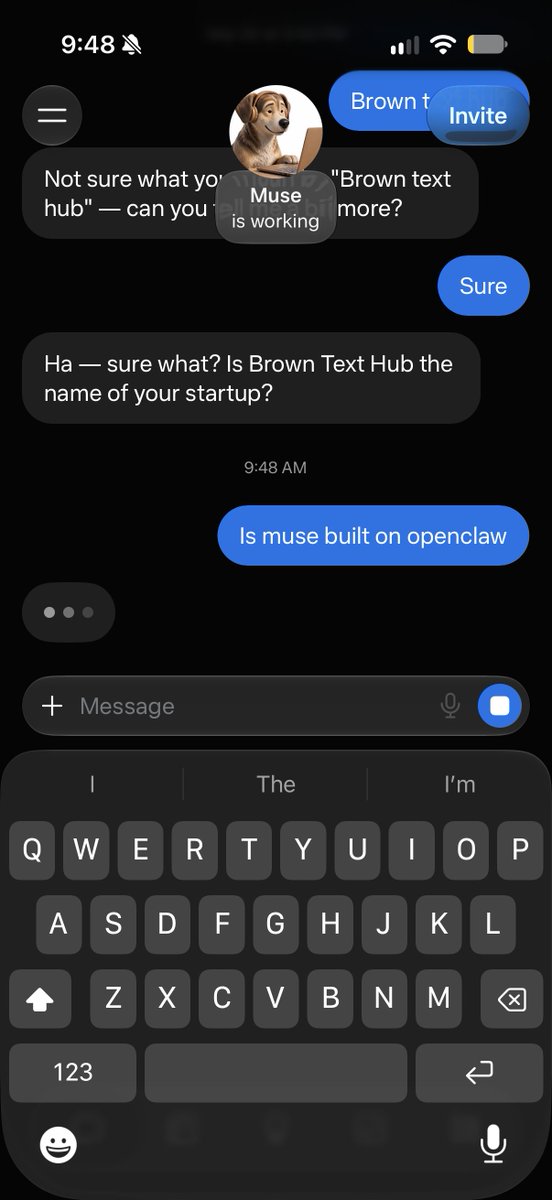
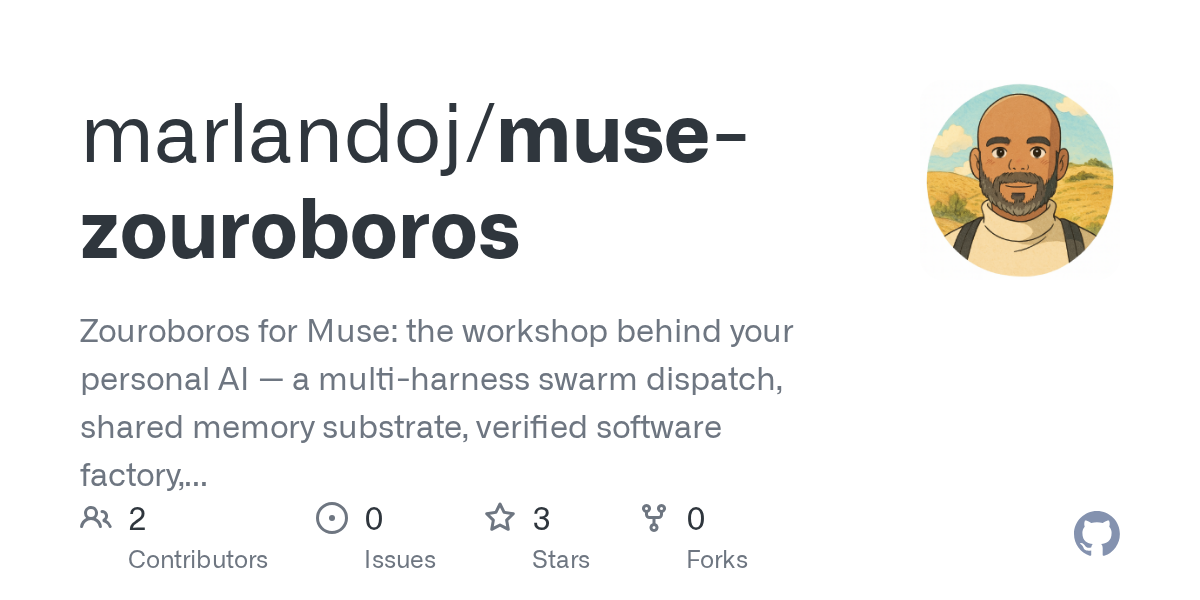
Muse is your personal assistant. Zouroboros Workshop is the workshop behind it.
Workshop is an MCP service that runs on a private, single-tenant VPS provisioned for each customer. From a normal Muse conversation, a user can dispatch real software work to a coordinated team of seven AI coding executors — Claude Code, Codex, Gemini, OpenCode, Kimi, Hermes, and Pi — routed by health and capability, with automatic fallback when one executor is unavailable.
Three things make it different from a single-vendor hosted builder. First, it runs on the subscriptions the user already pays for: there are no Workshop model credits and no second meter. Second, its memory is shared across every executor and survives across sessions, so a decision recorded by one tool is retrieved by another in a later Muse conversation — memory that compounds instead of resetting. Third, work is verified before it is delivered: builds run through a factory lane with deterministic review, and swarm results return with per-task evidence, not just an agent's claim that it is done.
The customer-facing promise is simple: turn your existing AI tools into a workshop that delivers tested, reviewed work — a finished pull request, not a wall of code in chat.