shipwithmuse

Entries matching “slides”

5 builds · page 1 of 1

U

mr_il

u/mr_il

My fun weekend project was to try to make the new Muse Glimmer 30B work with a longer context, deciding to go for 512k first. I had expected the usual YaRN shenanigans and maybe a LoRA. I couldn't have been wrong more. Upon closer look, Glimmer turned out to be rather unusual architecturally. The thing that make long-context adaptations painful in other models, full attention layers with token position encoding, it simply not there. Instead, only 2048 tokens-wide SWA layers have RoPE, and full GQA attention layers have no position encoding at all. It appears the model is trained to work with long-distance token relationships inferred from the context and SWA layers. It's a rather bold architecture bet, but it seems Meta managed to pull it off. As a result, the model architecture appears to be uniquely suited for context extension by simple mechanical means. To change model context length from stock 128k to, say, 512k, you need only to change “max_position_embeddings” config setting from 131072 to 524288. What confuses other models, like Qwen3.5 family, Glimmer just takes into its stride. I spent close to 70h of compute on DGX Spark to test stock model with extended context on a

Reddit post · Local & open models★ Pick
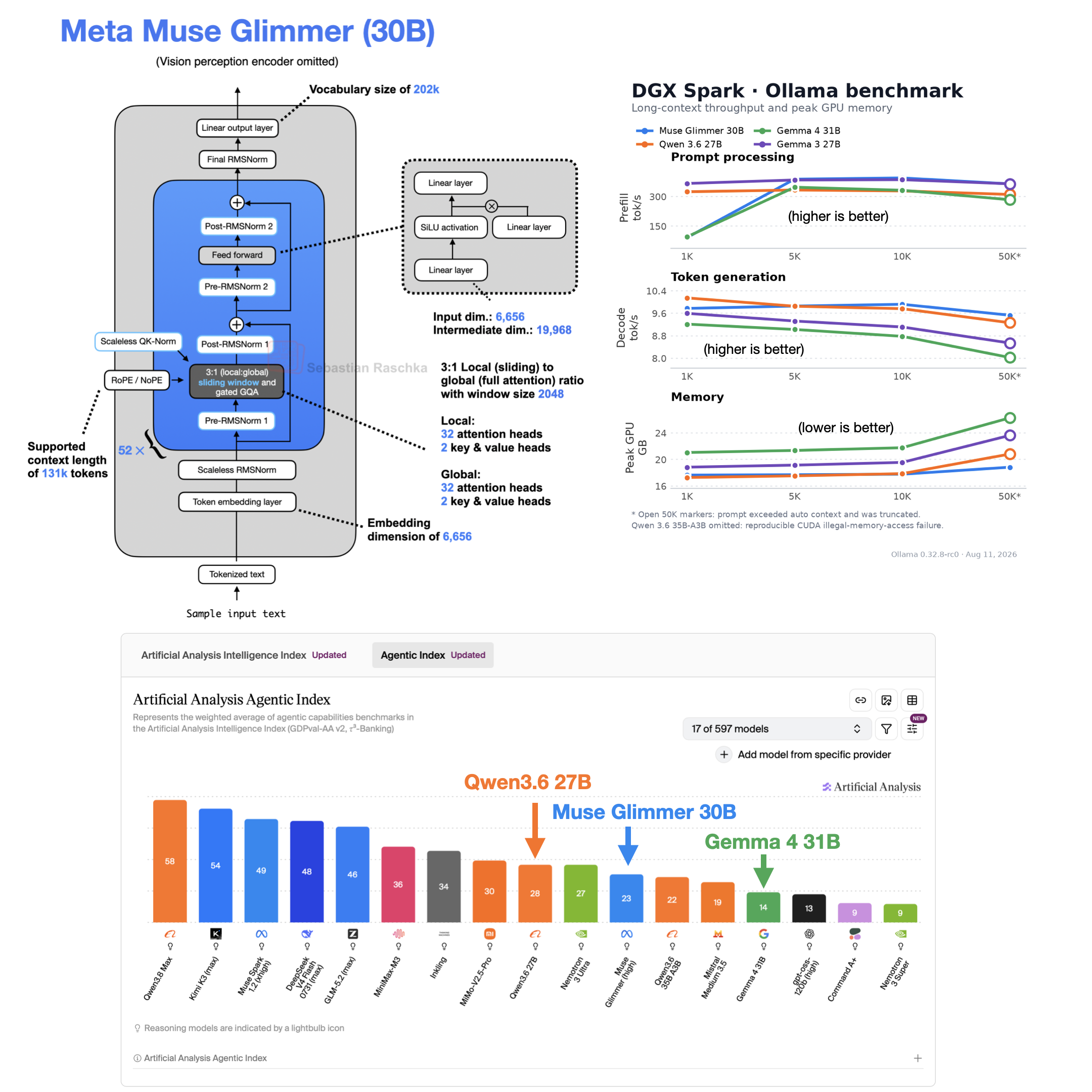
Muse Glimmer 30B stretched to 512K context

Your product

Sponsored

Put your logo, a line of copy and an image right here, between the builds Muse developers come to read. Same size as a post.

$100/week

Put your product here

Shown every 12 builds · on every catalog page

S

sebastianraschka.com

sebastianraschka.com

Sebastian Raschka breaks down Glimmer's dense architecture: 3:1 sliding-window to global attention, 32 query heads with only 2 KV heads, and ~52 KiB of KV cache per token.

Resource · Benchmarks & research

Muse Glimmer 30B architecture notes

Yash Patel

@yashvarpatel

🚀 Muse Spark 1.1 is live! Our new natively multimodal reasoning model brings powerful agentic & coding upgrades. CUA improved a lot, eg: on OS-World from 53.5 ➡️ 80.8 in 3 months. Fun personal CUA demo attached below: on making slides from these ~200 images of my trip to Kauai.

X post · Agents & automation· ♥ 16

Slides from 200 trip photos via computer use

elie

@eliebakouch

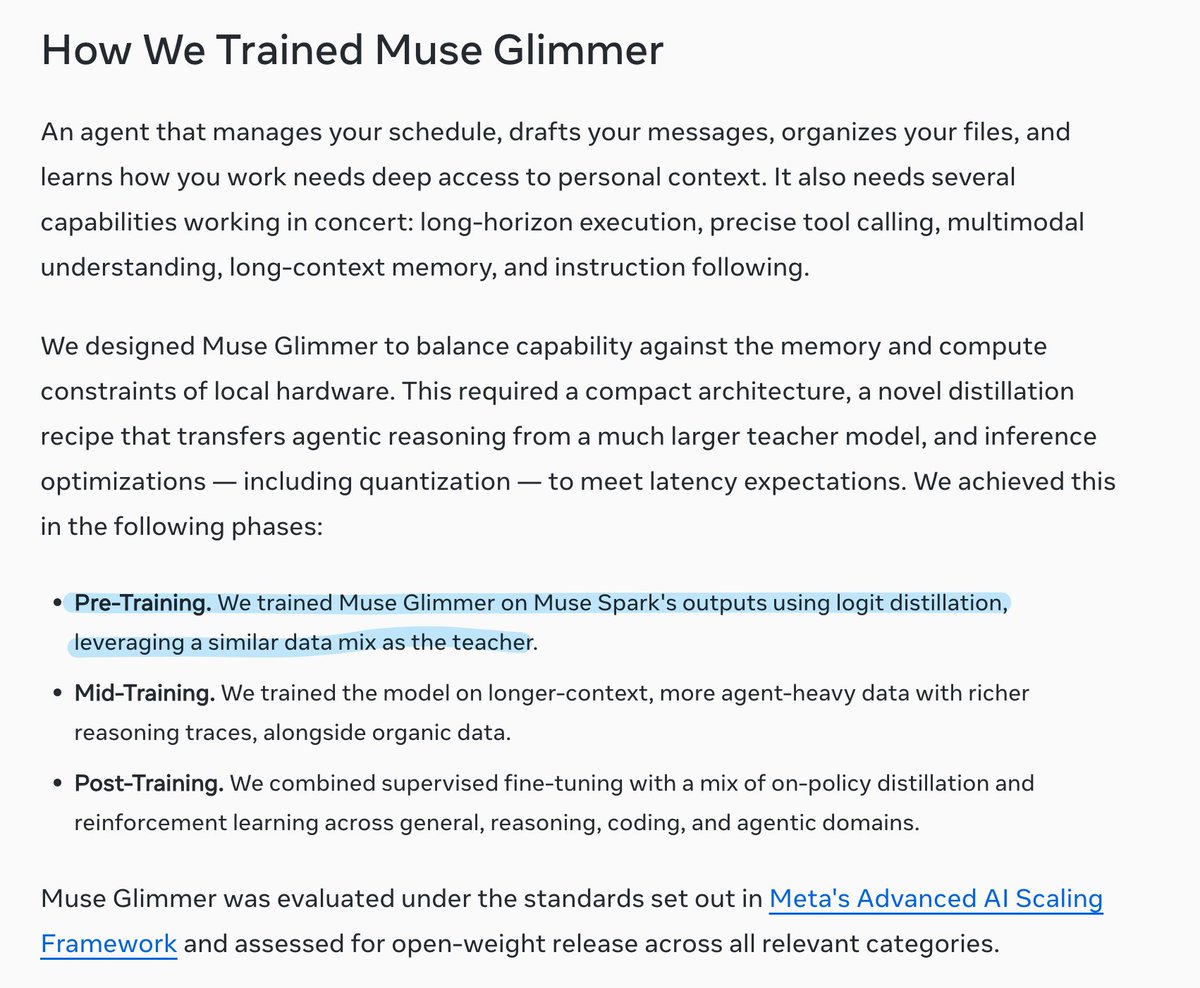
extremely exciting to see meta getting back into open weight models with a 30B dense first, and soon muse spark 1.2 they used knowledge distillation from muse spark, architecture wise it's similar to gemma 4 (which is llama 3 + swa (again!) + vision encoder), with scale free QK

X post · Benchmarks & research· ♥ 464

Glimmer architecture teardown

U

Ok-Inevitable8391

u/Ok-Inevitable8391

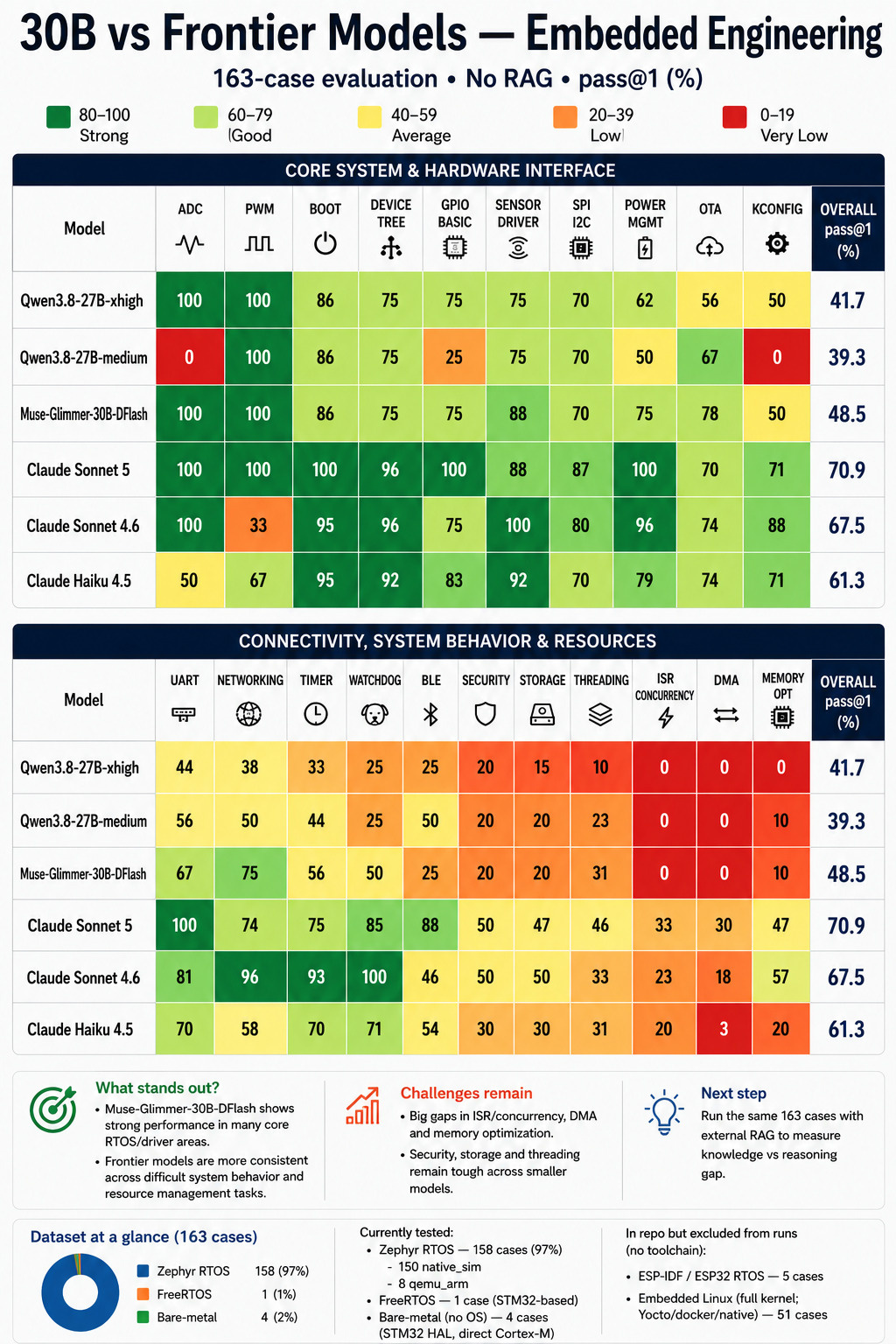
Benchmarked qwen3.8 xhigh, medium and muse glimmer. Xhigh effort mode with qwen3.8 took almost 30hrs. (And still failed on 16 cases because of the 32K output token limit) Medium effort mode and muse glimmer were 3-4 hours each. But I'm actually surprised by the muse glimmer results, they came better than the qwen. These benchmarks are on implicit knowledge of the model, which is a bit unfair to smaller models, but throw in a RAG and I'm sure they get on par with frontier models. I have taken the result of claude models directly from embedeval repo by ecro. I'm not pushing qwen down here, I like how qwen thinks and gives better results. I know with more context and RAG qwen will do better. I'm just appreciating muse here, cause i feel it is underrated. The advantage is efficient kv cache due to sliding window, which can give you more context window.

Reddit post · Benchmarks & research

Glimmer vs Qwen 3.8 on an implicit-knowledge eval