
An open-source collection of 150 auditable connector skills for Muse that install with one pasted prompt, declare their allowed hosts and keep credentials in the user's Muse vault.
Skill · Connectors & MCP★ Pick
20 builds · page 1 of 1
An open-source collection of 150 auditable connector skills for Muse that install with one pasted prompt, declare their allowed hosts and keep credentials in the user's Muse vault.
Skill · Connectors & MCP★ Pick
Your product
Sponsored
Put your logo, a line of copy and an image right here, between the builds Muse developers come to read. Same size as a post.
Shown every 12 builds · on every catalog page
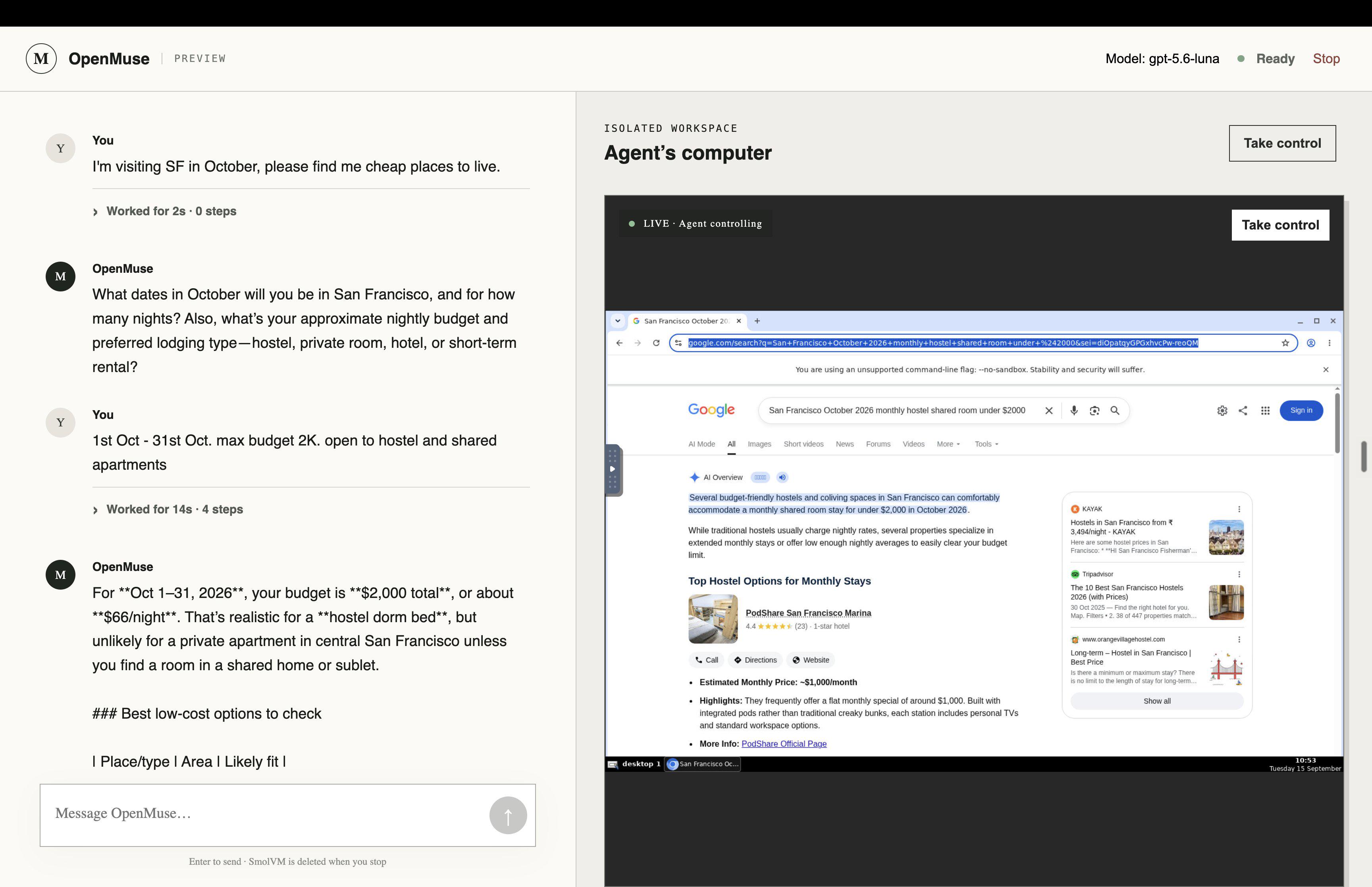
Built an open-source version of the Muse agent app which can be used with any model provider, run privately with local models. Please give it a try and reach out for any feedback ✌️ https://github.com/CelestoAI/celesto/tree/main/open-muse
Reddit post · Agents & automation
Composio compares Muse Code and OpenAI Codex on pricing, models, agent architecture, extensibility, safety and open-source support.
Resource · Coding & dev tools
Open-source, stateless MCP connector that publishes explicitly approved text posts from Muse to LinkedIn, with two tools and no database or scheduler.
Skill · Content & creative
Muse Code Remote is an open-source web UI and outbound WebSocket relay that lets users drive their terminal Muse Code agent from any browser without opening ports.
GitHub · Coding & dev tools
MuseFi is an open-source financial workspace pack for Muse: risk caps, a ticket schema and a paper broker that fills a synthetic tape, all deterministic and replayable.
Skill · Business & commerce· ★ 11
Threadwell Slack is an open-source Muse connector that bridges to Slack's official MCP server via a local OAuth bridge, submitted to the Muse Connector Platform with a full submission pack.
Skill · Connectors & MCP
Been building this for a few months, mostly for myself, and it just got a proper release so figured I'd post it. It's a native GGUF inference runtime with OpenAI/Anthropic-compatible APIs and a chat UI. The whole point is one consumer NVIDIA card + lots of RAM: MoE models that don't fit in VRAM run their experts on the CPU, or split with a hot set cached on the card. It figures out what fits at startup instead of you guessing offload layer counts. Runs Qwen 3.x dense and MoE (incl. Qwen3.8-Flash-Next), DeepSeek-V4-Flash, Ling 3.0, K2-Horizon, Gemma 4, Laguna, Muse Glimmer. Image input via mmproj on the Qwen models. Also does Z-Image-Turbo image gen next to a chat model on the same card. Numbers from my laptop (5070 Ti 12 GB, 60 GB RAM): - Qwen3.8-Flash-Next IQ1_S: ~35 tok/s decode, ~475 tok/s prefill - Qwen3.8-27B IQ2_XXS: ~40 tok/s - DeepSeek-V4-Flash: 6-7 tok/s (that's basically the DRAM bandwidth limit) - Z-Image 1024x1024 in ~15 s with a 35B loaded beside it Stuff I think is neat: - Kernels are compiled at runtime by NVRTC, so no CUDA toolkit in the wheel and no nvcc. Same kernel source compiles as plain C++ for a CPU-only backend. - KV cache in f16 / q8_0 / TurboQu
Reddit post · Local & open models

Atai Barkai
@ataiiam
🎉 Introducing 𝙾𝚙𝚎𝚗𝙼𝚞𝚜𝚎 An open source, self-hostable personal assistant that works with any agent harness. Includes: - Computer use: browser, terminal & files - Connectors for your personal apps - Ideas, goals & progress tracking - Built for Mobile and Web Repo → https://
X post · Agents & automation· ♥ 5.8K
An unofficial, open-source (MIT) VS Code extension that runs Meta's Muse Code (Muse Spark 1.3) in a side panel. Every tool call shows as a row with its diff, permission modes (Manu
GitHub · Coding & dev tools
LLMs have become extremely good at coding, maths etc, but how well do they do at playing a simple dungeon/maze game that even a child can solve easily? The LLM has to navigate a 10x10 grid map, completing objectives in the right order (collect weapon > kill monster > head to exit) while navigating the dungeon and avoiding walls. Three illegal moves fail the run. All models are tested with reasoning enabled. The code and more info on my GitHub if you want try it yourself: https://github.com/shinomakoi/dungeon-bench Model leaderboard: Model Score DeepSeek-V4-Pro (high) 🥇12/12 Gemma-4-31B-it 🥈11/12 Qwen-3.8-27B (medium) 🥈11/12 GLM-5.3-Flash (high) 🥈11/12 Muse-Glimmer-30B (medium) 🥉10/12 DeepSeek-V4-Flash (high) 🥉10/12 Granite 4.2 (full) 8/12 KAT-Coder-V2.5-Dev 8/12 Nemotron-3.5-Lightning-30B-A3B 5/12 Model Illegal moves DeepSeek-V4-Pro (high) 🥇0 Gemma-4-31B-it 🥈1 Qwen-3.8-27B (medium) 🥈1 Muse-Glimmer-30B (medium) 🥉2 Granite 4.2 (full) 🥉2 Nemotron-3.5-Lightning-30B-A3B 7 GLM-5.3-Flash (high) 8 KAT-Coder-V2.5-Dev 10 DeepSeek-V4-Flash (high) 12 DeepSeek-V4-Pro: By far the best result. Basically perfect performance in all maps.
Reddit post · Benchmarks & research

harjot.co
@harjjotsinghh
I pay for @Muse Code but didn't want to live in a terminal. On Windows it's WSL-only. So I built Helicon: an open-source desktop app for the actual Muse CLI. • uses your existing muse login, no API key • talks to muse serve over MSP, so Muse stays the agent • resumes
X post · Coding & dev tools★ Pick· ♥ 129
Helicon is an open-source desktop and web app that wraps Meta's Muse Code CLI in a Codex/Claude-style interface, grouping sessions by project with history, resume and diffs on Windows, macOS and WSL2.
GitHub · Coding & dev tools★ Pick
nanoMuse is an open-source personal AI agent inspired by Meta Muse that runs on Android with a shell, browser, MCP, skills and scheduled tasks, and can be pointed at DeepSeek, OpenAI or Ollama models.
GitHub · Agents & automation
Index of Telep IO's open-source Muse connectors, where the agent prepares a real-world action (a letter, a fax, a call) and a human reviews, pays and confirms before a provider performs it.
Skill · Errands & personal agent

Alexandr Wang
@alexandr_wang
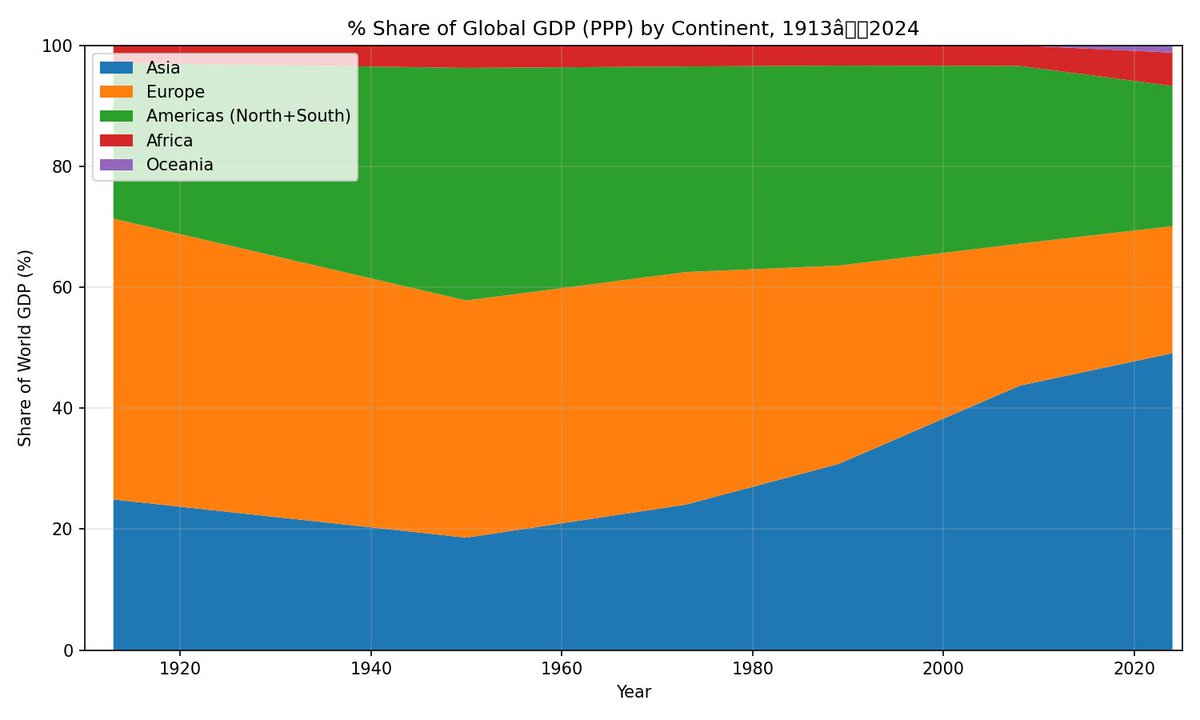
i find muse spark is very good at data analysis—both finding relevant open-source data and analyzing it. for example, here's my results for analyzing global share of GDP over past century: meta.ai/share/cw54skLB…
X post · Benchmarks & research· ♥ 591
Independent open-source community and connector directory for personal agents: search connectors by outcome, share workflow prompts, and import an OpenAPI 3.x document to prepare a connector listing.
Skill · Connectors & MCP
dealscan is an open-source agent built on Muse Glimmer 30B that reads producer, distribution and publishing agreements, extracts the payment terms and flags risky clauses in a markdown and JSON report.
GitHub · Business & commerce
Your product
Sponsored
Put your logo, a line of copy and an image right here, between the builds Muse developers come to read. Same size as a post.
Shown every 12 builds · on every catalog page
Muse Mac Connector is an open-source macOS menu-bar app that exposes an authenticated tool set over a Cloudflare tunnel so Meta Muse can take user-approved actions on files and apps on the user's Mac.
Skill · Connectors & MCP
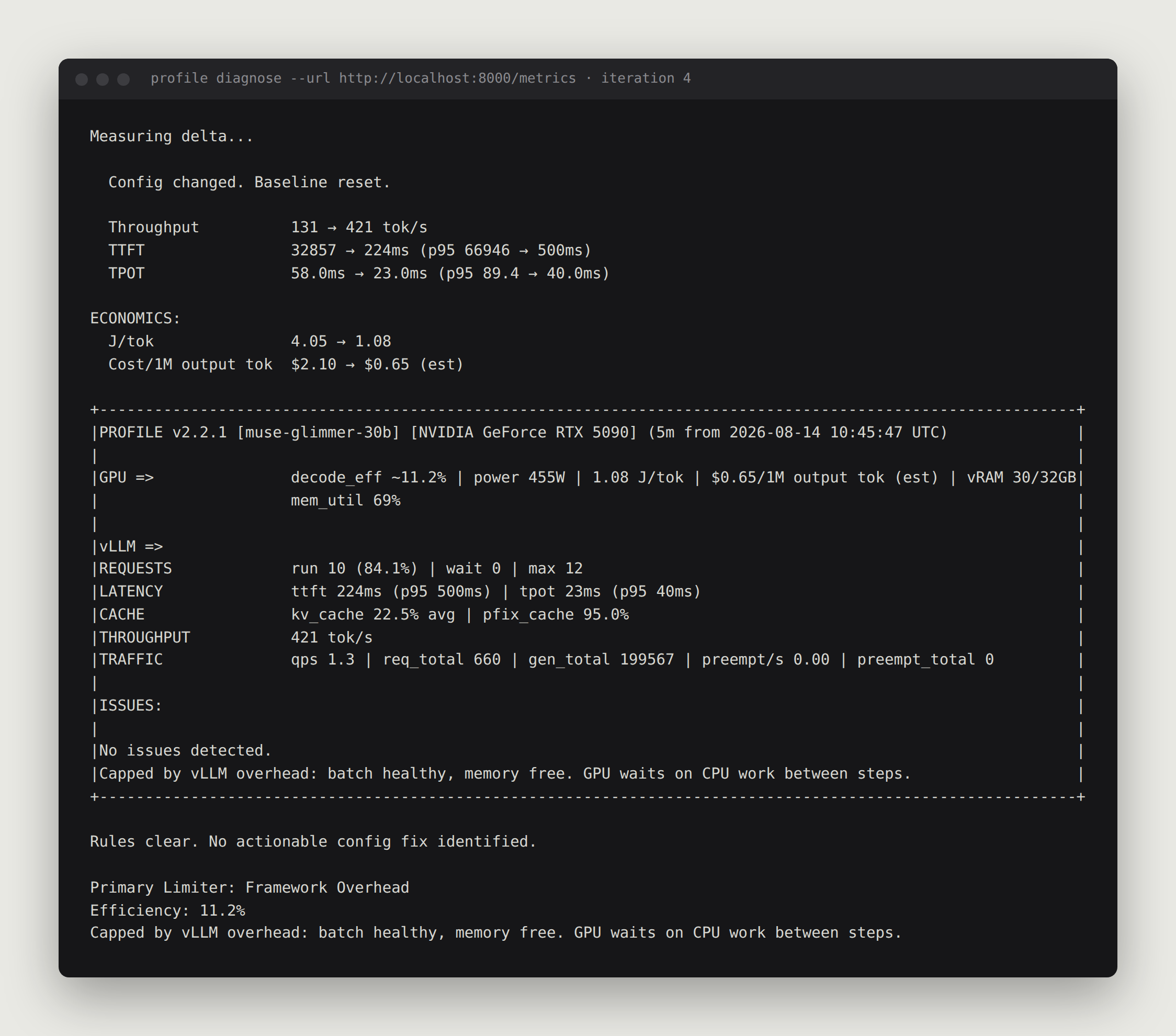
Hi all, Profile v2.2 is out. It's an open-source optimizer for inference servers. It computes your GPU's roofline ceiling, measures your live server against it, names the bottleneck, gives the flag. You apply. It re-measures. Every fix answers to a number. vLLM only today. More engines next. This release: core rule engine rewritten. Eight rules on a priority DAG with mutual exclusivity. Five alarms fire, four echoes are silenced, one true cause survives. Deterministic. AMD cards are now supported too. Tuning today is chaos: try a flag, wait, squint at a dashboard, repeat for days. Profile turns it into deterministic engineering: measure, fix, verify. Results in a few iterations. Mine took 4, ~30 minutes. My setup: RTX 5090, muse-glimmer 30B, SWE-Bench agents, no DFlash spec decoding. • 81 → 421 tok/s at 25k ctx • $3.41 → $0.65 per 1M output tok • TTFT 224ms (p95 500ms), TPOT 23ms at end of run • 4.72 → 1.08 J/tok https://preview.redd.it/4vazyxkcq6kh1.png?width=2248&format=png&auto=webp&s=77923a489b6f725240d23a7953150b5779260734 One iteration regressed hard: KV thrashing, TTFT 32.8s. Profile labeled it worse. Next fix recovered it. Regressions stay in the record. Watc
Reddit post · Local & open models


 ChatForm
 Tgmlabs