
kamz
@kev_wander
I created a little web app to store memories for my daughter, first moments, special moments, and made it as a garden where every memory is a flower
X post · Apps & websites· ♥ 2
19 builds · page 1 of 1
kamz
@kev_wander
I created a little web app to store memories for my daughter, first moments, special moments, and made it as a garden where every memory is a flower
X post · Apps & websites· ♥ 2
Your product
Sponsored
Put your logo, a line of copy and an image right here, between the builds Muse developers come to read. Same size as a post.
Shown every 12 builds · on every catalog page
The smallest and fastest MLX 4-bit (group size 64) Muse Glimmer checkpoint, served with SGLang's MLX backend on Macs with 48 GB+ unified memory.
Resource · Local & open models· ♥ 11
A local Muse Glimmer 30B vision-and-reasoning chat app for high-memory Apple Silicon Macs, running inference through ExecuTorch, MLX/Metal and DFlash with nothing persisted to disk.
GitHub · Local & open models
Maestro is a suite of native Muse Code plugins adding a command guardrail, proof-of-done checks, session-size watch, secret redaction, persistent memory and token/cost telemetry.
Skill · Coding & dev tools
Cobus Greyling's companion repo for Muse Glimmer 30B pairs a long-form intro with an offline-first interactive lab for exploring agent loops, benchmarks and memory envelopes before downloading the weights.
GitHub · Local & open models
A Vercel-hosted MCP connector for Muse that pushes cards to a 600x600 display web app, built around a serverless socket-lifetime spike with session state kept in memory or Redis.
Skill · Connectors & MCP
Your product
Sponsored
Put your logo, a line of copy and an image right here, between the builds Muse developers come to read. Same size as a post.
Shown every 12 builds · on every catalog page

Peter James
@heypeterjames
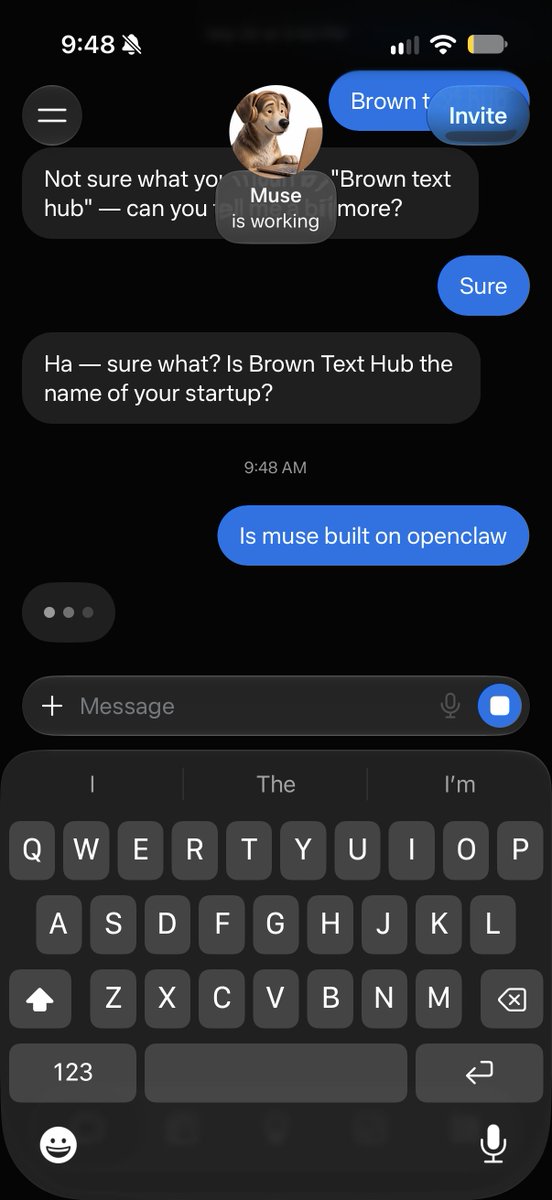
By chatting normally with the Muse iOS app I was able to have it send a zip of its entire filesystem from the linux root to my Google Drive via the google connector. /home/hatch is the agents home and contains top level files live soul.md, identity.md, memory, tools, and more
X post · Benchmarks & research· ♥ 3
An always-on laptop voice companion: local Porcupine wake word, local Whisper speech-to-text in Hindi and English, Muse Spark via the Meta Model API as the brain, offline TTS and local conversation memory.
GitHub · Agents & automation
Native Muse Code plugin that wires in Hindsight memory with one bank per repo, using SessionStart, UserPromptSubmit and Stop hooks to recall and store context across agents. Zero dependencies, runs on macOS, Linux and Windows.
Skill · Coding & dev tools
Persistent cross-session memory for Muse Code from Supermemory, installable from the Muse plugin marketplace on Muse Code 1.3+.
Skill · Coding & dev tools· ★ 1

Sumanth
@Sumanth_077
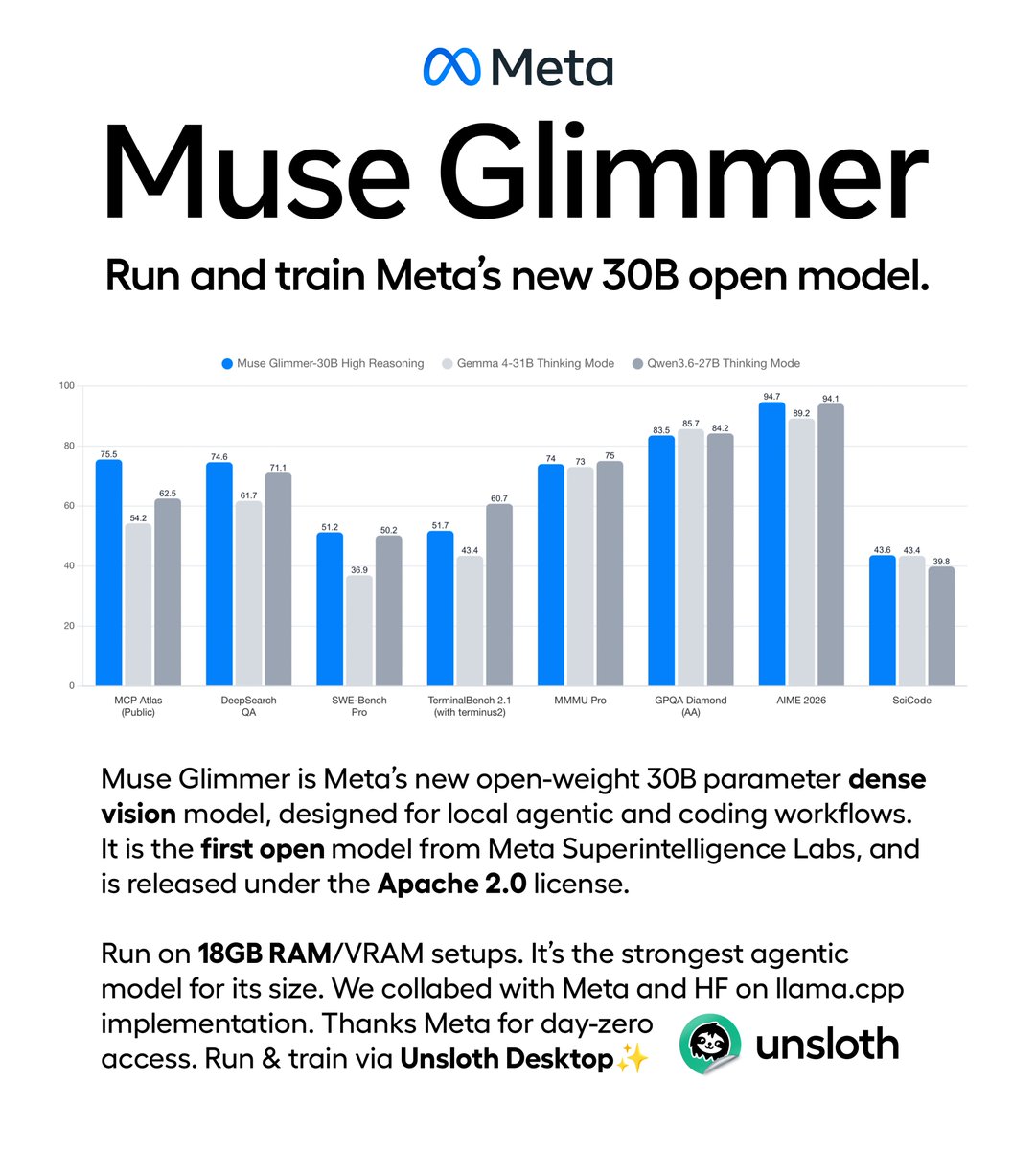
Run and fine-tune Meta's Muse Glimmer locally! Meta released Muse Glimmer, a 30B dense vision model designed for local agentic and coding workflows. The first open model from Meta Superintelligence Labs, released under Apache 2.0. The model runs locally at different memory
X post · Local & open models· ♥ 26
I've been migrating my workflow from ChatGPT Work / Codex over to Meta's Muse, and I've been auditing the harness as I go — reading cron files, checking diffs, mapping what the system actually does versus what it claims to do. It's a documentation gap. What the docs describe Meta's documentation is written for a normal user. It talks about the Ideas tab, the Goals tab, the Feed, and "background jobs that help Muse improve over time." Everything is described in terms of what it does for you. There is no architectural documentation. Nothing about how any of it is built. What is actually on disk Meanwhile, the home directory contains a fully legible agent architecture, just sitting there(these are just SOME examples, the system file structure is HUGE): • ~/dreams/alignment/ — a nightly job that regenerates an alignment synthesis: a written portrait of the user, how to handle them, current frictions, relationship guidance. • ~/workspace/objectives/goals/STUDYING.md — a daily learning-state projection with mastery bands, next-review dates, and retrieval prompts, plus a file of inferred goal leads the system guessed from behavior (with confidence levels and what would confirm or re
Reddit post · Benchmarks & research
An interactive Three.js scene that shows a stylized 'Muse Spark mind' with memory, reasoning, language and sensory regions (about 218 neurons and 340 synapses), with a live demo.
GitHub · Games & 3D
A reproducible Apple Silicon harness that runs six fixed quality tasks against MLX quantizations of Muse Glimmer 30B and records scores, tokens per second, peak memory and load time.
GitHub · Benchmarks & research
Cloud Codes runs Unsloth's 2-bit dynamic quant of Muse Glimmer 30B in about 14 GB of laptop memory and tests 100+ autonomous tool calls.

Video · Local & open models· ♥ 217
Mika Reyes gives a five-step setup for Muse: import memory, connect Instagram/Facebook/WhatsApp/Threads, enable WhatsApp access, build a daily feed and write down your goals.
Guide · Errands & personal agent
I've had Qwen3.6:27b (and Qwen 3 coder next before it) running along side gpt-oss:20b for a while now as my two main models (qwen for coding, gpt-oss for agentic stuff). Qwen is pretty self-explanatory, while I had been using gpt-oss because of how good it was at producing json and instruction following, despite the size and age. https://preview.redd.it/lr61tb02lejh1.png?width=1920&format=png&auto=webp&s=cef1f0bbfb43c8462162ec675d52c5896d174118 The "upgrade" to 3.8 is pretty evident, especially because of the SWE bench score improvement, but I was more reticent with Muse-Glimmer as I had some trouble when I tried Gemma4, which was far too opinionated when given a task, but Muse-Glimmer seems great - low memory footprint at 128K context, fairly fast and seems to follow instructions well. What models are you using locally and for what? did you have a similar experience with these latest models?
Reddit post · Local & open models
Luke's Dev Lab tests Muse Glimmer on a single-GPU 16GB setup across performance, memory, agency, HumanEval, and builds like a Kanban app, sand physics, a dungeon crawler, Blender and Godot.

Video · Local & open models
Wavect's guide covers Glimmer's hardware targets (24–32GB) and tool-use scores such as MCP-Atlas 75.5 and SWE-Bench Pro 51.2, and recommends a 20–30 task pilot before production.
Resource · Local & open models


 ChatForm
 Tgmlabs