Ran Muse Glimmer 30B locally in the browser with custom WebGPU kernels at ~25 tok/s on an M4 Max, matching llama.cpp speed.
Reddit post · Local & open models★ Pick
40 builds · page 1 of 1
Ran Muse Glimmer 30B locally in the browser with custom WebGPU kernels at ~25 tok/s on an M4 Max, matching llama.cpp speed.
Reddit post · Local & open models★ Pick
Your product
Sponsored
Put your logo, a line of copy and an image right here, between the builds Muse developers come to read. Same size as a post.
Shown every 12 builds · on every catalog page

Xuan-Son Nguyen
@ngxson
We are happy to announce that Muse Glimmer is day-0 supported on llama.cpp. Meta also provides an official GGUF quant:
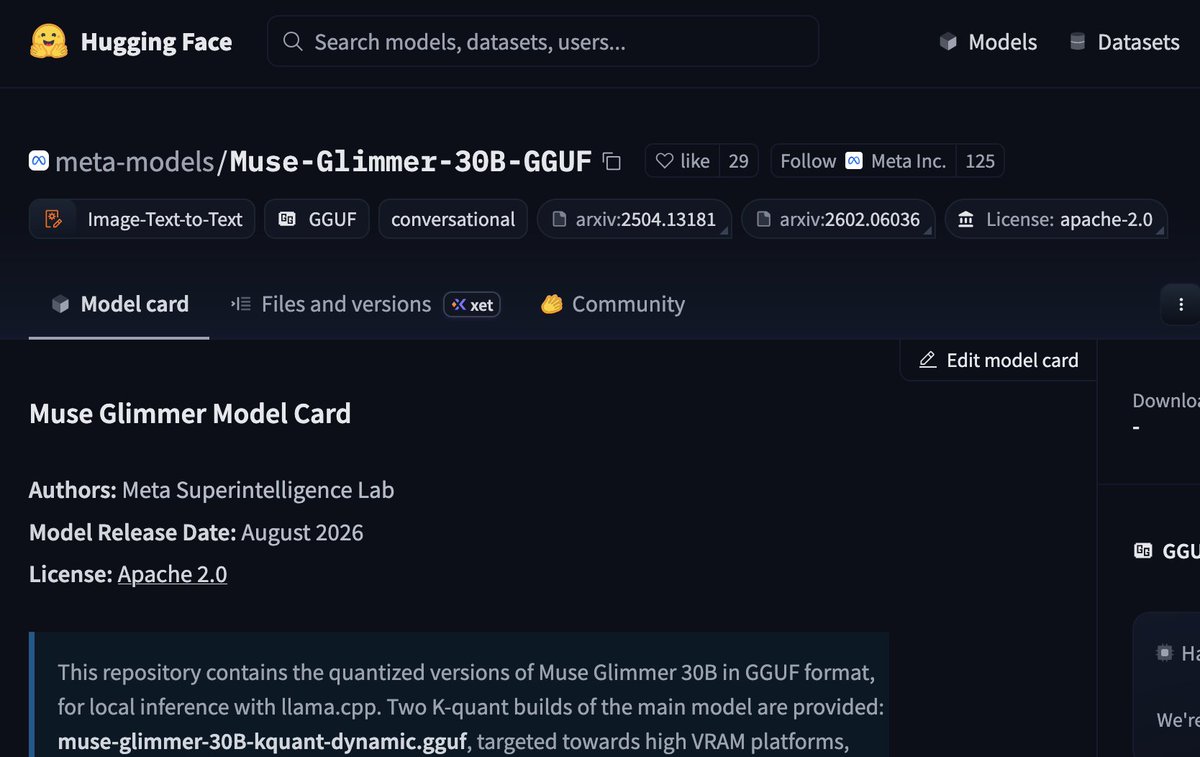
X post · Local & open models· ♥ 86

merve
@mervenoyann
Muse Glimmer 30B is shipped with DFlash drafter which speeds-up generation 2-4x at little memory cost 🔥 we support this in llama.cpp and transformers, see below how it looks like in the wild (llama webui) ⤵️
X post · Local & open models· ♥ 131
Resource · Local & open models· ♥ 343
GGUF conversions of Inco AI's DFlash 2 draft model for Muse Glimmer 30B, for speculative decoding in llama.cpp.
Resource · Local & open models· ♥ 16
ROCmFP4 GGUF of Muse Glimmer 30B with DFlash for AMD Strix Halo, requiring a ROCmFPX llama.cpp fork that adds the muse-glimmer architecture.
Resource · Local & open models· ♥ 4
Your product
Sponsored
Put your logo, a line of copy and an image right here, between the builds Muse developers come to read. Same size as a post.
Shown every 12 builds · on every catalog page
A starter script that downloads Muse Glimmer 30B, serves it with llama.cpp on an Apple Silicon Mac and connects it to OpenCode, with the server listening only on localhost.
GitHub · Local & open models
Venelin Valkov pairs Muse Glimmer with Hermes Agent on llama.cpp for a fully free local agent, testing whether a better harness fixes the model's mixed early reviews.

Video · Local & open models
A self-hosted llama.cpp serving stack that runs Muse-Glimmer-30B GGUF with DFlash2 speculative decoding on Kaggle's NVIDIA T4 x2, exposed through an authenticated OpenAI-compatible gateway.
GitHub · Local & open models
A pinned llama.cpp recipe for Muse Glimmer 30B on one NVIDIA GB10 that verifies Meta's official GGUFs by SHA-256 and reproduces text, tool-call, coding, vision and throughput checks.
GitHub · Local & open models· ★ 1
A llama.cpp container that serves Muse Glimmer 30B with vision and DFlash on an RTX 5090, reporting 98.8 tok/s single-stream and about 250 tok/s aggregate with 131k context.
GitHub · Local & open models
Your product
Sponsored
Put your logo, a line of copy and an image right here, between the builds Muse developers come to read. Same size as a post.
Shown every 12 builds · on every catalog page
Meta's developer post on running Muse Glimmer on a single consumer GPU with vLLM, llama.cpp and ExecuTorch, with quantized builds in 24-32 GB and cookbook recipes.
Resource · Local & open models
An experiment running Muse Glimmer 30B Q4_K_M via llama.cpp on an RTX 4060 laptop with 8 GB VRAM, testing autonomous Python bug fixing, tool-failure recovery and multimodal invoice extraction.
GitHub · Local & open models
Solution: So after more research it seems that this KHO was recently activated in the latest Ubuntu kernel which zorin is based on. It seems to be for live updates of kernel and whatever but it puts quite a bit of strain on system that requires a lot of memory like AI work load. So I edited my GRuB file to turn it off. I was lucky that somehow my 7.0.0-30 kernel had a bug that disabled the KHO also thank you to Muse Spark AI for able to run all the trace and helped me figuring it out. KHO locked out 2gb of RAM causing my Llama cpp out of memory error. The original post So I been running Zorin OS as my semi daily driver for learning AI and fun. I been plague with odd behavior as I run my AI on knife edge consuming nearly all 16 GB of Ram and 8 GB of VRAM. I found something odd, that my AI would failed to load depending on which kernel. It turn out at least one of the culprit was KHO it somehow ate about 2GB of RAM. I found this because my Kernel 7.0.0-30 and the old 6.17 load my AI just fine but kernel 7.0.0-28 and the latest 7.0.0.-31 always failed to load. Below is the AI analysis that I had it trace issue through my system: - `-30` boot `-2`: `Memory: 15384980K avail / 8261
Reddit post · Coding & dev tools
A quantization-aware-trained Q4_0 GGUF of Muse Glimmer 30B for llama.cpp. On held-out tokens it measures closer to BF16 than Meta's official Q4_K_M: 0.0213 vs 0.0228 KL and 95.9% vs 95.6% top-token agreement.
Resource · Local & open models· ♥ 3
Benchmarked Muse Glimmer 30B on my RTX 5090 (32GB), 262k context, UD-Q5_K_M + dflash-kquant + mmproj. Workload Stock master + DFlash ngram-simple PR #26842 + DFlash Code patch 78 t/s 57 t/s 220-253 t/s Mixed agent turn 77 t/s 68 t/s 188-213 t/s Tool-call JSON 71 t/s 75 t/s 155-181 t/s Heavy reasoning 52 t/s 58 t/s 120-130 t/s PR #26842 moves the DFlash draft argmax from CPU to GPU, which was the bottleneck. I cherry-picked it onto master (it branched before the Muse merge, one conflict to resolve manually) and it builds clean. Code generation now matches Meta's published 233 t/s, which I could not reproduce on stock master. Notes: • ngram-simple loses to DFlash on every coding workload. • Server caps context at the model's metadata context_length, use --override-kv for 262k. • The reasoning budget flags do not work with this template. This is verified: with the budget set to 64, the model still burned 2000+ chars thinking and the budget message never appeared. Leave max_tokens headroom for the reasoning block. Flags: llama-server ^ --model Muse-Glimmer-30B-UD-Q5_K_M.gguf ^ --mmproj mmproj-kquant.gguf ^ -c 262144 --parallel 1 ^ --override-kv "muse-glimmer.context_le
Reddit post · Local & open models
Eleven matched on/off pairs across Gemma 4 and Qwen3.6, holding model, quant, card, corpus and concurrency fixed inside each pair. Speed: 1.65x to 2.54x, every pair. Accuracy: nothing the paired intervals could separate from ordinary run-to-run movement. Muse Glimmer is the one that lost. Meta's matching DFlash drafter made the same 7900 XTX 9% slower, keeping 24.55% of drafted tokens against roughly four in five for the Gemma and Qwen heads. Acceptance fell across the run instead of warming up. Meta's model card reports 3.1x on an RTX 5090, and there are open llama.cpp issues for DFlash on AMD and under Vulkan, so I read it as the backend rather than the model. Acceptance turned out to be a poor predictor of speed. It moved under four points across five models while the multiple nearly doubled. What tracks the multiple is how bandwidth-bound the target is: a heavier quant gains more, and the two mixture-of-experts pairs gained least. Worth knowing before you benchmark anything: -md mtp-head.gguf silently disables speculation. Use -hf REPO:QUANT -hfd REPO, then read speculative from /slots and confirm it is true. Per-pair table, intervals, acceptance counters and the raw predic
Reddit post · Local & open models
Heeeey all! I just completed some fun tests with Muse Glimmer, I thought I'd let you know. In fact, the summary below was written by Muse itself! I ran a 2× DGX Spark cluster and got Meta's day-old Muse Glimmer 30B running the day after release — then pushed its context from the trained 131K all the way to 1M with YaRN, verifying retrieval at every rung. Sharing config + results since the "131,072+" hint in the model card turned out to be very real. Setup • Hardware: 2× NVIDIA DGX Spark (GB10, 128 GB unified each, ~273 GB/s), ConnectX-7 direct link between them • Engine: llama.cpp master (day-1 muse_glimmer support), built from source with CUDA sm_121 + GGML_RPC • Model: official Muse-Glimmer-30B-GGUF K-Quant-Dynamic (~18.3 GiB) + official mmproj (vision) + official DFlash drafter • Spec decode: --spec-type draft-dflash --spec-draft-n-max 15 (block-diffusion drafter) • Context extension: --rope-scaling yarn --rope-scale <2/4/8> --yarn-orig-ctx 131072 plus --override-kv muse-glimmer.context_length=int:<N> (llama.cpp caps at trained length otherwise) • Yes, we also ran it split across both Sparks with llama.cpp RPC — no reason beyond liking to cluster things for fun. Our daily dri
Reddit post · Local & open models
Meta's launch post for Muse Glimmer, an Apache 2.0 30B model for local agents that fits in ~20GB at 4-bit and runs on M4/M5 Max Macs, RTX 5090s or 24–32GB GPUs.

Resource · Local & open models
Hugging Face's launch post covers day-0 transformers, llama.cpp and vLLM support, Inference Endpoints, speculative decoding, TRL fine-tuning and agent demos for Muse Glimmer.

Resource · Local & open models★ Pick

Paolo Rosson
@redp314
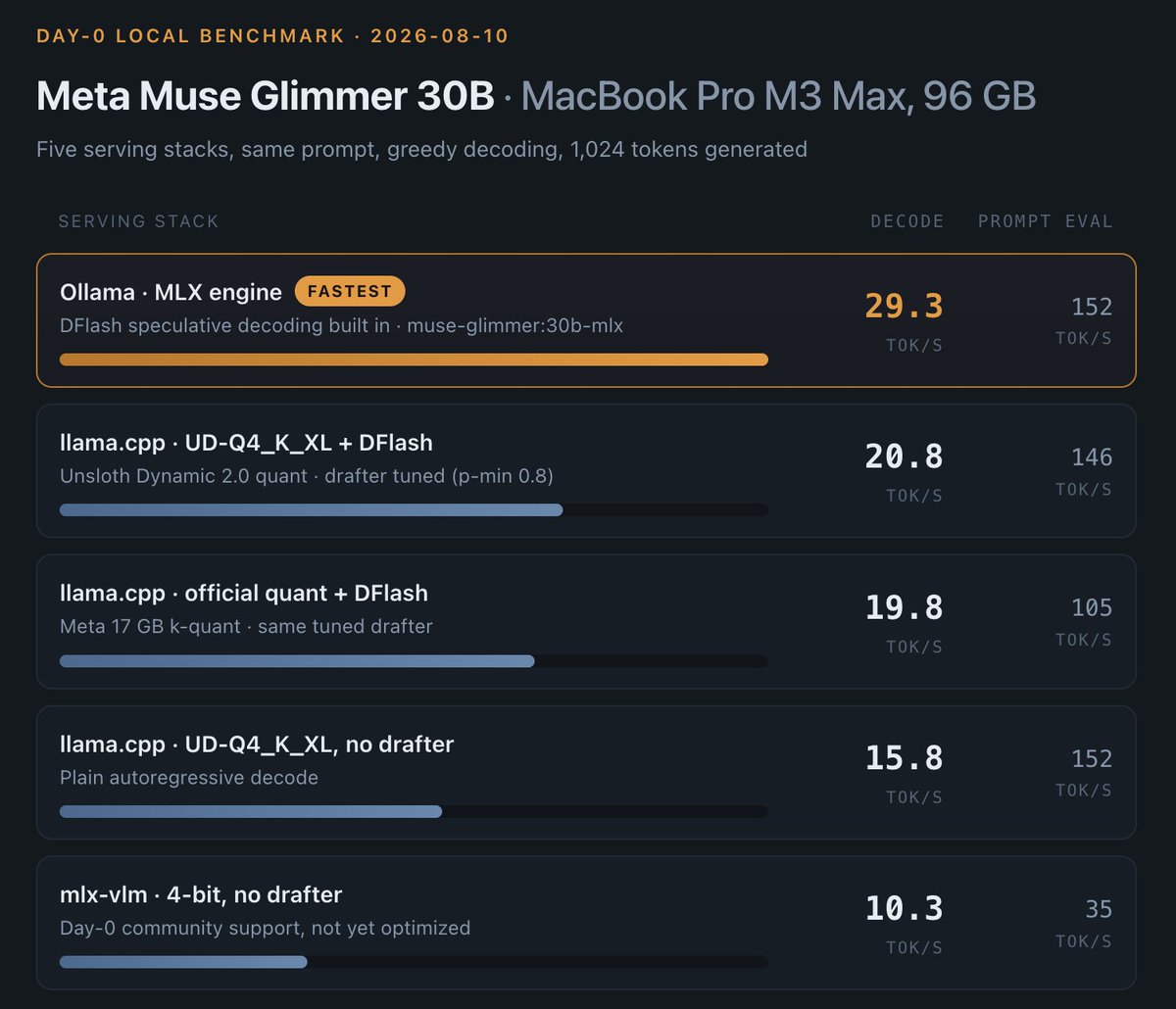
Got Meta's new Muse Glimmer 30B running on my MacBook (M3 Max, 96GG) and tested the serving options available so far. Fastest right now: Ollama's MLX engine (DFlash included) at ~29 tok/s. Tuned llama.cpp: ~21. Raw mlx-vlm: ~10, not optimized yet. Numbers below if you're
X post · Local & open models★ Pick· ♥ 44
A Makefile that downloads the three Muse Glimmer 30B GGUFs and builds and serves llama.cpp on Apple Silicon, automating a scriptable.com walkthrough.
GitHub · Local & open models
GGUF quantizations of the Inco AI DFlash2 drafter for Muse Glimmer 30B, for use with the BeeLlama.cpp llama.cpp fork.
Resource · Local & open models· ♥ 1
Hey Guys, I've got 4 x v100's in a Dell C4140 (NVlink) and I have been working on a fork of llama.cpp that is targeted at the v100's. Looking for testers to give it a go and provide feedback. WyvernTKC/llama.cpp-4xV100: Fork of llama.cpp Nvida Volta V100 (tensor parallelism 4 x v100 GPU) model arch type size (GB) pp layer pp tensor change tg layer tg tensor change glm4 9B Q8_0 glm4 dense 9.3 1187.9 2924.3 +146 % 67.6 123.0 +82 % qwen35 27B Q8_K_P qwen35 dense 29.3 640.4 1717.6 +168 % 22.2 52.4 +137 % gemma4 31B Q8_0 gemma4 dense 30.4 679.8 1621.2 ±322 noisy 20.6 46.7 +127 % muse-glimmer 30B F16 muse-glimmer dense 51.9 1048.4 2395.6 +128 % 15.1 40.4 +168 % llama 70B Q8_0 llama dense 69.8 302.5 950.5 +214 % 9.8 28.6 +192 % qwen35moe 35B-A3B Q8_0 qwen35moe MoE 256×8 34.4 1602.6 3143.7 +96 % 93.6 113.7 +21 % qwen3next 80B-A3B Q4_K_M qwen3next MoE 512×10 45.9 889.8 1647.0 +85 % 76.6 86.8 +13 % deepseek4 284B Q2_K deepseek4 MoE 256×6 90.9 188.8 616.1 +226 % 27.3 37.7 +38 % Thanks!
Reddit post · Local & open models
llama.cpp imatrix quantizations of Muse Glimmer 30B with image support via mmproj and MTP/DFlash notes.
Resource · Local & open models· ♥ 19
GGUF builds of Muse Glimmer 30B all cut from the same BF16 source weights, including full-precision files.
Resource · Local & open models· ♥ 6
HolaClaw's tutorial for running Muse Glimmer 30B behind OpenClaw on a Mac, with hardware requirements and llama.cpp and Ollama setup.
Resource · Local & open models
An experimental Rust and Metal inference runtime for Muse models on Apple Silicon, currently supporting Muse Glimmer, using llama.cpp as the correctness and speed baseline.
GitHub · Local & open models
Venelin Valkov runs Muse Glimmer 30B locally via llama.cpp server and tests it on coding with OpenCode, agentic tasks and frontend work.

Video · Local & open models
merve
@mervenoyann
Meta released Muse Glimmer 30B: multimodal model for your Claw/Pi setups 🔥 we tested and fine-tuned the model for you, and shipped day-0 support in transformers and llama.cpp, including DFlash for 2-4x speed-ups 🥵 read our blog huggingface.co/blog/muse-glim…
X post · Local & open models· ♥ 398
I noticed on the same hardware that I can get 24 x 128k contexts with muse glimmer (30b q8_0 + mmproj+dflash) only gets me 3x 256k or 6x 128k with qwen. But a straight forward analysis of the architecture suggests to me that qwen's state per token is somewhat smaller than glimmers. So it seems llama.cpp is particularly memory inefficient for the qwen arch. I presume there is an existing issue for this, but I couldn't find one. What's the deal? The extra concurrency makes a big difference in batched performance.
Reddit post · Local & open models
Chaty is a private offline desktop app built on Rust and llama.cpp that runs Muse Glimmer and other open models locally with a coding agent, RAG knowledge base, deep research and voice.
GitHub · Local & open models
Scripts that run Muse-Glimmer-30B with vision and tool calling on a 32GB M2 MacBook Pro via llama.cpp and Metal, without admin or sudo access, pulling Meta's official GGUFs.
GitHub · Local & open models· ★ 1
Muse Glimmer 30B feels significantly more precise and reliable, it almost never drops the ball or breaks rules. However, its designs lack creative depth and richness. Qwen3.6 35B, on the other hand, is prone to more occasional blunders/hallucinations, but its creative output is superior. It generates far richer, more complex voxel worlds and offers higher design quality. LLama.ccp Build Provenance: • Base: llama.cpp upstream (merge 4445f8d, build 661) • CUDA Toolkit 13.1 + MSVC 19.44 + sm_120a-real (native Blackwell PTX) • Flags: GGML_CUDA=ON, GGML_CUDA_FA=ON, GGML_CUDA_FA_ALL_QUANTS=ON, GGML_CUDA_GRAPHS=ON, GGML_NATIVE=OFF • License: MIT (upstream llama.cpp) Do you think Qwen3.6 is still the undisputed king here?
Reddit post · Benchmarks & research
A reproducible record of running the 17GB Muse Glimmer 30B GGUF with llama.cpp and Metal on a 24GB M4 Pro MacBook Pro, with notes on mistakes, fixes and how local inference works.
GitHub · Local & open models
This repo documents running Muse Glimmer 30B locally on an M4 Max MacBook via llama.cpp, benchmarking it with and without speculative decoding, and wiring it into Claude Code through LiteLLM for fully offline coding.
GitHub · Local & open models
Setup the latest (master) version of llama.cpp server with the guide and the official GGUF weights by Meta AI: https://huggingface.co/meta-models/Muse-Glimmer-30B-GGUF and connected the Hermes Agent to the llama.cpp endpoint. Getting about 22t/s (+3-4t/s) on M5 Pro, using ~24GB including the drafter (provided by Meta). The model did correct tool calls and actually did some useful work inside the Hermes Agent. Moreover, the resulting coding task/project works, which was not the case when running the model with OpenCode. Watch more: https://www.youtube.com/watch?v=cmENEolUtM4
Reddit post · Local & open models
Abid Ali Awan sets up Muse Glimmer 30B on an RTX 5090 with llama.cpp, dynamic quantization and DFlash speculative decoding, serves it locally and wires it into OpenCode to build a medical research web app.
Guide · Local & open models

filipe
@filicroval
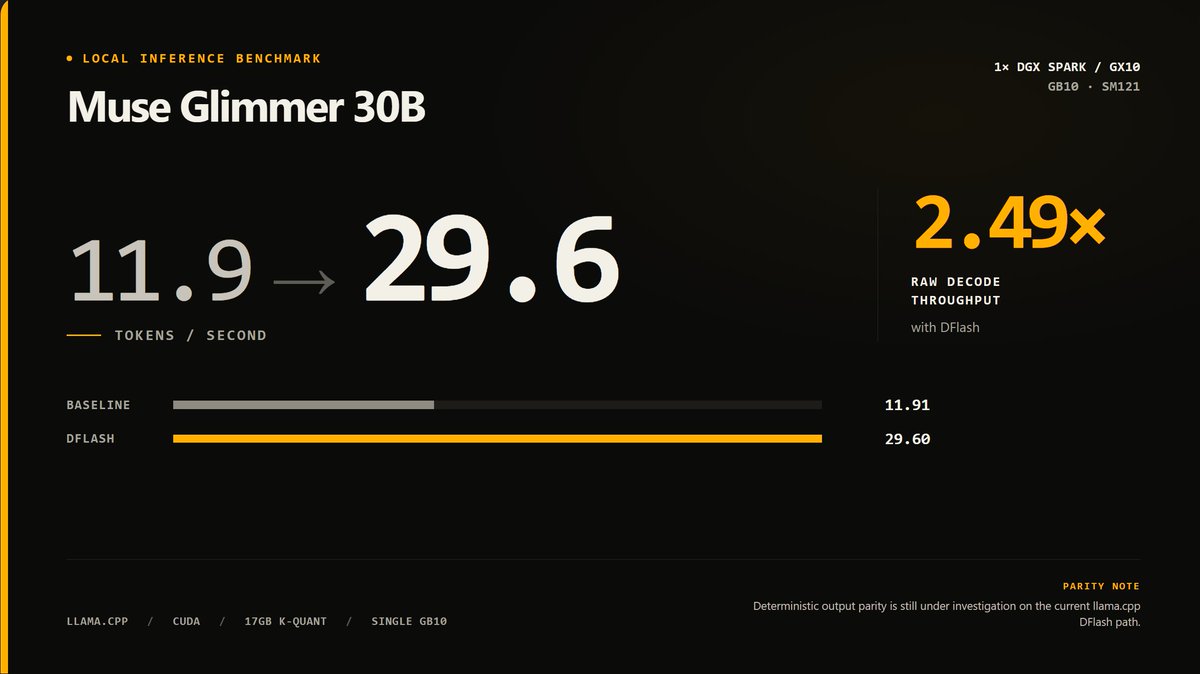
got Muse Glimmer 30B running on a single DGX Spark / GX10 at 29.6 tok/s with DFlash, up from 11.9 tok/s baseline, 2.49× raw decode throughput. packaged the whole thing into a reproducible GB10 recipe: - pinned weights + SHA-256s - llama.cpp compiled for GB10 / SM121 - baseline
X post · Local & open models· ♥ 5
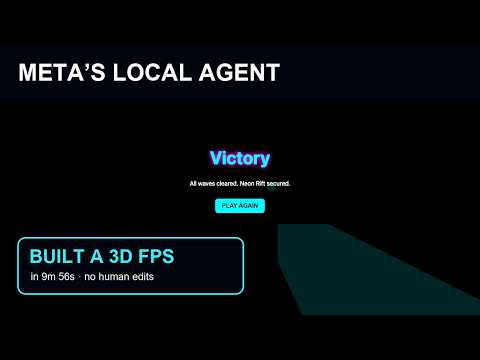
Agent Workflow Lab runs the Q8 GGUF of Muse Glimmer 30B through llama.cpp on an RTX 4090 plus 3x RTX 3090, measures DFlash speedups and a 120K-token retrieval probe, then has it build a Three.js browser FPS with no human edits.
Video · Games & 3D
Your product
Sponsored
Put your logo, a line of copy and an image right here, between the builds Muse developers come to read. Same size as a post.
Shown every 12 builds · on every catalog page


 ChatForm
 Tgmlabs