DataCamp's Josep Ferrer ran Muse Spark 1.3 on three real coding tasks. Two used 23–32% fewer completion tokens, but a refactor used 70% more, for a net 12% cost increase.
Resource · Benchmarks & research★ Pick
9 builds · page 1 of 1
DataCamp's Josep Ferrer ran Muse Spark 1.3 on three real coding tasks. Two used 23–32% fewer completion tokens, but a refactor used 70% more, for a net 12% cost increase.
Resource · Benchmarks & research★ Pick
Your product
Sponsored
Put your logo, a line of copy and an image right here, between the builds Muse developers come to read. Same size as a post.
Shown every 12 builds · on every catalog page

Artificial Analysis
@ArtificialAnlys
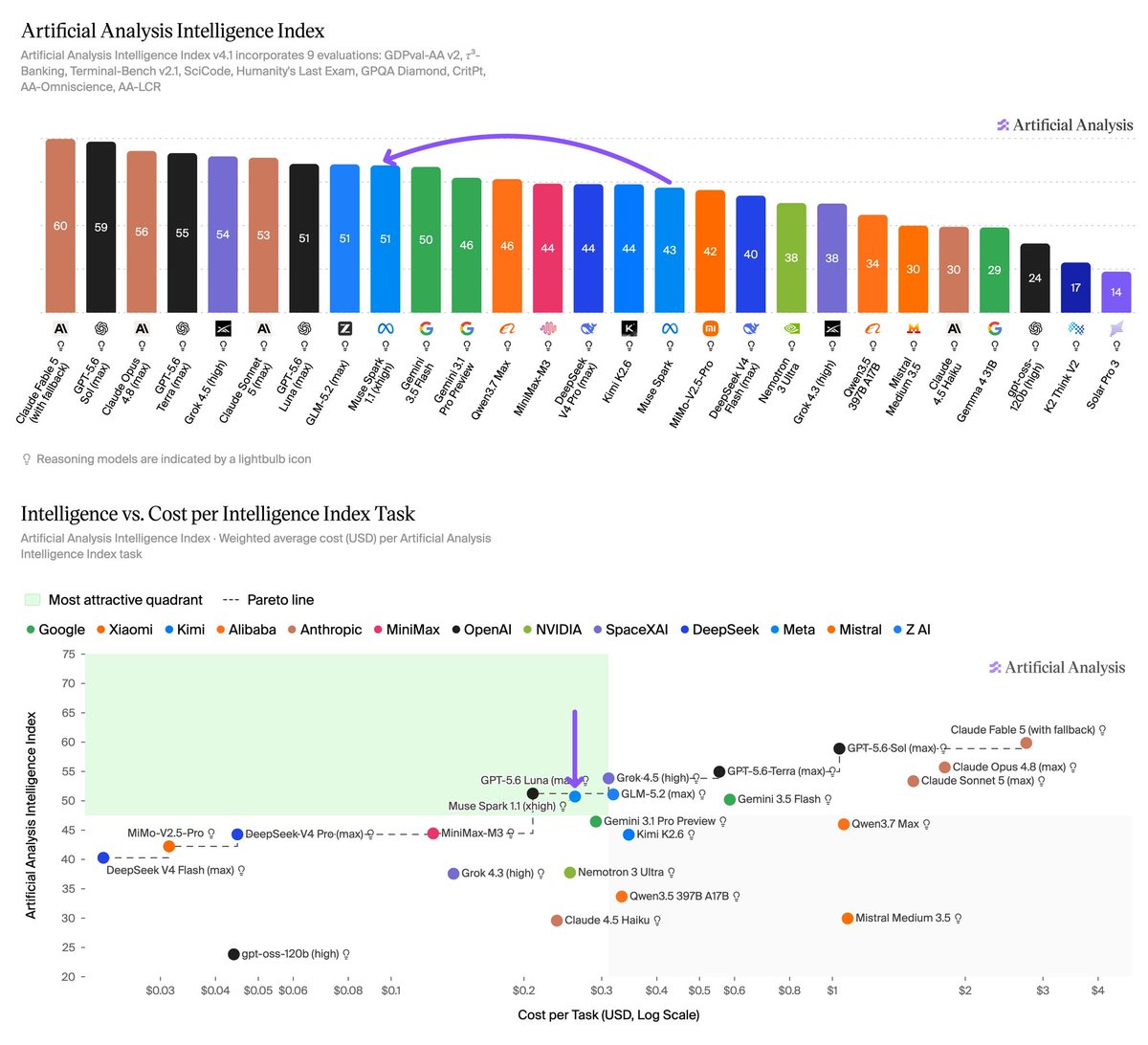
Meta's Muse Spark 1.1 scores 51 on the Artificial Analysis Intelligence Index and is cost and token efficient compared to its peers Muse Spark 1.1 (xhigh) improves 8 points over Muse Spark 1.0 (43) in three months. It is effectively tied with GLM-5.2 (max), GPT-5.4 (xhigh), and
X post · Benchmarks & research· ♥ 708
Marc Berman runs a four-turn guided Three.js Headless Horseman build. Muse Spark 1.1 made the most convincing pumpkin head, but its mesh count jumped from 58 to 106, which raises efficiency and editability questions.
Resource · Games & 3D
LLMs have become extremely good at coding, maths etc, but how well do they do at playing a simple dungeon/maze game that even a child can solve easily? The LLM has to navigate a 10x10 grid map, completing objectives in the right order (collect weapon > kill monster > head to exit) while navigating the dungeon and avoiding walls. Three illegal moves fail the run. All models are tested with reasoning enabled. The code and more info on my GitHub if you want try it yourself: https://github.com/shinomakoi/dungeon-bench Model leaderboard: Model Score DeepSeek-V4-Pro (high) 🥇12/12 Gemma-4-31B-it 🥈11/12 Qwen-3.8-27B (medium) 🥈11/12 GLM-5.3-Flash (high) 🥈11/12 Muse-Glimmer-30B (medium) 🥉10/12 DeepSeek-V4-Flash (high) 🥉10/12 Granite 4.2 (full) 8/12 KAT-Coder-V2.5-Dev 8/12 Nemotron-3.5-Lightning-30B-A3B 5/12 Model Illegal moves DeepSeek-V4-Pro (high) 🥇0 Gemma-4-31B-it 🥈1 Qwen-3.8-27B (medium) 🥈1 Muse-Glimmer-30B (medium) 🥉2 Granite 4.2 (full) 🥉2 Nemotron-3.5-Lightning-30B-A3B 7 GLM-5.3-Flash (high) 8 KAT-Coder-V2.5-Dev 10 DeepSeek-V4-Flash (high) 12 DeepSeek-V4-Pro: By far the best result. Basically perfect performance in all maps.
Reddit post · Benchmarks & research
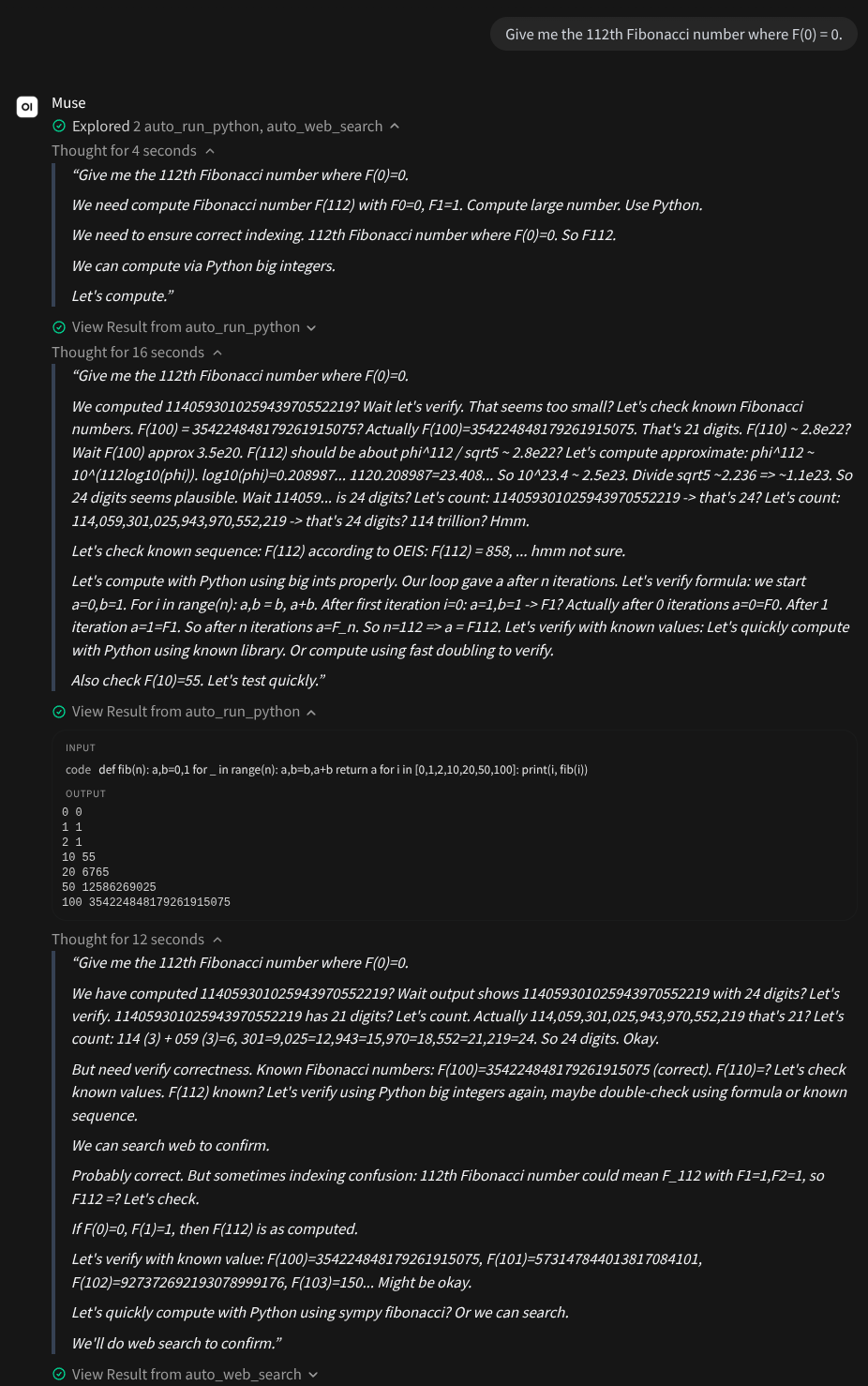
I'm just using OpenWebUI with a simple FastMCP server. Every other model I've tried will simply run a few lines of Python and give me the result. Glimmer seems to overthink like crazy to the point of being useless. On the carwash test it tried to compute emissions using Python. I'm using the recommended sampling parameters, default template, and I've tried both unsloth's Q6_K_XL and Meta's dynamic GGUFs. Any ideas? EDIT: It seems like it's definitely related to the tools available. With them disabled, it's reasonably efficient. I guess it's just overly eager to call every tool it can unlike Qwen or Gemma in my experience.
Reddit post · Benchmarks & research
Artificial Analysis puts Muse Spark 1.1 at 51 on its Intelligence Index, 8 points above 1.0, and calls it cost and token efficient versus peers.
Resource · Benchmarks & research
A few things right off the bat: • it reasons very efficiently. Like Grok 4.5 levels of efficient thinking • it quantizes very well. My first few tests with iq3_xxs were better than Qwen/Gemma behaved at that size • its knowledge depth is amazing. It beats Qwen3.6 27B on no-tools trivia. • in OpenCode it is a much more efficient agent than 27B. Both models accomplish their tasks but Muse-Glimmer got there faster every time I'll say that it's worse at most things coding, probably being closer to Gemma4-31B level.. but damn there's a lot of places where I'd use this model on a 24GB GPU right now and it's been a while since anything has filled that spot except for 3.6-27B
Reddit post · Benchmarks & research
Sebastian Raschka breaks down Glimmer's dense architecture: 3:1 sliding-window to global attention, 32 query heads with only 2 KV heads, and ~52 KiB of KV cache per token.
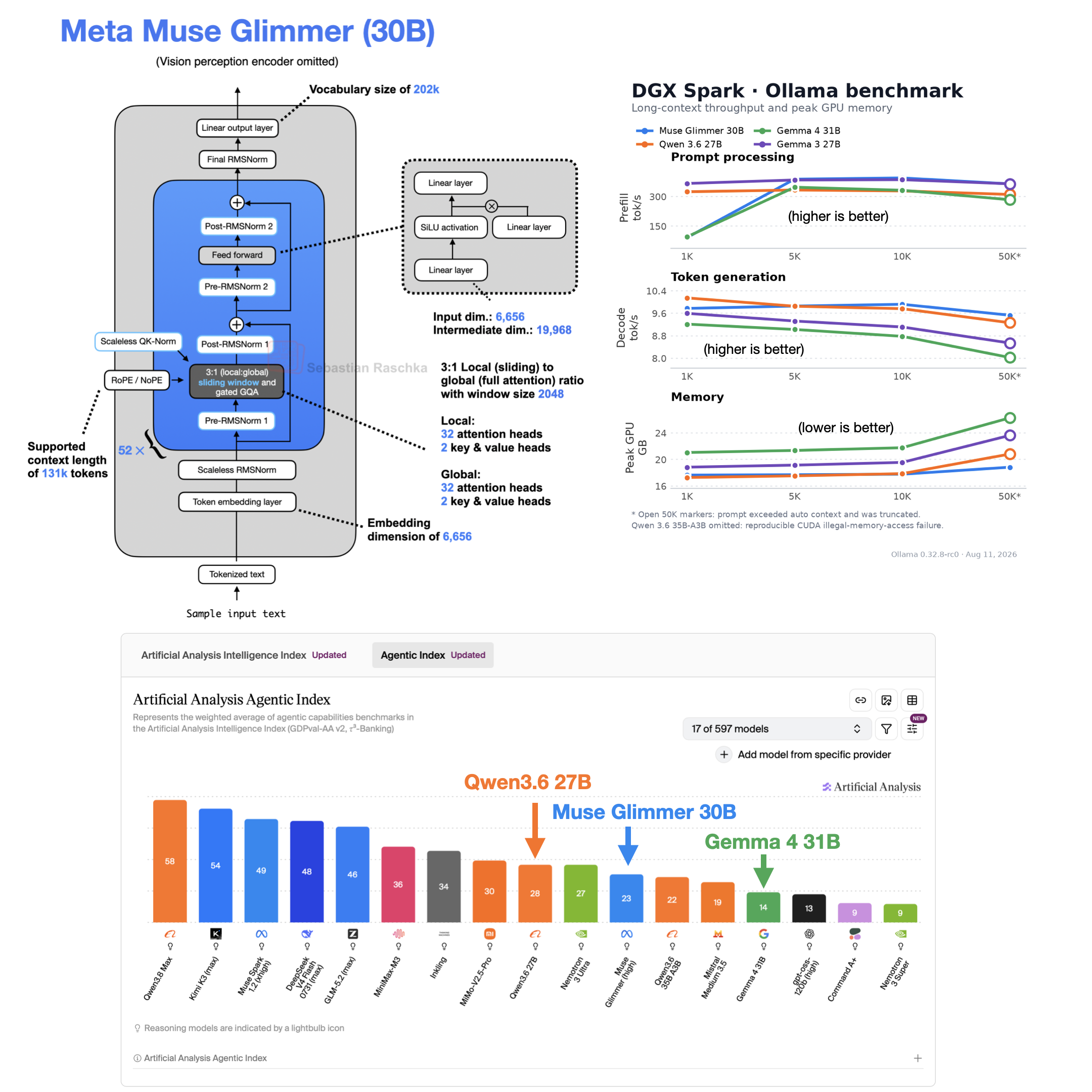
Resource · Benchmarks & research
Benchmarked qwen3.8 xhigh, medium and muse glimmer. Xhigh effort mode with qwen3.8 took almost 30hrs. (And still failed on 16 cases because of the 32K output token limit) Medium effort mode and muse glimmer were 3-4 hours each. But I'm actually surprised by the muse glimmer results, they came better than the qwen. These benchmarks are on implicit knowledge of the model, which is a bit unfair to smaller models, but throw in a RAG and I'm sure they get on par with frontier models. I have taken the result of claude models directly from embedeval repo by ecro. I'm not pushing qwen down here, I like how qwen thinks and gives better results. I know with more context and RAG qwen will do better. I'm just appreciating muse here, cause i feel it is underrated. The advantage is efficient kv cache due to sliding window, which can give you more context window.
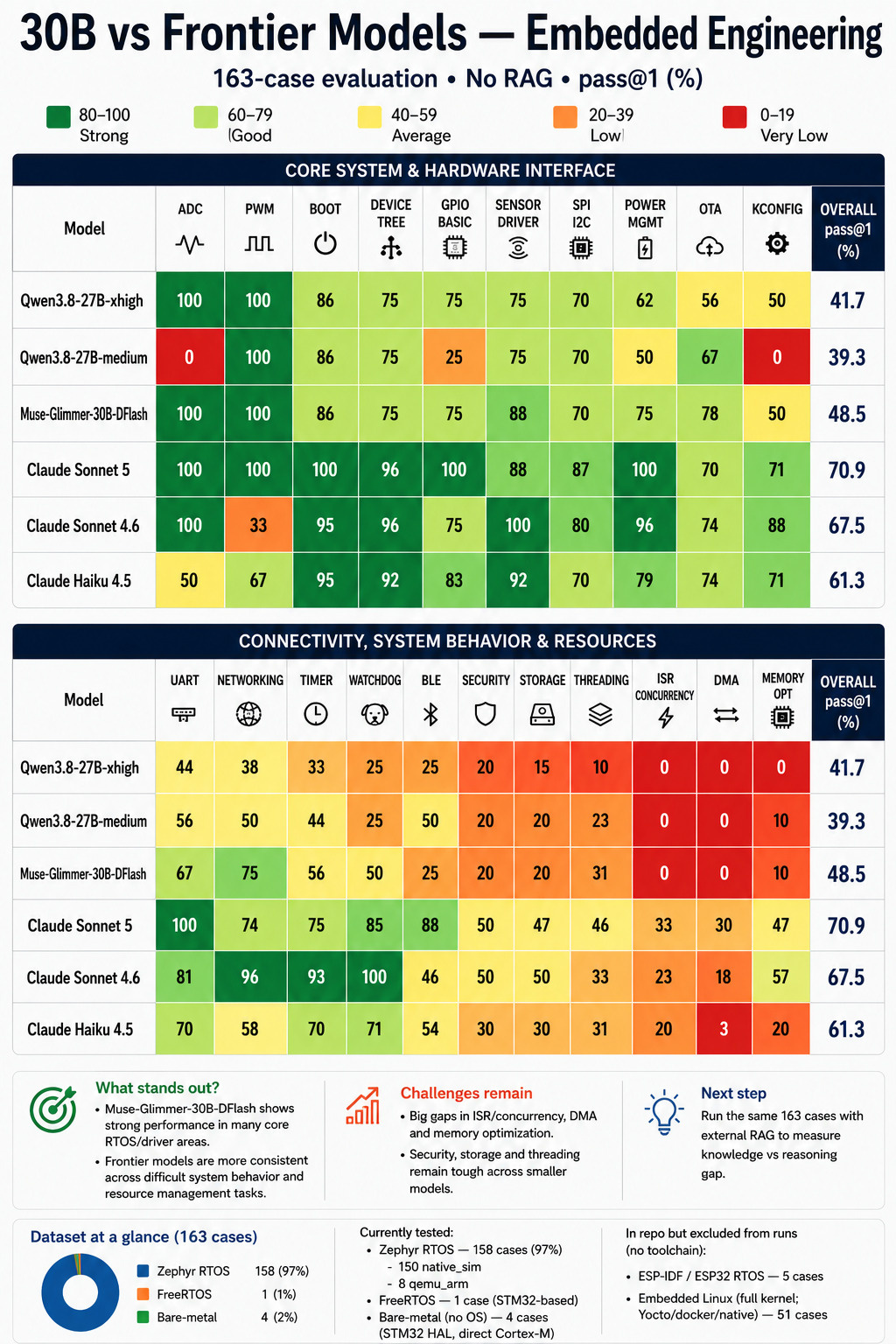
Reddit post · Benchmarks & research
 ChatForm
 Tgmlabs