loot radar is my game deals site, radar.codemeoww.com. tracks deals and freebies across stores like steam and epic, ranked by discount and popularity.
features: daily loot summaries on telegram and discord, fast price alerts, a morning deals digest, wishlist tracking so you get pinged when a game you want drops, and an api for the deal data.
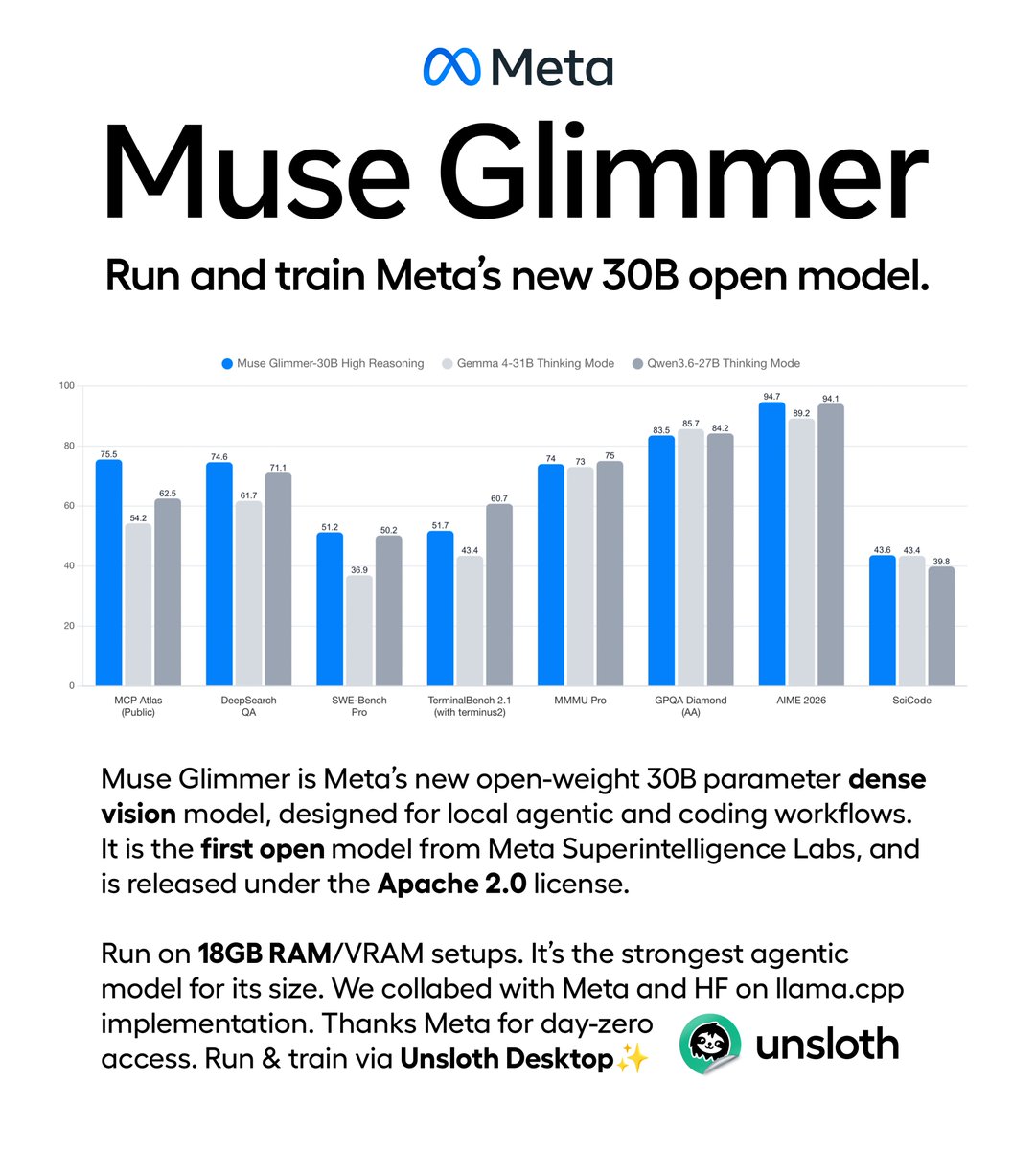
Run and fine-tune Meta's Muse Glimmer locally!
Meta released Muse Glimmer, a 30B dense vision model designed for local agentic and coding workflows. The first open model from Meta Superintelligence Labs, released under Apache 2.0.
The model runs locally at different memory
muse glimmer dropped yesterday and mlx-lm couldn't load it yet, so i wrote the text model port and opened a PR. i checked it against meta's own transformers reference before posting, 5 out of 5 next token matches and 0.9965 logit cosine, so it's not just coherent it actually matches the reference. if you want to run glimmer on apple silicon right now the model file is in the PR.
https://github.com/ml-explore/mlx-lm/pull/1710
I don’t know if I’d use it exclusively. I still need an excellent coding agent.
But here’s one example that was highly valuable:
I asked muse to prospect 50 accounts for my business that are squarely in my ICP. Build a CSV file with enriched data. Draft an initial and
Have a severe acquired mitochondrial disease that leaves me w no energy & used it to draft & send emails. It was complex med thing I didn’t have brain energy to put together & it created 3 detailed emails 4 me.Tyvm really good.Now pls solve disease :)
Bijan Bowen's first look at Meta's Muse Code terminal agent and Muse Spark 1.2, testing a browser OS, C++ skate game, CAD design, flight sim and subway FPS.
Got Muse Glimmer 30B running locally using the UD-Q2-K-XL quant paired with DFlash speculative decoding, and the results on modest hardware are pretty impressive.
Hardware Setup
Host: Ryzen 5 4600G with 96GB DDR4 RAM running headless Debian Trixie.
Guest VM:
QEMU/KVM assigned 4 cores and 32GB RAM,
running Debian Sid with ROCm 7.2.
GPU:
AMD Radeon RX 7600 XT 16GB passed through to the VM,
built llama.cpp fresh from master targeting gfx1102 and gfx1201 via HIP.
Context Size: Set to 62144 tokens.
Processed 14685 total tokens at roughly 308 tokens per second prompt evaluation and 20 tokens per second generation speed.
Speculative Decoding:
Using the dflash-kquant draft model with spec-draft-n-max set to 2.
Fed it a clean context slate consisting of eight JavaScript files and one HTML file alongside the problem description.
On the first turn, it identified and output the necessary diff snippets.
A quick follow-up prompt telling it to stop being lazy and output the complete updated files yielded functional code that dropped straight in and worked on the first try.
I just built and validated a complete Muse Glimmer deployment for one DGX Spark. I didn’t make another quant—I integrated the available pieces into a pinned, verified, DFlash-accelerated, tool-capable, reboot-durable stack that actually works in OWUI.
Today @muse:
-booked and paid for airport parking, after recommending the best location for charging a @Tesla
-advised on flights for an upcoming trip during my kids’ fall break timeframe (which it found)
-read a receipt from @AceHardware and found that the prices were better
I built an agent skill registry where every skill is signed and human-moderated, because agents keep running untrusted code
Hey [r/AI_Agents](r/AI_Agents) — long-time lurker, finally have something worth sharing.
The problem I kept hitting: agents install "skills" that are just random code from the internet. No signatures, no review, no way to confirm what you're running is what the author actually published. The big marketplaces don't audit anything — earlier this year a malicious skill got pulled from one and stayed downloadable through their mirror.
So I built the alternative: a free, open skill registry where every skill is Ed25519-signed by its author (verifiable before you install), every submission passes human moderation before going public, and there's install/rating telemetry so you can see what's actually used.
9 skills up so far — API debugging, browser automation patterns, headless Blender, video QC, web research, and a few more. Thin, I know. That's the honest state of it.
It's live: https://muse.ai/s/skill-exchange-hk6ihmab3mxh
Repo/API are open: https://github.com/sentientbias/skill-exchange
If you build agent stuff I'd genuinely love feedback — and if you've
I found a way to spend less time looking at Facebook. My Grok @bot already sends me a morning report with @agentmail , now I gave @Muse its own agentmail and it emails any interesting FB activity from friends to my Grokbot who then adds it to my morning report.
Hey everyone. I'm still wrapping my head around running local models and all the technical details involved. So the below is 99.9% Claude, as are the tests, harness, and conclusions. I'm just trying to make running local models on a strix halo better however I can. I don't like being a meat proxy, but here it is:
"ROCm beats Vulkan at prompt processing on Strix Halo" is repeated a lot. After ten boots and five models, I think a large part of it is the IOMMU.
model Vulkan/ROCm prefill @ iommu=pt @ amd_iommu=off gemma-4-26B-A4B q4_0 0.99 1.02 gpt-oss-120b mxfp4 0.99 1.05 gemma-4-26B-A4B Q8_0 0.86 1.00 muse-glimmer-30B Q4_K_M (dense) 0.71 0.91 Qwen3.8-27B Q8_0 (dense) 0.76 0.91 With the IOMMU on, Vulkan gives up as much as 29% of ROCm's prefill. Turn it off and that drops to ~10% at worst, and parity on the MoEs. Vulkan's gain tracks exactly how far behind it was.
The prefill gains themselves:
model GB read/forward Vulkan ROCm gemma-4-26B-A4B q4_0 2.0 +5.4% +2.6% gpt-oss-120b mxfp4 2.6 +8.0% +1.8% gemma-4-26B-A4B Q8_0 4.0 +20.0% +3.2% muse-glimmer-30B Q4_K_M 14.0 +31.6% +3.7% Qwen3.8-27B Q8_0 27.0 +26.2% +6.0% Method: A/B/A/B across ten boots, interleave
Made a fully fledged finance tracking app with savings goal and tracking and full insights it’s like better than any financial app I’ve had before because all the better features on those apps are paid and muse made it for me and it’s amazing.
I've had Qwen3.6:27b (and Qwen 3 coder next before it) running along side gpt-oss:20b for a while now as my two main models (qwen for coding, gpt-oss for agentic stuff). Qwen is pretty self-explanatory, while I had been using gpt-oss because of how good it was at producing json and instruction following, despite the size and age.
https://preview.redd.it/lr61tb02lejh1.png?width=1920&format=png&auto=webp&s=cef1f0bbfb43c8462162ec675d52c5896d174118
The "upgrade" to 3.8 is pretty evident, especially because of the SWE bench score improvement, but I was more reticent with Muse-Glimmer as I had some trouble when I tried Gemma4, which was far too opinionated when given a task, but Muse-Glimmer seems great - low memory footprint at 128K context, fairly fast and seems to follow instructions well.
What models are you using locally and for what? did you have a similar experience with these latest models?
Been building non stop with Muse code and it seems it has no limits! 😂 and the Muse app is so good, my little “Astro” built me a dashboard for my IG profile growth with suggestions and full breakdown of metrics. So good!
GPT 5.6 Sol numbers posted! You can check out the full trace and codebase for the two (!!) solved instances with the new trajectory viewer (actually built w/ the new Muse Code). Confirms that solutions are novel and not just regurgitated. Viewer link in 🧵
@meta @Muse has already helped me book a CA DMV appointment for wife yesterday, today it renewed my car registration, scanned my email for open items and create calendar events for others. Crazyy usecases.🔥 always dreamed of having this.
@alexandr_wang need more ideas 😁
After noticing that it is ranked among MUCH larger frontier models in the EQ-Bench Creative Writing benchmark and the Hemingway-bench, I decided to give it a try and was very impressed.
I didn't do very formal testing, but I did ask it to emulate the style of several different writers, including Henry Miller, David Sedaris, and Stephen King, and it produced passable prose that actually made me laugh in a couple of cases. The paragraph below is the results of the prompt "produce a humorous paragraph in the style of David Sedaris." (first try, not cherry picked)
I recently tried to be a better person and started composting, which mostly means I now have a small, damp science experiment in my kitchen that my mother calls “the smell of your future.” I bought a countertop bin with a charcoal filter, as if that would fool anyone, and I’ve taken to narrating my food scraps to myself — “Goodbye, avocado skin, you were a mistake” — while my husband watches from the doorway with the concerned expression of a man who has just realized he married a woman who talks to garbage. The city sent a pamphlet about proper composting, and I read it the way other people read horoscopes, underlining th
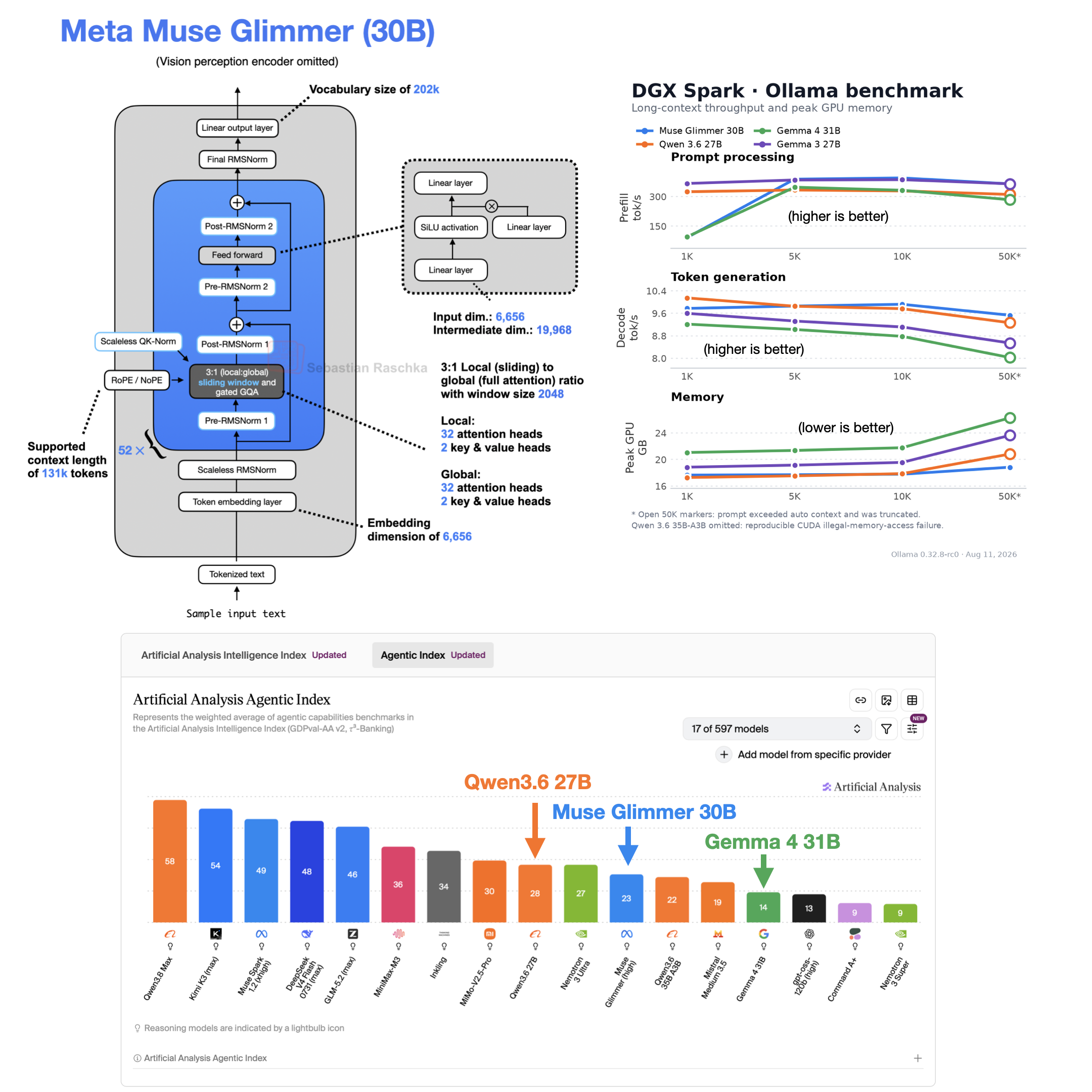
Sebastian Raschka breaks down Glimmer's dense architecture: 3:1 sliding-window to global attention, 32 query heads with only 2 KV heads, and ~52 KiB of KV cache per token.
smol-muse-glimmer scales Muse Glimmer's language backbone down to a 51M-parameter model and trains it on TinyStories, reaching validation cross-entropy of 1.8127 at step 5,000.
Benchmarked Muse Glimmer 30B on my RTX 5090 (32GB), 262k context, UD-Q5_K_M + dflash-kquant + mmproj.
Workload Stock master + DFlash ngram-simple PR #26842 + DFlash Code patch 78 t/s 57 t/s 220-253 t/s Mixed agent turn 77 t/s 68 t/s 188-213 t/s Tool-call JSON 71 t/s 75 t/s 155-181 t/s Heavy reasoning 52 t/s 58 t/s 120-130 t/s PR #26842 moves the DFlash draft argmax from CPU to GPU, which was the bottleneck. I cherry-picked it onto master (it branched before the Muse merge, one conflict to resolve manually) and it builds clean. Code generation now matches Meta's published 233 t/s, which I could not reproduce on stock master.
Notes:
• ngram-simple loses to DFlash on every coding workload.
• Server caps context at the model's metadata context_length, use --override-kv for 262k.
• The reasoning budget flags do not work with this template. This is verified: with the budget set to 64, the model still burned 2000+ chars thinking and the budget message never appeared. Leave max_tokens headroom for the reasoning block.
Flags:
llama-server ^ --model Muse-Glimmer-30B-UD-Q5_K_M.gguf ^ --mmproj mmproj-kquant.gguf ^ -c 262144 --parallel 1 ^ --override-kv "muse-glimmer.context_le
I wanted a quick calories counter for myself, using LLMs to evaluate the calories from pictures of meals + descriptions.
I needed to pick a model so I made a quick benchmark.
The setup was:
- Nutrition5k photos for photo + calories: https://github.com/google-research-datasets/Nutrition5k
- A tool with access to calories information from USDA FoodData Central + MEXT
- I evaluated models based on how many of the meals they managed to have under 20% of error
- All on the same randomly picked 25 meals.
Models too big for my machine were run through OpenCode Go/OpenRouter. I've also included Spark 1.3 since it'll supposedly be open weights.
Results Model % within 20% Mean bias Median Error Qwen 3.8 27b 16% +64 kcal 148 kcal GLM 5.3 Flash 28% +18 kcal 65 kcal Qwen 3.8 Max 32% -11 kcal 48 kcal Muse Glimmer 30b 32% +25 kcal 92 kcal Qwen 3.8 Flash 36% +2 kcal 91 kcal DeepSeek v4 Flash Vision 40% +52 kcal 65 kcal Muse Spark 1.3 48% -24 kcal 45kcal I know it's not the most scientific benchmark, but it's interesting to see that the order is not really linked to model size.
The most interesting for me is how Muse Glimmer 30b trounces Qwen 3.8 27b here. I think it hig
I have assigned @Muse the most complex task that other agents have failed…. Appealing my San Francisco property tax bill. And it’s.. working! It informed me that tonight was the deadline to file a review and doing the appeal. Really nice work @alexandr_wang and team
Every agent is going to have its 'cheat code', like X access for Grok. But this Instagram integration has been amazing for me. I follow a large amount of people and its too much work to manually go through profiles to see if they're still active. I had Muse do that and surface all the dead profiles I might want to unfollow.
The vLLM recipe page for Muse Glimmer has this for speculative decoding:
--speculative-config '{"method": "dflash", "model": "meta-models/Muse-Glimmer-30B-assistant", "num_speculative_tokens": 15}' This errors out on the current vllm/vllm-openai:muse-glimmer image, and each fix reveals the next error. Six separate issues in total, all in the DFlash path. The base model runs fine without the spec config. The source for the image isn't public yet (the recipe says "code will be released soon"), so I pulled the image layers through the registry API and read the code to figure out what was going on. Also checked tensor names by range-requesting the safetensors headers off HF instead of downloading the weights.
What I found:
• The drafter's config declares MuseGlimmerAssistantModel, which is in vLLM's registry. But the dflash code renames it to DFlashMuseGlimmerAssistantModel before the registry lookup, and that name isn't registered. Dies in config validation.
• vLLM maps the drafter's config to Qwen3Config (there's a comment calling it "Qwen3-shaped"). The muse JSON omits vocab_size and use_sliding_window, so Qwen3Config fills in its own defaults: vocab becomes 151936 (the model i
Disclaimer. This is the first time I've used Muse or VSCode as a harness. The reason I am using VSCode as a harness is this is a research project for my job, and we only have VSCode, Codex, and Claude Code approved for harnesses.
I ran it in a folder with only one HTML file (800 lines) that is a Roblox-style COD game. I just gave it a prompt "Can you fix the bugs in the file". It read the file 3 times, found one bug, started to fix it, then got stuck reading the same 10 lines over and over.
I imagine it's one of these three issues.
• It's a prompt error, being way too vague/open ended for the capabilities of a smaller model. I tried again, with a specific prompt to fix a specific bug, and it still just ends up so confused, trying to grep/find the file despite already having read it, and trying to find the code inside of the file.
• It's a limitation of small models running with a large harness/having way too much going on. I tried running it with Pi with its default prompt, and it just got stuck doing tool calls and never actually read the file. Tried running this just directly in the Unsloth Desktop UI with no harness but it failed to parse the file I inputted and tried to gen
Ran Muse Glimmer on a single RTX 3090 and found a max_tokens setting that made it look dumb; shares numbers at filled context and notes better-than-expected non-English handling.
 usecases










 ChatForm
 Tgmlabs