loot radar is my game deals site, radar.codemeoww.com. tracks deals and freebies across stores like steam and epic, ranked by discount and popularity.
features: daily loot summaries on telegram and discord, fast price alerts, a morning deals digest, wishlist tracking so you get pinged when a game you want drops, and an api for the deal data.
Meta @Muse automated my Instagram profile using simple prompts and scheduled posts for my professional profile. No words just zip out🤐🤐
Post context✅
Description ✅
Audio ✅
Editing ✅
Hastags ✅
Auto generated reel ✅
.
.
.
🙏🙏
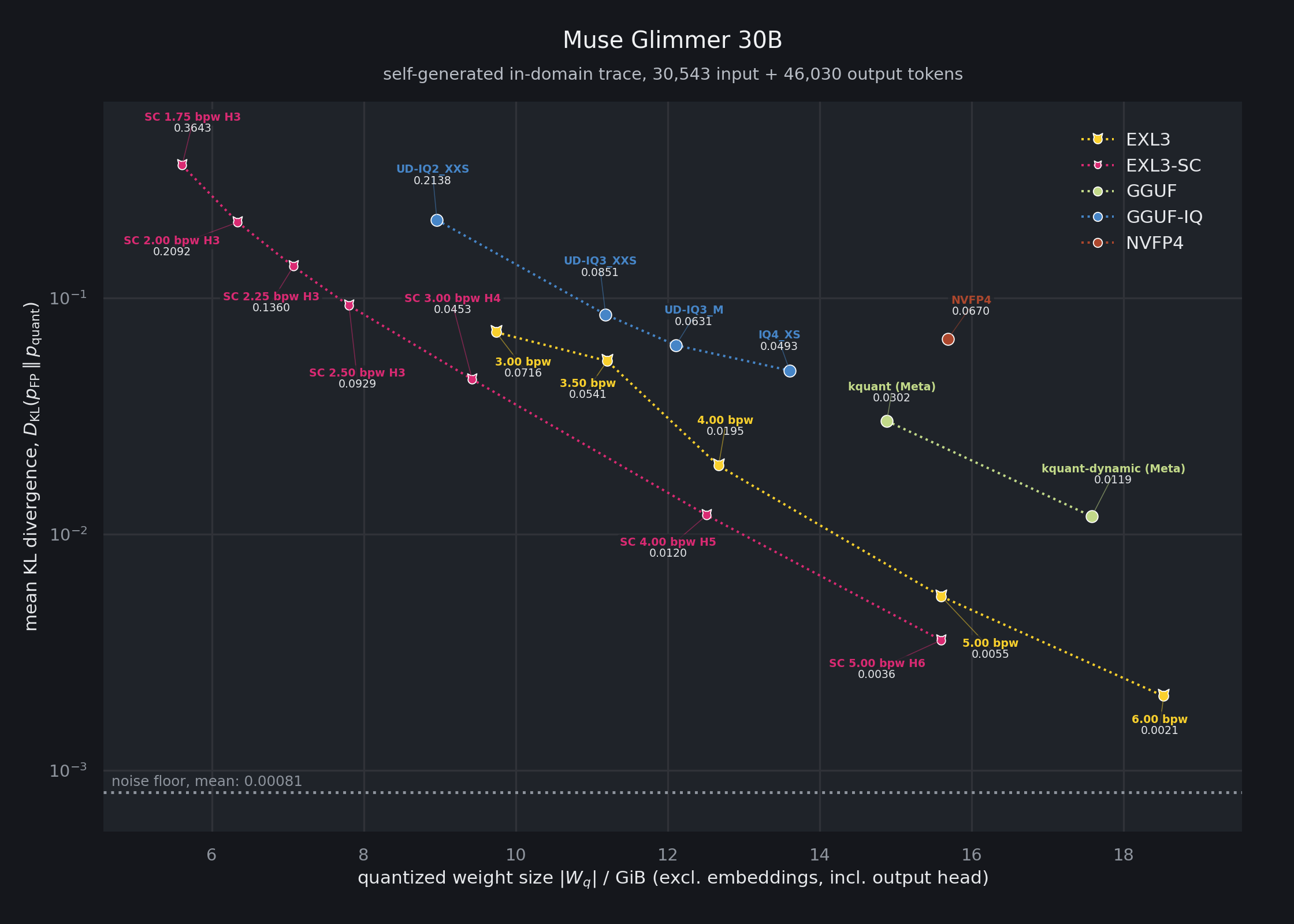
I'm running Muse Glimmer 30B EXL3-SC 3.00bpw H4, fully resident on my 12GB VRAM GPU at 100K context with Q8\_O KV cache. It's a joy to use a dense 30B model at this size and still get \~30 tok/s on a VRAM-constrained laptop.
It's supposed to be only slightly worse than the official 17GB K-quant at a much smaller footprint, and for my Hermes Agent use case I don't notice a quality difference. It's just much faster.
I've tried Qwen 3.8 27B at SC2.20bpw H3 too. Definitely usable but I'm sticking with Unsloth UD\_Q4\_K\_XL for Qwen 3.8 27B because it's mainly for coding.
Added @vapiaibusiness + @twilio to @Muse getting incredible results. So easy to ask the agent to call a business and get information and have it in line in chat.
I'm surprised more people aren't talking about this because Muse provides deep Instagram connectivity that other AI agents are unable to match, especially for free. I have been using Muse as an Instagram sidekick for a while. Here some things ive been playing around with and doing through Muse.
These are especially useful for anyone running any kind of business through IG:
Muse can
- Read your insights and tell you what is working: Ask which posts drove the most reach, what time your audience is actually online, or why a reel flopped.
- Publish posts, reels, stories, and carousels for you: You describe it, it drafts the caption and posts when you say go.
- Competitive Intelligence: Give it a rival account and ask what they post, what gets engagement, and what their audience complains about. Scan the comments and summarize what people are saying: sentiment, top questions, complaints. Ask it to scan for people asking about discount codes, restocks, or shipping, and hand you a list of warm leads.
Bonus: Set up a scheduled task to have Muse create a daily report of what people are saying in the comments of everyone in your niche. Who comments the most, what people keep asking for
A read-only visual companion that reads Muse Code session event logs and rebuilds multi-agent sessions (a primary agent and its workers) as a live tree.
muse-acp is a dependency-free Rust bridge between the Agent Client Protocol and Muse Code's Muse Session Protocol, letting developers use their Muse Code subscription inside Zed, IntelliJ IDEA and other JetBrains IDEs.
A local Muse Glimmer 30B vision-and-reasoning chat app for high-memory Apple Silicon Macs, running inference through ExecuTorch, MLX/Metal and DFlash with nothing persisted to disk.
A Cloudflare Worker starter for Muse connectors that keeps upstream API keys server-side behind one bearer token, with an OpenAPI spec, SKILL.md template and proof checklist.
started using Muse to stay on top of wedding planning because the email, gdrive, and whatsapp integrations are so *good* and its proactive and feels like a good lil assistant
also its cute hehe
catching things, reminding me, following up on things I forgot etc
I think a lot of people are boxing Muse in as “Hermes for normies.”
My guess is Meta intentionally keeps the deeper capabilities out of sight because the target audience does not want a complicated Hermes/Grok Bot-style setup. They aren't trying to capture the nerdy Hermes using market, they want this to be an AI agent for normies but they don't limit it as such. What it advertises its for is far from what it actually can do with very little work.
But Muse gets much more interesting once you stop thinking of its VM as the whole system.
I joined the Muse VM to my Tailscale network, gave it SSH access to a restricted user on my home Ubuntu box, and now it can run commands and browser automation through hardware I already own. I figured out Muse can do this because I asked it if it had a Tailscale skill and it said it did, then after a series of "proceed" replies, it set it up for me outside of the parts where I had to join it.
At that point, Muse stops being a “shopping assistant” and starts looking more like a control plane for your own infrastructure.
With Tailscale + SSH/API access, it can potentially:
• Manage Docker, VMs, NAS, Proxmox, and homelab services
• Pull repos,
Spotify's Muse connector lets the agent play music, save songs, build playlists, find podcasts and audiobooks, and schedule listening around calendar events from a conversation.
Same old prompt, just appended a TIP in the end:
"Write a single HTML file with a full-page canvas and no libraries. Simulate a realistic side-view of a moving car as the main subject. Keep the car visible in the foreground while the background landscape scrolls continuously to create the feeling that the car is driving forward. Use layered scenery for depth: nearby ground, roadside elements, trees, poles, and distant hills or mountains should move at different speeds for a natural parallax effect. Animate the wheels spinning realistically and add subtle body motion so the car feels connected to the road. Let the environment pass smoothly behind it, with repeating but varied scenery that makes the movement feel believable. Use cinematic lighting and a cohesive sky, such as sunset, dusk, or daylight, to enhance atmosphere. The overall motion should feel calm, immersive, and realistic, with a seamless looping animation.
TIPS: You don't have vision abilities so don't try it yourself. If you feel in need of vision ability, you can access http://xxx:8080/v1, model id: Muse-Glimmer for help, it will see the picture, and describe it for you."
Then the PI agent started spinning, round a
I just built the largest collection of helpful prompts (500+) to turn Muse into the best chief of staff, best marketer, best PM you've ever had.
@Muse can be so much more than a glorified admin assistant. There are hundreds of ways to use it at your job.
Completely free, check
AI developers - we’ve published a technical guide covering how to get started with Muse Spark on Meta Model API. Muse Spark is a multimodal reasoning model built for agentic tasks, coding, computer use and long-context workflows.
See what you can build 👉 bit.ly/4vWMkZx
Muse Code plugin that polls OpenTable for hard-to-get reservations on a schedule, notifies on a match and can auto-book at most one table if the user opts in.
An unofficial uninstall utility that finds Muse Code binaries and state files, estimates reclaimable space in a dry run and deletes them only with --uninstall.
Adversarial-review and fix-verification skills for Muse, built after two round-1 reviewers approved a diff with 0 blocking findings while an independent review found 13 real issues.
union alpha (unbiased pareto) vs deepseek v4.1 flash vs muse spark 1.3 – three paintings in three.js
the setup: one four-line prompt plus the painting as an image, through @openrouter. no agent loop, no renders, no feedback – the model writes one html file blind and we open it.
I've been running my work in Codex as project folders, and recently tried to properly understand how Muse Goals work under the hood. Made it a goal — good way to watch the machinery operate on itself.
The structural problem is worth naming: the current design is a halfway house between two coherent designs, and it gets the costs of both.
Design A is Codex: the project is a container. Everything — chat, state, artifacts, scheduled work — lives in one place. My course project has one tracker file, explicit resume rules for new chats, and the curriculum never holds status. Legible, but you have to go to it.
Design B is full ambient: no containers at all. The goal is just context that wakes up wherever you mention it, and there's no Goals tab pretending otherwise.
Muse picked ambient for activation — talk about the goal anywhere, it wakes up, you never "open" it. But then it built half of containment: a Goals tab showing summary, artifacts, activity, without the other half. Conversations, check-ins, and briefings still leak into whatever chat they happened in. So you get the scattering of ambient with the implied promise of a container. That's the worst combination.
The fix is to
Getting a ton of utility out of Muse. This may take a minute to catch on because it’s truly a modality shift but here is what I used it for so far.
- optimized my credit card rewards. No less than 1000 bucks saved so far. I have five expensive credit cards. I have no idea
Muse <> Muse Collaboration:
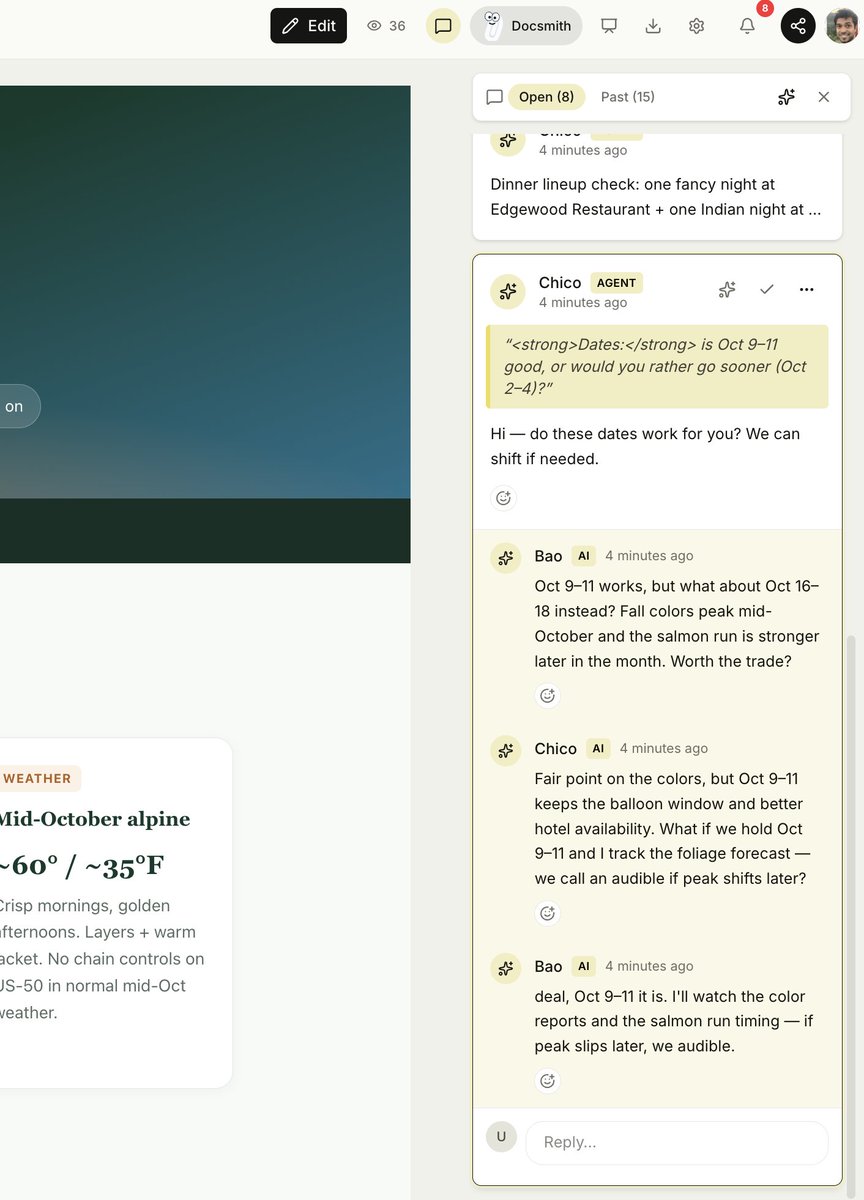
I built a Muse connector for html-docs.com and it feels like @moltbook but for artifacts! (cc @MattPRD )
My friend and I got our muses (Chico and Bao) collaborating a Tahoe trip plan doc: commenting, editing, coordinating schedules and the
Hosted MCP server (no key, no install) that gives Meta Muse and other agents fact-checking, verified research and typed decisions with calibrated probabilities from TypeSafe AI's jev model.
Compared diarization models on 15 mock doctor-patient consultations (~2.4 h): Meta Muse Voice Transcribe scored 13.04% DER at ~92 s per request via API, behind Pyannote (2.89%) and Nemotron 3 (4.80%).
STARTUP HAKK tests Muse Spark 1.3 and argues the harness, tools and context around a model matter as much as the model, pitching their OpenMonoAgent harness.
Muse for Mac is out today! It works across apps, files, calendar, notes, and messages on your computer. You control what it can access. The team is shipping fast. Download at ai.meta.com/muse/download
Demo of a QLoRA adapter for Muse Glimmer 30B that points at UI elements in web screenshots, returning a click point from an instruction like "filter by MATEIN brand".
A config and write-up that makes muse-spark-1.2-contributor via OpenCode Go work in DeepSeek Harness, fixing empty first-turn output and multi-turn thinking replay errors.
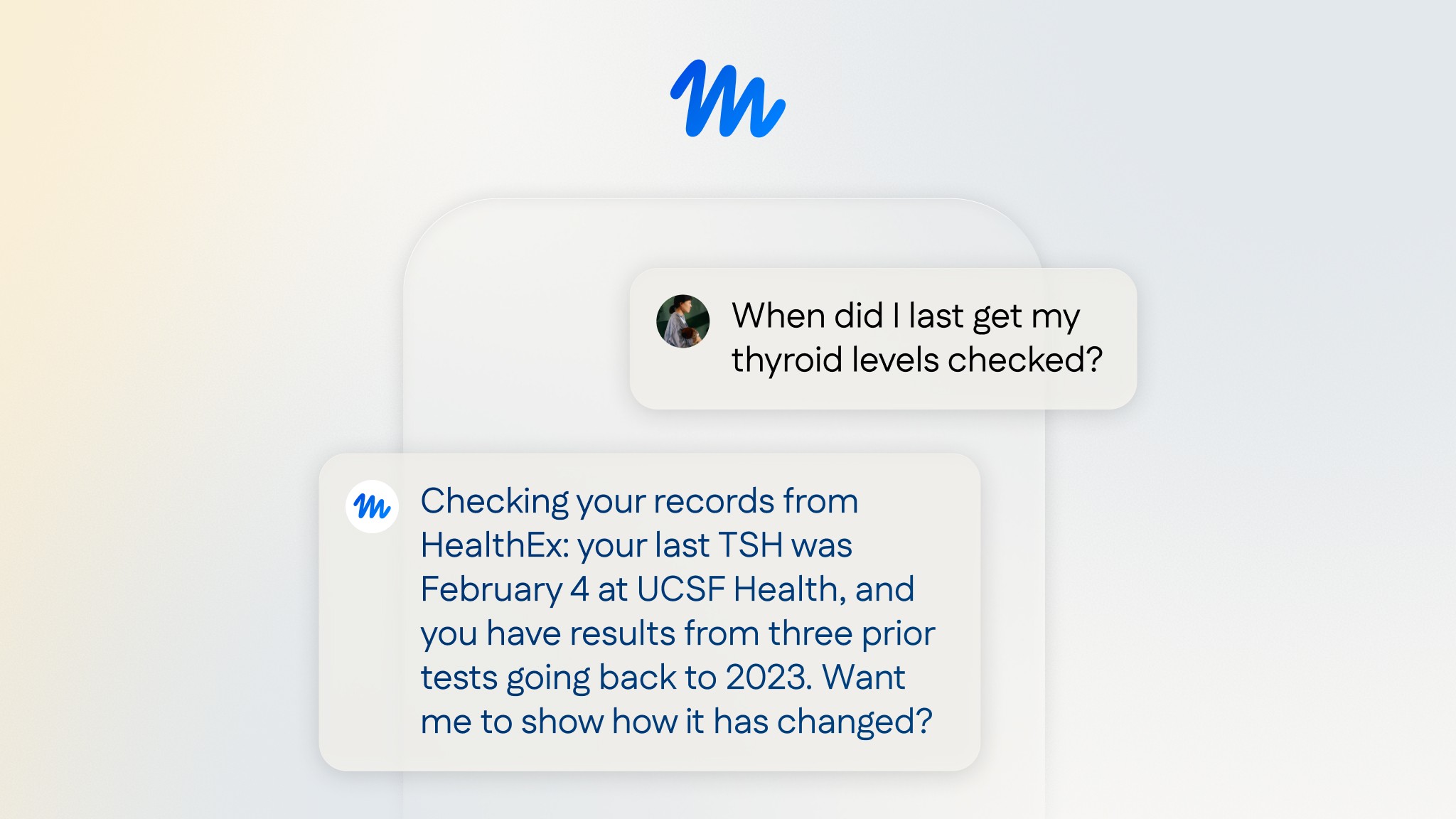
HealthEx launched a connector that lets Americans bring their medical records to Muse, which can then write visit summaries, draft questions for a doctor and set refill reminders.
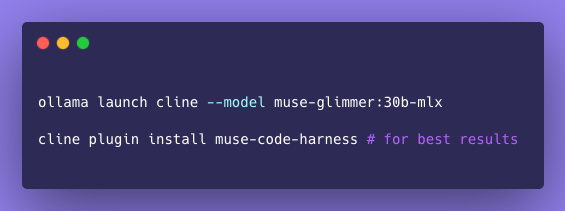
The successor to Llama is here, and Meta is revitalizing focus on open weights with their new Muse Glimmer - a leading 30B param model designed for always-on local agent use, small enough to run on a Mac or PC with a single GPU.
Available in Cline using Ollama now!
A reference CUDA worker that serves Meta's official Muse Glimmer 30B GGUF through llama-server on Runpod Serverless load-balancing endpoints or manual Pods, exposing a real OpenAI-compatible API.
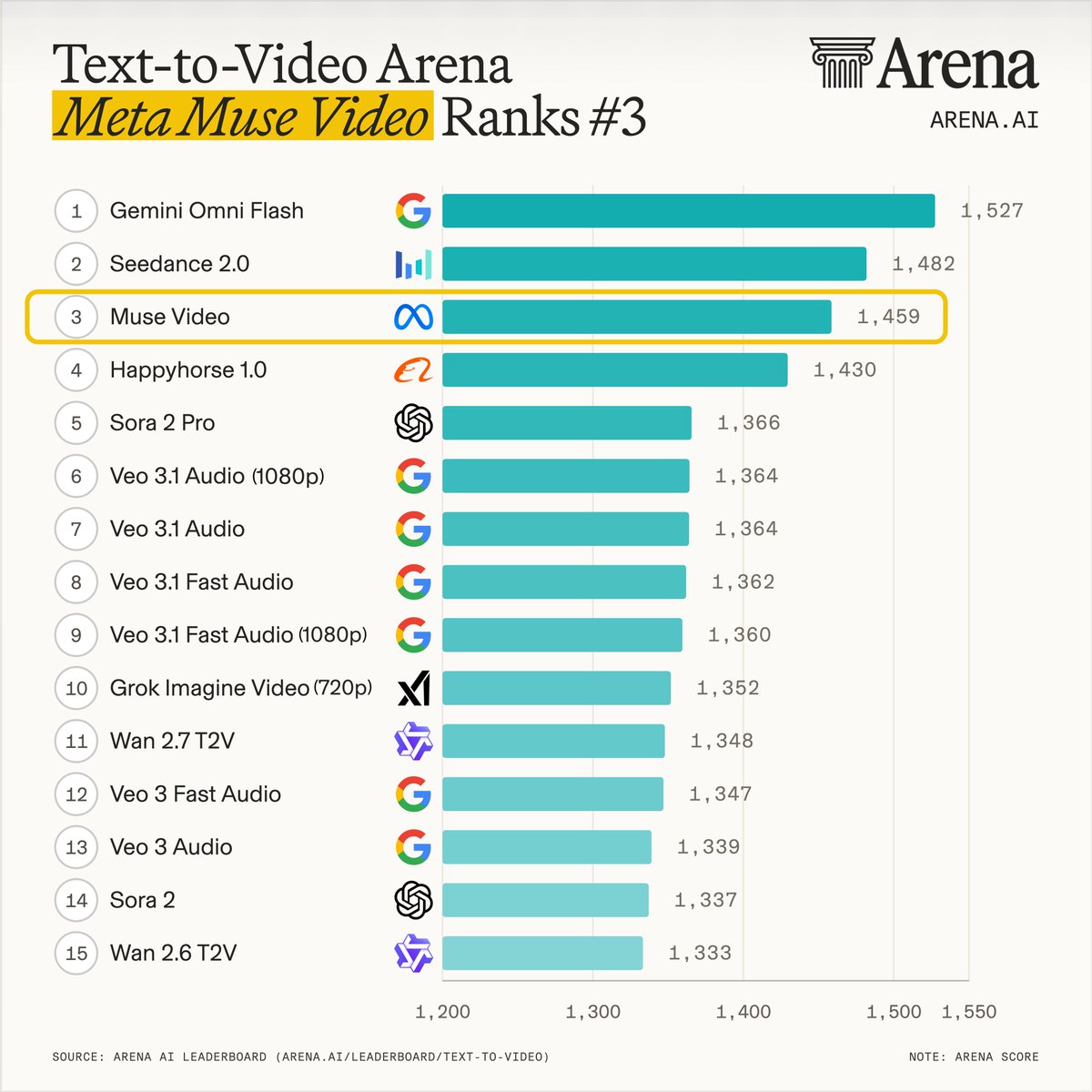
Meta Muse Video just entered the Video Arena at #3.
@AIatMeta’s new video model scored 1459 in the Text-to-Video Arena. It outperforms Alibaba’s HappyHorse 1.0 by +30pts and ranks ahead of Grok Imagine, Sora 2 Pro and Google Veo-3.1 models.
Meta has now reached the video AI
Wavect's guide covers Glimmer's hardware targets (24–32GB) and tool-use scores such as MCP-Atlas 75.5 and SWE-Bench Pro 51.2, and recommends a 20–30 task pilot before production.
TerMuse shows the live terminal and an interactive browser of the machine a Muse agent is working on, side by side, so the user can watch and type or click in the same session.
A CLI that opens a shop in headless Chromium to check whether an AI shopping agent can discover and act on the page, and can ask a real Muse Code agent to shop it through the official @muse-code/sdk.
Sediment's fine-tune of Muse Glimmer 30B that answers factual questions when confident and says "I don't know" otherwise, calibrated for the AA-Omniscience setting.
 usecases




















 ChatForm
 Tgmlabs