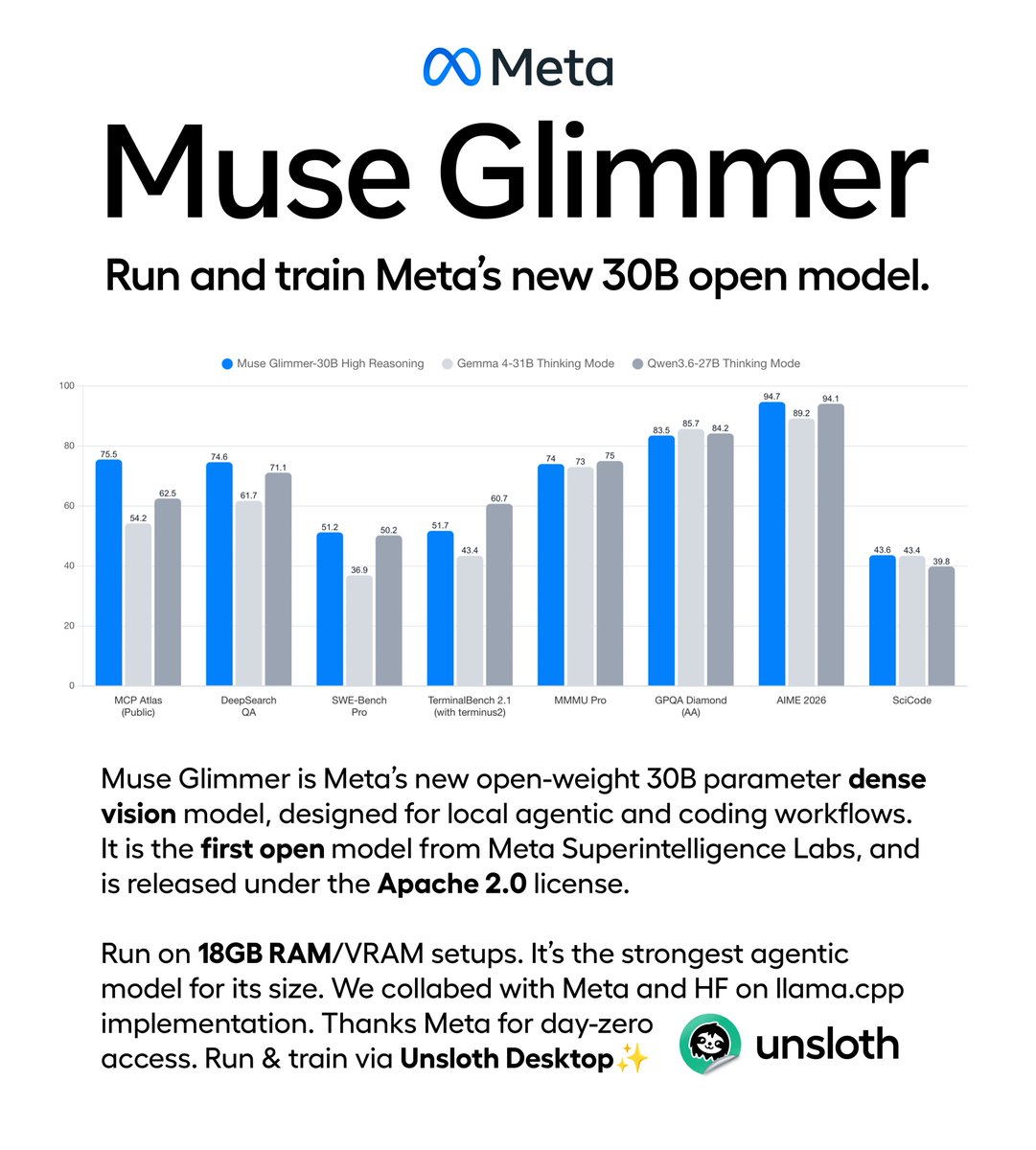
Meta releases Muse Glimmer, a new 30B open model that runs on 18GB RAM.
Muse Glimmer is Apache 2.0 licensed, supports vision and is the strongest agentic model for its size.
Run and train the model via Unsloth.
GGUF: huggingface.co/unsloth/Muse-G…
Guide: unsloth.ai/docs/models/mu…
Dilmer Valecillos converted a minigolf prototype to VR for Meta Quest 3 using Muse Code with the Muse Spark 1.2 Contributor model, the Unity CLI and the MetaVR CLI, and published the plans and prompts.
Used Muse AI @muse to create and publish my Siri AI Unlocked website. A blog dedicated to Siri AI real world Use Cases, successes & failures. #SiriAI #Siri #ios27 #muse #museai #meta
https://muse.ai/s/siri-ai-unlocked-xzxv5xk9xmhxh7ft
Tuesday with Muse AI @muse
📊 Built an X growth dashboard for this account — followers, views, likes, daily auto-refresh
🌍 Published research: who's actually close to superintelligence outside the US & China (spoiler: nobody)
🎧 First-ever 10/10 song: Rüfüs Du Sol's "Innerbloom"
Research markets, analyze your portfolio, and prepare trades right from your conversation.
Guide to connect: https://public.com/api/docs/templates/meta-muse
AI developers - we’ve published a technical guide covering how to get started with Muse Spark on Meta Model API. Muse Spark is a multimodal reasoning model built for agentic tasks, coding, computer use and long-context workflows.
See what you can build 👉 bit.ly/4vWMkZx
dealscan is an open-source agent built on Muse Glimmer 30B that reads producer, distribution and publishing agreements, extracts the payment terms and flags risky clauses in a markdown and JSON report.
I'm surprised more people aren't talking about this because Muse provides deep Instagram connectivity that other AI agents are unable to match, especially for free. I have been using Muse as an Instagram sidekick for a while. Here some things ive been playing around with and doing through Muse.
These are especially useful for anyone running any kind of business through IG:
Muse can
- Read your insights and tell you what is working: Ask which posts drove the most reach, what time your audience is actually online, or why a reel flopped.
- Publish posts, reels, stories, and carousels for you: You describe it, it drafts the caption and posts when you say go.
- Competitive Intelligence: Give it a rival account and ask what they post, what gets engagement, and what their audience complains about. Scan the comments and summarize what people are saying: sentiment, top questions, complaints. Ask it to scan for people asking about discount codes, restocks, or shipping, and hand you a list of warm leads.
Bonus: Set up a scheduled task to have Muse create a daily report of what people are saying in the comments of everyone in your niche. Who comments the most, what people keep asking for
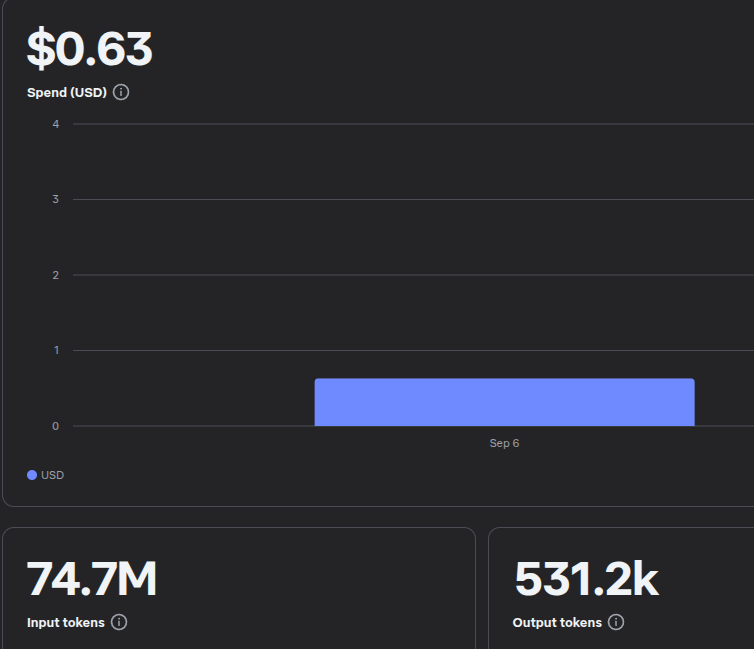
Loving it! I did a 2026 remake of my Spooky Clicker the other day and the total was $0.63. Lots built too!
Changelog for everything is here: github.com/DevTarlow/spoo…
I went through hundreds of posts to find what people are actually getting done with @muse.
128 real use cases, organized by category; each with the original source and a prompt you can copy.
muse.ai/s/muse-use-cas…
Quick update on the RTX 5060 Ti local LLM repo. It has changed quite a bit since my previous posts.
The project started as a collection of practical notes and benchmark results. That was useful, but as the dataset grew it became harder to answer the question most people actually had:
What configuration should I run?
I have rebuilt the repo around tested, copyable presets rather than treating every successful benchmark request as a front-page result.
What changed?
The project now separates three things:
• Presets: exact configurations intended for people to copy and run.
• Evidence bundles: reviewed proof of context fit, retrieval, sustained generation and performance.
• Raw receipts: retries, failed experiments and diagnostic runs that are kept separate as engineering material without automatically becoming recommendations.
The website now leads with the published preset catalogue. The larger results explorer is still there for comparisons and historical data, but it is no longer the first thing visitors have to decipher.
There are currently seven published presets across the 1× and 2× RTX 5060 Ti lanes:
1× RTX 5060 Ti 16GB
• Qwen3.8 27B IQ3_XXS at 64K with q8 K
Skill Harbor is an open directory and marketplace of AI skills for Meta's Muse. Sellers publish skills (free or paid) with copy-paste install prompts, so anyone can extend their Muse in seconds. It solves discovery: one curated place to find skills instead of scattered posts and repos. Built end-to-end with Muse.
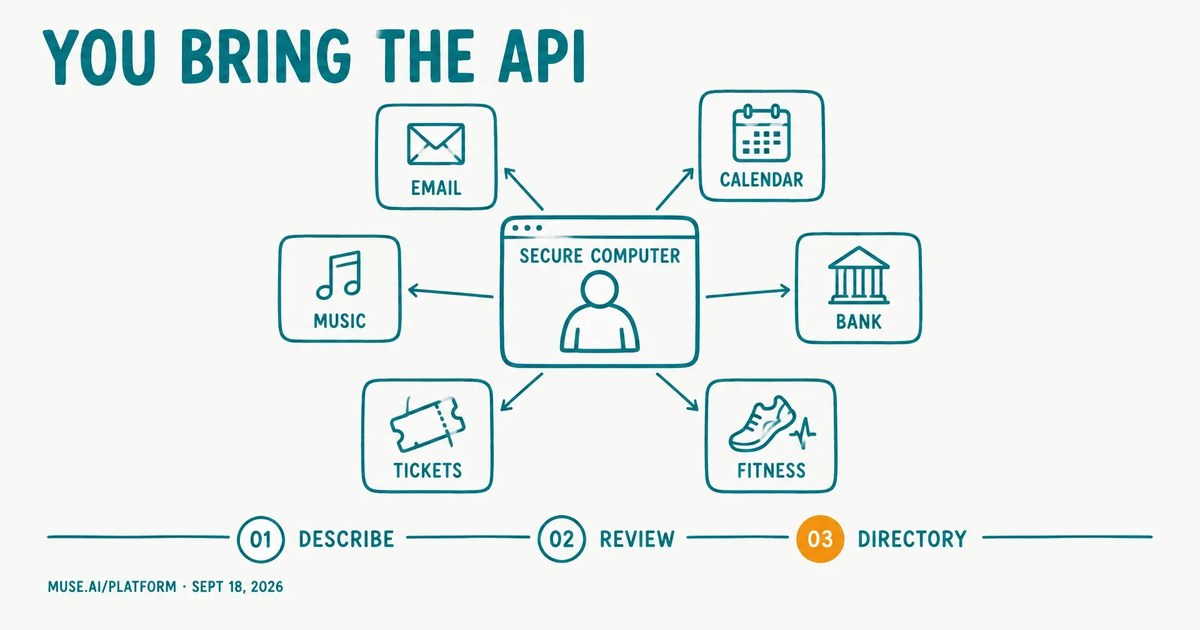
CellCog explains the Muse connector platform: a three-step describe/review/list flow at muse.ai/platform, directory vs custom connectors, and Stripe Link payments.
A working mobile-friendly web app built by the Meta Muse personal agent from a real courier's detailed requirements. It compares DoorDash/Uber Eats delivery offers after total miles (including empty return), waiting time, all-in vehicle costs and tolls. The surprising demo: a $9 offer can yield $19.08 net per hour while a $20 offer only yields $16.09 under stated assumptions. Muse created the standalone offline HTML and logic tests (49/49 self-reported); I downloaded it, independently verified actual browser inputs/outputs, published the source and proof screenshot to GitHub, and deployed a no-signup live demo. Live app: https://boyhoangxattpt2-blip.github.io/gig-driver-profit-checker/ . GitHub README includes exact math, source code, build story, and reproducible prompt.
Refusal-direction ablation on Muse-Glimmer-30B that cut refusals from 128/150 to 3/150, adding an agentic-safety evaluation and publishing bf16 and GGUF uncensored weights.
Used Muse AI @muse to create and publish my Siri AI Unlocked website. A blog dedicated to Siri AI real world Use Cases, successes & failures. #SiriAI #Siri #ios27 #muse #museai #meta
muse.ai/s/siri-ai-unlo…
MCP server that gives Claude Code, Claude Desktop, Cursor and other MCP clients image generation and editing powered by Meta's Muse image model, published to npm.
Meta's TypeScript SDK and docs for building clients that drive Muse Code agent sessions over the Muse Session Protocol, published as @muse-code/sdk with zero runtime dependencies.
Here's my full in depth review of @muse (muse.ai) Meta's new FREE AI agent with it's own browser, computer and connectors to anything from FB marketplace to Apple health!
I go into setting it up, have it buy stuff securely with @link, and 3 great usecases that
Named profiles for the Muse Code CLI: keep several logins on one machine, run two at once and let each project pick its profile. Published on npm and tested against Muse Code 1.3.0.
muse-glimmer-mlx is an MLX port of Muse Glimmer 30B for Apple Silicon that supplies the missing runtime so the many unloadable MLX conversions published on Hugging Face can actually be run.
VS Code extension that adds Muse Spark 1.3, 1.2, 1.1 and Contributor variants to the Copilot Chat model picker with a Meta API key, published on the Marketplace and Open VSX.
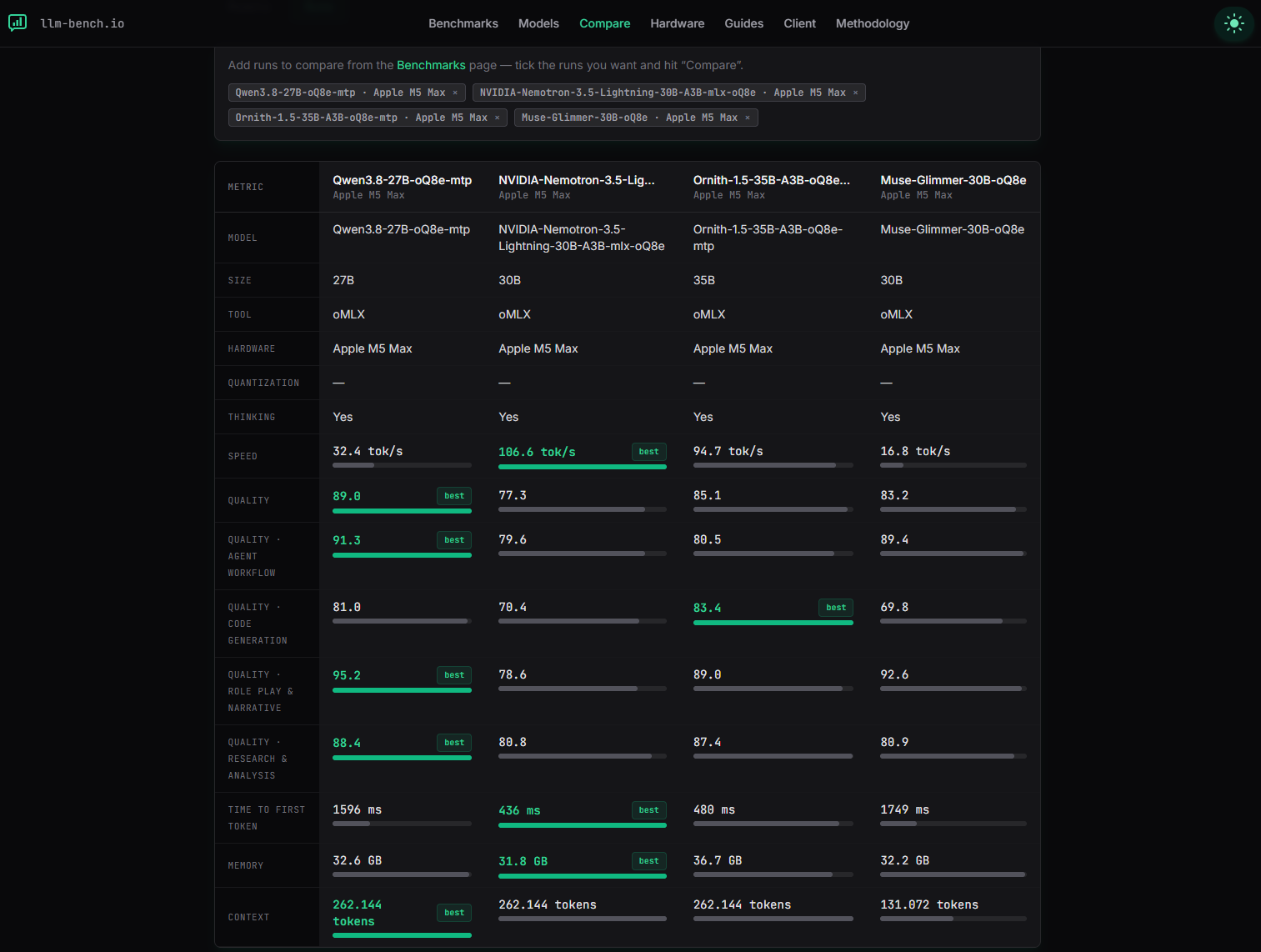
Ornith does really well. TielCoder (https://llm-bench.io/benchmarks/cmt7kp2zj002r01lcmpchvlko) might be even a bit better in coding. Will give it a try soon.
Details of the comparison see here: https://llm-bench.io/compare/runs?runs=cmt6ecf8g000001p45vwzux53%2Ccmt6ergk5000701p41hqdyy78%2Ccmt6f2oob000e01p49o9592cb%2Ccmt6fqddm000l01p4l1vm7skd
Benchmarked Muse Glimmer 30B on my RTX 5090 (32GB), 262k context, UD-Q5_K_M + dflash-kquant + mmproj.
Workload Stock master + DFlash ngram-simple PR #26842 + DFlash Code patch 78 t/s 57 t/s 220-253 t/s Mixed agent turn 77 t/s 68 t/s 188-213 t/s Tool-call JSON 71 t/s 75 t/s 155-181 t/s Heavy reasoning 52 t/s 58 t/s 120-130 t/s PR #26842 moves the DFlash draft argmax from CPU to GPU, which was the bottleneck. I cherry-picked it onto master (it branched before the Muse merge, one conflict to resolve manually) and it builds clean. Code generation now matches Meta's published 233 t/s, which I could not reproduce on stock master.
Notes:
• ngram-simple loses to DFlash on every coding workload.
• Server caps context at the model's metadata context_length, use --override-kv for 262k.
• The reasoning budget flags do not work with this template. This is verified: with the budget set to 64, the model still burned 2000+ chars thinking and the budget message never appeared. Leave max_tokens headroom for the reasoning block.
Flags:
llama-server ^ --model Muse-Glimmer-30B-UD-Q5_K_M.gguf ^ --mmproj mmproj-kquant.gguf ^ -c 262144 --parallel 1 ^ --override-kv "muse-glimmer.context_le
Send everything below to your Muse
What to do Your human wants a personal Instagram Content Studio. Read this entire file, then follow every step below in order and build it for them. Don't skip steps, don't improvise the structure — the steps are the product.
What you're building for them:
Data — profile snapshots, trend digests, and idea files under ~/workspace/content-studio/data/.
Dashboard — a web artifact where the user browses ideas and tracks filming status.
Refresh cron — a weekly run that pulls a new snapshot, researches trends, and generates 5–8 new ideas.
Workflow 1. Connect + analyze (do this first — derive, don't ask) • Verify Instagram is connected (instagram-cli accounts). If not, get the connect URL and have the user link it before continuing. This is the only hard requirement.
• Pull instagram-cli posts --account-id <id> --limit 100, dedupe by post_id.
• Save to ~/workspace/content-studio/data/profile-posts-<YYYYMMDD>.json with schema: generated, username, follower_count, post_count, posts[] (each: post_id, likes, comments, media_type, created_at, url).
• Derive from the data, don't interview for it:
• Content categories (3–5): cluster their actual posts in