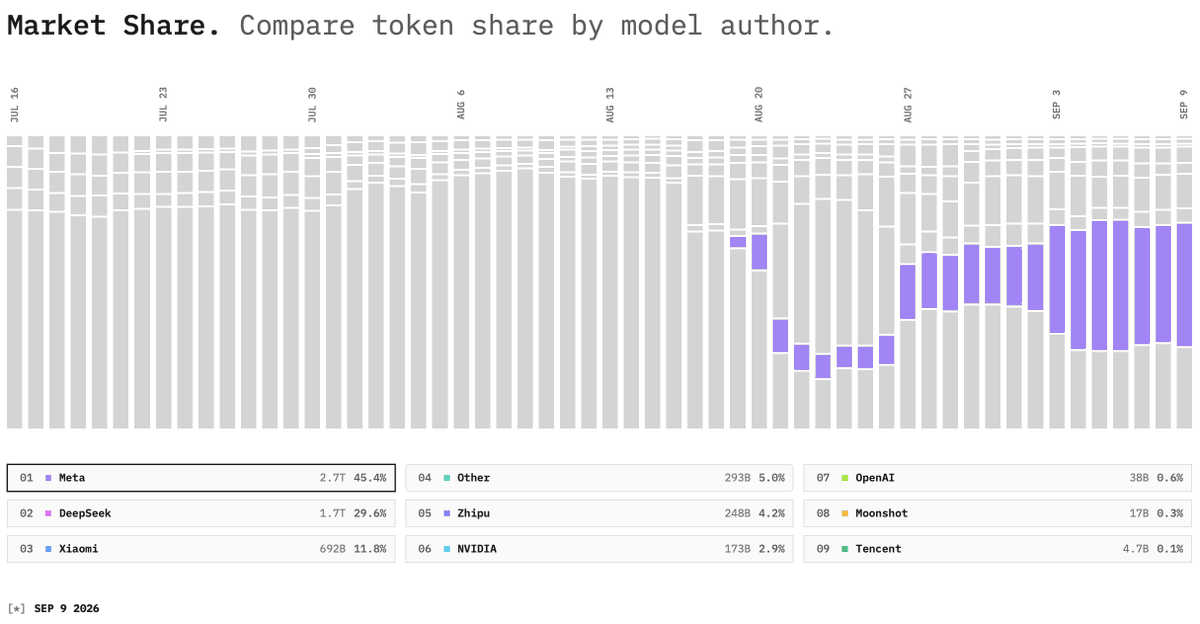
$META just went from 3.5% to 45.4% token share on OpenCode in just over two weeks
Muse Spark 1.3 being good + free is enough to become the default for most users
Default gets you usage → usage gets you data → data makes the next model better
Anthropic and OpenAI can’t afford
opencode-delegate is a Claude Code plugin where Claude plans and writes briefs while opencode sessions on free models, Muse Spark 1.3 by default, implement and review each task.
Installer that routes OpenCode's coder and reviewer agents at a Muse coding subscription, calling api.meta.ai directly with no local proxy, reusing the muse login key.
OpenCode plugin that reads the muse CLI login, registers a muse-code provider against api.meta.ai and rediscovers available Muse models every 30 minutes, metered against the Muse Code subscription.
AI John walks through installing OpenCode, creating an API key and connecting Muse Spark 1.3 on the Contributor Free tier, noting prompts may be used for training.
A benchmark that tests whether Muse Glimmer 30B on a single RTX 5090 works as an OpenCode backend, using the same tasks as earlier DeepSeek and Qwen runs; first results show 18/18 episodes with zero malformed tool calls.
A small local proxy between Grok Build and OpenCode Zen that fixes muse-spark-1.2-contributor-free streaming, with a technical report of protocol captures and root cause.
A set of small fixes that let Muse Spark run in pi, Agent Orchestrator, opencode and other OpenAI-compatible tools, handling its non-standard SSE event and missing model-catalog entries.
A config and write-up that makes muse-spark-1.2-contributor via OpenCode Go work in DeepSeek Harness, fixing empty first-turn output and multi-turn thinking replay errors.
muse-spark-crew is an opencode skill that orchestrates ten specialist subagents on Muse Spark 1.3, from architect to security auditor, with a phased fan-out and review gates.
A documented setup that runs Muse Spark 1.3 Contributor inside Claude Desktop on macOS through a small Node proxy that translates Anthropic requests to OpenCode Go's OpenAI-style API.
A fork of NemoAgent that swaps the LLM layer to OpenCode Go models, defaulting every role (dialogue agent, executor, router) to Muse Spark 1.3 Contributor with a per-role reasoning level.
I had one shotted this with explicit instructions to create this game with all the Asset specifications on @opencode and it generated in 30-40 Seconds. Couple more iterations and inputs will give us a production ready game. Great Job Team Meta #ReverseSonic
musecode adds a /musecode slash command, a Haiku relay agent and a muse-run CLI so Claude Code Workflow fan-outs run their leaf tasks on the free Muse Spark 1.3 model through opencode.
Wondering why all the hate for muse spark 1.3 since in my testing on a codebase with about 10k LOC it performed pretty well , sometime even outperforming Gemini flash 3.8 in solving some hard bugs where flash took much longer and needed more guidance for these tasks .. Granted I think Gemini is certainly better for frontend and designs much better looking interfaces without much prompting, but for complex bugs spanning multiple backend parts I think Muse spark perform really well….
PIMX_ELTEX runs Muse Spark 1.3 in OpenCode on six prompts, from 3D games and an open-world mini GTA to car simulators and web apps, at about 3 minutes per project.
Muse is your personal assistant. Zouroboros Workshop is the workshop behind it.
Workshop is an MCP service that runs on a private, single-tenant VPS provisioned for each customer. From a normal Muse conversation, a user can dispatch real software work to a coordinated team of seven AI coding executors — Claude Code, Codex, Gemini, OpenCode, Kimi, Hermes, and Pi — routed by health and capability, with automatic fallback when one executor is unavailable.
Three things make it different from a single-vendor hosted builder. First, it runs on the subscriptions the user already pays for: there are no Workshop model credits and no second meter. Second, its memory is shared across every executor and survives across sessions, so a decision recorded by one tool is retrieved by another in a later Muse conversation — memory that compounds instead of resetting. Third, work is verified before it is delivered: builds run through a factory lane with deterministic review, and swarm results return with per-task evidence, not just an agent's claim that it is done.
The customer-facing promise is simple: turn your existing AI tools into a workshop that delivers tested, reviewed work — a finished pull request, not a wall of code in chat.
An OpenCode plugin that ports Muse Code's subagent coordination core: durable child workers, a ledger mailbox and admission control, so subagents survive crashes and respect capacity.
Portuguese-language repository of versioned agent skills for OpenCode and Muse, each a lean SKILL.md with references and templates (ticketing, conventional commits, skill authoring, frontend design).
Wrappers that run the Muse Code harness against OpenCode Go and Zen Responses endpoints for muse-spark-1.3-contributor without changing normal Muse config or needing a proxy.
Ran the model with quants (Q4) by Unsloth with latest (build from master) llama.cpp server.
It takes ~20GB ram running on M5 Pro with 48GB at about 17t/s. Didn't do any reasoning loops/overthinking.
Overall, sits below Qwen3.6 27B, wasn't able to get good code (frontend and backend) results. On the positive side, it didn't fail any tool calls.
Your opinions/findings?
Watch more: https://www.youtube.com/watch?v=_5wKhkUT438
A config (in Spanish) plus two helper proxies for using Muse Spark 1.2 Contributor from Claude Code and Hermes through routatic/proxy and an OpenCode Go subscription.
A pure-stdlib Python proxy that exposes Meta API access to Muse Spark through OpenAI-compatible endpoints for tools like OpenCode and Hermes, with no muse CLI required.
A same-prompt bakeoff site that starts with a playable penguin Tetris generated by Muse Spark 1.3 in OpenCode, with a fixed prompt for comparing other models.
A starter script that downloads Muse Glimmer 30B, serves it with llama.cpp on an Apple Silicon Mac and connects it to OpenCode, with the server listening only on localhost.
Got Muse Glimmer 30B running locally on my Mac (M5 Max - 128 GB )and the instruction following is impressive. need to setup with opencode next
Video Speed - 5X
WTF Code uses Muse Spark 1.3 Contributor Free through OpenCode to build an interactive project from scratch, testing UI, animation, debugging and multi-step development.
First impressions on Muse Glimmer!
It's incredibly fast for a dense model, currently running an average of 208tps with a max of 274tps on a single 5090 with their DFLASH config.
Comparatively, though, both using Open Code, Qwopus Coder (with thinking off) produced a much
IchBinFabian installs Muse Code, compares Muse Spark 1.3 pricing with Claude Code and Codex, reviews the benchmarks and builds two real projects in OpenCode for a combined 82 cents.
A few things right off the bat:
• it reasons very efficiently. Like Grok 4.5 levels of efficient thinking
• it quantizes very well. My first few tests with iq3_xxs were better than Qwen/Gemma behaved at that size
• its knowledge depth is amazing. It beats Qwen3.6 27B on no-tools trivia.
• in OpenCode it is a much more efficient agent than 27B. Both models accomplish their tasks but Muse-Glimmer got there faster every time
I'll say that it's worse at most things coding, probably being closer to Gemma4-31B level.. but damn there's a lot of places where I'd use this model on a 24GB GPU right now and it's been a while since anything has filled that spot except for 3.6-27B
sol-loop pairs a GPT planner on a Codex subscription with Muse Spark in opencode as executor, which returns evidence and diffs for each atomic spec; the author says over 99% of tokens run on Muse.
Abid Ali Awan sets up Muse Glimmer 30B on an RTX 5090 with llama.cpp, dynamic quantization and DFlash speculative decoding, serves it locally and wires it into OpenCode to build a medical research web app.