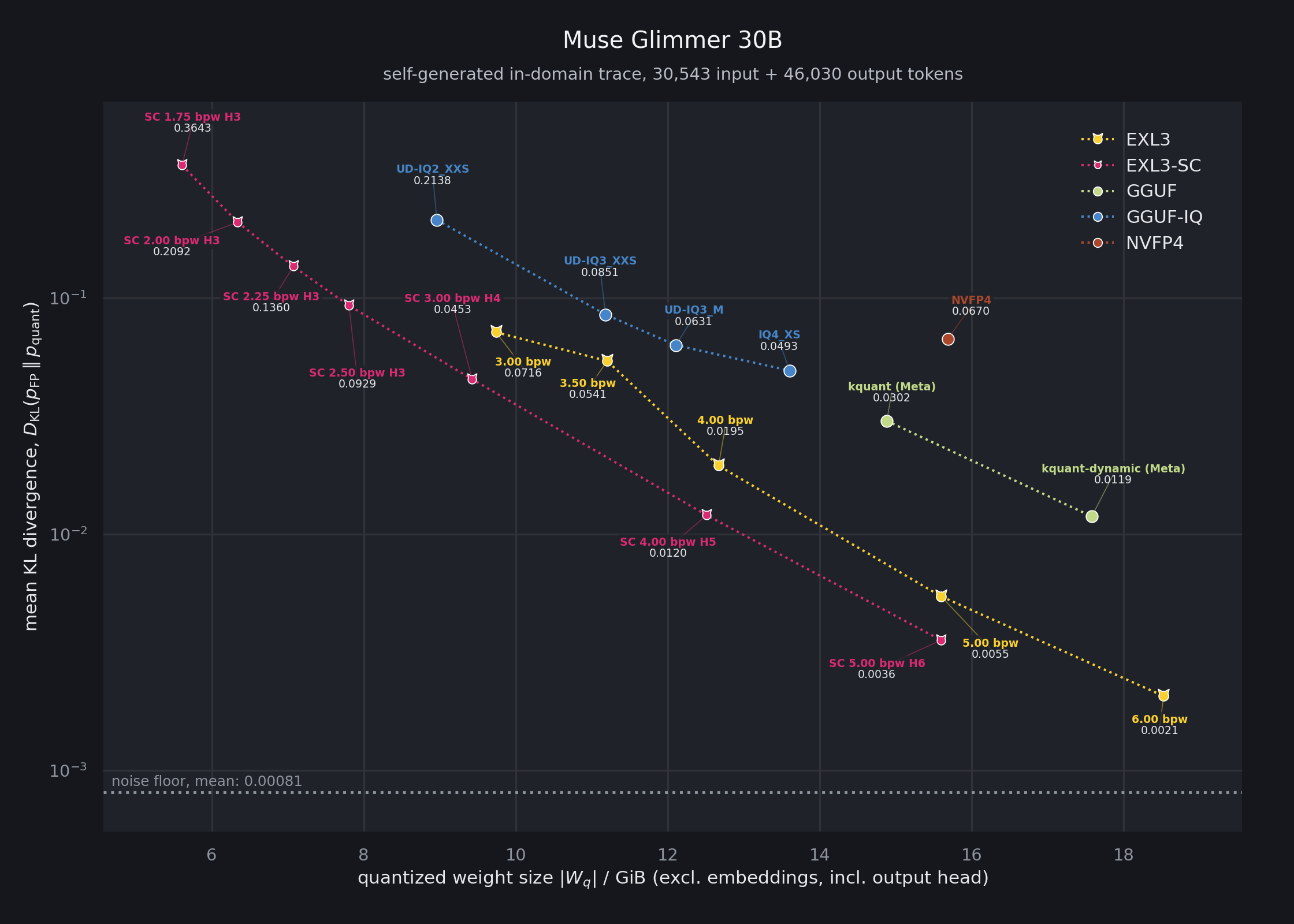
I'm running Muse Glimmer 30B EXL3-SC 3.00bpw H4, fully resident on my 12GB VRAM GPU at 100K context with Q8\_O KV cache. It's a joy to use a dense 30B model at this size and still get \~30 tok/s on a VRAM-constrained laptop.
It's supposed to be only slightly worse than the official 17GB K-quant at a much smaller footprint, and for my Hermes Agent use case I don't notice a quality difference. It's just much faster.
I've tried Qwen 3.8 27B at SC2.20bpw H3 too. Definitely usable but I'm sticking with Unsloth UD\_Q4\_K\_XL for Qwen 3.8 27B because it's mainly for coding.
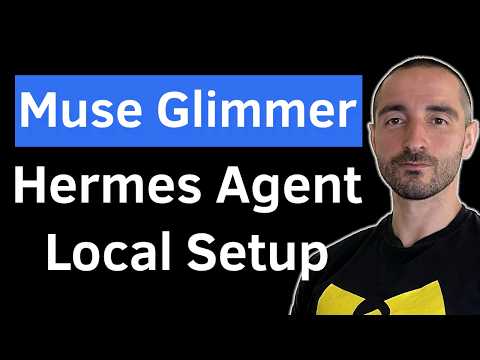
Venelin Valkov pairs Muse Glimmer with Hermes Agent on llama.cpp for a fully free local agent, testing whether a better harness fixes the model's mixed early reviews.
Setup the latest (master) version of llama.cpp server with the guide and the official GGUF weights by Meta AI: https://huggingface.co/meta-models/Muse-Glimmer-30B-GGUF and connected the Hermes Agent to the llama.cpp endpoint.
Getting about 22t/s (+3-4t/s) on M5 Pro, using ~24GB including the drafter (provided by Meta).
The model did correct tool calls and actually did some useful work inside the Hermes Agent. Moreover, the resulting coding task/project works, which was not the case when running the model with OpenCode.
Watch more: https://www.youtube.com/watch?v=cmENEolUtM4
A static Space showing a Hermes-agentic fine-tune of Muse Glimmer 30B proposing one or two tool calls or answering directly; the model card reports 16/20 on a simulated loop gate.
A pure-stdlib Python proxy that exposes Meta API access to Muse Spark through OpenAI-compatible endpoints for tools like OpenCode and Hermes, with no muse CLI required.
gemini 3.7 flash vs deepseek v4 pro 0813 vs muse spark 1.2 – on voxel city dioramas
three models each built three crossy road-style 3d scenes – a construction site, a nyc intersection, a river with a drawbridge – as single self-contained html files
the setup:
@nousresearch's
We've been curious how far local models have actually come for agentic coding tasks, so we ran an experiment.
Setup:
• Model: Muse Glimmer (30B), packaged as a single llamafile
• Agent: Hermes coding agent (connected via llamafile's local server mode, zero API keys needed)
• Target: Mozilla AI's Otari gateway
The Issue:
We pointed Hermes at a real, reported bug in Otari (#183) where the gateway returned a vague 502 error on image requests instead of passing through the actual provider error.
What the Agent Did:
Hermes read the issue, navigated the repo, isolated the bug, created a branch, ran existing tests, wrote a new regression test, and opened a draft PR (#727). All of it ran locally and offline, with zero code written by hand.
It's still draft PR territory rather than a merged fix, but it's a solid signal that ~30B local models are getting genuinely capable for real dev workflows, not just toy demos.
Video walkthrough of the run: https://youtu.be/5GAgbT-XgHU?si=vJqEDGm9hssCO5-M
Happy to answer questions about the setup, model performance, or how Hermes handled tool calling!
Out-of-tree Hermes Agent model-provider plugin for the Meta Model API and the Muse Spark family, including the low-cost muse-spark-1.2-contributor tier.
Hermes Agent plugin that adds a muse-code provider reusing your Meta login, so Muse Spark runs on your Muse Code subscription instead of per-token API billing.
A video companion repo with the commands and configs for running Muse Glimmer 30B locally on an RTX 3090 and comparing the Prime Agent and Hermes harnesses under the same conditions.
I know this is the most trivial thing ever, but I made a video for folks who want to get started trying to wrangle their kid events.
The schools have 5000 apps we need to manage. So I let Muse do it, and I replicated 5-6 hours of Hermes set up time in about 30 minutes with Muse. And Muse was successful in connecting to all of the kid things: grades, announcements, events, baseball and soccer schedules, etc.
https://www.youtube.com/watch?v=LszTtZ_QWWc
A config (in Spanish) plus two helper proxies for using Muse Spark 1.2 Contributor from Claude Code and Hermes through routatic/proxy and an OpenCode Go subscription.
NetworkCoder runs Muse Glimmer 30B on an RTX 3090, measures speed and VRAM, and gives two agent harnesses the same model, endpoint, project and prompt to compare results.
Muse is your personal assistant. Zouroboros Workshop is the workshop behind it.
Workshop is an MCP service that runs on a private, single-tenant VPS provisioned for each customer. From a normal Muse conversation, a user can dispatch real software work to a coordinated team of seven AI coding executors — Claude Code, Codex, Gemini, OpenCode, Kimi, Hermes, and Pi — routed by health and capability, with automatic fallback when one executor is unavailable.
Three things make it different from a single-vendor hosted builder. First, it runs on the subscriptions the user already pays for: there are no Workshop model credits and no second meter. Second, its memory is shared across every executor and survives across sessions, so a decision recorded by one tool is retrieved by another in a later Muse conversation — memory that compounds instead of resetting. Third, work is verified before it is delivered: builds run through a factory lane with deterministic review, and swarm results return with per-task evidence, not just an agent's claim that it is done.
The customer-facing promise is simple: turn your existing AI tools into a workshop that delivers tested, reviewed work — a finished pull request, not a wall of code in chat.