
Refusal-direction ablation on Muse-Glimmer-30B that cut refusals from 128/150 to 3/150, adding an agentic-safety evaluation and publishing bf16 and GGUF uncensored weights.
GitHub · Local & open models★ Pick· ★ 1
Refusal-direction ablation on Muse-Glimmer-30B that cut refusals from 128/150 to 3/150, adding an agentic-safety evaluation and publishing bf16 and GGUF uncensored weights.
GitHub · Local & open models★ Pick· ★ 1
Your product
Sponsored
Put your logo, a line of copy and an image right here, between the builds Muse developers come to read. Same size as a post.
Shown every 12 builds · on every catalog page
A small Inspect evaluation on Muse Glimmer that tests whether incentive framing changes what an agent reports to its principal when the evidence is held constant; the author reports a null result.
GitHub · Benchmarks & research
You.com's harness for evaluating Muse Glimmer 30B on DeepSearchQA with You.com MCP tools inside pi sessions. A custom RLM v5 extension reached F1 0.8054 on 50 tasks (0.6910 over 900x3) versus 0.50 for plain skill injection.
GitHub · Benchmarks & research

John Yang
@jyangballin
My favorite demo from the launch: muse spark 1.1 + opencode runs evaluation of *itself* + mini-SWE-agent (by @KLieret, @closji, urs truly) on DeepSWE!
X post · Benchmarks & research· ♥ 40
A project that fine-tunes a DSpark speculator for Muse Glimmer 30B on on-policy coding and agentic traces to raise acceptance length on agentic workloads, evaluated with Terminal-Bench.
GitHub · Local & open models
An effort to make Muse Glimmer 30B actually use a 512k-token context (4x native) as a ~17GB GGUF in 32GB VRAM, trained on DGX Spark and evaluated with RULER-style retrieval tests.
GitHub · Local & open models· ★ 1
A reproducible evaluation of a stochastic defect where Muse Spark 1.1, under some agent-like request envelopes, wrote to claude-smoke.txt when asked for muse-smoke.txt; a neutral control kept 80/80 filenames intact.
GitHub · Benchmarks & research
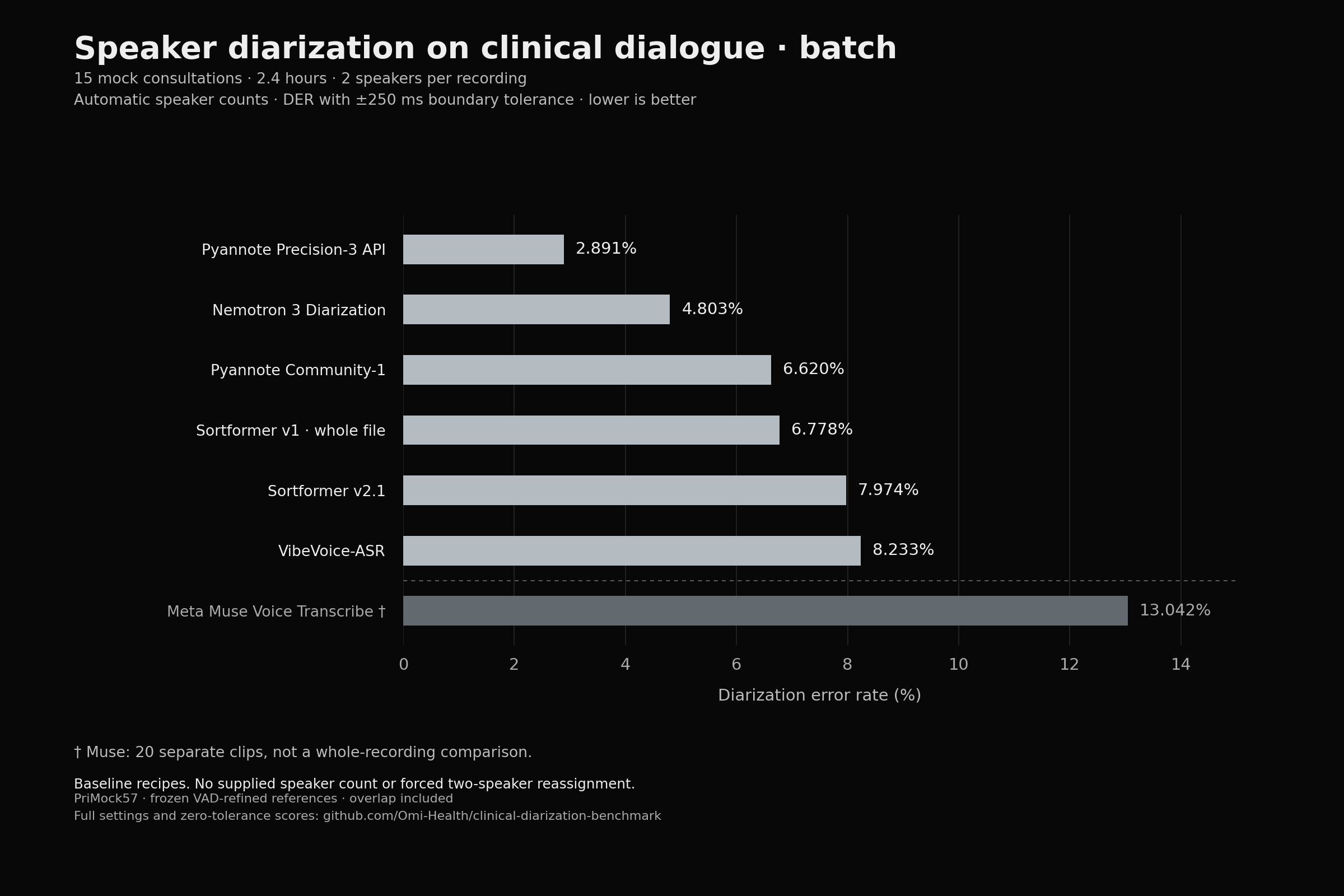
I've been working on clinical speaker attribution at Omi and wanted to compare the current diarization models on the same audio. I used 15 mock doctor–patient consultations from PriMock57, about 2.4 hours. Full recordings, automatic speaker counts, without telling the models there are two people. Batch Diarization error rate (DER), with ±250 ms boundary tolerance. Lower is better. Model DER Median processing time Pyannote Precision-3 2.891% 18.9 s / recording (API) Nemotron 3 4.803% 0.688 s / recording Pyannote Community-1 6.620% 18.691 s / recording Sortformer v1 6.778% 3.869 s / recording Sortformer v2.1 7.974% 1.077 s / recording VibeVoice-ASR 8.233% 123 s / recording Meta Muse Voice Transcribe † 13.042% 92 s / request (API) Local models ran on one NVIDIA L4. API times include round-trip overhead; VibeVoice-ASR also performs transcription. † Muse used 20 separate clips because of its 10-minute request limit, so its result isn't a whole-recording comparison. Pyannote Precision-3 had the lowest error. Nemotron came next and was the fastest local model. Streaming Model DER Pyannote live API 3.959% Nemotron 3 † 4.971% Sortformer v2.1 † 6.958% VibeVo
Reddit post · Benchmarks & research
8 builds · page 1 of 1


