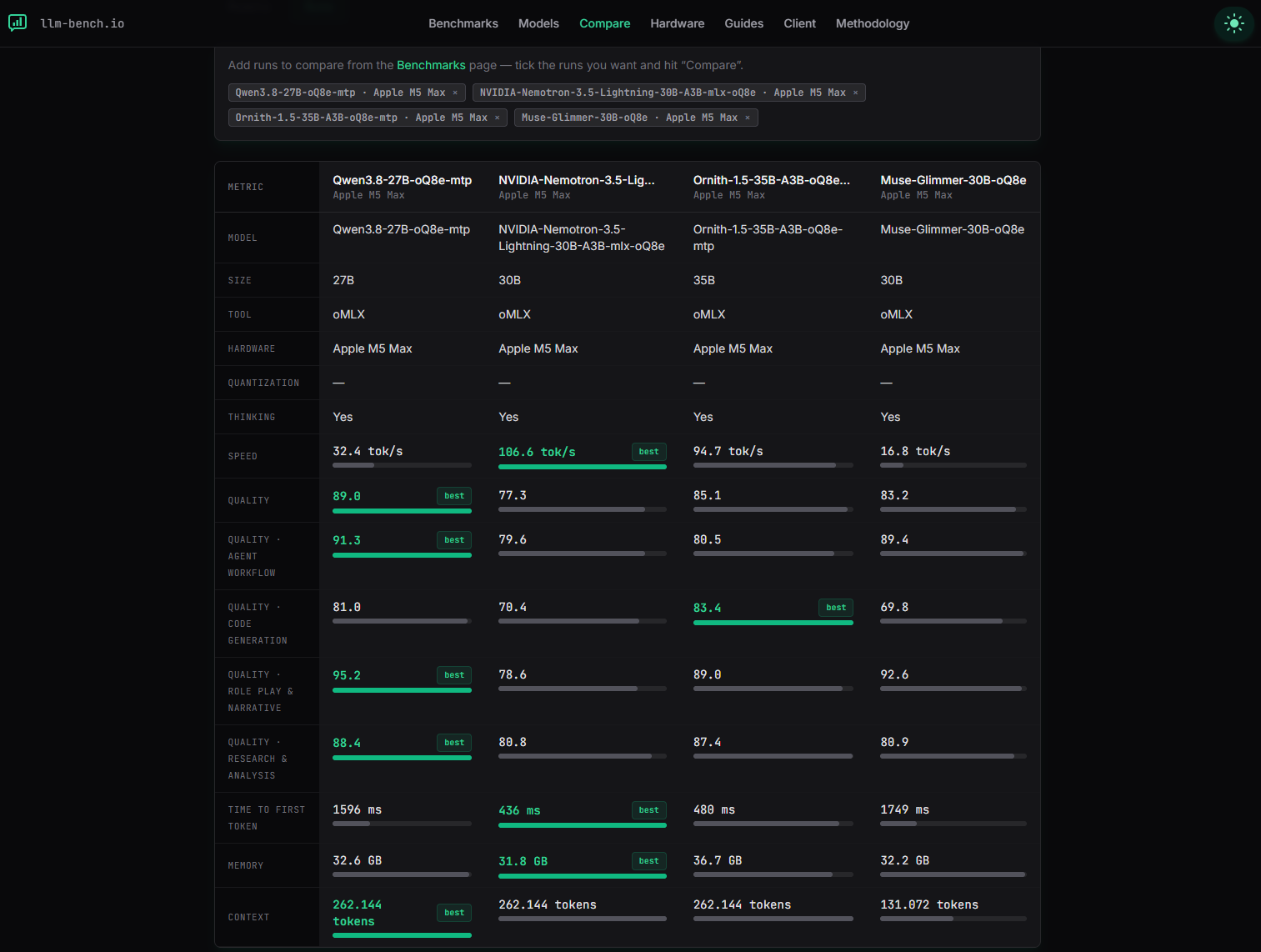
Ornith does really well. TielCoder (https://llm-bench.io/benchmarks/cmt7kp2zj002r01lcmpchvlko) might be even a bit better in coding. Will give it a try soon.
Details of the comparison see here: https://llm-bench.io/compare/runs?runs=cmt6ecf8g000001p45vwzux53%2Ccmt6ergk5000701p41hqdyy78%2Ccmt6f2oob000e01p49o9592cb%2Ccmt6fqddm000l01p4l1vm7skd
I've been working on clinical speaker attribution at Omi and wanted to compare the current diarization models on the same audio.
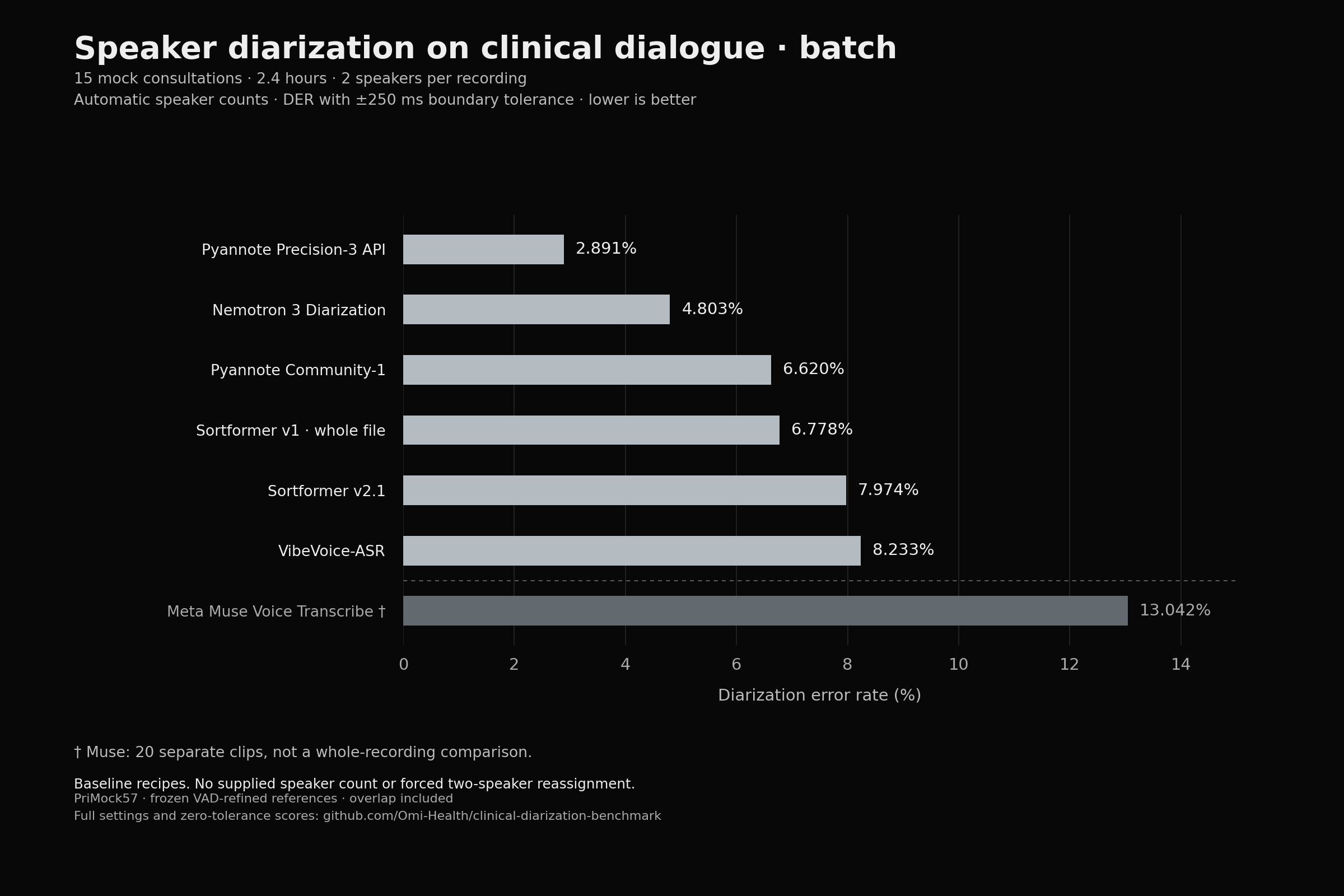
I used 15 mock doctor–patient consultations from PriMock57, about 2.4 hours. Full recordings, automatic speaker counts, without telling the models there are two people.
Batch Diarization error rate (DER), with ±250 ms boundary tolerance. Lower is better.
Model DER Median processing time Pyannote Precision-3 2.891% 18.9 s / recording (API) Nemotron 3 4.803% 0.688 s / recording Pyannote Community-1 6.620% 18.691 s / recording Sortformer v1 6.778% 3.869 s / recording Sortformer v2.1 7.974% 1.077 s / recording VibeVoice-ASR 8.233% 123 s / recording Meta Muse Voice Transcribe † 13.042% 92 s / request (API) Local models ran on one NVIDIA L4. API times include round-trip overhead; VibeVoice-ASR also performs transcription.
† Muse used 20 separate clips because of its 10-minute request limit, so its result isn't a whole-recording comparison.
Pyannote Precision-3 had the lowest error. Nemotron came next and was the fastest local model.
Streaming Model DER Pyannote live API 3.959% Nemotron 3 † 4.971% Sortformer v2.1 † 6.958% VibeVo
Call Muse Code from Codex or ChatGPT desktop via MCP tools and skills for independent code review, approach comparison or delegated implementation, using a Muse Code subscription or API key.