I still can’t believe I can run my plumbing company with an agent so easily.
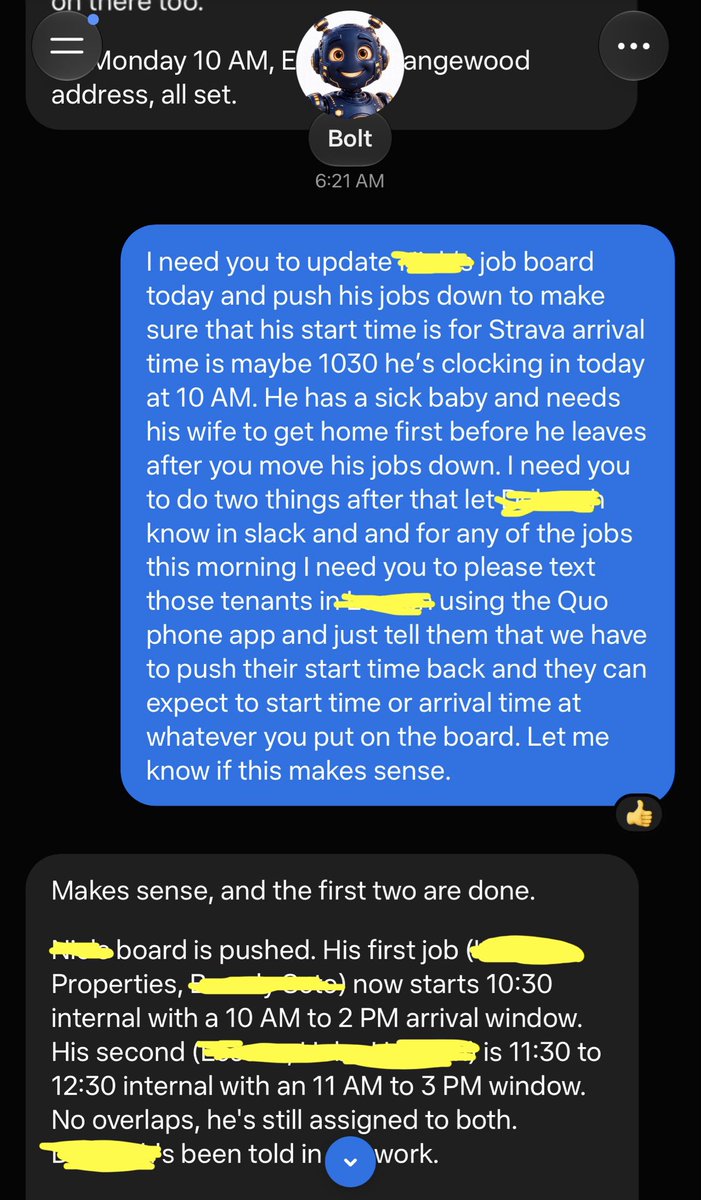
I send this message to my Muse agent while in bed at 6am.
And it:
updates my job board,
texts customer,
updates office manager who arrives at 8am in slack
Notifies technician
The single biggest upgrade you can give your Muse: stop asking questions and start giving briefings.
Instead of "find me a flight," try "I need to be in Chicago Thursday night, I hate red-eyes, I'd pay $80 extra to avoid a layover, book nothing without asking me first."
The more constraints you hand over, the less it has to guess. And guessing is where the funny business happens.
Try it once. Three lines:
1. The goal
2. What good looks like
3. What not to do
From @musebooklol
Meta's @Muse is the best personal agent I've tried to date.
It actually save me $800+ a year on my cable and phone bills, which is just insane value for a free AI agent.
Here's my new video where I walk through 10 of my favorite Muse use cases, including a personalized morning
Independent community Box connector for Muse by a former Box and Meta employee, aimed at finding files, explaining changes, extracting contract dates and saving briefs, with a 50-use-case roadmap.
muse is not a great AI app, it’s a fantastic *personal* app. the ai model meta uses is not even frontier and yet you don’t care because the experience is so damn good.
the secret sauce is meta built a much, much better open claw trained on your habits, preferences and decades of
I've been using Muse pretty heavily since shortly after it launched, and I'm curious what everyone else is actually doing with it.
I've been trying to get past the "ask it a question" stage and use it more like a real personal assistant.
So far I've been testing it for things like:
- Creating a personalized morning briefing around the news and information I care about
- Travel research, bookings and itineraries
- Keeping track of projects
- Reviewing bills and subscriptions
- Researching things and then actually helping me follow through on them
The biggest difference I'm noticing is that I'm starting to think less about "what question should I ask AI?" and more about "what do I need to get done?"
I'm still figuring out where Muse is genuinely useful versus where it's just AI novelty.
For those of you who have been using it for a few days:
What's the most useful thing you've actually had Muse DO for you so far?
And is there anything you're trying to make it do but haven't figured out yet?
I've been testing different workflows almost every day, so I'd be interested in comparing notes.
But probably my biggest Muse project so far has been putting together a Muse Tips & T
opencode-delegate is a Claude Code plugin where Claude plans and writes briefs while opencode sessions on free models, Muse Spark 1.3 by default, implement and review each task.
Built a Sleeper fantasy football co-pilot: tracks across multiple 12-team leagues with FAAB budgets, sends weekly waiver/start-sit briefings plus Thu/Sun pre-game checks with inactives and weather as a tiebreaker. Already caught an OUT starter & recommended a swap.
I've been running my work in Codex as project folders, and recently tried to properly understand how Muse Goals work under the hood. Made it a goal — good way to watch the machinery operate on itself.
The structural problem is worth naming: the current design is a halfway house between two coherent designs, and it gets the costs of both.
Design A is Codex: the project is a container. Everything — chat, state, artifacts, scheduled work — lives in one place. My course project has one tracker file, explicit resume rules for new chats, and the curriculum never holds status. Legible, but you have to go to it.
Design B is full ambient: no containers at all. The goal is just context that wakes up wherever you mention it, and there's no Goals tab pretending otherwise.
Muse picked ambient for activation — talk about the goal anywhere, it wakes up, you never "open" it. But then it built half of containment: a Goals tab showing summary, artifacts, activity, without the other half. Conversations, check-ins, and briefings still leak into whatever chat they happened in. So you get the scattering of ambient with the implied promise of a container. That's the worst combination.
The fix is to





 ChatForm
 Tgmlabs