extremely exciting to see meta getting back into open weight models with a 30B dense first, and soon muse spark 1.2
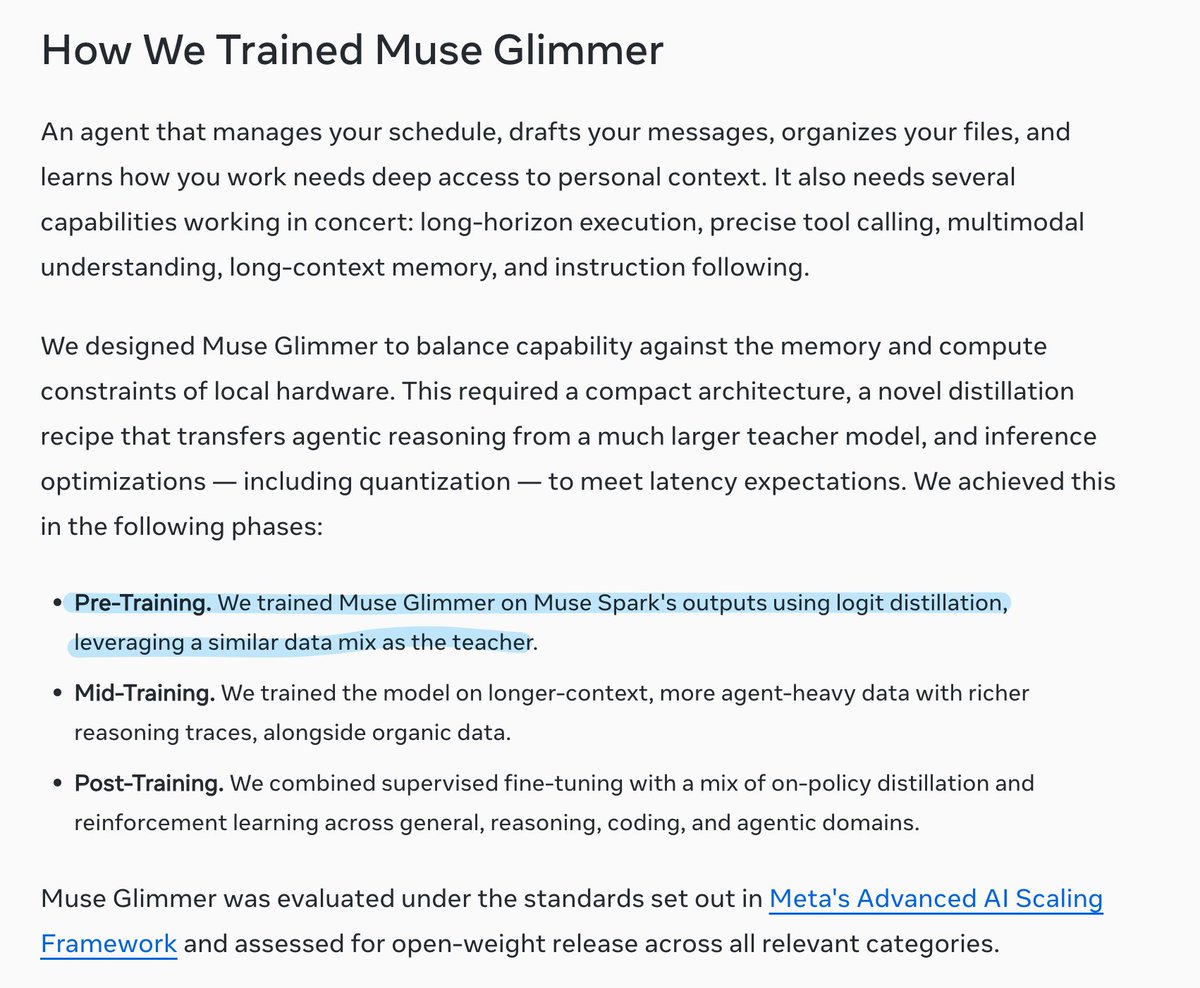
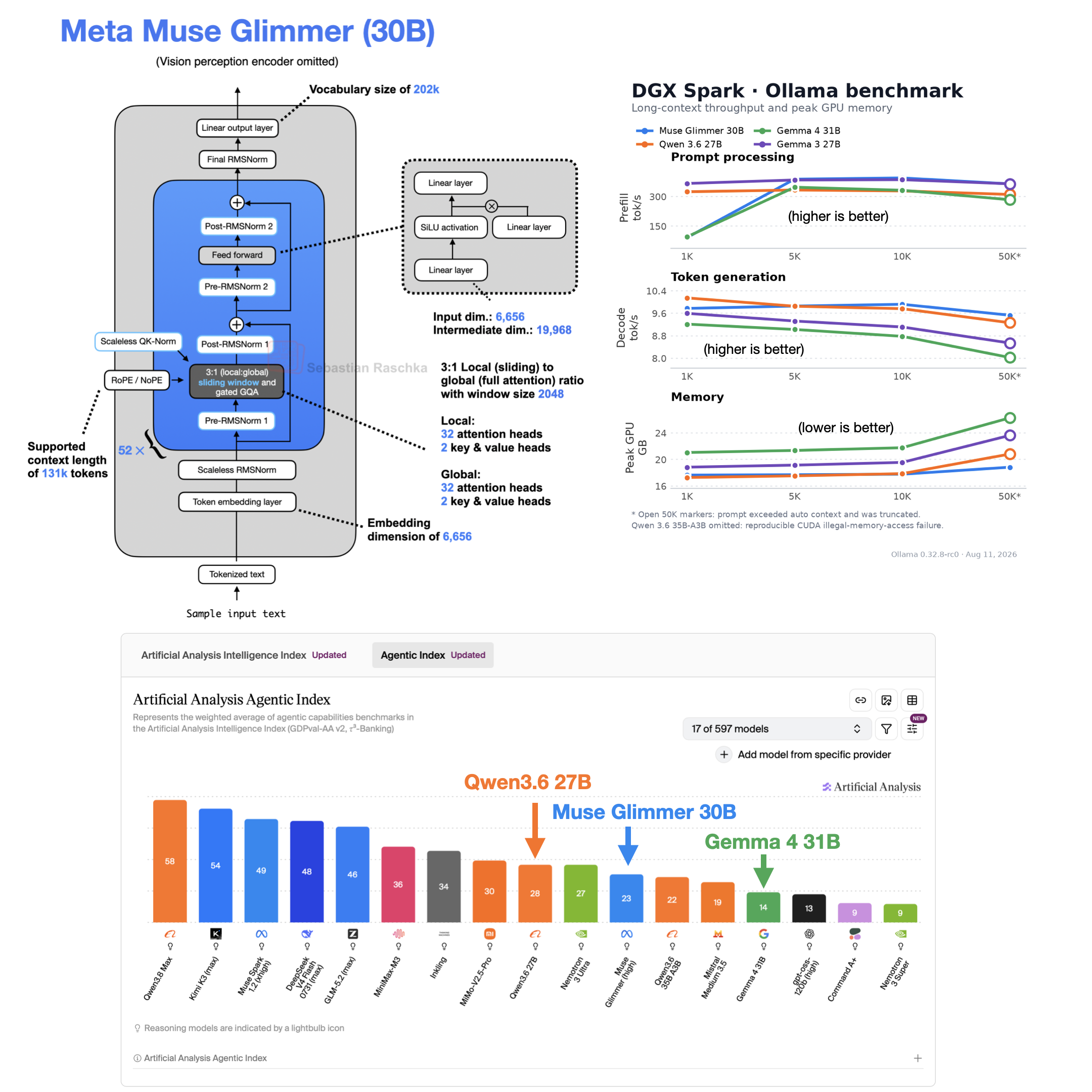
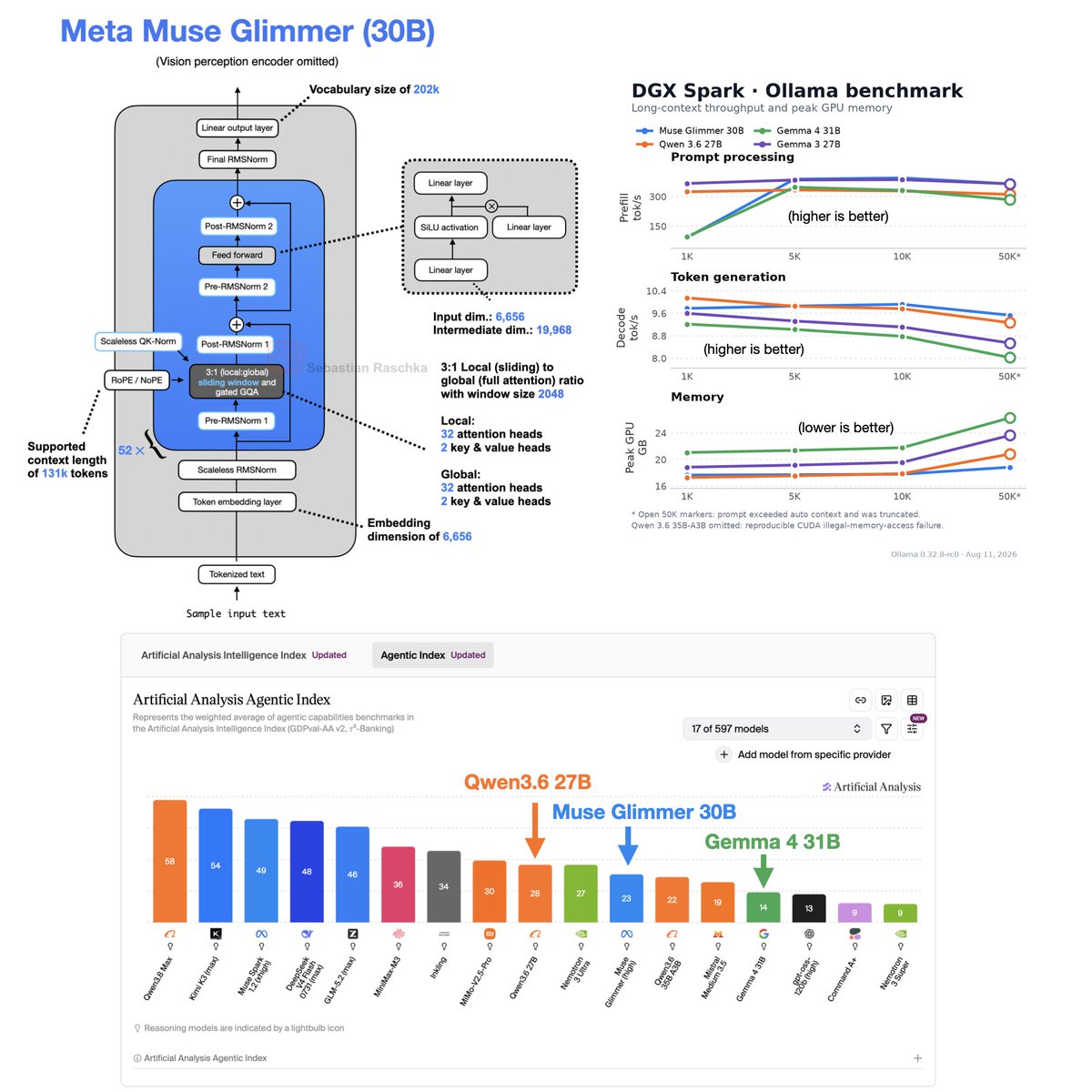
they used knowledge distillation from muse spark, architecture wise it's similar to gemma 4 (which is llama 3 + swa (again!) + vision encoder), with scale free QK
Sebastian Raschka breaks down Glimmer's dense architecture: 3:1 sliding-window to global attention, 32 query heads with only 2 KV heads, and ~52 KiB of KV cache per token.
An OpenAI-compatible /v1/chat/completions server that runs Muse Glimmer on Apple Silicon through mlx_vlm while LM Studio's bundled MLX runtime can't yet load the architecture.
Stackademic covers the architecture of Muse connectors, how to design connector actions, prompt-injection risk, and whether building one is worth it now that the platform is open.
A 4-byte GGUF header edit that raises Muse Glimmer 30B's 131,072 context limit to 262K. The author shows YaRN scaling only adds prefill cost on this architecture, and verified 262K with 8 slots on one RTX 4090.
Whoa, Meta released a new open-weight LLM yesterday, something that hasn't happened since the good old Llama days.
Their Meta Muse Glimmer model is a 30B multimodal reasoning model with a Gemma-like architecture design. (“Glimmer” is probably a wordplay on “Spark,” the more
An architecture port adding the muse_glimmer model class (vision tower, language model, projector and image processor) to mlx-vlm, so any Muse Glimmer checkpoint runs multimodally on Apple Silicon.
smol-muse-glimmer scales Muse Glimmer's language backbone down to a 51M-parameter model and trains it on TinyStories, reaching validation cross-entropy of 1.8127 at step 5,000.
I've been migrating my workflow from ChatGPT Work / Codex over to Meta's Muse, and I've been auditing the harness as I go — reading cron files, checking diffs, mapping what the system actually does versus what it claims to do. It's a documentation gap.
What the docs describe
Meta's documentation is written for a normal user. It talks about the Ideas tab, the Goals tab, the Feed, and "background jobs that help Muse improve over time." Everything is described in terms of what it does for you. There is no architectural documentation. Nothing about how any of it is built.
What is actually on disk
Meanwhile, the home directory contains a fully legible agent architecture, just sitting there(these are just SOME examples, the system file structure is HUGE):
• ~/dreams/alignment/ — a nightly job that regenerates an alignment synthesis: a written portrait of the user, how to handle them, current frictions, relationship guidance.
• ~/workspace/objectives/goals/STUDYING.md — a daily learning-state projection with mastery bands, next-review dates, and retrieval prompts, plus a file of inferred goal leads the system guessed from behavior (with confidence levels and what would confirm or re






 ChatForm
 Tgmlabs