as a healthcare ai founder, my number #1 use case for muse in managing my medications
- muse found a cheaper way to get my meds
- muse texted one medical to get the rx sent to the right place
- muse ordered it
- muse is now on autopilot to reorder when i’m about to run out
A config (in Spanish) plus two helper proxies for using Muse Spark 1.2 Contributor from Claude Code and Hermes through routatic/proxy and an OpenCode Go subscription.
An Express-based Muse connector that books Uber rides from natural language, with routes for fare estimates and ride requests, connector auth middleware and a privacy page.
A single-file marketing site (hash routing, GSAP transitions, Lenis scroll, Three.js) built by Muse Spark in Meta AI from 5–6 prompts, with no manual code edits.
An Apache-2.0 template for Meta Muse connectors with per-connection tokens, async job scaffolding and a single registry that generates routes, OpenAPI and llms.txt, deployable to Vercel, Workers or Docker.
Currently on a Flight to LA.
It’s my wife’s 30th birthday trip. I just used Muse by $META to find the closest and cheapest Jeep Wrangler to rent tomorrow.
It knows I have the Amex gold card. It knew I had an Amex offer of $30 back when you spend $150+ at @turo
Then it
Had the Muse agent probe its own tool schemas and internal docs for ~90 minutes, finding undocumented abilities like full HomeKit control, geofence triggers, BLE scanning and wearable-routed calls, and that iPhone messaging is draft-only.
A hybrid FastAPI gateway where a 1-bit BitNet layer on CPU filters routine traffic and Muse Spark 1.3 is called only for sales, urgency, money or low-confidence cases; the author estimates the local filter handles about 60-70% of volume.
A fork of Spotify's shunt plugin for Claude Code and Codex whose hooks block full reads of large files and route them to Muse Spark via muse exec; the author measured about 4,800 tokens out and 300 back on a 617-line file.
Wires TypeSafe Jev into a Muse agent's decision loop via a shadow-mode router that asks typed questions before expensive or irreversible steps, plus a 23-skill library the router picks from.
Routing overlay for the Superpowers plugin for Claude Code where Muse writes the code, Codex reviews it, and rules keep expensive models from being misused.
Installer that routes OpenCode's coder and reviewer agents at a Muse coding subscription, calling api.meta.ai directly with no local proxy, reusing the muse login key.
Day 2 with Muse and I'm sold.
It rebuilt my boys trip page for October - dates, routes, the works - and even found a foliage drive I hadn't thought of.
Then it set up my Instagram Content Studio with a full batch of trip ideas, captions, and shot lists ready to go.
Then FPL:
A fork of NemoAgent that swaps the LLM layer to OpenCode Go models, defaulting every role (dialogue agent, executor, router) to Muse Spark 1.3 Contributor with a per-role reasoning level.
Meta Model API OAuth for the pi coding agent. It routes Muse Spark through the openai-responses provider, since the author notes the Muse prompt cache hits about 0% on /chat/completions, and sends 24h prompt-cache retention.
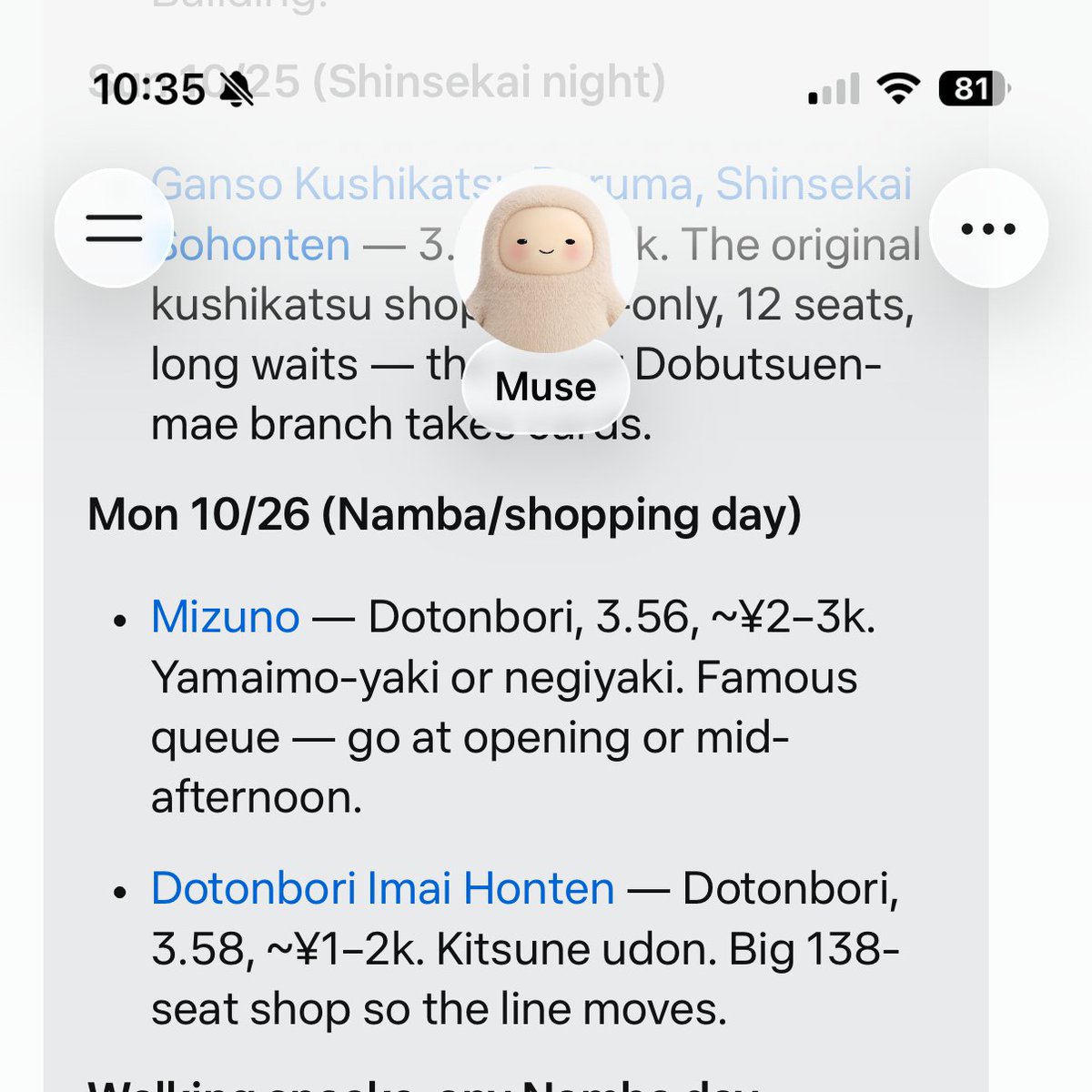
im going to japan for the first time & i let @Muse plan it for me
muse handled:
→ every train line & route + bought the tickets
→ all activities + reservations at the busiest restaurants & spots
→ dumped the whole trip into my google calendar
did this in 10 minutes btw
Every model gets the same thing: the Game Boy screen, eleven buttons, a walkability grid, and 1,000 turns to beat Brock. No walkthrough, no pathfinding, no hints. Same prompt for all of them.
Scoring is a 10-milestone ladder (left the house, got a starter, reached Route 1, ... beat Brock), so a run that never wins still places by how far it got.
14 runs so far, 4 of them got the badge. Best is GPT-6 Astra at 246 turns. Cheapest win was Gemini 3.8 Flash at $3.70. A free local model (Muse Glimmer 30B) burned all 1,000 turns and got as far as Reached Route 1.
Full turn-by-turn logs, costs, and the VODs are all up at https://pokebench.tv.
I've been running my work in Codex as project folders, and recently tried to properly understand how Muse Goals work under the hood. Made it a goal — good way to watch the machinery operate on itself.
The structural problem is worth naming: the current design is a halfway house between two coherent designs, and it gets the costs of both.
Design A is Codex: the project is a container. Everything — chat, state, artifacts, scheduled work — lives in one place. My course project has one tracker file, explicit resume rules for new chats, and the curriculum never holds status. Legible, but you have to go to it.
Design B is full ambient: no containers at all. The goal is just context that wakes up wherever you mention it, and there's no Goals tab pretending otherwise.
Muse picked ambient for activation — talk about the goal anywhere, it wakes up, you never "open" it. But then it built half of containment: a Goals tab showing summary, artifacts, activity, without the other half. Conversations, check-ins, and briefings still leak into whatever chat they happened in. So you get the scattering of ambient with the implied promise of a container. That's the worst combination.
The fix is to







 ChatForm
 Tgmlabs