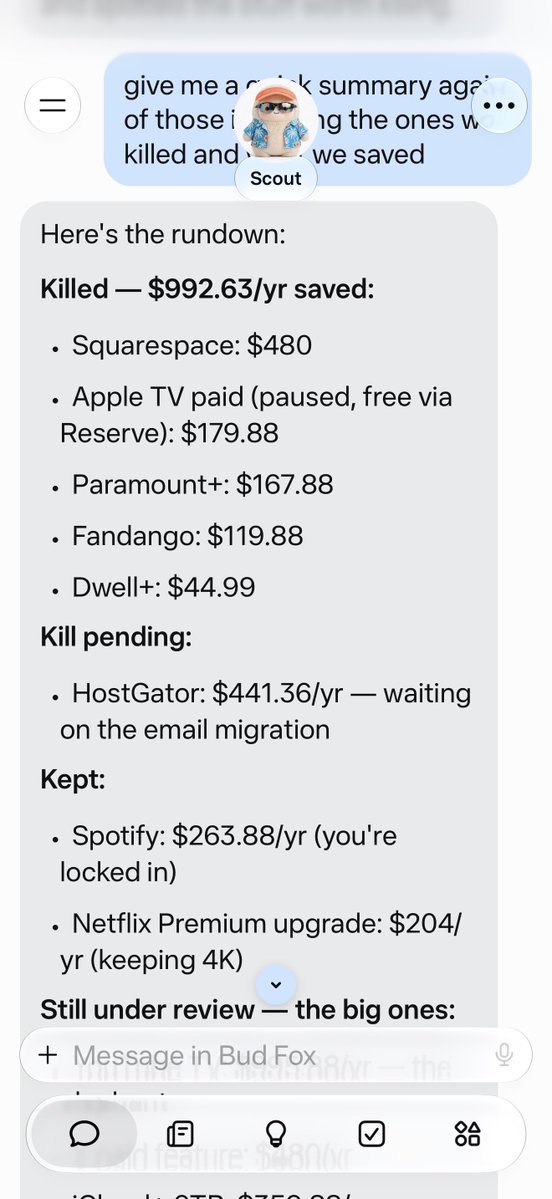
I should change his name to $cout because he’s saving me money - killed Squarespace, migrated to Shopify - found my Apple TV was already free thru my Chase Sapphire Reserve, activated that one - hostgator has the reaper coming for it.
Bud Fox my finance guy making moves. Iykyk
Same theme - I told @Muse to move one of my website domains from GoDaddy $GDDY to Cloudflare $NET. Something I've been meaning to do for years but too lazy. Saved some $ too.
I was able to migrate multi agent workflows to Muse from Claude. I gave it the master prompt- Muse executed flawlessly- no feedback- just my prompt- built for Claude 4.6. It is now running this prompt every morning at a fraction of the cost.
Leaned up all of my emails-
I've been migrating my workflow from ChatGPT Work / Codex over to Meta's Muse, and I've been auditing the harness as I go — reading cron files, checking diffs, mapping what the system actually does versus what it claims to do. It's a documentation gap.
What the docs describe
Meta's documentation is written for a normal user. It talks about the Ideas tab, the Goals tab, the Feed, and "background jobs that help Muse improve over time." Everything is described in terms of what it does for you. There is no architectural documentation. Nothing about how any of it is built.
What is actually on disk
Meanwhile, the home directory contains a fully legible agent architecture, just sitting there(these are just SOME examples, the system file structure is HUGE):
• ~/dreams/alignment/ — a nightly job that regenerates an alignment synthesis: a written portrait of the user, how to handle them, current frictions, relationship guidance.
• ~/workspace/objectives/goals/STUDYING.md — a daily learning-state projection with mastery bands, next-review dates, and retrieval prompts, plus a file of inferred goal leads the system guessed from behavior (with confidence levels and what would confirm or re




 ChatForm
 Tgmlabs