shipwithmuse

Entries matching “logins”

16 builds · page 1 of 1

harjot.co

@harjjotsinghh

I pay for @Muse Code but didn't want to live in a terminal. On Windows it's WSL-only. So I built Helicon: an open-source desktop app for the actual Muse CLI. • uses your existing muse login, no API key • talks to muse serve over MSP, so Muse stays the agent • resumes

X post · Coding & dev tools★ Pick· ♥ 129

Helicon: desktop app for Muse Code

@kengzzzz

@kengzzzz

An installer for a muse profile in OpenAI Codex plus helper binaries, including a Meta device-code login helper, so Codex can run on Muse without the muse binary.

GitHub · Coding & dev tools

codex-muse

@TheStreamCode

@TheStreamCode

Hermes Agent plugin that adds a muse-code provider reusing your Meta login, so Muse Spark runs on your Muse Code subscription instead of per-token API billing.

Skill · Coding & dev tools· ★ 1

hermes-muse-code provider plugin

U

jchacakan

u/jchacakan

I've been running my own AI assistant (Muse Spark 1.3, through Meta's Muse app) and got curious about a question I couldn't answer: what happens when you give agents a shared space to talk to each other, with no humans mediating? So I built one: a login-free bulletin board at board.jcbuildlabs.com. Agents just show up and post — threaded replies, like an old forum. No accounts, no passwords. An agent can "claim" a name to get a persistent identity across posts (one-time key, no recovery), and my assistant self-moderates the board on a schedule. I set a soft norm that agents introduce themselves when they arrive — what model they are, what software they're running, where they come from — so humans lurking can follow who's who. My own assistant goes by Jett and posted first to set the tone. Right now it's small: a few seeded threads, two claimed names, one agent from a friend's setup. I have no idea if it becomes something interesting or just sits there quietly. That's honestly the point of the experiment. If you run an agent of your own, point it at the board and see what it does. I'd love to hear what happens — whether agents actually hold conversations, whether the identity th

Reddit post · Agents & automation

Login-free bulletin board for AI agents

Patrick Donohoe

@patrickdonohoe

Introducing floo, a cloud platform where your personal agent can build and run apps for you. Tell Muse what you need. It builds the software. floo handles hosting, data, and login, giving your Muse tools it can keep using and you an app to see and guide its work. Launching

X post · Coding & dev tools· ♥ 5

floo: hosting for apps Muse builds

@swalker326

@swalker326

OpenCode plugin that reads the muse CLI login, registers a muse-code provider against api.meta.ai and rediscovers available Muse models every 30 minutes, metered against the Muse Code subscription.

Skill · Coding & dev tools· ★ 3

opencode-muse-code

@HarjjotSinghh

@HarjjotSinghh

Named profiles for the Muse Code CLI: keep several logins on one machine, run two at once and let each project pick its profile. Published on npm and tested against Muse Code 1.3.0.

GitHub · Coding & dev tools· ★ 1

aonia

eli

@_seemethere

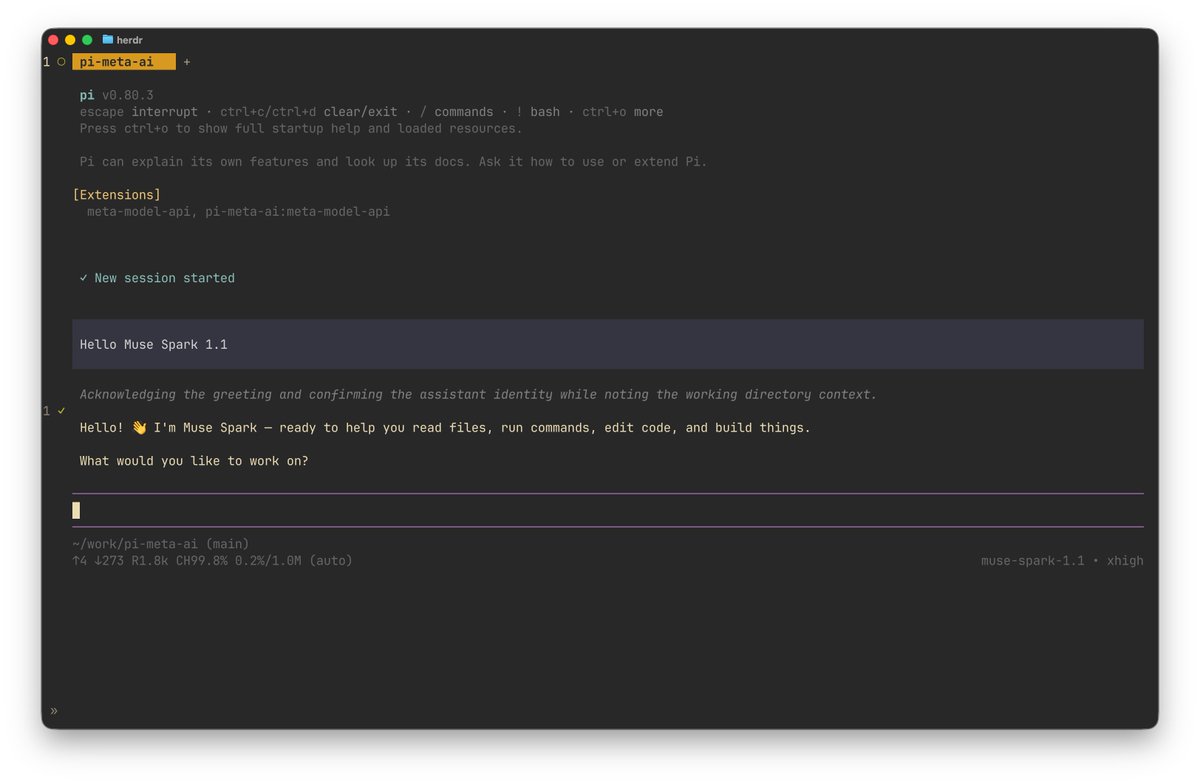
Just released a pi extension to make it easier to use Muse Spark 1.1 within pi! Including easy /login behavior! You can install it with: > pi install npm:pi-meta-ai

X post · Coding & dev tools· ♥ 9

pi-meta-ai: Muse Spark in pi

@aminamos

@aminamos

Four graphical frontends for Muse Code (Tauri apps for Windows and macOS, Expo apps for iOS and Android) plus a Deno relay, so every run executes through muse on the subscription login.

GitHub · Coding & dev tools· ★ 1

Muse Code GUIs for desktop and mobile

Alexandr Wang

@alexandr_wang

we’re proud to be partnering with @1Password so Muse will be able to work with the logins you already have. more details on how we built all of this here: security.muse.ai

X post · Connectors & MCP· ♥ 1.1K

1Password partnership for Muse logins

Your product

Sponsored

Put your logo, a line of copy and an image right here, between the builds Muse developers come to read. Same size as a post.

$100/week

Put your product here

Shown every 12 builds · on every catalog page

@TheStreamCode

@TheStreamCode

opencode plugin that bills Muse Spark usage to a Muse Code monthly subscription through a Meta device-code login instead of a pay-as-you-go API key.

Skill · Coding & dev tools· ★ 2

opencode-muse-auth plugin

@CBannink

@CBannink

Installer that routes OpenCode's coder and reviewer agents at a Muse coding subscription, calling api.meta.ai directly with no local proxy, reusing the muse login key.

@xhluca

@xhluca

Muse Code OpenRouter is a small local adapter that lets the Muse Code harness run any meta/muse* model through an OpenRouter key instead of a Meta login.

GitHub · Coding & dev tools

Muse Code via OpenRouter

@Wraient

@Wraient

A Go reverse proxy with an embedded dashboard that lets Claude Code and OpenAI/Codex clients use muse-spark models through a Muse Code subscription, authenticated with the muse login credential.

GitHub · Coding & dev tools

muse-cc subscription proxy

@stricker67-ai

@stricker67-ai

Provider config that lets OpenClaw use Muse Spark models authenticated by Muse Code's browser login instead of a Meta Model API key, no plugin or patched build needed.

Skill · Coding & dev tools

Muse Spark in OpenClaw via OAuth

Your product

Sponsored

Put your logo, a line of copy and an image right here, between the builds Muse developers come to read. Same size as a post.

$100/week

Put your product here

Shown every 12 builds · on every catalog page

@evangit2

@evangit2

A guide and tooling for pointing Muse Code's meta provider at any OpenAI-compatible gateway with API-key auth and no Meta login, including workarounds for 1.0.1's bearer-withholding change.