Andrew Brown's three-hour freeCodeCamp course on building apps and agent workflows with Muse Spark and the Muse Code CLI, ending in a full-stack Go/SQLite/Docker build.

Video · Coding & dev tools★ Pick
8 builds · page 1 of 1
Andrew Brown's three-hour freeCodeCamp course on building apps and agent workflows with Muse Spark and the Muse Code CLI, ending in a full-stack Go/SQLite/Docker build.
Video · Coding & dev tools★ Pick
Docker Sandboxes (sbx) kit spec that runs Muse Code in YOLO mode inside an isolated sandbox via a musex command, verified with sbx v0.39.0 on macOS arm64.
Skill · Coding & dev tools

Cline
@cline
We tried using Meta's new Muse Code agent, but it has a bug that doesn't let it sign in from a docker container. So we did a fun experiment: Meta claims Muse Spark 1.2 was co-trained with their Muse agent harness. So we extracted instructions from their system prompt and added
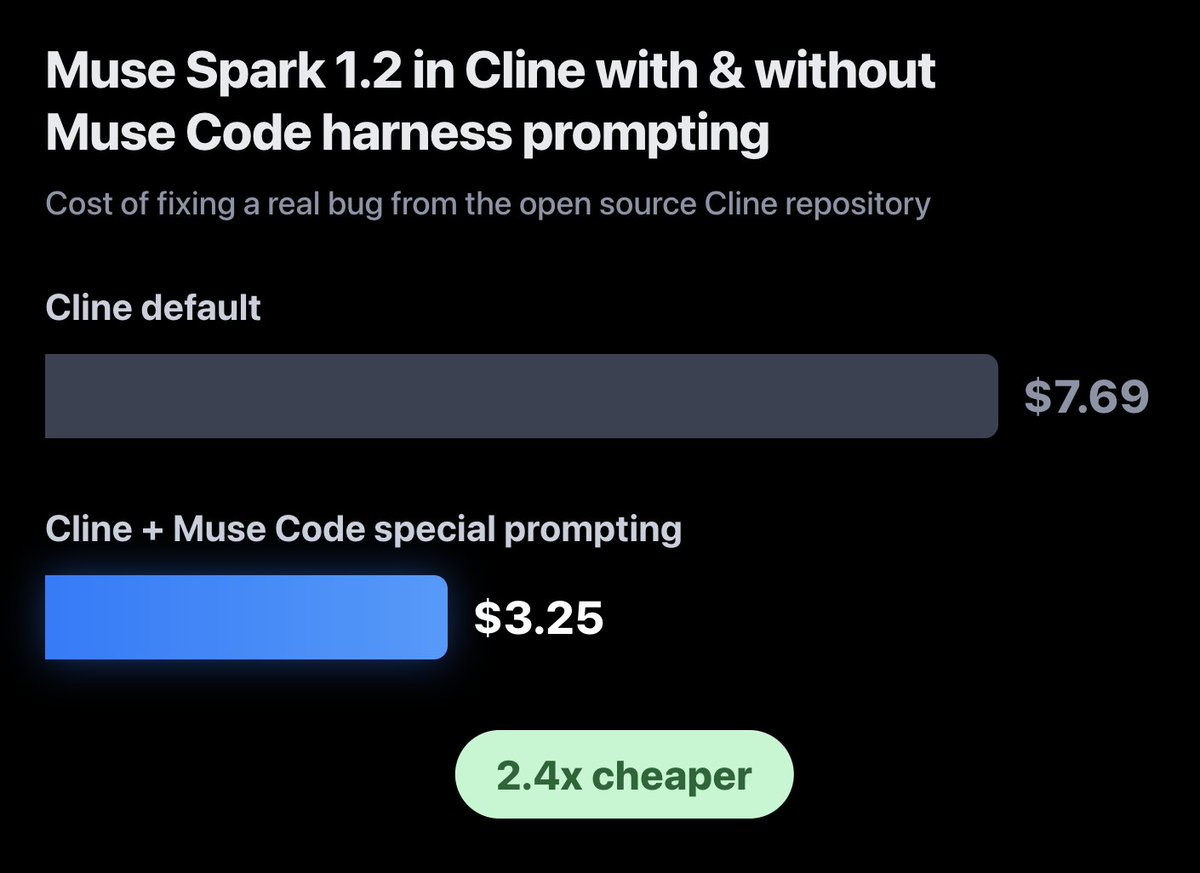
X post · Coding & dev tools· ♥ 993
freeCodeCamp's write-up of its three-hour Muse course by Andrew Brown, covering model benchmarks, API integrations, agent frameworks, the Muse Code harness, and a Go/SQLite/Docker full-stack build.

Resource · Coding & dev tools
I think a lot of people are boxing Muse in as “Hermes for normies.” My guess is Meta intentionally keeps the deeper capabilities out of sight because the target audience does not want a complicated Hermes/Grok Bot-style setup. They aren't trying to capture the nerdy Hermes using market, they want this to be an AI agent for normies but they don't limit it as such. What it advertises its for is far from what it actually can do with very little work. But Muse gets much more interesting once you stop thinking of its VM as the whole system. I joined the Muse VM to my Tailscale network, gave it SSH access to a restricted user on my home Ubuntu box, and now it can run commands and browser automation through hardware I already own. I figured out Muse can do this because I asked it if it had a Tailscale skill and it said it did, then after a series of "proceed" replies, it set it up for me outside of the parts where I had to join it. At that point, Muse stops being a “shopping assistant” and starts looking more like a control plane for your own infrastructure. With Tailscale + SSH/API access, it can potentially: • Manage Docker, VMs, NAS, Proxmox, and homelab services • Pull repos,
Reddit post · Agents & automation★ Pick
Your product
Sponsored
Put your logo, a line of copy and an image right here, between the builds Muse developers come to read. Same size as a post.
Shown every 12 builds · on every catalog page
A Docker Sandboxes kit that runs Meta's Muse Code CLI in an isolated sandbox, allowing network access only to the Meta services needed for install, auth and model requests.
GitHub · Coding & dev tools
An Apache-2.0 template for Meta Muse connectors with per-connection tokens, async job scaffolding and a single registry that generates routes, OpenAPI and llms.txt, deployable to Vercel, Workers or Docker.
Skill · Connectors & MCP
The vLLM recipe page for Muse Glimmer has this for speculative decoding: --speculative-config '{"method": "dflash", "model": "meta-models/Muse-Glimmer-30B-assistant", "num_speculative_tokens": 15}' This errors out on the current vllm/vllm-openai:muse-glimmer image, and each fix reveals the next error. Six separate issues in total, all in the DFlash path. The base model runs fine without the spec config. The source for the image isn't public yet (the recipe says "code will be released soon"), so I pulled the image layers through the registry API and read the code to figure out what was going on. Also checked tensor names by range-requesting the safetensors headers off HF instead of downloading the weights. What I found: • The drafter's config declares MuseGlimmerAssistantModel, which is in vLLM's registry. But the dflash code renames it to DFlashMuseGlimmerAssistantModel before the registry lookup, and that name isn't registered. Dies in config validation. • vLLM maps the drafter's config to Qwen3Config (there's a comment calling it "Qwen3-shaped"). The muse JSON omits vocab_size and use_sliding_window, so Qwen3Config fills in its own defaults: vocab becomes 151936 (the model i
Reddit post · Local & open models


 ChatForm
 Tgmlabs