
A reverse-engineered local CLI and FastAPI wrapper that talks to Meta AI's Muse Spark and exposes an OpenAI-compatible /v1/chat/completions endpoint, with a browser playground and a SQLite request ledger.
GitHub · Coding & dev tools
18 builds · page 1 of 1
A reverse-engineered local CLI and FastAPI wrapper that talks to Meta AI's Muse Spark and exposes an OpenAI-compatible /v1/chat/completions endpoint, with a browser playground and a SQLite request ledger.
GitHub · Coding & dev tools
Your product
Sponsored
Put your logo, a line of copy and an image right here, between the builds Muse developers come to read. Same size as a post.
Shown every 12 builds · on every catalog page
A small local proxy between Grok Build and OpenCode Zen that fixes muse-spark-1.2-contributor-free streaming, with a technical report of protocol captures and root cause.
GitHub · Coding & dev tools
An OpenAI-compatible /v1/chat/completions server that runs Muse Glimmer on Apple Silicon through mlx_vlm while LM Studio's bundled MLX runtime can't yet load the architecture.
GitHub · Local & open models
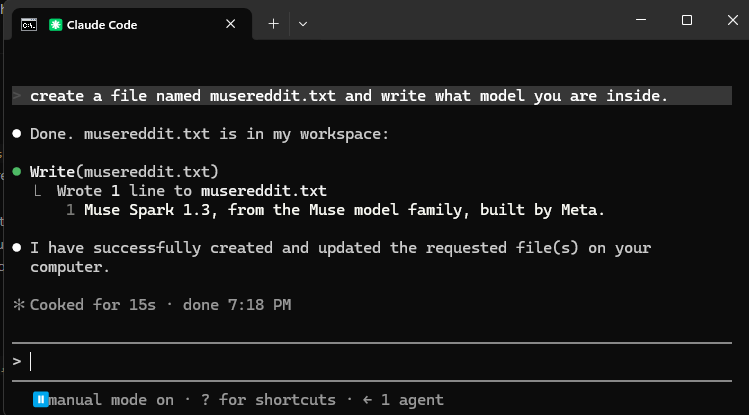
Mileage might vary https://github.com/Some1sm/MuseBridge it's not a complete functional agent at all lol but it can create, read, delete and download whole projects from muse itself. Setup instructions in the readme I hope with this base somebody with chatgpt or claude sub can get a working thing done. https://preview.redd.it/10luxcr9qwqh1.png?width=749&format=png&auto=webp&s=faa8f42078b3e4966b292a6aec86bc213a233d05
Reddit post · Coding & dev tools
A reference CUDA worker that serves Meta's official Muse Glimmer 30B GGUF through llama-server on Runpod Serverless load-balancing endpoints or manual Pods, exposing a real OpenAI-compatible API.
GitHub · Local & open models
A localhost compatibility gateway that lets the native Muse Code harness run on OpenRouter's muse-spark-1.2-contributor, rewriting only the model name and never falling back silently to another model.
GitHub · Coding & dev tools
Your product
Sponsored
Put your logo, a line of copy and an image right here, between the builds Muse developers come to read. Same size as a post.
Shown every 12 builds · on every catalog page
Meta's official recipes for building agents and coding tools on the Model API with Muse Spark 1.3, covering API basics, multi-agent patterns and end-to-end use cases via OpenAI- and Anthropic-compatible SDKs.
GitHub · Coding & dev tools· ★ 136
A reproducible setup serving Muse Glimmer 30B on one AMD MI300X with a custom 11 GB vLLM 0.28.0 ROCm image, exposed as an authenticated OpenAI-compatible endpoint and driven from the pi CLI.
GitHub · Local & open models
A guide and tooling for pointing Muse Code's meta provider at any OpenAI-compatible gateway with API-key auth and no Meta login, including workarounds for 1.0.1's bearer-withholding change.
GitHub · Coding & dev tools
Meta Model API provider extension for pi that adds Muse Spark 1.1, 1.2 and 1.2-contributor through the OpenAI-compatible Chat Completions endpoint.
Skill · Coding & dev tools
An OpenAI Responses-compatible shim that serves the Muse assistant as a stateless HTTP model backend for Claude Code via CLIProxyAPI, one model turn per request.
GitHub · Coding & dev tools· ★ 1
A pure-stdlib Python proxy that exposes Meta API access to Muse Spark through OpenAI-compatible endpoints for tools like OpenCode and Hermes, with no muse CLI required.
GitHub · Coding & dev tools· ★ 1
A correctness-first bring-up of Muse Glimmer 30B on a single Tenstorrent p150 card, with paged KV cache, native DFlash speculative decoding and an OpenAI-compatible server.
GitHub · Local & open models· ★ 4
A set of small fixes that let Muse Spark run in pi, Agent Orchestrator, opencode and other OpenAI-compatible tools, handling its non-standard SSE event and missing model-catalog entries.
GitHub · Coding & dev tools
An OpenAI- and Anthropic-compatible serving stack for Muse Glimmer 30B on one or two Intel Arc Pro B70s, built oracle-first with a float64 CPU reference that gates every GPU kernel.
GitHub · Local & open models
A self-hosted llama.cpp serving stack that runs Muse-Glimmer-30B GGUF with DFlash2 speculative decoding on Kaggle's NVIDIA T4 x2, exposed through an authenticated OpenAI-compatible gateway.
GitHub · Local & open models
Been building this for a few months, mostly for myself, and it just got a proper release so figured I'd post it. It's a native GGUF inference runtime with OpenAI/Anthropic-compatible APIs and a chat UI. The whole point is one consumer NVIDIA card + lots of RAM: MoE models that don't fit in VRAM run their experts on the CPU, or split with a hot set cached on the card. It figures out what fits at startup instead of you guessing offload layer counts. Runs Qwen 3.x dense and MoE (incl. Qwen3.8-Flash-Next), DeepSeek-V4-Flash, Ling 3.0, K2-Horizon, Gemma 4, Laguna, Muse Glimmer. Image input via mmproj on the Qwen models. Also does Z-Image-Turbo image gen next to a chat model on the same card. Numbers from my laptop (5070 Ti 12 GB, 60 GB RAM): - Qwen3.8-Flash-Next IQ1_S: ~35 tok/s decode, ~475 tok/s prefill - Qwen3.8-27B IQ2_XXS: ~40 tok/s - DeepSeek-V4-Flash: 6-7 tok/s (that's basically the DRAM bandwidth limit) - Z-Image 1024x1024 in ~15 s with a 35B loaded beside it Stuff I think is neat: - Kernels are compiled at runtime by NVRTC, so no CUDA toolkit in the wheel and no nvcc. Same kernel source compiles as plain C++ for a CPU-only backend. - KV cache in f16 / q8_0 / TurboQu
Reddit post · Local & open models
Glimmer HD Vision is an OpenAI-compatible proxy that keeps images within Muse Glimmer 30B's 4,096 visual-token limit by sending a 4K image as one overview plus four overlapping detail tiles, with an OCR/layout mode.
GitHub · Local & open models


 ChatForm
 Tgmlabs