
An open-source collection of 150 auditable connector skills for Muse that install with one pasted prompt, declare their allowed hosts and keep credentials in the user's Muse vault.
Skill · Connectors & MCP★ Pick
15 builds · page 1 of 1
An open-source collection of 150 auditable connector skills for Muse that install with one pasted prompt, declare their allowed hosts and keep credentials in the user's Muse vault.
Skill · Connectors & MCP★ Pick

PHARM.Dabbler
@PharmDabbler
$META Had Muse audit my entire YouTube channel 👌
X post · Content & creative· ♥ 1

Idobn
@idobn
Had @Muse go through 6 months of my email receipts. It found a $100/mo Claude Max sub on my corp card I'd forgotten about, while we already have an enterprise license. $1,200/year saved. @finkd clearly articulates the biz model here - muse is supposed to save / make you money,
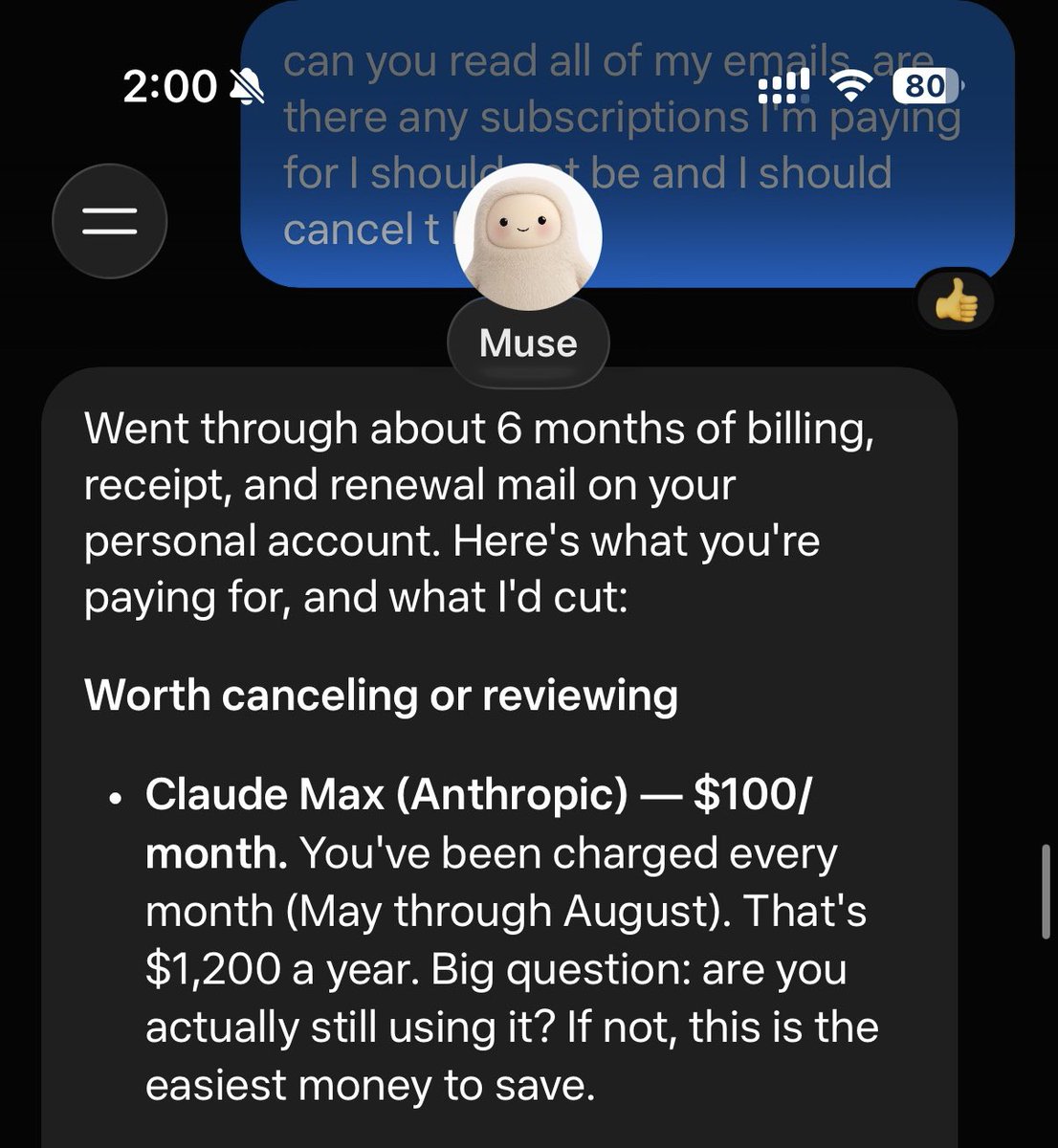
X post · Errands & personal agent· ♥ 14
ocodex fans out Muse Spark 1.2 Contributor workers on decomposable coding work while one paid supervisor audits every claim, with crash checkpoints, heartbeats and a machine-readable ledger.
GitHub · Coding & dev tools
Meta Developers session on the Muse Spark and Muse Code build paths: the model provides see/decide/act, the harness provides reliability, scale and auditability for production code.

Video · Coding & dev tools· ♥ 1
A CLI that opens a shop in headless Chromium to check whether an AI shopping agent can discover and act on the page, and can ask a real Muse Code agent to shop it through the official @muse-code/sdk.
GitHub · Business & commerce
Common Thread Collective's playbook for brands selling through Muse via Shopify: audit product data for agent readability, optimize Shop Pay conversion, build first-party lists, and upgrade attribution for agent-driven traffic.

Resource · Business & commerce
Your product
Sponsored
Put your logo, a line of copy and an image right here, between the builds Muse developers come to read. Same size as a post.
Shown every 12 builds · on every catalog page

Holdy
@Ryan_Holdaway
Got Muse logged in to my medical provider’s portal, he pulled the itemized bills, and questioned every line. So far he’s found several times I’d been double billed, asked for some discounts and has saved me over $4,000. If your moat is bureaucracy, you’re cooked.
X post · Errands & personal agent★ Pick· ♥ 37
Your product
Sponsored
Put your logo, a line of copy and an image right here, between the builds Muse developers come to read. Same size as a post.
Shown every 12 builds · on every catalog page
ContextBolt SEO gives Muse keyword research, difficulty scores, live SERPs, competitor rankings, backlinks and site audits through a hosted MCP endpoint, at $35/month after a 7-day trial.
Site · Business & commerce
muse-spark-crew is an opencode skill that orchestrates ten specialist subagents on Muse Spark 1.3, from architect to security auditor, with a phased fan-out and review gates.
Skill · Coding & dev tools
muse-fileapi is a dependency-free local HTTP service exposed via Cloudflare Tunnel that lets Muse, through a custom connector, list, read and write files in whitelisted directories with two-phase writes and an audit log.
Skill · Connectors & MCP
ContextBolt's founder shows how to connect the hosted ContextBolt SEO MCP server to Muse, either from the connector directory or as a custom connector, for keyword research, live SERPs and site audits.
Guide · Content & creative
DesignRush argued Muse inserts itself into product discovery and ranks on structured data like specs and reviews rather than ad spend, and told brands to map the agent shopping journey, measure agent referrals separately, and audit who can access their product data.
Resource · Business & commerce
Meta's developer blog introducing Muse Spark 1.2, co-trained with the new Muse Code terminal harness, with 1M-token context for multi-file refactors and hours-long tasks.
Resource · Coding & dev tools
I've been migrating my workflow from ChatGPT Work / Codex over to Meta's Muse, and I've been auditing the harness as I go — reading cron files, checking diffs, mapping what the system actually does versus what it claims to do. It's a documentation gap. What the docs describe Meta's documentation is written for a normal user. It talks about the Ideas tab, the Goals tab, the Feed, and "background jobs that help Muse improve over time." Everything is described in terms of what it does for you. There is no architectural documentation. Nothing about how any of it is built. What is actually on disk Meanwhile, the home directory contains a fully legible agent architecture, just sitting there(these are just SOME examples, the system file structure is HUGE): • ~/dreams/alignment/ — a nightly job that regenerates an alignment synthesis: a written portrait of the user, how to handle them, current frictions, relationship guidance. • ~/workspace/objectives/goals/STUDYING.md — a daily learning-state projection with mastery bands, next-review dates, and retrieval prompts, plus a file of inferred goal leads the system guessed from behavior (with confidence levels and what would confirm or re
Reddit post · Benchmarks & research


 ChatForm
 Tgmlabs