shipwithmuse

№ 0672GitHub

MuseFactory

A personal software factory built on Muse agents and Erlang/OTP principles: a markdown backlog goes in, and each run takes one item through planning, dual review, TDD, code review and verification.

MuseFactory on github.com
ggulati/musefactoryREADME ↗
# MuseFactory

A personal software factory: a backlog markdown doc goes in, reviewed and verified code comes out — built on the [Erlang/OTP design principles](https://www.erlang.org/doc/design_principles/des_princ.html): files are message queues, workers are workers, and everything is designed to crash and recover.

**How it works**

1. The user keeps a plain markdown backlog — top-level bullets are items, sub-bullets are detail, order is priority. The backlog is the message queue; nothing reads it "live" or triages the whole thing anymore.
2. One `dev-factory` workflow run processes **exactly one** backlog item, then terminates with a typed terminal envelope (`done`, `awaiting-approval`, `blocked`, or `failed`). The run works the item through the `develop` skill: orient → plan → dual plan review (product + technical) → isolated worktree → TDD implementation → debugging → code review → verification → report.
3. The **supervisor** (an LLM, following `SUPERVISOR.md`) applies the envelope to the backlog and checkpoint state via deterministic scripts, and asks any unanswered questions again — byte-identically — in the project side chat. A reply in that chat is the real-time event; resume happens inline in that chat turn.
4. A per-project **liveness tick** (2-minute cron, delivered to the project side chat) exists for exactly one reason: silent worker death has no event. The tick detects dead runs, crash loops, and week-long stalls — nothing else.

**Design principles**

- **Files are message queues, workers are workers** (Erlang/OTP). Checkpoints and backlogs are state, not orchestration; the workflow does no supervision and the supervisor does no work.
- **One run = one item.** No queue loops, no self-relaunch, no backlog edits by workers.
- **Nothing is implicitly approved.** An ambiguous reply to an approval gate gets a one-line confirmation question, never a resume.
- **Crash-only design.** Every race-sensitive protocol is a deterministic script, not LLM prose. A crash at any point converges on re-run: mutations are idempotent, envelopes are applied exactly once via a `handled_run_ids` ledger, and all shared-state changes go through a single project-wide mutex with compare-and-swap preconditions.
- **The supervisor supervises; scripts serialize.** The LLM never edits state directly — every mutation is a script invocation held for milliseconds.
- **Reviews ar

Also filed under Agents & automation

See all →
  1. 1007

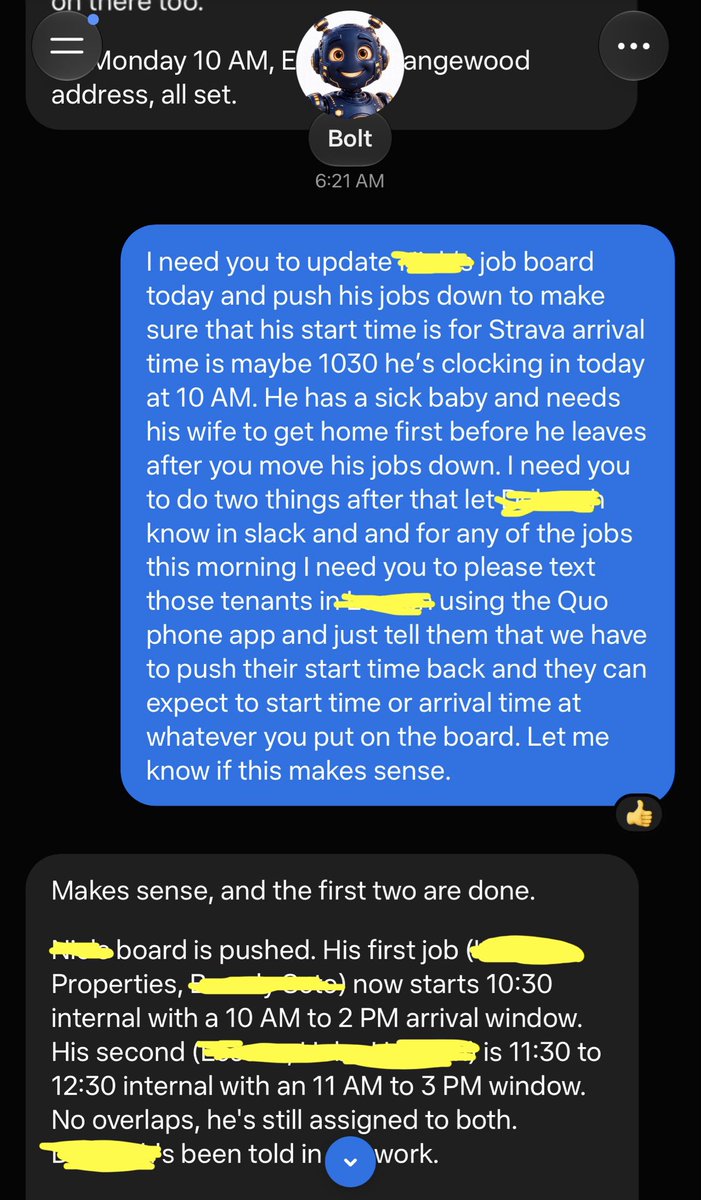
    Plumbing company run by a Muse agent★

    I still can’t believe I can run my plumbing company with an agent so easily. I send this message to my Muse agent while in bed at 6am. And it: updates my job board, texts customer, updates office manager who arrives at 8am in slack Notifies technician

    @HouseHackerJon

    X post

    Agents & automation

  2. 0199

    Muse as a control plane for a homelab via Tailscale★

    I think a lot of people are boxing Muse in as “Hermes for normies.” My guess is Meta intentionally keeps the deeper capabilities out of sight because the target audience does not want a complicated Hermes/Grok Bot-style setup. They aren't trying to capture the nerdy Hermes using market, they want this to be an AI agent for normies but they don't limit it as such. What it advertises its for is far from what it actually can do with very little work. But Muse gets much more interesting once you stop thinking of its VM as the whole system. I joined the Muse VM to my Tailscale network, gave it SSH access to a restricted user on my home Ubuntu box, and now it can run commands and browser automation through hardware I already own. I figured out Muse can do this because I asked it if it had a Tailscale skill and it said it did, then after a series of "proceed" replies, it set it up for me outside of the parts where I had to join it. At that point, Muse stops being a “shopping assistant” and starts looking more like a control plane for your own infrastructure. With Tailscale + SSH/API access, it can potentially: • Manage Docker, VMs, NAS, Proxmox, and homelab services • Pull repos,

    u/ogbrien

    Reddit post

    Agents & automation

  3. 1074

    Ziggy, a 24/7 voice assistant on Muse Spark

    An always-on laptop voice companion: local Porcupine wake word, local Whisper speech-to-text in Hindi and English, Muse Spark via the Meta Model API as the brain, offline TTS and local conversation memory.

    @TanayYadavDev

    GitHub

    Agents & automation

  4. 1065

    Muse checks a training run and locks the Mac from a phone

    Built a small bridge so Muse can act on my Mac from my phone, and recorded a real session: it looks at the Terminal, reports the epoch, loss and accuracy it sees, then locks the machine when asked. What struck me building it is how much of the work is permissions, not intelligence: per-action consent, small window captures instead of a live feed, rejecting stale observations before any input. Free beta if anyone wants to try it. Developer here, ask away. try wand here today

    u/OldChemical3853

    Reddit post

    Agents & automation

More GitHub

See all →
  1. 1066

    Muse remote-control bridge for Intel Macs

    Since Muse for Mac ships only for Apple silicon, this small service lets Muse's cloud VM screenshot, click and type on an Intel Mac, compressing each 5K frame to about 150 KB and handling Retina coordinate scaling.

    @LilMuh

    GitHub

    Errands & personal agent

  2. 1040

    CursorBench 4.0 score-vs-cost report

    A self-contained visual report comparing CursorBench 4.0 score against cost per task for Opus 5.5, Fable 5.1, Grok 4.7 and Muse Spark 1.3, where Muse Spark 1.3 Max scores 41.6% at $2.64 per task. GPT-6 points are clearly marked as estimates.

    @dominicletz

    GitHub

    Benchmarks & research

  3. 0992

    Uber for Muse connector

    An Express-based Muse connector that books Uber rides from natural language, with routes for fare estimates and ride requests, connector auth middleware and a privacy page.

    @AshutoshKD

    GitHub

    Connectors & MCP

  4. 0984

    Movies & TV Muse connector (TMDB)

    A Muse connector powered by TMDB that exposes search, trending, now-playing, upcoming and top-rated movies, TV shows and people lookups behind connector auth.

    @AshutoshKD

    GitHub

    Connectors & MCP

Curator picks

  1. 1046

    Medical bills audited line by line, $4,000 saved★

    Got Muse logged in to my medical provider’s portal, he pulled the itemized bills, and questioned every line. So far he’s found several times I’d been double billed, asked for some discounts and has saved me over $4,000. If your moat is bureaucracy, you’re cooked.

    @Ryan_Holdaway

    X post

    Errands & personal agent

  2. 1013

    Shop Pay agentic checkout on every Shopify store★

    We are excited to announce we are partnering deeply with Muse to enable agentic checkout with Shop Pay on all Shopify stores, offering people an easy and delightful way to shop and check out with Muse.

    @tobi

    X post

    Business & commerce

  3. 1009

    Private e-book library app from Google Drive★

    Muse built me a private library for the e-books and articles in my Google Drive. Everything is organized by topic, and each section opens onto its own subcategorized shelves. Each book opens like a real book and is readable in-app

    @chiasmus_cap

    X post

    Apps & websites