For funsies, I got Claude Code running on my Muse agent’s computer tonight.
Muse gives every agent a Linux VM with 2 vCPUs, ~8GB RAM, 100GB of persistent disk plus a scheduler, hosted artifacts and their permission system.
The VM has no inbound ports, so I built a tiny
I think a lot of people are boxing Muse in as “Hermes for normies.”
My guess is Meta intentionally keeps the deeper capabilities out of sight because the target audience does not want a complicated Hermes/Grok Bot-style setup. They aren't trying to capture the nerdy Hermes using market, they want this to be an AI agent for normies but they don't limit it as such. What it advertises its for is far from what it actually can do with very little work.
But Muse gets much more interesting once you stop thinking of its VM as the whole system.
I joined the Muse VM to my Tailscale network, gave it SSH access to a restricted user on my home Ubuntu box, and now it can run commands and browser automation through hardware I already own. I figured out Muse can do this because I asked it if it had a Tailscale skill and it said it did, then after a series of "proceed" replies, it set it up for me outside of the parts where I had to join it.
At that point, Muse stops being a “shopping assistant” and starts looking more like a control plane for your own infrastructure.
With Tailscale + SSH/API access, it can potentially:
• Manage Docker, VMs, NAS, Proxmox, and homelab services
• Pull repos,
Took your custom-connector idea to the physical world: the "service with an API" was my robot. Muse wrote the connector for my rover's API, then installed PyTorch & Depth Anything V2 in the VM because the camera is 2D, drove to the black ball and stopped a few inches short.
Just tried something new with Muse and Meta VR CLI 🤯, and it’s insane that this works! But it makes sense because we’re literally getting a VM with our agent.
I told the agent to install Meta VR CLI and use it to search our developer docs going forward. This is huge for VR/MR
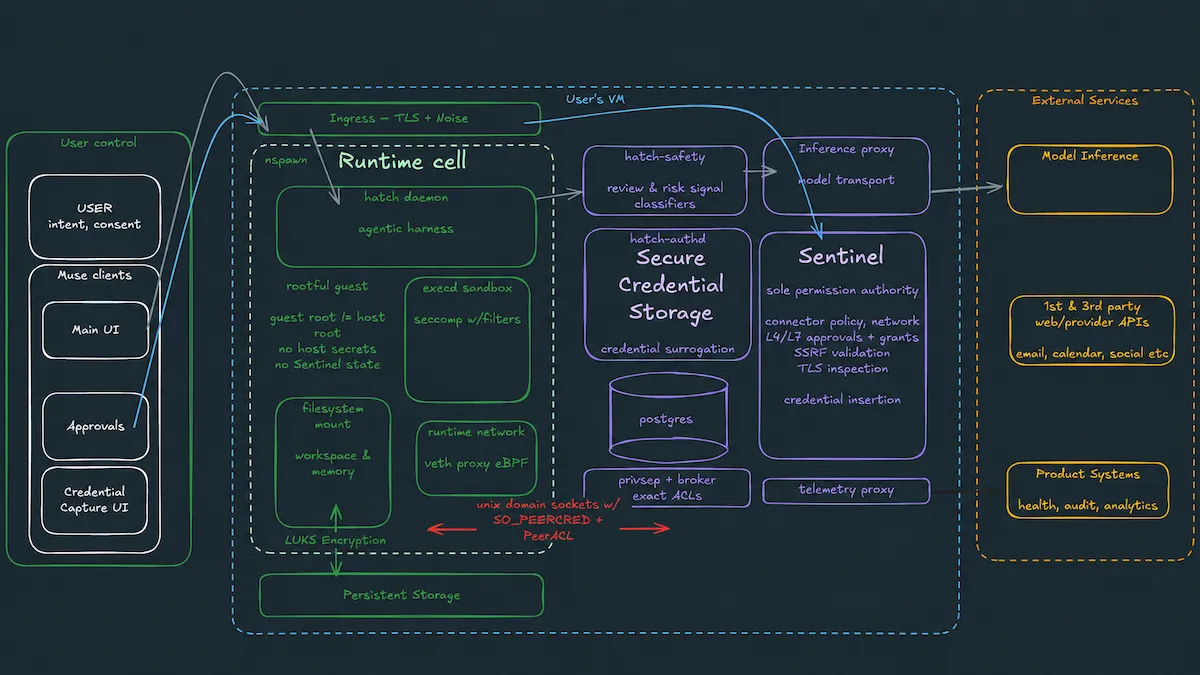
Rohan Adwankar found Muse runs on Cloud Hypervisor microVMs with a 327 MB Rust harness that boots in ~40 s, an on-VM Postgres with 194 tables and 60+ privsep tool workers.
DeepLearning.AI's The Batch covers Muse's security design (isolated VMs, the Sentinel credential layer, prompt-injection classifiers) and its free tier of up to 100M tokens a week.
Since Muse for Mac ships only for Apple silicon, this small service lets Muse's cloud VM screenshot, click and type on an Intel Mac, compressing each 5K frame to about 150 KB and handling Retina coordinate scaling.
I've been migrating my workflow from ChatGPT Work / Codex over to Meta's Muse, and I've been auditing the harness as I go — reading cron files, checking diffs, mapping what the system actually does versus what it claims to do. It's a documentation gap.
What the docs describe
Meta's documentation is written for a normal user. It talks about the Ideas tab, the Goals tab, the Feed, and "background jobs that help Muse improve over time." Everything is described in terms of what it does for you. There is no architectural documentation. Nothing about how any of it is built.
What is actually on disk
Meanwhile, the home directory contains a fully legible agent architecture, just sitting there(these are just SOME examples, the system file structure is HUGE):
• ~/dreams/alignment/ — a nightly job that regenerates an alignment synthesis: a written portrait of the user, how to handle them, current frictions, relationship guidance.
• ~/workspace/objectives/goals/STUDYING.md — a daily learning-state projection with mastery bands, next-review dates, and retrieval prompts, plus a file of inferred goal leads the system guessed from behavior (with confidence levels and what would confirm or re
Meta's engineering write-up on Muse security: isolated VMs, a separate Sentinel permission authority, credential surrogation and layered prompt-injection defenses, with bug bounties up to $300,000.
https://github.com/mvrius/bluebubbles-muse
BlueBubbles server on my Mac, Muse hook polling it every ~5s.
How it works: the poll driver (bash shim + Python filter) checks for new messages and filters on an allowlist of senders, 1:1 chats, and group GUIDs. A new message from an allowlisted sender wakes Muse into a side chat with the message as context. Replies go back out as normal iMessages through the Mac.
Why this instead of a messaging connector: connectors need an approval tap on every send, otherwise similar could be acheived via Messenger connector.
Setup: BlueBubbles on the Mac, Tailscale so the agent VM can reach it, run the installer. Repo has the hook scripts, installer, architecture doc, and skill definition.
Known issues: I am noticing that sometimes Tailscale connection drops on the Mac. I found that I need to bring down/up tailscale every hour for connection to stay up.
A fun example from earlier today, I updated my calendar, moved dinner with my wife by 30 minutes - Muse mesaged the Family chat and informed my wife of the change.
Cool findings:
- Muse has a Tailscale option, you can connect the VM it runs on in Client model with other machines running Tailscal
Compared to Grokbot. I prefer Muse over Grokbot for everything except this. The VM and browser is too locked down to do anything useful. As a workaround, I setup my own VM as a sandbox and gave it access. This works, but not ideal.
A SKILL.md-driven setup that makes a machine without a public IP, such as a Muse/Hatch hosted VM, reachable over SSH through a public relay and self-recovers after reboots.
Tried to let a Muse agent's VM query Home Assistant on a home tailnet through Muse's documented tunnel proxy; every request died with 'empty reply from server' in ~8 s, and he shares the debugging so far.
Alex Volkov tests the Muse agent's research and Stripe-powered payments, and walks through its VM security, personal-data handling and the training opt-out.
1/ we’ve built a lot of connectors to make it easier to integrate Muse into your life. Muse runs in a secure VM and we don’t use your data for ads or anything other than to make Muse great for you. you can connect Muse to Gmail, Google calendar, Outlook, Plaid, Opentable, Google
Power user @Muse feature - custom connectors 🔧. Muse has tons of connectors for popular services built in. Even better, Muse can write its own software and run it in the VM you and your Muse share in the cloud. So you can connect Muse to any service with an API.
I’ve seen a couple of posts about this so wanted to demystify. Today, every Muse user gets a free computer in the cloud. It's a real computer, and we’ve designed the security architecture of the Muse Secure VM carefully so you and your Muse can do almost anything you could with a
Hey just a thank you to Muse and Meta. I fed it pictures of books I want to sell and it researched prices then listed items on eBay with its own computer.
My kid hates reading so I asked muse to put together a book about about funny or interesting Starbucks and Sephora product reviews and we read them together.
I didn’t know when to show up to a concert to see only the main band and it gave an accurate exact time.
It watches my water filter replacement schedule now and pings if action is needed. It watches prices for seasons of TV shows I want to buy from Fandango.
I run a Hermes agent for my small business but want a separate agent for personal things. Muse is perfect.
Meta's launch post for Muse, a personal agent powered by Muse Spark 1.3 that runs in a dedicated Muse Secure VM and acts across email, travel, forms and purchases.







 ChatForm
 Tgmlabs